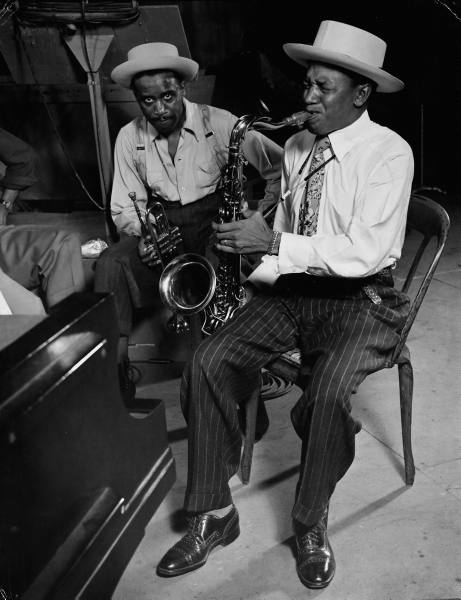
Illinois Jacquet and Harry Edison on set for Gjon Mili’s film Jammin’ the Blues.
From the Google collection of Life Magazine photos (there are heaps more – check them out!)

Illinois Jacquet and Harry Edison on set for Gjon Mili’s film Jammin’ the Blues.
From the Google collection of Life Magazine photos (there are heaps more – check them out!)
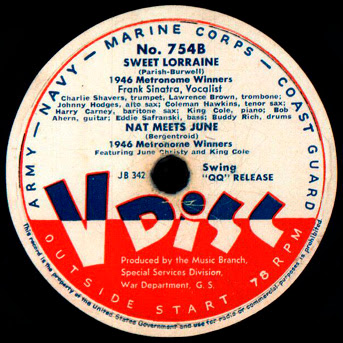
My favourite part of the new Coleman Hawkins Mosaic set is the little collection of 1946 recordings by the Metronome All Star Band. This particular session features Charlie Shavers, Lawrence Brown, Johnny Hodges, Coleman Hawkins, Harry Carney, Nat ‘King’ Cole, Bob Ahern, Eddie Safranksi, Buddy Rich, Frank Sinatra, June Christy and Sy Oliver (arranging), recording in New York on the 15th December 1946. All proceeds from the artists’ royalties were donated to charity. My two favourite songs are ‘Sweet Lorraine’ and ‘Nat Meets June’.
Esquire All Stars (featuring Frank Sinatra) – Sweet Lorraine:
Esquire All Stars (featuring Nat King Cole and June Christy) – Nat Meets June:
These Metronome all-star bands (there were a few, and they’re listed on wikipedia), were compromised of big name stars. These musicians were chosen by polling the Metronome magazine’s readership, who were asked to compile their ‘dream team’ bands. So we’re listening to a group of big name individual megastars, who’ve come together to specifically to record just these songs. You can read a bit more about them on allmusic.com.
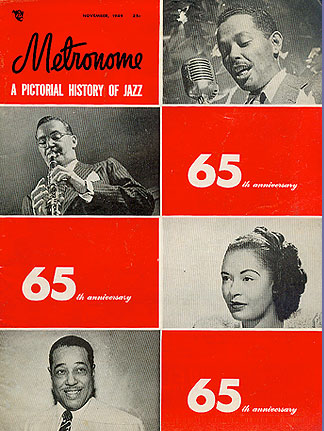
(cover of the 65th anniversary issue of Metronome magazine, November 1948)
Other magazines did this sort of stuff as well, including Esquire. It’s something I’ve written about quite a few times, and you can check out these posts if you’re curious.
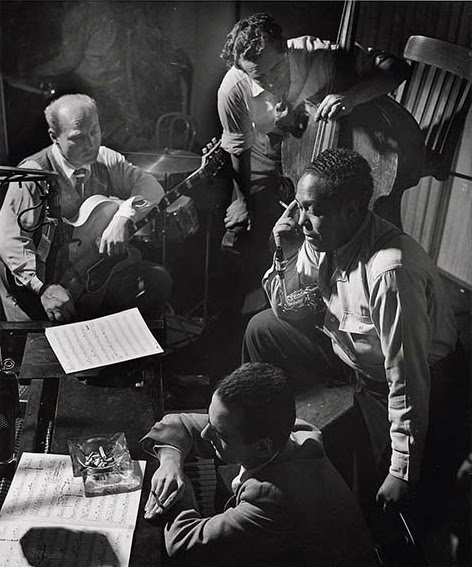
(Herman Leonard’s 1949 photo of the Esquire All Stars featuring Charlie Parker and from the Morrison Hotel Gallery)
For more photos of this sort of jam session, you must search for ‘Gjon Mili’ in the Life Magazine collection hosted by Google.
These little Coleman Hawkins Metronome All Stars recordings are really lovely. I’m quite fond of a bit of velvety vocal and really laid back swing. Nat King Cole and June Christy are both featured on Mosaic sets (here and here respectively), but those sets aren’t in press any more. I prefer the Christy one (which also showcases Peggy Lee), but both sets are lovely and chillaxed.
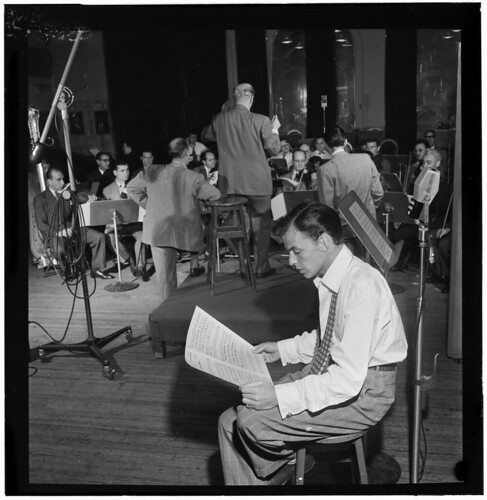
[Portrait of Frank Sinatra and Axel Stordahl, Liederkrantz Hall, New York, N.Y., ca. 1947] (LOC), originally uploaded by The Library of Congress
Frank Sinatra, of course, needs no introduction, but I’m not a huge fan of his later work, particularly the crooner stuff. In fact, I really dislike it …, no I HATE it, and LOATHE dancing to it (for the most part). He did some really danceable stuff with Tommy Dorsey (including a really good version of ‘Blue Skies’), and some more palatable stuff later on, but it’s a bit harder to find. That’s one of the things I love about these 1946 Metronome recordings – he demonstrates just how orsm a vocalist and musician he was, and he shares the spotlight with other mega stars, so the vocals become just one part of the story, rather than the whole show.
I found these particular Metronome All Stars recordings on the Coleman Hawkins Mosaic set, but they’re not representative of all the material in that set (unsurprisingly – it’s an anthology of work from a twenty five year period). You can probably pick up these two songs pretty easily from other sources.
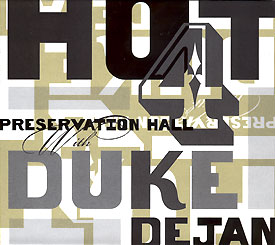
This is my favourite Preservation Hall Jazz Band album. It’s called Preservation Hall Hot 4
“with Duke DeJan” and I like it because it’s a smaller group, and while they’re definitely trucking along, it’s a calmer, quieter album. Their version of ‘Dinah’ is my most favourite, probably because I used to run to it every morning, back in the olden days, when my knees could hack both lindy hop and running. Ah running, I miss you so :(:::
I should write a post about Pres Hall at some stage, but for now, the basics are: this is a band that’s been around for squillions of years, and is really the ‘house band’ for the Preservation Hall in New Orleans. The personnel have changed over the years, but the core ethos – play good music – has not. They have a jillion albums, and if you like jazz, you really should buy them all. I especially like the album with Del McCoury’s band, but you mightn’t – there’s a lot of stringy old timey action there. I also like the Preservation: An album benefitting Preservation Hall and the Preservation Hall Music Outreach Program album, but the Hurricane Sessions one is good too.
Dancers tend to favour their version of ‘Shake That Thing’ (from the album Shake that thing), ‘Last Chance to Dance’ and ‘Sugar Blues’ (from the Hurricane Sessions album). But I prefer this quieter, gentler album. It’s really quite a different type of jazz – less of that raucous collective improvisation. More of that quieter, listening-to-each-other stuff.
This Jazzwax post “Coleman Hawkins: 1922-1947” is an interesting complement to the Mosaic Coleman Hawkins set and to the idea of Anthologies or collections of individual works as a creative product in its own right (as I began discussing in my post “More thoughts, also illness-addled and pseudoephedrine-fuelled.“).
I’m also interested in the new film Ballads, Blues and Bluegrass directed by Alan Lomax and featuring lots of lovely archival footage from the Folkways project

I’m looking forward to this new album by Solomon Douglas’ band. You can listen to it here.
With all my talk about Australian jazz history (I have to warn you: I’ve just been to the doctor, and am now on some SRS DRUGZ to combat another installment of the fucking sinus infection, so this post is probably less coherent than even the earlier ones. even.)…
So, as I was saying. With all that talk about Australian Jazz History, I forgot to tell you about Geoff Bull and the Finer Cuts.
Things to know:
When I first heard the CD I was all “omg, this is the worst thing I have ever heard.” I was tempted to delete it. I know, harsh, huh? But I had just been wallowing in my new Coleman Hawkins set (ie in sixty million 1930s big band recordings of the highest order), had just bought the latest Gordon Webster album and was really feeling quite over the ‘little street jazz band combo’ thing. I wanted a huge, sophisticated rhythm section. I was over rowdy solos.
I know. I’m a dickhead. It’s like I forgot what jazz was all about for a minute there. Maybe it was because I was getting sick. Who knows what was going on inside my head.
But I gave the CD/EP a rest, and then I came back to it. After I saw the band at the Corridor. That gig really impressed me. I wrote about it here. I really like to see a combo working well. And they did. So I gave the CD another go.
Now I’m all “omg this is good. I will even DJ it.” The song ‘Glory Glory’ is gold. It’s really quite lovely. I Approve. I really like Geoff’s vocals and trumpeting. I do like the piano. I’m still not 100% sold on some of the vocals, but then it took me a while to come around to Jesse Selengut’s vocals, and that was obviously crazy talk. But then I’m quite conservative. I know a lot of people do like the vocals, and you might too.
In summary, then, you should:
and
and also
I’ve been doing a bit of writing and thinking about ethnographic music research (mostly because I’ve never quite resolved my own qualms about ethnographic research practice from my own work), and have come across this interesting article about the Lomax anthologised collections. I was especially interested in the comments about how anthologies might work in a digital environment.
I’m a big fan of the work by editors, librarians, DJs and other folk who develop curated collections of works. I like exploring the connections someone else has made between individual items. I don’t think ‘the album is dead’, but I do think we’re living in a time when strategic organisation and curatorship of art (especially music) can be quite exiting.
But then, I’m a DJ, so I would say that.
I don’t buy the argument that DJing isn’t as creatively worthy as recording or playing music yourself. I just think that DJing – as with other forms of thoughtful curatorship – is a different type of creativity.
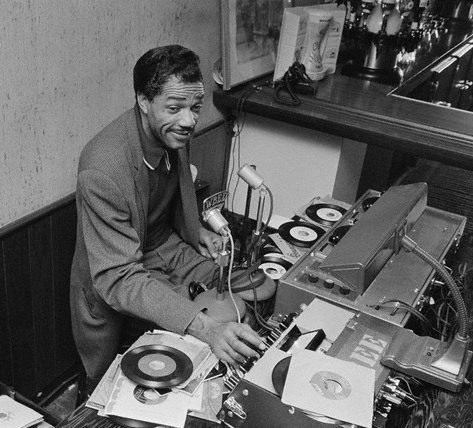
This is probably why I’m fascinated by that picture of Slim Gaillard DJing. He was such an unusual person, was as likely to tell you a completely made up story about his life as a ‘true’ one, I reckon his DJing would have been great. And I bet he did things like talk over tracks, interrupt songs and other DJing badnaughtywrongs.
…and more.
I also want to look at how Black Power Mixtape (which is a collection of footage taken by Swedish filmmakers in the 1960s, edited together and with a commentary by modern black activist folk and accompanied by a modern sound track) is related to all that Music Inn/Stearns’ Jazz Dance work with Al and Leon.
…part of my brain is also thinking about the French reception to and feelings about Australian Aboriginal art and the Utopia community.
Edit:
This piece Reflections on Anthologized Recordings: The Alan Lomax Collection on Rounder Records and the John A. and Ruby Lomax 1939 Southern States Recording Trip on the Library of Congress American Memory Website (vol 4, issue 2, 2002 of Echo) by Anthony Seeger is an interesting start. I was especially caught by the discussion of the future of anthologies in a digital environment.
The name Seeger catches my eye for a number of reasons, but most recently for its association with the Preservation Hall Jazz Band:
Edit 2:
I need to follow up this panel discussion on ‘Teaching Controversial Topics in American History‘ in Echo (6.2)
Edit 3:
I’ve just seen This review of John Szwed’s book Alan Lomax: The Man Who Recorded the World which may be useful. Szwed is pretty good stuff, but I’ll have to read the book to see.