Digital business tools for dancers: Sam’s hack.

Topic: useful admin tools for dance businesses

[NB not tools for social media marketing or graphic design. Just basic business tools]

Last year I did some research into the various tools a dance business uses, and discovered some useful things. Note, I am based in Australia, so some of our laws RE storing personal data aren’t shared by other countries.

If you’re running a business that teaches dance and runs parties and workshops, you need a few digital tools:

– a website
– an email tool
– a way to take payment digitally
– a way to organise registrations
– You’ll also need some sort of accounting software too, but your local tax laws and accountant’s preferences will help you decide what you’ll use.

We’re all usually bound by pretty tight budgets, so it’s fair to say that we want the best we can get, for the least amount of money. And we all know that the cheapest isn’t always the best.
But we also know that not all of us have the technical skills or experience running a dance business (not to mention time) to learnt to use a bunch of new computer things.

Anyway, this is what I found. It’s not an exhaustive list, and it’s pretty much just for me here in Australia.

Let’s assume we have two users.
User 1: New to running a local dance business, lots of good _dance_ and teaching skills, very little experience marketing, handling income and expenses, no real experience dealing with computer software, etc. Limited budget, time-poor. So, a regular dancer.

User 2: Experience running a dance business, experience with a range of software tools, dance and teaching skills. Time-poor, small budget. Wants to upgrade from older tools, reduce admin hassle, and streamline the process. So, the other type of regular dancer :D

From what I’ve seen, there are a couple of ways to get all the tools you need:
1. An all-in-one tool that handles email lists, digital sales (both online, or via a phone in person at a dance), a nice looking website (with the analytics you need)

2. A host of individual tools (eg a sales tool, an email tool, a website tool (whether it’s one you build yourself, or one out of the box)

The first option can be (and usually is) more expensive. There are cheapy options out there, but most of them don’t do all the things a small dance business really needs. Sometimes the more expensive complete packages are a bit limited (eg the email option only lets you have 500 addresses on your list; the website sales integration only works with a particular bank or shop front app).

But the first option is easier because:
– you don’t have to spend lots of time learning to use a lot of different tools.
– you have one account that you log into, from which you can add other users/admin accounts
– the integration of all the tools means you can see when user X buys a product, cross reference it with how often they open emails from you, and track their progress through your site. To my mind, this is the BEST thing. But it’s not so useful if you’re not at the point where you need or can make use of this data.
Downside of this option: price. It can seem super exy for a small business that doesn’t have any seed money.

By far the best of these options is Squarespace. It’s not the cheapest, in fact it’s quite expensive, but it saves you a lot of things:
– security is better because you don’t have a heap of random tools with different log ins that you share with everyone in your team;
– security can be weaker, because you only have that one point of entry to all these essential tools. Good thing is that squarespace is pretty secure.
– the website templates are really really nice, and look really professional. This is essential for a business that needs customers to trust it’s online shop.
– the website design can be changed via the code directly, or using the design tools in the main dashboard. You can create a page quickly, and move images and blocks of text around quickly.
– the shop front tool is beautifully integrated from the front end (the customer’s point of view). It looks slick and professional, which is good for developing trust.
– you can add approximately one billion trillion ‘extensions’ to the basic website. ie you can integrate a bunch of other tools, from accounting software, to email marketing, store fronts, your social media accounts, and printing. Yes, you can create your own tshirts and sell them through your site without having to handle printing or inventory.
– it will help you through buying a domain, which is often another sticking point for new businesses.

The downside of squarespace:
– it’s expensive
– learning to use the website building tools can be tricky (I found it challenging, and I have a lot of experience building sites from code to using builders)

The second option (lots of different tools) is often the cheapest option. But it’s ‘messy’. If you go this route, these are the tools I’d recommend:

– Square for sales. It’s secure, it has good support (ie people to help you), you can use it with your phone (so you don’t need to buy any sales hardware). It has a simple online shopfront (very basic, but serviceable, and not too ugly), and it’s the cheapest. Cheaper than paypal or Trybooking. And more flexible.
It is ‘basic’, but that’s it’s appeal: it’s not too hard to learn to use. But don’t expect too many bells and whistles.
You can take your phone to class, and then when people arrive and want to pay, you can do it all right there with just your phone. No cash, no extra hardware. Game changer in a covid world.
Equity: many of us offer free or discounted tickets for students, low income, etc. I haven’t checked it, but I’m certain Square would offer a ‘reduced’ or ‘comp’ sales option for your items.
– Does it handle your inventory (eg how many items you have left to sell, etc)? I assume so, but I’m not sure.
– Does it handle registrations (which is another way of talking about inventory)? I haven’t tested this.
I haven’t used a separate registration tool for years, as most of the modern online sales tools handle that as a basic feature. As dance event organisers, we really want to know how many people are coming, how many tickets we have left, and then we want to know info about each sale (lead/follow, etc). Not very complex stuff, really.

– Website.
I’d go with squarespace. I’ve used a range of website building tools, from blogging tools (eg wordpress), as well as building my own from scratch (and hosting on my own server at home), but I think that for the time and energy, squarespace gives you something beautiful that’s quick and easy to administer. And because you can create multiple accounts for the one site, you don’t get that ‘webmaster bottleneck’ that has plagued the dance world. It also handles all that domain purchasing stuff, which is SO important.
There are cheaper options (eg Square’s simple website option), but Squarespace also has some nice analytics in the basic package, so you can see which page is getting the most traffic, etc.

– Email. You must have a proper email tool (you can’t just create a list in your apple Mail or Outlook Express; that way lies horrific privacy and security dramas). Email and website are the two most important things you must have as a small business. So people can find you, and then you can reach out to them directly.

Mailchimp is still the big email player. It’s recently gotten more expensive (ie your basic account gives you a smaller number of email addresses in your basic list), but it has wonderful features. You can see who’s opening your emails, and which links are getting clicked in your analytics. The template building tool is lovely, and the emails come out looking really slick. It has some lovely automated features (eg a series of automated emails to help customers; a series of automated steps that create lists of people who open emails quickly for you).
But if you’re not doing any of this email marketing stuff, it’s probably overkill for you. And it’s expensive once you get past X number of email addresses.

Squarespace does have an email option, but it’s limited in terms of analytics. And it gets expensive when you add heaps of email addresses. And you WANT to have a zillion people on your email list. That’s the gold.

Personally, I go with Mailchimp, as I have had an account for years, and it’s been grandfathered in. And because I’m super interested in learning about email marketing. ie more than just spamming your audience with ‘buy! buy!’ emails. I’m interested in sending the right message to the right audience. eg sending links to the new beginner course rego page to the people who registered in the last beginner course of 2022.

The revivalist narrative will not die.

I keep coming across white organisations telling a ‘history’ of lindy hop that gives ‘the revival’ pride of place. ie white people claiming the modern lindy hop world as their own altruistic work.
So the term ‘revival’ is problematic because it implies that lindy hop was dead (replaced by rock and roll and/or bebop) before white people came along and brought it back to life. In this narrative, white people are heroes for saving ‘this wonderful dance’ and bringing it back to life.

Black people are totally absent from this story, except as venerable elders who teach eager white people. The white people are also credited with bringing these elders ‘out of retirement’ and back to the dance floor.
It’s all very problematic.

1. Lindy hop wasn’t dead. There’s a whole family of Black social partner dances that are thriving (Tena Morales’ event the International Swing Dance Championships showcases them every year, but white people don’t go to that and aren’t involved, so it must not exist).

2. Because it wasn’t dead, it didn’t need reviving. Declaring lindy hop ‘terra nullius’ (ie no people living in this territory) was white people giving themselves permission to take lindy hop. So the white people who ‘went looking’ for Black elders were pretty much just out on a bit of a colonial expedition. Just like Captain Cook expanding the British Empire, ‘discovering’ a huge big southern continent (‘Australia’).

3. Those Black elders, like Frankie Manning and Norma Miller and so on were still dancing, but in their families and homes and community spaces. Black spaces, to which white people did not have access. The story told most often about Frankie Manning, that his working in the post office was somehow less important or lower status than his dance career is classist and racist. The US Postal Service has a long history as an important employer and union locus for Black communities. It was good, solid work. Norma, of course, was running a dance business (managing troupes), Mama Lou Parkes was still dancing professionally… and so on.

4. The Black dancers who were involved in lindy hop in the 1980s tend to disappear in these revivalist narratives. Angela Andrew and other Black women have lots to say about the number of Black dancers out there lindy hopping in the 1980s, but they somehow disappear when white people tell the stories.

5. The white ‘ownership’ (appropriation) of Black lindy hop in that 1980s period is not only about selling places in classes and workshops (and thereby ‘creating community’ via economic relationships), but also about the exploitation of Black dancers working for white troupe managers (we won’t go into some of the more troubling accounts from that period).

RE the USPS:
I came across references to the importance of the postal service in Hidden Figures and the way it provided a pathway to the space program for Black women (SUCH a good book).

There’s also Philip F. Rubio’s book ‘There’s Always Work at the Post Office: African American Postal Workers and the Fight for Jobs, Justice, and Equality’ (which I haven’t read, but have read _about_.
This all makes the US govt’s cuts to the USPS a matter of institutional racism and white supremacy, rather than a push for smaller government generally (though I’d argue the two are the same thing).

The more I learn about the USPS as a site for unionising, civil rights activism and Black community empowerment, the more troubled I am by white histories of lindy hop that devalue the USPS in Manning’s life. If the civil rights elements of this workplace are ignored, then white ‘historians’ can continue with their bullshit about ‘Frankie never talked about racism in lindy hop, so it didn’t happen’. I’d say that Frankie, as with any other Black worker in America then and now, was very much aware of racism in the entertainment industry and in America generally, and was very careful about what he said to white people about it, and when.

As with the workers who continue to go back to places like Herrang, despite unsafe or inequitable working environments, when you don’t have the financial and personal safety of white privilege, you have fewer choices about the work you can do. And teaching middle class white kids to lindy hop might have suited Manning.

A practical covid management plan that is socially responsible

I’m currently working on a covid management plan for a dance school. I’m quite enjoying the process.
Here’s the process:

–The Plan–

Restating the org’s values

  • Which helped me understand how and why the org would develop a covid policy, what issues to focus on, and how to implement it,
  • Which ensured we were all on the same page.

Stating the covid plan philosophy

  • In this context, a philosophy is theoretical or ideological model for addressing concrete issues,
  • Which is basically applying the org’s abstract values to a concrete issue (covid),
  • Phrasing the philosophy as a list of clear applications of values to a specific issue (covid)
  • This could be a list of a hundred items, or a list of two.

Developing two goals for the plan

  • These are deliberately limited in scope (ie this isn’t a govt department managing the health of a whole city or state, it’s a small dance school),
  • They are very focussed and practical.

Putting all this into practical actions

  • There are four ‘actions’ which cover four general areas of covid management,
  • These actions can be phrased as ‘guidelines’ (ie covid rules) for the org, but they can also guide procedures.
  • They deliberately limit the scope of the plan to keep it very local and very practical.

So that’s the whole Covid management plan.
From here, I use the plan to develop:

  • Guidelines (or rules)
  • Procedures (eg if a rule is ‘you must provide proof of vaccination’, who does this checking, where do they check, what do they do if someone doesn’t have proof, what constitutes proof, etc etc)
  • Social media strategy to communicate all this, and also to provide information about covid that will encourage people to participate
  • Website materials (eg a public statement of the guidelines)
  • A handbook that contains all the procedures, contact info, covid facts, etc.

–Developing the plan–

At this point I have a first draft, and it’s been to the org’s boss for comment and approval to go ahead and develop it.
After some tweaking, I’ll send it off to the rest of the org (teachers and staff) to get their feedback, impressions, comments, suggestions, etc.
I’ll also do a model for public comment.

This Plan development process, and the plan itself, are guided by:

A key part of this process is an ethos of community strength, and collectivism. My experiences working on sexual harassment in dance has made it clear that top-down solutions are a) not effective, b) burn out the people doing the work, c) maintain existing power structures that _enable_ injustices like sexual harassment. As I learnt working on Melbourne Lindy Exchange (MLX) for years, you need to develop work practices that allow any one person to drop out or take a break at any time. Which is, of course, what flexible, healthy workplaces are all about.

–A final form?–

A key part of this plan is to be agile. It must be able to change and respond to social changes. Covid will change. The community changes.
An Important thing I learnt from working on sexual harassment stuff, is that we can’t just develop a code and leave it at that. That doesn’t work. We need to update it, to change and develop our approach, as we learn more, and as our communities change.
So putting this plan together, I’m assuming that it will need to be changed and updated regularly; I can’t just post it on the website and forget about it. There’ll be feedback from staff about the processes, there’ll be changes in covid, we’ll see things like the development of new vaccines and healthcare strategies.
This means that the Plan itself, and where it lives needs to mutable.
This is a very exciting idea. It’s a lot like lindy hop itself: you have basic structural elements, but it is, fundamentally, about innovation, improvisation, and responding to the needs of its users.

–Why am I doing all this work?–

I have a long history of writing and researching and lecturing, but I am rubbish at presenting my plans and projects in ways that make it easy for the audience to take my work and do their own projects with it.
So I’m deliberately learning how to:

  • Develop a plan
  • Present a plan to stakeholders who have different types of engagement
  • do good community/group consultation and engagement.

I’m also really interested in how social media management can be employed in social justice work, so I’m quite keen on using things like instagram, facebook, etc etc in new and interesting ways. Which, bizarrely (unsurprisingly?) circles back to my doctoral research and academic research, which was all about how small communities use media in unique ways.

–What have I learnt so far?–

One of the most exciting things I’ve learnt so far, is that if a project like this is equitable in design, it actually fights racism, misogyny, homophobia, etc. I think one of the most exciting things about the Camp Jitterbug covid plan, is that it came from the experiences of people of colour, people of a range of genders, people with lived experience doing activist community labour. It’s proof that anti-racist work is good for all of us.

Social media strategies and chillaxing the sales energy

Reading through a few different style guides by different brands, I came across the Mailchimp style guide.

One of the most interesting bits is the discussion of what they post on which social media channel:

Mailchimp has a presence on most major social media platforms. Here are our most active accounts and what we usually post on each:

Twitter: Product news, brand marketing, events, media mentions, evergreen content, “we’re hiring!” posts

Facebook: Product news, brand marketing, events, media mentions, evergreen content, “we’re hiring!” posts

LinkedIn: Product news, recruiting content, media mentions, evergreen content

Instagram: Design outtakes, cool office visitors, life at Mailchimp, cool stuff we made

This caught my eye for the way each channel has a specific job, and the brand has a specific type of content on each channel. So Linkedin mailchimp is all serious business time, and instagram mailchimp is fun and visual. Comparing facebook and instagram is especially interesting. Instagram reads as a ‘cool’ channel for mailchimp, whereas facebook is more serious. The biggest difference between the two is the way facebook works as an avenue for sales (product news), and instagram does _not_ do sales (it’s essentially about brand identity).

This caught my eye because I’ve been thinking about the way we need to develop an audience before we start to sell them things. Or rather, we create a relationship with people, and when they’re ready, they go looking for our products. This is a more long term strategy, but it’s also a less didactic, less aggressive relationship. Particularly in the dance world, where brands are often dance schools speaking to their students. We don’t see a whole lot of different brands using social media in a cohesive way in the dance world. There’re usually just bands, dance schools, events, teachers, apparel and footware brands, and perhaps DJs. There a couple of social enterprise brands (largely based on antiracism goals), and a couple of other odds and ends. But the discourse is largely dominated by pedagogy. Which brings with it a very… top down power dynamic and mode of address.

There’s also a degree of panic or anxiety about ‘time running out’ from the brand itself, as they fight to improve numbers for class enrolments or event registrations. Both have fixed due dates, and both tend to work with the assumption that more is better. I suspect this impetus is largely the result of a bigger narrative in the dance world: that we must ‘grow’ the scene. ‘Share’ the dance. It’s a powerful ideology, particularly when it’s coopted by businesses selling a product that can be attached to this discourse (classes in particular). And it of course brings a worrying blend of cultural appropriation, capitalism, and colonialism.

So if we are developing a brand or public profile for a business or entity (a dance school, a social enterprise, a band), how can we use social media to be economically sustainable _and_ socially sustainable? In other words, how can we not be pushing salesperson jerks when we speak to people via our social media.

I think that it’s most useful to remember a few key rules:
Build the audience before you start to sell.
There will be a lead time from when you start posting to when you should expect people to come looking to buy what you’re selling. So don’t try to sell your product right up front.
This holds true for brands that are doing things like anti-racist activism work as well. Speak to your audience, to your community before you start selling or asking for donations.

Devote an entire channel to the ‘other stuff’.
Offer stuff that you enjoy about dance, or that is central to your dance community (or community of people who also dance), and then create clear pathways to your product from there. Don’t push people to buy; let them come looking when they’re ready.

Don’t panic sell.
There’s a tendency in dance event social media in particular to suddenly ramp up the number of posts, and the urgency of the tone, the closer we get to the event date. Particularly if there’s a perceived ‘lack’ of sales. Guilt-selling is not a successful strategy.
Again, this brings us back to the idea that we devote our attention to nurturing the broader profile of the brand, rather than just focussing on sales.

And of course, this all brings us back to the point of the mailchimp style guide: plan ahead.

  • Plan your social media strategies well in advance.
  • Think carefully about your ‘brand identity’.
  • Make clear decisions about what role each social media channel plays in your overall strategy.
  • Let your content do its job; don’t force every post to sell sell sell.

All this will make your social media work much less stressful, and make engaging with your channels a lot more enjoyable for your audiences.

And if you are working with a social enterprise brand, then you’ll find your social media strategies fit more comfortably with your ethics and values. In particular, you’ll see your relationship with the people in your local community not as a series of chances to raise money or recruit volunteers, but as a network of relationships that build and sustain a community.

Promoting your dance or jazz music business online

Here are some things I’ve learnt about promoting dance or music related businesses online. I’m not a marketing specialist, but I am a media studies specialist who’s been promoting dance events online for about 15 years now.

You need a website.

You need an email newsletter.

Why?

  • With both of these media, you are the producer broadcasting a message to your readers.
  • Audiences tend to regard these as authoritative sources, unfiltered by social opinion.
  • If a social media platform collapses or moves out of vogue, your data won’t disappear with it.

They don’t need to be fancy. In fact, the simpler the better. A single page website with clear headers and a simple structure is best. A newsletter can be sent out maybe once a month. So long as it’s sent out _consistently_, at the same time each week or month, it’s all good.

What about social media?
Important, but in a different way. Think of your behaviour on social media as your brand (which is the public version of you and your business) interacting with lots of real people and other brands out in public. It’s a way for you to develop personal and professional networks in your community or industry. And social media get used a lot, by a lot of different types of people, of all ages and demographics. Perhaps the best thing about social media, for marketing and advertising, is that it allows you to know who’s seeing your ad, when, and where. Something that was harder to judge before social media. Before social media, a brand used social media to ‘broadcast’ a message. With social media, a brand can interact with audiences in a much more complex way.

Websites are important.
Of the two, the website is most important. If you do a tiny bit of audience research (eg we used a very simple survey to routinely ask all our dance class attendees how they found us), you can see which media are most important. For our dance classes, a ‘google search’ accounted for 90% of our attendance. Even if they saw a post on facebook first, they still used a search engine to actually get them to class (and make the sale).

This is where we talk about SEO. Search Engine Optimisation. It’s not magic, it just means ‘make it easy for search engines like google to find your website’. We know a lot of things about google. We know that when it indexes your website, it pays attention to the words you use. ie it ‘reads’ your code. And google tells you how to make it easier for their search engine to find your site.

What should your website include?

  • Your name. The name you want people to use when they announce you over a microphone or list you on a program.
  • Your contact details. A phone number, and an email address. Right at the top. And in the footer too. Make it really easy for busy bookers, festival programmers, and prospective clients to find you. If someone’s prepared to pick up the phone to talk to you, they want information quickly, and they’re close to making a decision.
  • Some useful key words. What do you do? Dance teacher? Then you need ‘dance teacher’ right at the top of your page. Are you a lindy hopper? A jazz musician? Do you run weekly balboa classes? Then say so, right there in text on the page. Make it easy for google to find you when your audience does a google search.

Pictures?
Most importantly, don’t hide information away in images. Search engines like google can’t ‘find’ your information if it’s hidden in an image. All google knows about your lovely instagram graphic is that it’s a .jpg file, 1080px x 1080px, created on 2 January 2022. Even more importantly, people who use screen readers can’t find your information if it’s locked inside an image.

Do use photos on your website or newsletter, because they look nice, and it’s easier to sell a product if people know what it looks like.

Don’t hide information in an image.
Each image should have a ‘title’ tag, and ‘alternative’ text (‘alt’ text) to that tag. If you’re writing your own website code, that’s easy to do. You just add alt=”the information from your image” to the image element. Most website building tools (like squarespace) and newsletter tools (like mailchimp) offer you the option to add alt text as well. Yay!

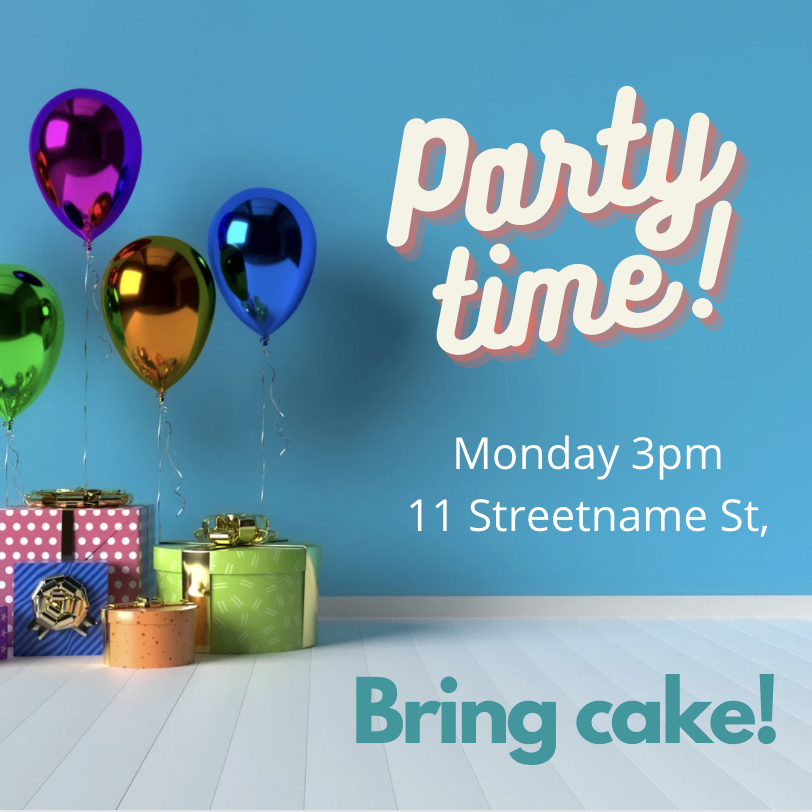
As an example, this little graphic is very effective for instagram. It has all the information we need – there’s a party, when and where it’s on, and bring cake!

But without alt text, all your web browser knows is that this is an image, 812px x 812px, called ‘Screen-Shot-2022-04-06-at-2.30.41-pm.png’. No one will come to your party.
If you add alt text like “party time! Monday 3pm, 11 Streetname St, Bring cake!”, then a google search will be able to find the information and serve it up as a result in a google search.

What about a newsletter?
Don’t underestimate the value of a newsletter. People actively choose to sign up for your newsletter, which is a way of signalling to you ‘I am interested enough in you and your product to give you access to my inbox’.

Newsletters give you lots of useful information about your subscribers as well. How many people click on links? Or open the email at all? How many unsubscribe? How many ‘bounce’? All these analytics can help you improve your newsletter: which subject lines convinced people to open the email? Which calls to action in your newsletter got a response?

If you use a newsletter service like mailchimp (and you really should. For privacy, security, efficacy, and ease), you often have the option of displaying an archive of your past emails. Each of these past emails is another tool for improving your SEO: another hundred or thousand times a search engine will read your name on the internet and add that page to its index.

Most of all, a newsletter lets you speak directly to a group of people who are even just a little bit interested in you and what you do. Gold!

Take this seriously
If you’re going to stand up on stage and play, or run a class for people to learn to dance, you have to let people know. Even if your business runs mostly via word of mouth, having a solid website can work just like a nice business card. Something that means a lot more in a world where most people have a smartphone in their pocket (or hand!)

If you need a hand with this stuff, drop me a line I can give you some tips. For a very reasonable rate :D

the basics of dealing with sexual harassment in lindy hop

ok, I have a bit more time to write.
==First off. This work will fuck you up.==
I and every other woman I know who’s worked extensively on this topic since 2015 (and before) is massively burnt out, and dealt/dealing with vicarious trauma from this work. Many of us (all of us?) have been subjected to threats of violence, legal action, smear campaigns, and worse. For me, the individual offenders were kind of small potatoes. The most distressing part of this has been the way men in the lindy hop scene actively worked to protect and enable offenders. ENABLE offenders. I have generally found that any man who actively objects to safe space policies is a sexual offender, and any woman who actively objects to safe space policies is a survivor. I wish I was generalising.

==Second. If you want to get into this stuff, plan ahead for trauma.==
You need to find a good therapist to talk to, particularly if you are not a man. Because at some point you’ll really realise, at a visceral level, that all these people who object to kicking out sexual offenders are ok with you (and every other woman and girl) being the victim of violence. And that fucks you up. But the work itself (reading endless accounts of assaults, dealing with the obstructionist arseholes, threats of violence, legal actions, and personal defamation) is just so. hard. You can’t do this alone, friend. Get help.

==Third. We have to be bottom-up, not top-down in our actions.==
I eventually realised that we cannot stop men offending. We can’t change the bigger social forces that train men to believe that it’s ok to sexually assault someone, that their pleasure comes before anyone else’s well being.
So the real solution for stamping out sexual assault in a relatively self contained scene like a dance community, is to power up the sisters and potential victims.

We do need codes of conduct and all the institutional changes (and mad props to Sarah, Michael, Charlie etc in Baltimore for their leadership on this). But these processes don’t change the power structures that enable sexual violence by men against women. It’s still powerful people at the top of a hierarchy managing the bodies of people at the bottom. We need to change this shit.
How?
In Sydney we saw incredible results when a group of Asian women started looking out for each other and getting up in the face of an unrelenting white man who targeted Asian women. They would step in when he approached new women dancers. They’d tell young women and girls not to tolerate his shit. They’d actively him skip in class rotation (even when he tried to physically grab them). They pushed and pushed and pushed to get him banned from things. And so on. A clear result of this was a marked increase in the number of poc at our events, not only women, but _all_ poc, because those offenders aren’t just committing acts of sexual violence. They’re also bullies, racist, etc etc.

Not only do we need to get intersectional on this, but we need to reconstruct the bullshit that convinces women dancers to tolerate sexual harassment and violence. And that is often as simple as having them practice saying ‘no thank you’ to dance invites in class.

==Fourth. Know your local laws, use your local resources==
Laws RE sexual assault and harassment differ between countries. Look up your local laws. There are general human rights type laws, but there are also work place safety laws that apply. Be wary of issues like defamation law. Know your shit before you bring the shit. And that means finding a lawyer who specialises in the relevant laws (not just some rando who ‘is a lawyer’). Be ready to fundraise to cover these expenses.

There are services that can help, so you don’t need to reinvent the wheel. Legal Aid can offer free legal advice here in Australia, and there is the equivalent in many other countries. Find the websites and help lines. Look up the excellent posters and campaigns that have already been going on in your country.

Get intersectional. This is a big one. The model a lot of us in the lindy hop world (in the US, Canada, UK, Australia, NZ, parts of Europe) use white, middle class, heterosexual gender roles and relationship models for ‘fixing’ this issue. Look further afield.
– How do Black women manage unwelcome sexual attention? What role do older Black women play in moderating men’s behaviour?
– How does the queer scene address sexual violence against trans kids (here’s an answer: https://www.transhub.org.au/unhealthy-relationships)?
-> You can learn from these examples. Do not, ever, generalise from your own experiences, especially if you are straight, white, living in a city, middle class, and English speaking.

==Fifth. Get local, get specific.==
There have been phenomenal projects undertaken all over the lindy hopping world to deal with this issue.
Dance Safe – 댄스세이프 in Seoul is incredible – they’ve done surveys, worked across a massive local scene to join often-unfriendly groups and individuals on board. They distributed literally boxes and boxes and boxes of info pamphlets. They used posters, they got away from gender binaries. It is just incredible. And locally appropriate, from language to age and culture.
Check out the codes of conduct that Tena Morales’ International Swing Dance Championships have. The language is very specific to the Black community of the US, where people speak English, carry guns, and are dealing with racism.
…and so on. Steal ideas from everyone, but make your work locally relevant, and locally appropriate.

==Sixth. Iterative design is the go==
Iterative design basically means that you’re never ‘finished’ with your code of conduct, your reporting process, your activism. Update your code of conduct annually. Learn from other organisations. You will get better and better at this.

==Seventh what are your limits? What is your code?==
Before you do anything else, write down (or record to camera or voice memo) your limits. What will you tolerate? What will you not tolerate?

My personal limits:
– I will not walk past someone who’s being harassed. I will intervene.
– I will risk physical violence for someone else’s safety.
– I will ask annoying questions in public about an event or person who aren’t fulfilling their duty of care.
– I won’t let men touch me if I don’t want it.
– I will not smile and make nice.
– I will walk away from an unpleasant dance.
– I will say ‘no thank you’ to an unwanted dance invite.
– I work to stay aware of my own privilege and power, and I will leverage them to help out people who need it.

Know what your limits are. Be sure of what you will tolerate.

==Eighth and final: this is about gender.==
We know, beyond doubt, and with mountains of substantiating data, that sexual violence in lindy hop is a problem with men. Men are the vast, vast majority of offenders. Women and girls are the victims/targets. We don’t have data for it (yet), but if we extrapolate from the wider community, men are also the targets of men’s sexual violence.

So men need to fix their shit. They need to step in and take ownership of this issue. Because women like me are far too fucking busy fending off groping hands and lewd comments at the mic, in the DJ booth, or on the dance floor to help your sorry arses. Step the fuck up.

local v global networks of exchange and infection

…just some random thoughts from a discussion on fb that i’m posting here to keep track of.

If big dance events that were held over new year could collect accurate covid infection stats, it’d be super interesting to compare these with other sample groups. 1 in 5 is lower than omicron in Sydney at the moment, so I suspect it was higher at Focus. But if it was lower, that’d be pretty interesting… maybe because it was mostly local people, we’d see a lower rate of infection?
The issue, though, is that an event like Focus brings together people from separate networks of people. ie we live and interact with a limited number of people in our day to day life (friends, family, workmates, shop keepers, etc). The big issue comes not when we interact with them, but when networks interact. So if you and I went to Focus, I’d be exposing you (and your network) to the germs of my network (and vice versa).
I’m interested in how the statistical side of things (numbers) works in cooperation with the social side of things (the ways people interact, and how relationships determine who we’ll interact with). Here in Australia, the govt health advice has been based on:
1) states (ie mid-level government borders of responsibility),
2) local government areas (ie groups of suburbs),
3) households (nuclear families in particular) in free-standing houses, and
4) workplaces.
ie we are divided up by government powers, labour practice, and patriarchal ideas of the ‘family’. So restrictions are put in place to open or close state borders (and our states are geographically massive, but very low population density), to enforce lockdowns or restrict gatherings in local communities. Contact ‘bubbles’ are defined by households (ie an actual house) rather than apartment block. Allowable activities are also defined by houses rather than apartments (eg ‘kids play in your yard’ rather than ‘kids play in your local park’).
We’ve seen these divisions collapse when it comes to people who don’t fit into the white, heterosexual, monogamous middle class parents model. ie most people don’t fit into these categories. Most people actually are: engaged in extended family networks, are in precarious employment, aren’t in a monogamous heterosexual nuclear family, etc etc. The higher rates of transmission happen in places like apartment blocks, and in extended families, whereas the govt advice has focussed on how to behave in free standing houses, nuclear families, and fixed workplaces.
We know it’s more useful to think of people as part of the relatively stable networks of family+friends+work I described above, than the ‘household’ or ‘individual’ . The networks are bigger than a nuclear family unit, but they’re also more stable; we tend to max out at a specific number of contacts. And if we think in terms of networks, we can account for extended families, networks of care (eg neighbours caring for neighbours, friendships, sexual partners, etc) and get a more accurate picture of how real people interact (the nuclear family model just doesn’t account for the majority of relationships).
We can apply this idea to dance communities. We all operate within local dance communities (eg I’m in the inner west of Sydney, in NSW, in Australia), and that community network includes musicians, DJs, dancers, venue operators, _and_ my family and friends. But when we go to exchanges, my local network interacts with other people’s local networks.
As dancers, we already think about this interaction of networks: we are all pretty good at identifying someone’s home town by the moves they dance, the shape or aesthetics of their dancing, the music they like or dance to (eg fast or slow) _and_ markers like ethnicity, etc. Even at our most athletic, we can only partner dance with about 40 people in 2 hours of dancing, max (so long as there are no birthday jams!), but are more likely to dance with between 10 and 20.
But when we go to weekend events, we dance for far more hours, with far more people. Each of us, individually, represents a different local network as well as a local dance scene. So when we interact at an exchange, we are exposing ourselves to far more germs. Or increasing the chance of catching covid.
Our state govt has just added a restriction on dancing, where our public health officers Kerry Chant explained that dancing (ie solo dancing) brings us into contact with more people, in closer contact. ie the stuff that makes dancing feel wonderful is also what spreads covid 😃
Bizarrely, years ago I did a conference paper on the way f2f and global networks interact at exchanges. The thing about lindy hop is that we _must_ interact physically – dance – as part of the community. When we travel to dance, we expand that network of physical contact.
In the lindy hop world, that network of contact spreads dance skills, aesthetics, moves, rhythms, ideas, friendships, sexual relationships, etc. But in the covid world it also spreads…covid. Because the lindy hop world is designed _specifically_ to enable that f2f physical contact, it’s as though we built a machinery specifically designed to spread covid.

I smell bullshit

Yesterday a white guy had a troll on a productive discussion about teaching lindy hop. The original post in that discussion was

I was teaching “jig walks” today and it was pointed out to me that the word “jig” miiight not be the best of words. Anyone know anything about this?

This is a pretty good way to open a discussion about race in jazz dance, and it’s not the first time it’s come up in that forum. I won’t go into details here, because that’s not the point of my post.
This discussion had last been active about three months ago. Yesterday a white guy commented:

I am the only one with a Color Screen? or all screens are in black and white now?

I could just hear the eyes rolling from the southern hemisphere.

This is a classic tactic by antagonists in a social setting. We see this sort of behaviour in dance classes quite often, where a student (usually a white man, but not always) derails a discussion or activity with a ‘question’ that centers him and his feelings.

In a dance class setting, I would not engage with this questions, as it will eat up time and energy. As a woman teacher (who usually taught as a lead), I would be very quick to manage this sort of behaviour, as it’s a common tactic used by male students to grasp power in the class. So I’d probably ignore that comment and move us along with a practical exercise that demands attention. If the question is actually relevant to the class matter we’re working on, I would make very clear our position on the topic, and then move on. I think it’s worth looking at how we can, as teachers, respond to racist comments in class. Some of the strategies we use for dealing with sexism and homophobia will work here.

This is also a fairly classic and predictable tactic used by white men to derail discussions about racism. Again, the premise of this sort of question is that the interests of white men are more important than those of Black folk, and that antiracist action is somehow less important than ‘real’ topics.

In the context of dance, ‘historical accuracy’ is frequently used as a tactic for de-centering the interests of living Black dancers. In other words, it’s very common to hear a white male ‘dance historian’ argue that Black dancers in the past did X, Y, or Z, and did not talk about how a word was racist, and that if we are interested in historical accuracy, we must center _their_ behaviour. These sorts of ‘historians’ very rarely ask themselves why a Black dancer of a previous generation, making their wage from teaching white people, would not have spoken up about racism.

This is racist because a white person is using the name of a Black person who has passed as a sigil of authority, rather than standing aside for living Black people to speak and address their interests. They are, effectively, taking ownership of a Black elder and that elder’s knowledge. I can only imagine how maddening and infuriating this is for Black dancers.

In my own mind, when I hear this sort of talk from white, male ‘historians’, I think “Ah, here is a white man using the name of Black elders to maintain his own patriarchal power. He is not comfortable with young Black people (of all genders) changing the discussion to address their living needs and issues. So he dismisses issues like ‘language’ as ‘irrelevant’, and derails a productive discussion to recenter himself and his own interests.”

I find this co-opting of Black lives and people very disturbing. It is as though white jazz dance historians are more comfortable with a dead Black man than with living Black people.

(image source)

Why watch something you hate?

I’ve been thinking about this question: ‘why watch things you know you’re going to hate?’
There are lots of personal reasons – boredom, the pleasure of a hate-watch, curiosity, keeping up with trends, I’m not the only person watching the telly in my household, etc etc. But I also try to keep abreast of things that I know I won’t like, so that I have an idea of what’s happening in various media – film, telly, music, books, comics, etc. I also believe that it’s ok to dislike or hate something. And to talk about why we hate or dislike something.

In the case of the Beatles, they’re the epitome of Boomer cred: white person cultural tastes. To even say (as Heidi did) that ‘the Beatles are over-rated’ is almost a taboo. How can they be overrated? They’re the BEATLES!

When we talk about why dislike something that we’re _supposed_ to like (or love), we offer critical engagement with dominant culture. I do often say ‘I hate that!’ without qualification, but if I’m at the point where I want to talk about it on fb (unlike twitter, which is just friends), I usually offer qualification.
Why do I hate this program ‘Get Back’? What is it about it that makes me so uncomfortable? Why watch something I won’t like? What is happening in this text that narks this feminist so much? Why do I dislike it, even though I like the music? That last question is the interesting one: what’s happening in a text like this that lets me both love parts of it (the melodies) and hate other parts of it (the gender and race politics at work in the text and surrounding the text)? This is the best question, I think.

It’s an example of how a text doesn’t carry innate value or meaning. It’s just light and sound. But each time I engage with it, I make meaning, and my meanings change. I can look at this film and ask ‘Where are the women? Why has nothing changed in the music industry?’ And I can ask ‘Where are the poc? Why has nothing changed in the m/s music industry?’ But I can also ask, ‘Is this how a group of white men can negotiate disagreements without violence?’ or ‘Is this how a song gets made, collaboratively?’ The text doesn’t change, but my way of reading and interacting with it does.

This is, of course, the core of concepts like ‘critical race theory’. Why would I read the diary of a slaver who justifies his work as economic necessity, when I know I’m going to hate it? Why not just read things that I love that make me happy?

When you read and watch from a marginalised position (esp as a woman, a poc, etc), there are so few m/s texts that offer uncompromised joy and happiness.

Spreading stuff in families, workplaces, and other networks

Lock Down Smarter, Not Harder” (DANIEL REEDERS 24 AUGUST 2021) is a really great article by a very clever friend.

Of course, as soon as I read Daniel’s original tweets on this, my brain started thinking about the way dance steps/styles travel between communities. Dance steps are units of meaning, ways of communicating ideas, who we are, and what we value. In Australia our local lindy hop scenes are separated by huge distances (the two closest scenes are a 3 hour drive apart; most are ~1000km apart), so they tend to have distinct local flavours, even with The Internet. We can think of these as functioning the way a workplace does. For many of us, these are our workplaces. Our germs and dance steps circulate within that local community, which expands into our homes and family circles.

When we travel to meet each other and dance together at exchanges, we literally exchange a whole bunch of things. Dance moves, strategies for preventing sexual assault, hospitality, songs, germs. We make jokes about things like ‘exchange flu’ or ‘Herrang flu’, but this is precisely how covid works: we move out of our own bubbles (local networks) and interact with people from other networks. Boom, new dance steps, new musical trends, new germs.

Daniel’s article does some fantastic work explaining why each local network is different.

Estimating transmission rates depends on understanding the network landscape, and that’s exceptionally difficult to map in real time. You can’t do it using the abstract mathematical models that dominate our public debate.

You and I, lindy hoppers, could do a very good job of explaining the internal relationships of our dance communities. The number and types of classes and parties. The formal dance troops gathering regularly to practice. The casual ‘sessions’ where people get together to jam and practice. Regular live music gigs where we interact with nondancers, venue staff, and musicians. Friendships. Romances and hook ups. Employer/employee gigs. After-dancing snack spots. And so on.

When I was doing my doctoral research, a big chunk of it was ethnographic mapping of local and global dance scenes (pre fb and youtube). To get an accurate picture of how a scene worked, I had to do participant-observation, and then have community members engaged in the ‘mapping’ process. I went from very big survey samples, to a series of smaller focus groups and discussions. Because each human is different, and each local community reflects not only the society in which they function, but also the particular dynamics of each local scene.

If I went in with the assumption that every local scene relied on live bands for social dancing, I’d have no way of describing places like Seoul. If I went in with the assumption that every scene had only male-female dance partnerships, I’d miss… every single dance scene that actually exists 😃
The way lockdowns are enforced in Australia at the moment, there is the assumption that every local community works in the same way. This ‘way’ reflects a particular type of family and culture: white, middle class, suburban, patriarchal.

As Daniel says, the structures within a local network are even more complex than a dance scene. Particularly migrant, outer-suburban communities. People taking turns bringing elders food. Sharehouses where everyone works at least 2 jobs in an ‘essential’ industry. Crowded apartments where more than one family share a shower, kitchen, and common areas. Informal childcare arrangements. And so on.
In the white nuclear family model where four people live in one house in the relative isolation of a suburban house, the father/husband goes to an office job, and the mother/wife stays home to look after the kids. This fits very nicely with the lockdown model. You can order people to work from home, to order groceries online, and stay home together, getting some sun in the garden every day.

Extended family networks don’t look or act like this. So they need different models. Curfews, cops on corners, and other draconian lockdown features won’t (and can’t) stop these people meeting.
The truly interesting part of Daniel’s article is where they point out that a relatively limited number of germs circulate within a smaller network. Even if you’re caring for nanna, living in a crowded house, or going dancing every week, practicing with your buddy, you’re only interacting with a set number of predictable people.

The difficulty comes when you go to work. In workplaces we see a number of the contained networks overlap. People from different networks interact and share germs. And not just on a one-to-one basis, where one father-worker shares their germs with another father-worker and his nuclear family. Boom. Exponential sharing.

In a dance scene, this might be a dance class where not only does everyone learn the new dance step from their partner, but everyone learns how to dance with a million other people. ‘Learn how to dance with’ = become more open to sharing and learning ideas (both physical ideas and creative ideas). Then they get onto the social dance floor and this sharing of moves and movement goes superexponential.

If workplaces are where smaller networks interact, then workers need safer workplaces:
– Shorter shifts, so they are exposed for less time;
– Better pay, so they need work only one job, and at that job for fewer hours (ie 8 hours a day);
– Paid sick leave, and leave for testing (or on-site testing) so they can go get those covid tests;
– Job security, so they aren’t fired or lose income if they miss a shift.
But none of these things are present in casualised work, or workplaces that have been de-unionised.
As a sort of extension of my doctoral work, I’ve found that a top-down response to sexual assault and harassment in a dance community is highly ineffective. Simply having a code of conduct where organisers lay down the ‘don’t rape people!’ rule does not prevent sexual assault.

Again, if we want to control a negative factor, we need to get highly specific, we need to give individuals the power to make decisions about their own lives and actions. Rather than a top-down, blanket order to ‘stop touching each other!’ we need to give people the freedom to avoid contact in ways that preserve their local support networks (families, or peer groups), and even more usefully _use_ their local networks to spread information, resources, and support. The agility of the Sikhs delivering meals safely. The authority of an aunty putting teenagers to work. The collaboration of girlfriends stepping in to divert a creeper from a new dancer. And so on.

Capitalism, patriarchy, however you like to think about these bigger, authoritarian hierarchies, are bad for people’s health.