just so good to each other

I’m writing this at 1.30am, when I should be asleep, but I am not, as I just got home from dancing, and you know what that means. No sleep for one hundred years.

Sitting in the kitchen, eating my toast just now, and reading a couple of very interesting articles hooked up by friends on the facey, I was struck by just how important dancing is to me for making friends from other countries. Tonight I’d spent a good ten minutes talking to a really nice guy from Spain, Alex, who’s been living in Sydney for a while, and has a few months left on his visa. We’d discussed the two kisses of Spain compared to the three of France. Three is too many, we had all agreed earlier, but two is just enough. And I’d told the story of catching a cab with the rowdy Argentineans in Stockholm, who were enraged by the Swedish hotel’s bar closing before midnight and not having any music. Where were we to drink?! Gas had a flight to catch at 6am, and we had no time to waste! Alex explained that some things are very important, and should not be laughed about.

A little earlier that evening Alice asked if I’d be coming to eat Korean food with our two visiting Korean Blokes (YES) one of whom had texted me earlier in the day to ask if I would like to have lunch this week (YES).

These things are all very important to me. I love, love, love that I live in a big, busy city that receives lots of visitors from overseas. I love that lindy hop gives visitors a way into our community, language, and culture. I love that I can travel to Seoul or Stockholm or San Francisco and meet up with people I don’t know, and don’t even share a language with, and dance with them, share a table with them, and be welcomed.

This is why I’m quite keen to revive the sappier lindy hop traditions at my own parties and events. Tonight we were relaunching Harlem, our (now) twice-a-monthly party, and I’d taken care to find out who was visiting from out of town (7 Canberrans, 1 German, and not counting our semi-resident Koreans and Spaniard), and who was leaving (Bec, who is off to Adelaide soon). I wanted to have a welcome dance, so that we would all know who was new in town, and to dance with them. I wanted to farewell Bec, and let her know that we would all miss her and wish her well.
Because the farewell/welcome/birthday dance tradition has largely disappeared in Sydney, except for occasional and under-participated efforts, I took a moment to explain how these work. There were new dancers in the room, and they’d only had one dance class (that night), so they wouldn’t know what to do. People who’d been around for a while mightn’t realise that the point was to conquer any nerves, and rush in to dance with ours guests, not leave them feeling unloved. I encouraged everyone to crowd close, and to rush in to dance with our guests – welcome them! And it went really well. Was really nice. It was particularly nice to segue into a snowball, one of my most favourite lindy hop traditions.

Afterwards, Alice, my teaching partner, declared that we needed to explain the welcome dance at our classes this Wednesday and teach our students how to cut in and join the dance. She wasn’t having any of our students not joining in a welcome jam. She’s right. And I know our students would love the game of it.

Earlier in the night, we’d taught two classes. An intermediate class exploring the ‘Frankie Sixes’ (or ‘Frankie’s Sixes’), which is a very nice series of 6-count steps. You’ve probably done them before, and they have the flow and energy characteristic of Frankie’s choreography: they just feel good. I think that this is one of the most important parts of Frankie Manning’s legacy. He was a great choreographer, and we need to keep his choreography alive, because it teaches us how to do great lindy hop, and how his creative ideas worked. This is the language of lindy hop; this is how you put all these words together in an exciting, creative way. Needless to say, the students felt feels, and we felt feels, and it was grand.

Then we taught a beginners class basic 6 count moves. We used our usual social-dancing-first approach, and it was just lovely. There’s nothing like a group of first-time dancers to remind you just how great this dance is. Every time, a handful of people will take the time to tell you that this is the most fun they’ve ever had. And you can say, “Yes it is! And I still feel that way about it!” This was my second first-time-beginner class this week, so I’m feeling very spoilt. I also had a conversation with a few of the intermediates who’d taken that beginner class too. I said that it was so nice watching the experienced people in the class, because they were just so nice to the new people. And one of the guys said, “Dancing with beginners is just so good. They remind you of how much fun it is to start dancing.” He was right. Beginners remind you of just how good dancing is. Just how wonderful music is.

As the class came to an end, I decided to try something new. We always end with a song where we social dance what we’ve learnt in class. By this stage the students feel happy and confident, and really enjoy just dancing without worrying about getting it right. It’s a nice bookend to our warm up, which is also about just dancing and not worrying about getting it right. One of our students used to say, “The best part of these classes is the last fifteen minutes.” He’s right: the rest is good, but the last fifteen minutes are where it all happens.

The very best part of these beginner classes is standing and watching them all dance and smile and laugh as they social dance together. They treat each other so well, and are so good to each other. It makes up for all the horrible things I read in the news every day. These are people who will welcome a stranger into their city and home.
As the song progressed (Easy Does It, of course), I moved around the room and invited the people who’d arrived for social dancing to join in on the dance floor. And they did. And when we called out “Change partners”, the students went and found someone new to dance with. And they gradually drew all the new people onto the dance floor, and it was quite the most wonderful thing that I’ve ever seen.

These students had only taken one class, but they were happy and laughing and smiling and relaxed, and quite ok with making mistakes and not being perfect. And you could see the other social dancers, the more experienced dancers light up and feel quite welcome and lucky to be dancing. I was so proud. I thought, ‘Frankie would have liked this.’ He would have laughed that big laugh, and told them to keep dancing.

Metronome All Stars

The Metronome All Stars.

CHP01

Metronome magazine had an annual comp between about 39 and 60-something, where the readers voted for their favourite musician. The ‘winners’ recorded a song or two that year.
BOOM. Good songs.

I think Brian Renehan first put me onto these recordings in about 2004, and I’ve since squeed with joy every time I find one on a Mosaic set or in some sort of collection. Many of them are on this little collection which I found in a cheapy throw-out bin in JB Hi-fi. But a lot aren’t. The outtakes are solid gold, because you get to hear a stack of fab musos talking shit in the studio.

I regularly DJ the 1941 recording of One O’Clock Jump (Cootie Williams, Harry James, Ziggy Elman, Tommy Dorsey, J.C. Higginbotham, Benny Goodman, Benny Carter, Toots Mondello, Coleman Hawkins, Tex Beneke, Count Basie, Charlie Christian, Artie Bernstein, Buddy Rich), but my super favourites are the 1946 recordings with June Christy. I love June Christy. ‘Nat Meets June’ (top shelf, mate), and ‘Sweet Lorraine’ (my favourite song).

Look at the musicians in this recording: Charlie Shavers, Lawrence Brown, Johnny Hodges, Coleman Hawkins, Harry Carney, Nat ‘King’ Cole, Bob Ahern, Eddie Safranksi, Buddy Rich, Frank Sinatra, June Christy, Sy Oliver. Whenever people ask me to play Sinatra, wanting some gross crooner rubbish, I give them this. Because it’s amazing.

https://www.youtube.com/watch?v=J2ijPiOLYCw

I wrote more about this group in the post Metronome all-stars 1946 from 2012.

Fashion advice.

This sort of blouse is very now in lindy hopping circles. Gorgeous foofy sleeves ending just below the elbow so you can really bring your hand game. And buttons in the back. I love buttons down the back, as they leave the front nice and clear. But for dancing… not good. Because the lead’s hand and arm are continually moving against this part of your back. And the obvious result is popped buttons.

Here’s my fashion advice (remember it, as I’m not going to do this very often): sew up the back seam by hand, so the buttons become faux buttons. Make sure you leave the top one open so you can get your head in and out.
Note: this might make the blouse a bit tight for getting on and off, so you might actually go with a side-seam zip instead/as well as.
If you do go this method for a comp or fancy dance, do your hair after you put the shirt on, and you might consider a hairdressing cape to cover your clothes and stop bits of hair going all over your nice shirt.

I also sew up the front of button-up-front blouses and shirts because my enormous bosom explodes them open when I dance. It’s actually more to do with the shirts not fitting properly across the back as well as the front, but my sewing is PERFECT and I won’t hear a word against it.

Right. That’s it. This is the last fashion advice from me. Except for buy more leggings (especially Australian ones) and wear them to train in because they are awesome.

I dunno, I’m not convinced

Look, I don’t think I’m all that excited about dancing to careful 3 minute transcriptions of recorded big bands. I like a little more chaos with my historical recreation. I’ve been listening to some live and radio recordings from the 30s and 40s, and some modern stuff like this video from the Kansas City soundtrack, and I like it when they go off-script. There’s a really great sax battle in one of the Kansas City songs, and it’s entirely not-historically-accurate, but it is entirely awesome.

What exactly are my issues?
I think it’s a bad idea to train dancers to dance to 3 minute songs.
Recordings of bands are amazing and important. But if we just reproduce those recordings exactly, we’re missing the point of jazz: improvisation, innovation, and taking risks within a shared structure.
We need to encourage song writers and arrangers to develop new music, to keep those skills alive and to foster the recording of modern jazz bands.
I LOVE seeing a good band leader managing a band, getting a musician to solo at just the right time, because that musician is on fire, responding to the crowd, working the vibe in the room up and down. Listening to the audience, bantering with them.

As I write this, I’m thinking about Adrian Cunningham, who’s currently one of my favourite band leaders. He gets fantastic performances out of musicians I might see every week at home. But the show is fresh and exciting because he’s innovating and improvising with the whole band and whole song, even while the soloists or individual musicians are improvising within that bigger shape. I know that these guys need decent transcripts to work with old songs. And I know a big band needs a big stack of charts, and that they rely lesson improvisation and more on the careful choreography of musicians and parts. But, to be honest, big bands aren’t the bands I book or see as often as small bands. Simply because lots of musicians = lots of individual pay packets = a big hire fee for the band.

I danced to a very nice and very faithful version of Lavender Coffin by Gordon Webster’s band at Snowball, and while I had a bunch of fun, I was actually left thinking, ‘Gee, I hear this song all the time. I’d like to hear something new.’ It’s a decent song, but it’s not amazing. And it gets DJed all the time. It’s very safe. What makes the recording good is the band’s performance on the recording.
I understand what Webster’s doing with his band: this is pop music, and playing favourites to make a party. His songs are quite formulaic, and have a very clear, almost identical structure. They’re great. They’re exciting. But they’re entirely predictable. This is great if you’re dancing a set sequence of steps, or want everything in your dance to be safe and predictable.
But I dance to live music because I like to be surprised. I want something new and interesting. Sometimes that new stuff is going to suck balls. But sometimes it’s going to be wonderful.

Negotiating consent

Jesse has linked up this interesting piece from the Lindy Affair blog: Unapologetic consent: your obligation to offer it and your right to revoke it. I wish it hadn’t happened this way, but one thing I do like about the dramas of this year is the way dancers are moving into more complex engagements with ideas like ‘consent’.

My favourite part of this piece:
“Some teachers require students to ask each other to dance as they go around the classroom; I really love this practice.”
I love it too! I think we need to do it in our classes.

In our very first class of the 6 week block, we generally have all the stoods social dancing all over the floor by about 20 minutes in. Because they’re not in a circle, we call ‘find a new partner’ instead of ‘rotate’. The noise level gets INCREDIBLY HIGH and it’s HEAPS of fun. One of my chief delights is watching brand new dancers take about 3 minutes of chitchat and introductions before they actually start dancing. It’s a little negotiation of consent before they touch a stranger. It takes a while, and slows the class, but I love it, because it’s about good social dancing skills. We often describe what we’re doing as ‘being at a really good party’, and then point out stuff that makes it a good party – conversation, fun music, dancing, laughing. And most beginner students already know how to be at a party, so we just utilise those skills in our classes.

I think that when we do fast rotations in class, and just yell ‘rotate’, expecting students to dance immediately without introductions, we are training basic social skills out of them. And that’s bad.

I think our approach with the new dancers needs a bit of work. While we do say repeatedly ‘introduce yourself before you touch someone’, and we talk about how to talk about touching your partner, I think we should articulate the ‘how to ask for a dance’ stuff. I’d also like to change the pacing so they don’t feel a need to rush to ‘find a partner’.

Australian dance events and their codes of conduct: let’s be more awesome

As I noted in Polite ladies don’t swear I’m doing a survey of the Australian swing dance events and their codes of conduct. Do they have them? Are they publicly available? Can they be found and read easily?

This post is a very basic, very simple overview.
I ask:

  • Does the event have a code of conduct listed on its website?
  • Is it available from a link on the main page (it should be), or is it hidden behind a few clicks?
  • If the event doesn’t have a code, does its parent organisation?

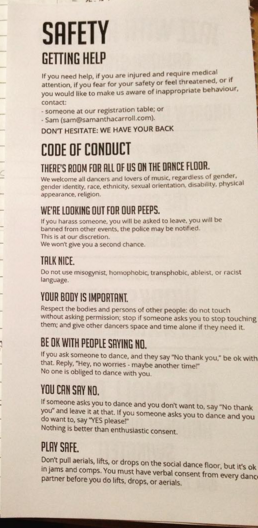
Of course, having a code is pretty much a token exercise without supporting response strategies, training for all workers, and the code itself being readable, accessible, and available in paper form at the event. It has to be accompanied by in-class teaching and training for cultural change.

So of course, the next step in assessing Australian events would be to assess the in-person responses and processes of each event. So far MLX is winning: I was very impressed by what I saw this year at that event. Hopefully we don’t have to wait until something happens to assess an event’s response strategy.

Why did I do this? Why am I being such a pain? Because I’m a keen social dancer, I’m a DJ, and I go to events. I want to be safe. I want my friends to be safe. As a woman, I experience sexual harassment pretty much every week, and pretty much every time I leave the house. So you know what? I say FUCK THAT noise. I want my lindy hop to be safe, and I am DONE with fuckers who are busy with one hundred excuses for not doing something to make dance events safe. THERE IS NO ACCEPTABLE EXCUSE.

And if I ask questions about this, other people will too. We’ll stop being a community of ostriches, and we’ll start actually stepping up. I hope that other women will see that a woman can say something quite loudly, and be powerful.

Why is a code important?
It tells your attendees the ‘rules’. It makes it clear to attendees and workers that your event is thinking about and working towards safety and preventing sexual harassment.
It also helps create a culture of ‘prevention’ and ‘respect’. I was absolutely delighted by the way MLX’s public code of conduct and open discussion of these issues led directly to a general attitude of ‘look out for each other’ at the event itself. I saw dancers go out of their way to do things for each other.
So having a code tells people that a code is important. It tells people that these ideas are important enough to talk about, write about, and act upon.

What should a code include?

  • Basically, a list of ‘rules’: dos and don’ts.
  • You also need to include a ‘what do you do if you need help?’ process for dancers
  • a list of contact names (for both attendees and workers to contact)
  • a response strategy or process if something does happen (eg when do you call the cops?
  • training for all workers before the weekend, to be sure everyone knows the code, and knows the process.
  • I think it should also include a list of consequences: eg repeated complaints about you, and you’re banned.
  • A process and training for carrying out these consequences. eg once you’re banned, your name and picture is in the door kit, and door staff are trained in how to prevent your entry (eg calling the police). Banned dancers should be notified in person about being banned, and this knowledge should be circulated amongst local dance organisers.
  • Banning: if you have banned someone, do you have a responsibility to warn organisers about them?

This last point is particularly important, I think. It’s not ok to say “each issue will be dealt with on a case by case basis.” You need to plan ahead. That means coming up with scenarios, and response strategies, and then training people in these strategies. Because we are a community of dancers and musicians, and the relationships between scenes are absolutely central to our local, national, and international success and viability (try running a big exchange without a network of peeps in other cities to invite and to help you distribute promotional material), we need to think collaboratively about response strategies.
eg Last week I banned a guy who’s been groping women. He gave me a bullshit line about how ‘it’s just a blues’ hold!’ Yeah right, buddy. I’m not no noob to be buying that shit. I’ve told other organisers in my city about this guy, what I’ve done, and what he said. The blues dancers and event organisers were immediately alarmed, because this line ‘it’s just a blues hold’ is some very bad PR for blues. And let’s be honest: the blues scene has been faster and more diligent in their responses to these issues than the lindy hop scene.
So these local peeps now have a chance to raise the issue in class: ‘it’s a blues hold’ is not a license to grope. The other organisers in my town know that this guy is not welcome at my events, and that he’s aggressive and may retaliate against me personally at a dance event. So they’re keeping an eye out (I hope! I know other dancers are). And if they do choose to ban him as well, they have a precedent. But they may also use this as a chance to give him an ultimatum: get your shit together, or you lose my events too.

Me, personally, I’ve found having a network of organisers in my town, and good, clear communications about these issues absolutely essential. We may not all be best friends, but we are all capable of open, civil conversation, and have all worked in at least civil will to reduce conflict where we can. In this instance, I know that there are other organisers in my city (many of whom are actually my friends) thinking about these issues, and giving me feedback on my processes.

Anyway, back on topic.

NSW (Sydney)
Me first.
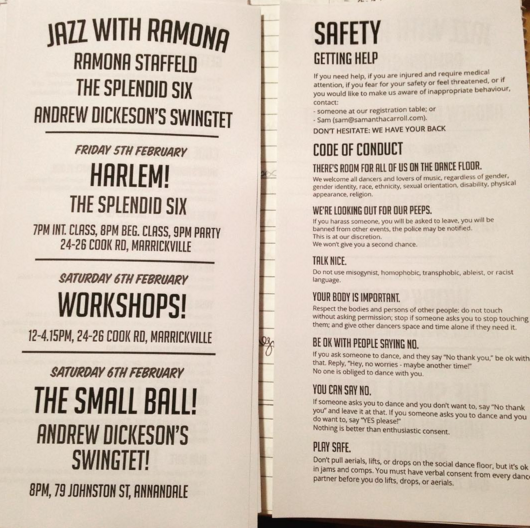
Little Big Weekend (lindy hop/solo jazz) – that’s me and Swing Dance Sydney. It does have a publicly available code, and we do have a safety response plan at the door. I circulate the code with all teachers, musicians, sound engineers, etc etc before the weekend, and make it clear to all these people in their written agreements, that they must all read and agree to abide by the code before they work for me. So we are pretty much pirates, right?
My weaknesses:
– no written copy of the code at the door
– the code has too many words
– I’m thinking about a visual guide to not harassing people, which I’d like to get done next year.
– I’m currently working on a readable, useable version of the code for the door
– we need more training: our teachers need in-class strategies; our door staff need training for dealing with banned people; we all need training in knowing when to call the police. I’ve worked with security guards at events before (including one memorable late night party where a DJ threatened me, and I got to tell the big security guard to kick him out), I’ve kicked people out quite a few times (random drunks mostly), and I’ve called ambulances. But what’s my plan for responding when a woman is sexually assaulted at my event?
– I’d like to do some security/defence training for dealing with trouble at events.

These are my focus areas for 2016.

Jazz with Ramona – as with LBW above

Sydney Lindy Exchange – no code of conduct (NB I did provide Bruce with a draft version when I was first working with this event earlier this year, but it’s not been adopted). This event is managed by Bruce Elder and Swing To It Sydney. Swing To It does not have a code either.

Sydney Blues – does have a code of conduct. I don’t know how it runs on the day. This event is run by Chris Kearns.

For Dancers Only (lindy, bal, tap, solo) is run by Trudi Pickering in Sydney and has a Code
NB the Canberra version of the site doesn’t have the code. This seems like a site design problem, rather than an oversight.

ACT (Canberra)
Canberrang (lindy hop, blues, balboa, solo) – no code of conduct. This event is managed by Jumptown Swing, a non-profit organisation based in Canberra. Jumptown does have a Declaration of Safe Space document on its website, but the link’s hidden under a drop down menu.

Jumptown Jam (lindy hop, blues, balboa, solo) – no code of conduct. Also Jumptown Swing managed.

Slow Down (slow lindy, blues, slow balboa, slow solo)- Does have a code, but the link is hidden behind a drop down. Run by Cathie Gough and Shobana Nambier, and sponsored by Cathie’s company Savoy Canberra. Savoy Dance Canberra has no code of conduct.

VIC (Melbourne)
Melbourne Swing Festival (lindy hop, solo, blues) – no code of conduct. Managed by Swing Patrol Melbourne, which does have a code of conduct on its site.

Melbourne Lindy Exchange (lindy hop, blues, solo, balboa)- has a safe spaces document AND guidelines for attendees. Run by a non-profit organisation the Melbourne Jazz Dance Association. Has a very good f2f safe spaces process, and provides hard copies of the code at the door to events.
I was on the MJDA founding committee, and we specifically included the concepts of equity and accessibility as well as promotion and preservation of jazz music and dance in the Association’s charter.

Blues Before Sunrise (blues dance) Doesn’t have a code of conduct, but was held in March this year, and was really too early to have gotten to this issue. It’s a tricky one because Steven Mitchell was involved with this event as a teacher. I think (but can’t be sure) BBS won’t be running in the future, as the organisers are moving on to other projects. This event was administered by Swing Patrol Melbourne.

Cider House Blues (blues) – Does have a code, and developed it before the Mitchell thing. This event is run by a few friends.

SA (Adelaide)
Southern Blues (blues) – Has a safer spaces policy.

WA (Perth)
Hullabaloo (lindy hop) – has an inactive page atm. It’s run by the Perth Swing Dance Association, and I’m pretty sure the event will have a code and a process, as they are fully ninjas behind the scenes on this stuff. The PSDA does have a code, but it’s hidden behind a few too many clicks.

Perth Lindy Jam has no code. It’s run by Swing It, and was only held in March, so again it’s probably not had time to get a code sorted. Swing It does not have a code.

Shag About (shag) – Does not have a code. It’s run by Shag About, which does not have a code.

Margaret River dance camp (lindy hop?) – does not have a code. It’s run by Simply Swing, which does not have a code.

QLD
Sunshine Swing (lindy hop) – doesn’t have a code on its site, but its site is a place holder only atm. This event has been undergoing some changes. I’m not sure whether it’s run by Empire Swing or Corner Pocket Swing. Corner Pocket doesn’t have a code, nor does Empire Swing.

Swing Camp Oz (lindy hop, etc) does not have a code of conduct. This event is run by Joel Plys from outside Australia. There has been a fb post about a code of conduct, but this code is wholly inadequate.

Bal on the River (balboa) does have a code.

TAS
Swingmania in Launceston does have a code, but it’s a bit tricky to find. It’s linked from the Registration page, and the link is right above the ‘register’ in this body of text: “SwingMania is an inclusive and warm environment. Any participant who marginalises another may be asked by the organising committee to cease their involvement with the event. To view our full Code of Conduct”. So while it’s harder to find, it’s actually cleverly placed, because you know registrants will read it. Hopefully.

[edit: I added For Dancers Only and Swingmania after this page was published because I forgot them]

As you can see, we’re not doing very well, Australia. Time to get your shit in gear, right? After all, we’ve had 11 months since January, so we should all have been thinking about it since then. And there have been some very good resources floating about.

Basically, if you haven’t got a code of conduct on your event’s website (and on your dance school’s website), you’re telling dancers you don’t prioritise their safety. I know that getting content onto a website can be a pain if you’re not tech-savvy, but I’m pretty sure we all manage to get ads for our next event up on the website promptly.

Let’s step up. Be more awesome.

Polite ladies don’t swear

I’m all about swearing.
And so is Clem Ford, whom I have the hero worship for atm.
I’m currently pushing up my program of asking difficult questions in public about how dancers are responding to and preventing sexual harassment. I’ve been told, repeatedly, that I need to stop shouting in public and start sending private emails. Yeah right. Because I really want to go behind closed doors with someone who has a history of enabling sexual assault.

[nb as I type this, I’m getting a bit trembly. Because every time I get public on this stuff, I get a host of nasty comments on this blog, scary messages on facebook, and thinly veiled threats. But fuck it. I think about the fact that my hesitating on banning a particular man at my dances this year eventually made it possible for him to grope and scare one of my students. I’m stepping UP because I can. It scares the shit out of me, but really, yolo, right?]

I’m just about to spend some time assessing all the Australian swing dance events’ websites, looking for codes of conduct. If they don’t have one, I’m going to ask them publicly where it is.
I recently had a discussion with the MLX committee about their code of conduct (and its absence a few weeks before the event). I was just DELIGHTED by their fierce response. They were all over this shit. And they produced a great document. As with all these things, it needs some pruning and tidying. But they got it going, they had it available in hard copy at the door, people were reading it, and I saw the process in action over the weekend. I was just so excited to see how public discussion about this stuff at a non-profit event prompted dancers to be pro-active about looking out for each other. It was just great. Just GREAT.

But not every event is doing so well. I’m going to spend a couple of minutes here with Swing Camp Oz.

Where is the code of conduct for this event? This is an important place to start, because Mitchell was heavily involved with this event, and was actually at this event in Australia when his history as a rapist and perpetrator of violent attacks was made public.

And yet there’s no code of conduct for this event. More worryingly, this event does not pay its local teachers and DJs properly*. This worries me, because I’m currently realising that sexual assault in lindy hop does not operate in a vacuum. We actually produce a culture which makes it possible by exploiting dancers in a range of ways.

I talk about this in the post How to exploit people, and I say:

More importantly, when you exploit people, you are facilitating conditions which make it possible for your workers to be abused in other ways. Including sexual harassment and bullying. So when you say, “Oh, you should DJ/teach/manage the door for free because I want you to, and I’m just doing this ‘for the scene’,” you’re telling people that they should do unfair, unsafe, unpleasant, exploitative things ‘for the scene’ just because someone powerful or ‘important’ asks them to.

To make it clear: when you fuck over volunteers, DJs, etc, you are creating conditions which train dancers to accept sexual assault and harassment by high profile teachers and dancers. You are creating and contributing to rape culture.

But let’s continue with today’s news.
Today there was a bullshit piece in New Matilda about Clem Ford‘s public outing of men who send her hate mail and attack her. This is a response: Why Courageous Jack Kilbride Is Not The Answer.

This bit is my fave:

Kilbride posits that “The problem with writers like Clementine Ford is although their sentiment is justified, their vitriolic writing style means that people will always get offended.” Which by virtue, is suggesting that politeness and civility are the only ways to get things done. We know by looking throughout history that every revolution was started by someone using their manners and asking very politely, right?

Because I like to swear a bit on my blog, and on fb, particularly when I’m talking about this stuff. I’m just full of the rage, and I have to let it out, so there’s room inside me for photos of overweight ponies and capybaras.

I’ve heard the expression ‘ladies don’t swear’ a few too many times, particularly in reference to lindy hop. I’ve also had a few men say that they don’t want to read my pieces on preventing sexual harassment (eg this one) because they have too many swears.

A lot of modern day lindy hoppers try to recreate an imaginary swing era where ‘women were women and men were men’, and those women were all fluffy and girly, and those men were spat-wearing gentlemen. This gives me the living shits, because these modern dancers are using this imaginary world to stop me leading, to make me wear ‘girly’ outfits, to stop men following, and to make me sit down and shut up.

But then I listen to Ryan Swift’s Track podcast where Dawn Hampton drops a few fucks and a few shits, and I realise: BAD ARSE WOMEN DANCERS USE ALL THE TOOLS AVAILABLE TO THEM. We are not here to make you feel comfortable, my friends. We are here to bring the shit.

*[EDIT: How do I know this? I was asked to coordinate the DJs for this event in 2009, and when I asked about the pay/working conditions, I was very unimpressed and decided not to take the role. Since then I’ve actually put my conditions in writing. I developed this document over the past 15 years of running events, through my experience working with various event organisers and DJs.
But that was six years ago. Have things changed since then? Marginally. But certainly not to the point where this event is inline with the rest of Australia. And absolutely not to the point of being inline with the larger, higher profile American and European events. How do I know? I talk to other DJs, teachers, and organisers who’ve been involved with the event.

[EDIT: I’ve changed the title of this post because it is misleading. In case you missed the point, asking questions about these things is difficult and destabilising. It is uncomfortable. Which is exactly the point. Our culture discourages women from asking questions, from being loud, from being rude, from being ‘difficult’. It wants us to sit down, be quiet, and put up with men assaulting or harassing us. It absolutely wants to stop us speaking up for other people.
A large part of patriarchy is training women to see each other as rivals and competitors. Lindy hop is talking a bit about ‘active follows’ at the moment, but what that really means is ‘be active up to the point where you imperil the status quo, and the status of your male partner. Then stop.’
When we don’t just take it quietly, we disturb the status quo. We make it harder for men to take advantage of us. This makes them angry. This makes us worry about our safety. The implied threat of violence is often what keeps us from speaking up. And sexual assault is an act of violence. To trot out that Margaret Atwood quote, “Men are afraid that women will laugh at them. Women are afraid that men will kill them.” This is not an exaggeration. I had an experience at SLX while I was DJing that had me worried about my safety. Because I didn’t do exactly what a man wanted.]

how to exploit people

link

I’ve had a couple of emails this week alone asking me if my business would like the opportunity to work for free. I said no.
But I know a lot of DJs work for free for ‘experience’ or ‘exposure’, I know newer dancers perform for free for ‘exposure’ or ‘experience’, and I know teachers work at big events within Australia for ‘experience’. None of whom receive free entry to the event or any equitable compensation (eg a free pass). One of the bigger areas of exploitation in the dance world is administration – running large events or regular classes.
All of this is pretty much bullshit.

I’m particularly annoyed by the way volunteering is used to gain free labour from dancers, without providing safe, reasonable working conditions. Volunteering is a good thing in many cases (and the lindy hop community needs it to work), but you have a responsibility as the employer (because that’s what you are) to provide safe, equitable, and just working conditions and terms for all the people who work for you. Volunteers, employees, and contractors.Simply justifying this lack of pay as ‘growing the scene’ or doing it ‘for the scene’ is not ok.

If you really want to ‘grow the scene’ you pay people so they can then invest some of that money back into the scene (or you know, paying their electricity bill). A healthy, growing community is sustainable, economically and socially. In other words, you want to retain skilled workers (rather than overworking them and burning them out) so you can retain their knowledge and abilities and help your community improve what it does.
You want to offer people opportunities to develop these skills and interests, so that they can move on to run their own projects, develop their own ideas, and help your community become a more interesting, diverse creative space. In other words, you’ll get better dancing, DJing, and events in your scene if people stick around longer, and feel good about what they do. Eventually people get tired of being screwed over, and they drop out.

More importantly, when you exploit people, you are facilitating conditions which make it possible for your workers to be abused in other ways. Including sexual harassment and bullying. So when you say, “Oh, you should DJ/teach/manage the door for free because I want you to, and I’m just doing this ‘for the scene’,” you’re telling people that they should do unfair, unsafe, unpleasant, exploitative things ‘for the scene’ just because someone powerful or ‘important’ asks them to.

Whenever I hear the phrases ‘grow the scene’ and ‘doing this for the scene/community’, my alarm bells ring. Volunteers, workers, dancers, DJs, teachers, students ARE the scene. So you should – you have a responsibility protect their interests and rights.