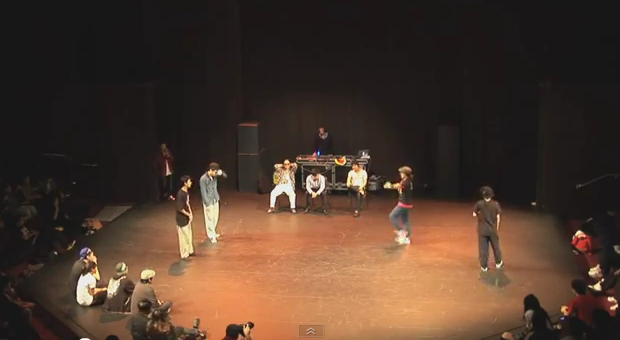
‘Historical Recreation’: Fat Suits, Blackface and Dance

I’m just doing some housekeeping over here in the blog (hence the somewhat dodgy CSS), and have been looking back through unpublished drafts. This is a post that I wrote back in July. I put off publishing it then because I was getting a bit more attention than I felt comfortable with. So I just put it on pause. It’s probably going to be read as controversial, but to my mind it’s really just standard critical engagement with a few texts. But the fact that I’m writing about people in my own community in a way that academics often don’t – ie with a real sense that my words have consequences and aren’t just ‘neutral’ observation – changes the way this will be read. And the way I think about writing this stuff.

So, I guess this is my unpacking and rummaging through a little cultural baggage. I’ve made plenty of apologetic explanations below, though it kind of shits me that I feel so little confidence in my own ideas. But, you know, this is a post about talking about important issues. Right now, in this moment when my government is taking such a shameful stance on refugees (fuck off, you’re not white, we don’t want you here), is continuing with the NT Intervention (fuck off, you’re not white, we don’t want you here) and generally being complete arseholes, I think it’s more important to take a few risks myself.

Structurally, this post begins with Lisa Wade’s article which discusses Sarah and Dax’s ESDC 2011 routine. I tie in (in a limited way), the Two Cousins video clip which starred Ryan Francois and Remy Kouakou Kouame.
Then I explain why I’m not entirely ok with Lisa’s use of ‘black’ and ‘white’ – I want a more critically nuanced approach, one which also looks at how class and gender work in ethnicity. I’m especially frustrated by her use of the concept of ‘tacit knowledge’ because it doesn’t prioritise or encourage activism (or speaking out about or engaging with racism). I suggest a more politicised approach helps. Then I suggest that all this makes more sense within cultural context: race and ethnicity in Australia, Britain and America; the way different film texts work within an historical industrial context; reading Sarah and Dax’s performance in relation to their broader online presence (ie their blog). That last bit is important because I tie their talk about bodies, beauty and gender into this performance’s portrayal of bodies, ‘fat’ and masculinity.

I started writing this comment over at Lisa Wade’s post ‘RACE, APPROPRIATION, & LINDY HOP: HOW TO HONOR OUR HEROES’, but I couldn’t really justify such a long comment on someone else’s post. I want to write and write about this, because I’ve spent so much time looking at cultural transmission in lindy hop, and the role digital media plays in this process. I’ve spent a long time thinking about this stuff, and I think I have some responses to Lisa’s question

How do white people, especially when they’re more or less on their racial own, honor art forms invented by oppressed racial groups without “stealing” them from those that invented them, misrepresenting them, or honoring them in ways that reproduce racism? You tell me… ’cause I’d like to know.

But it’s such a complex issue, and I’m not really sure I have the brains to work through it right now. I certainly want to return to my brief and fairly rubbish post about Slow Club’s Two Cousins clip, but I don’t really have room to think about that right now, either.

So why am I posting at all? I want to jot these ideas down. I want to participate (that is my greatest fault, I think – I hate the thought of missing out!) Also, I LOVE to talk and write. And this is my blog, so I can just ramble on as long as I like.

This is Lisa’s original post. I’m reproducing it here because posts disappear. Please note: I’m using Lisa’s first name rather than her last because that’s how we tend to address peeps in the dance world. I certainly don’t mean any disrespect.

RACE, APPROPRIATION, & LINDY HOP: HOW TO HONOR OUR HEROES
by Lisa Wade, 1 day ago [6 Jully 2011] at 10:00 am

Lindy hopper Jerry Almonte sent along a clip of the first place-winning routine in a division at the European Swing Dance Championships. Lindy hop is a partner dance invented by African American youth in Harlem dancing to swing music in the early 1930s. It’s near and dear to my heart; I’ve been a lindy hopper for 13 years (minus that year with a broken leg).

Modern day lindy hop raises difficult questions. In a post I wrote when the beloved Frankie Manning died, titled Race, Entertainment, and Historical Borrowing, I tried to capture the conundrum. I’m going to quote myself extensively, only because this is a tricky issue that deserves real discussion:

Though lindy hop was invented by African Americans, lindy hoppers today are primarily white. These contemporary dancers look to old movie clips of famous black dancers as inspiration. And this is where things get interesting: The old clips feature profoundly talented black dancers, but the context in which they are dancing is important. Professional black musicians, choreographers, and dancers had to make the same concessions that other black entertainers at the time made. That is, they were required to capitulate to white producers and directors who presented black people to white audiences. These movies portrayed black people in ways that white people were comfortable with: blacks were musical, entertaining, athletic (even animalistic), outrageous (even wild), not-so-smart, happy-go-lucky, etc.

So what we see in the old clips that contemporary lindy hoppers idolize is not a pure manifestation of lindy hop, but a manifestation of the dance infused by racism. While lindy hoppers today look at those old clips with nothing short of reverance, they are mostly naive to the fact that the dancing they are emulating was a product made to confirm white people’s beliefs about black people.

So we have a set of (mostly) white dancers who (mostly) naively and (always) wholeheartedly emulate a set of black dancers whose performances, now 70 to 80 years old, were produced for mostly white audiences and adjusted according to the racial ethos of the time. On the one hand, it’s neat that the dance is still alive; it’s wonderful to see it embodied, and with so much enthusiasm, so many years later. And certainly no ill will can be fairly attributed to today’s dancers. On the other hand, it’s troubling that the dance was appropriated then (for white audiences) and that it is that appropriation that lives on (for mostly white dancers). Then again, without those dancers, there would likely be no revival at all. And without those clips, however imperfect, the dance might have remained in obscurity, lost with the bodies of the original dancers.

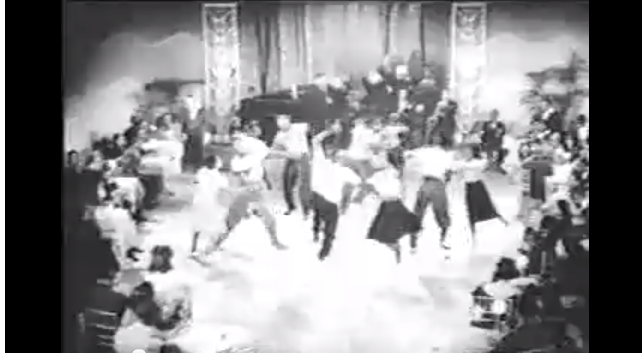
It is this paradox that stirred Jerry to send along the clip of Dax Hock and Sarah Breck performing a routine that was an homage to a famous clip from the movie Day at the Races, featuring Whitey’s Lindy Hoppers. Here’s the original clip from 1937.

And here’s Dax and Sarah’s routine (Dax, btw, is in a fat suit; an entirely different and equally troublesome issue).

To be as clear as possible, I do believe 100% that Dax and Sarah have no intention to mock and, as essentially professional lindy hoppers, I doubt very much that they’ve never considered the ideas I’ve explained above.

Dax and Sarah are not my target here and, besides, they’re just two people. All conscious lindy hoppers struggle with these issues. My target, and my own personal struggle, is the entire endeavor.

I leave this as an open question for discussion, and one that extends far beyond lindy hop to jazz, blues, rap, and hip hop music; other forms of dance, like break dancing and pop and locking; and even the American obsession with spectating sports that are currently dominated by black athletes. It also extends far past the relationship between blacks and whites, as Adrienne Keene well illustrates in her blog, Native Appropriations.

How do white people, especially when they’re more or less on their racial own, honor art forms invented by oppressed racial groups without “stealing” them from those that invented them, misrepresenting them, or honoring them in ways that reproduce racism? You tell me… ’cause I’d like to know.
———————
For more, I’d be thrilled if you read my original post, inspired by the passing of Frankie Manning.

Also worth considering is this beautiful music video (Slow Club, Two Cousins) featuring lindy hoppers Ryan Francoise and Remy Kouakou Kouame performing vintage jazz movement. Is it different? What makes it so (other than production value and the race of the dancers)? Can you articulate it? Or is it tacit knowledge?

Inspired in part by The Spirit Moves?

I’m interested in Lisa’s points, but I think some of the key issues need a little expansion. I find some of her conclusions troubling. So I’m going to address them here in a disorganised, ad hoc way. Cool. Not.

Initially, I’m not comfortable with talking about race or ethnicity without also talking about class (and then gender and then sexuality). This becomes particularly important when you consider lindy hop in Japan or Korea or Singapore. The majority of dancers there are not white, but perhaps they are middle class? I think that it’s very, very important to interrogate class as an engagement with social and cultural power; it is not enough to end with skin colour as the defining marker of race or ethnicity.
In a related point, I also have some troubles with the way Lisa talks about ‘white people’ as though they were a homogenous group. I mean, setting aside class, sexuality and a heap of other issues, it’s been fairly stunning to me to see how simply having a group of women perform the Tranky Doo changes its meaning. So I think we need to be careful of using ‘white’ and ‘black’ as blanket terms, lumping masses of people together under single terms. ‘Black’ is especially interesting, as the word works in different ways in Australia, in America, in the UK, in Europe. And then within those countries the word is used in different ways by different groups and individuals.

And I have some concerns about approaching this discussion via the concept of ‘tacit knowledge’. Simply, I think there are other, more useful ways of talking about what’s going on in the clips. I’m with Katrina Hazzard Gordon and Stuart Hall and Paul Gilroy and bell hooks and Judith Butler… I think we need to engage with the ideology at work here in an actively politicised way. Because these performances aren’t ideologically neutral, nor are the effects of their actions neutral. We need to engage with these issues, we need to unpack the politics, interpersonal as well as institutional. To do otherwise would be to ignore the way these texts embody the wider discourses of the societies in which lindy hop scenes exist, how they function culturally and socially in the modern lindy hop world, and how they articulate power within lindy hop today.

As an example, Lisa suggests that we cannot articulate why a performance might be racist, but we have ‘tacit knowledge’ of what racism is. I find this approach a little lame. Racism does not exist in a black/white, on/off dichotomy. It works in complex ways and a particular text might be articulating racist ideas in a range of ways, might be read as racist because of how it frames or reproduces and supports racism through the relationship between textual elements, reception and then dissemination. I would suggest that not being able to articulate why something ‘feels’ racist should just be the starting point. Don’t stop here! Speaking up about racism is very important – do it!
If I find a particular routine or image discomforting, I don’t say ‘oh, it’s racist because I have a tacit knowledge of racism’. I start analysing the text, the way the text is framed, where I found it, what other texts were circulating at the same time. I start interrogating my own feelings and try to figure out what’s happening. The goal here is that we learn how to articulate our concerns, and then develop the confidence to articulate them. Tacit my arse. Let’s get fucking ACTIVE here!

After all, if we simply say ‘I think it’s racist but I can’t explain why’, how is this any more convincing an argument than ‘I don’t think it’s racist, and I don’t have to explain why’? You need to start expressing your ideas, and exploring your concerns so that you can then say to those ‘I don’t think it’s racist’ people: “I’m suspicious of the fact that we see so many scenes where black dancers are dressed as servants in films. So I reckon we should think twice before we recreate those scenes.”

Cultural context is important. It’s difficult to apply American critical tools for discussing race and cultural transmission to the UK or Europe (where Ryan Francoise and Remy Kouakou Kouame are based), for example. The black British migrant experience is also quite different to the American, and histories of slavery in Britain, America and Australia are quite different. I faced similar challenges discussing lindy hop in Australia, where our discursive engagement with race is quite different to the American example.

It’s very difficult to talk about black American dance in film in the 30s without also talking about slavery, blackface and minstrelsy and segregation in American history. It’s difficult enough addressing these issues in an American setting, but it’s even harder in an Australian context. Many Australians simply aren’t aware of this country’s slave history. A recent debate about the use of blackface on a tv program revealed not only most Australians’ unfamiliarity with blackface in Australia, but with the racial politics at work in blackface in an American context. Nor do many Australians really understand the long standing history of segregation in this country. They simply don’t know that black Australians couldn’t eat, drink, shop, swim or travel in the same spaces as white Australians. So when Australians watch sequences from films like the Day At The Races, with all its intonations of segregation, black face, slavery and so on, these themes don’t resonate in the same way as when an American watches. I guess, here, we also need to talk about audiences and reception as well as cultures of production (and institutions producing and disseminating media texts).

When we’re talking about dance clips, who is watching? Where are they watching? The Slow Club text is a music video. We are talking about Dax and Sarah’s showcase routine as an AV recording of a performance at a dance competition in Europe. I am a white, middle class woman living in a large, well-serviced, safe city in Australia watching these clips on my (reasonably ok) internet connection in my own home on my own computer. I am a dancer, but I am not a brilliant dancer. I am/was a media studies scholar who’s studied and published and taught film and media studies and who wrote a PhD on race/gender/identity in dance and digital media. All these things shape the way I read these texts. What I see will reflect who I am and what I am reading for. How I use these texts will reflect these things as well. I am also reading these texts in relation to each other, and in relation to a vast body of audio-visual recordings of dance. I’m accessing them online, and I’m reading them in relation to other online texts – Sarah and Dax’s blog, Faceplant, the Yehoodi discussion board, the Yehoodi Talk show, Lisa’s blog, etc etc etc. These texts don’t exist in isolation. They are part of and constitute a discourse on/about dance.

The Slow Club clip is interesting because it’s a British band featuring European dancers. The song exists in an international context, and is referencing American television performances by black American dancers. But these performances circulate today again in an international context, and are most familiar to middle class dancers in a number of countries.
I think we need to talk about masculinity as well. Luckily Paul Gilroy and Stuart Hall have done a lot of the heavy lifting for discussions about black British masculinity and identity.

While I’ve found the Slow Club clip quite exciting and interesting and posted a little bit about it already, the Dax and Sarah clip is a little more challenging. I cannot help but engage with this performance in reference to the things they’ve written about gender on their own blog. I wrote a couple of things in response to their posts myself: Women talking about their own bodies and how this issue was trolled or women dancers wearing high heels and talking about it (Saturday, March 26th, 2011) and Fuck that shit. I’m not wearing no fucking high heeled shoes (Tuesday, April 5th, 2011). I’m sure they are endorsing conventionally gendered notions of physical ‘beauty’. I’m not sure they’re actually engaging reflexively with the way their appearance (when that appearance includes gender and race and class and other identity markers) informs audiences’ readings of their dancing.

I don’t want to give the impression that I’m on some sort of anti Dax and Sarah vendetta. I’m not. It’s just that they keep/kept leaping into the public discourse with such enthusiasm. As I wrote in the ‘Women talking about their own bodies…’ post, I think that lindy hoppers need to think through their public personas, and to be aware of the fact that teachers and performers – ‘celebrity lindy hoppers’ – are going to attract a great deal of public scrutiny.

As I write this I’m thinking about my own experiences with public scrutiny. The recent attention to this blog has been difficult to adjust to. I’m not sure I like all this attention. I know I haven’t liked some of the unpleasant comments I’ve had to delete, and it’s definitely been strange being approached by strangers at dance events who feel they ‘know me’ or have a right to regale me with their opinions at 2am while I’m DJing. I haven’t liked that. But then, this is the internet. If I’d wanted to keep my ideas secret, I shouldn’t have posted them…

… wait a minute. Fuck that. It smells a little too much like ‘don’t wear a short skirt or walk about by yourself at night if you want to be safe’. Don’t we all deserve respect and safety, just BECAUSE?

Yes.
Which is why I want to repeat: Sarah and Dax are great dancers, I suppose they could also be great people (I wouldn’t know). But that doesn’t mean I don’t think there are some problems with the things they’ve said online and done in dance performances. I feel that we need to engage with the ideas behind and within dancing as well. That stuff isn’t ideologically neutral: dancing IS discourse. And when you put it out there, in a competition, you are inviting discussion. So I’m going to discuss.

Firstly, I certainly don’t think Dax or Sarah intended offence, and I’m almost certain they intended their dancing as homage. That routine also has to be read in reference to other recreations of iconic routines: in this setting, and by these dancers, this routine was almost certainly intended as a mark of respect and admiration for the ‘original lindy hoppers’. It is however, I’m fairly certain, not a critically reflexive performance of racialised identity. In other words, I don’t think Dax and Sarah thought this thing through. Which, really, isn’t that surprising if you read them as young white people who haven’t had to engage with the issues of race and power embodied in the Day At The Races film. When you are a member of an empowered group, you don’t need to think about these things. Because they enable what you do, rather than inhibit you.

The troubling part seems to be the ‘fat suit’ (and what a troubling term that is), and I would have liked to see Lisa place this in the foreground of her article, rather than setting it aside. It seems to me that the suit initiates connotations of ‘humour’, and that is where many of the difficulties with this routine lie. It is difficult to negotiate when and how the ‘joke’ begins in this routine. Fat people are funny? Black fat people are funny? White fat people are funny? I find all these ideas deeply offensive, but also indicative of both the dancers’ ideas about physical beauty (which they have both articulated at length on their blog) and of modern lindy hop’s ideas about ‘beautiful bodies’. Would the routine have prompted such debate if it had presented a more familiar example of male athleticism? If Dax had appeared in his usual muscled, fit, and conventionally attractive body?

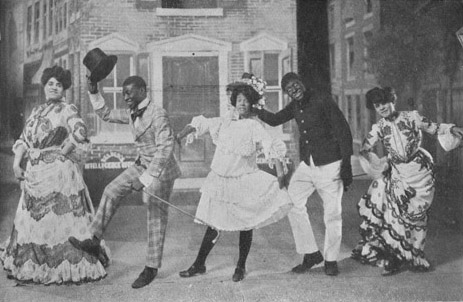
I’m wondering if the fat suit works as a sort of ‘blackface’. It’s a performance of a particular type of masculinity which, while it isn’t physically ‘black’, is continually referencing the black bodies dancing in Day At The Races. The very point of that routine is that it requires audiences’ familiarity with that film. Race is there, even if it is ‘invisible’. And I must say, here, that whiteness is as much about race and ethnicity as blackness is. To make whiteness ‘neutral’ or unmarked by race is wrongtown.

But then, how are we supposed to respond to this routine? Are we supposed to ‘laugh at the fat guy’? I know that in most lindy hop culture the muscled, athletic body is valorised (you only need consider the popularity of P90X and Insanity for evidence). If we are supposed to ‘laugh at the fat guy’, is it possible to also admire and valorise this ‘fat body’ at the same time? The crux of the original Day At The Races clip lies in exactly this tension: the dancer’s ability to perform impressive acts of athleticism with his body. Additionally, ‘fatness’ and fleshliness carried different connotative values in 1930s black American culture. So Dax and Sarah bring a different understanding of ‘fat’ to that clip, and to their performances. And audiences watching Dax and Sarah perform are watching from another point in time and culture.

I think gender is important here. The ‘fat suit’ – the ‘fat guy’ – only works in reference to the other male bodies on screen, and most particularly, the female body on-screen and on-stage. Dax in the ‘fat suit’ only works when compared to Sarah’s presentation of highly conventional female ‘beauty’. While she is also in connotative ‘blackface’ (at that same distance Dax is – through reference to the film and in her costuming), she is also in ‘whiteface’, wearing an athletic, healthy, conventionally ‘female’ body. The joke requires the conventionally attractive white/black heterosexual woman as foil for the ‘laugh at the fat guy’ joke. Part of the joke is the implication that ‘the fat guy’ has to be a seriously badarse dancer to secure such an attractive partner, because she’d otherwise have no interest in him.

I suspect that this is where the real conflict lies. One of the most persistent taboos in lindy hop today is disrespecting dancers from the 30s or 40s. It makes us uncomfortable to negotiate the disrespect of ‘laughing at the fat guy’ when this ‘fat guy’ (Dax in costume) is meant to be one of the Whitey’s Lindy Hoppers. Not only is Dax appropriating a black performance (of awesome dancing) from a film produced in decidedly unjust social context, he is also capitalising on the joke. He is not going to be the butt of this joke – we know he is wearing ‘the fat suit’ – so he is ‘safe’. He’s ‘not actually fat’. He doesn’t need to physically experience what it is to be ‘fat’ in modern American culture. He takes no risks. But at the same time he can also claim credit for the dancing ability he demonstrates – it’s good dancing, he is a good dancer. This is also where their performance fails, really, to realise the goals of the original performance. The original dance scene was impressive because he was a ‘fat guy’ who danced well despite/with his body. We never forget that Dax is ‘wearing the fat suit’. He has nothing to ‘overcome’, here.

[I would to talk about a Yehoodi talk show interview (16 March 2011) where Dax talks about dancing with an injury on So You Think You Can Dance, and how this is different to ‘dancing fat’, but I don’t really have space or time or brainz to do it. Except to say that there’s something interesting to be written about dance, injuries, perceptions of injuries, pain and masculinity.]

There is the chance, though, that Dax and Sarah didn’t intend this reading. Perhaps they are working to present an alternative portrayal of white masculinity. The physically large, well-fleshed heterosexual man as desirable, desiring, powerful and admirable subject. Perhaps they are trying to say “Look – ‘fat’ is, after all, only an arbitrary evaluation of physical size articulating western consumer values and notions of ‘beauty’.” Perhaps they are trying to comment reflexively on bodies and embodiment in dance. Perhaps. I’m not convinced. The thing is, this clip is existing in the same discourse as their blog, where they have both repeatedly articulated conventionally heterosexist and patriarchal ideas about gender, sex and beauty.

They are not, unfortunately, fucking over the patriarchy here.

Where do I leave this discussion? With a loud sigh and a bit of head shaking, I’m afraid. I don’t really have a solid ‘solution’. I think it’s a really excellent thing that we are actually talking about this issue openly in lindy hop today. It’s something that’s bothered me as long as I’ve been dancing. I mean, there are some problematic things happening here as well. I’d be very surprised if Australian dancers actually participated in this online discussion about race and dance or engaged with it in their dancing.

[EDIT: wtf does Lisa mean by “white people more or less on their racial own”?! When the fuck are people ever on their ‘racial own’? And what does that even MEAN?]


Starting DJing in Sydney: Some Basic Tips

Just as I finished posting that last ranty mcrantington rant about DJing (NEEDS MOAR DJS ? (part 2) (Thursday, November 17th, 2011)) there was a flurry of emailing and suddenly, DJing in Sydney gets very interesting. This is a post about getting into DJing in Sydney. Which is suddenly, thanks to the generosity of quite a few people, very doable.

Avril and Ryan who teach on Wednesdays at the Unity Hall Hotel in Balmain Rozelle Neighbourhood Centre, 665 Darling St Rozelle (classes 7 and 8pm), have opened their small and friendly social dancing slot up to new DJs. I’ve also heard that another couple of venues are interested in doing the same sort of thing, but I’ll have to add their details when I have them confirmed. [Edit 8/12/11: Amanda and Max who teach Tuesdays in North Sydney have also offered opportunities for new DJs during their social dancing] [Edit 25/07/12: Alice and I teach on Wednesdays at the Petersham Bowls Club, and have a 30minute spot at 8pm which is perfect for new DJs].

This is an excellent place to begin DJing. There’s no pay and the crowd will be small, but that’s really what you want for your very first (few) gigs – low pressure. Avril and Ryan [and Amanda and Max] [and Alice and I] are very nice and friendly, and Unity Hall is of course Home Of Mo Jazz in Sydney.

What do you do? Drop them an email, or better yet, go along to their class and have a chat to them about doing some DJing there in the future. That second option is probably the best as it’ll give you a chance to scope out the scene and get an idea of what goes down there each week.

Why start with an after-class gig rather than a larger social dancing night? Well, firstly, you might have some good ideas, but you ain’t got mad skills – yet!

Shorter after class social dancing slots are perfect for new DJs:

  • There’s no pressure to be major-awesome; you’re not making or breaking a major social dancing night;
  • Shorter sets mean you can get in, get a taste, get out. DJing can be quite tiring at first;
  • Teachers at these regular local gigs are relaxed and friendly, which means less stress for you;
  • Students are relaxed and friendly and supportive;
  • These are quieter, smaller events. Yes, I know the urge to show off for a big crowd is strong, but trust me – you don’t want to piss off a crowd of hardcore social dancers. Yet;
  • The timing generally is more relaxed. You can take a bit of extra time to figure out how you plug your laptop into the sound gear because there aren’t a hundred people standing about staring at you.

What should you bring?

  • Your laptop or ipod or whatever it is you’re playing music from, making sure it has a media player you know how to use (itunes, winamp, whatever you like). I’d go with something really simple and familiar at first – time enough to obsess about software later;
  • An RCA Red/ White Stereo connection cable (which cost very little, and can be found at most electronics shops and all music shops):
  • TWO ¼ inch (6.5mm) TS mono phone jack connections (which cost very little, and can be found at all music shops):
  • Your laptop’s power cord;

If you’ve been practicing for a while, or want to go hardcore, then bring your headphones and an external soundcard. But you don’t really need those for your first gig.

How do you prepare?

  • Listen to your music and get to know it. Practice dancing to it in your lounge room so you know how ‘fast’ it feels, whether it’s high or low energy, etc;
  • Learn to use your media player. Experiment with all the settings – every single one;
  • Practice plugging your laptop into your stereo at home;
  • Turn off all the applications on your laptop that you won’t be using – the internet stuff, etc. This means your computer can devote all its energy to playing music, and will make crashes less likely;
  • Turn off all the notification noises – the bing bongs that tell you when you’ve got an email, the boops! that tell you you’re turning the volume up or down;
  • Practice playing pretend sets. How do you drag and drop songs into your playlist?

What should you play?
That’s really up to you. I don’t think you can call yourself a swing DJ if you have less than 90% of your (DJing) collection devoted to swinging jazz. I have lots of other music, but I don’t DJ it for swing dancers. If you’re totally stuck for ideas, perhaps you should work on your music collection for a while before you start DJing.

  • There are basic lists of iconic songs all over the place: Reuben’s list is a good place to start, this is my short list of overplayed songs), and this is my list of ‘essential’ swing albums;
  • What do you hear in class/out social dancing? Ask the DJs. Talk to your local DJs, and be brave enough to chat to DJs at larger events. I know it’s tempting to interrogate a DJ who’s just sitting there, tapping their laptop, but resist the urge – they’re working. Grab them later on – they LOVE talking about music!
  • Don’t ask DJs or teachers to give you music. Would you ask your mechanic to give you free parts for your car?
  • Join the FB group of Australian DJs;
  • Check out www.SwingDJs.com;

Don’t expect to be the best DJ in the world your first time. Just go and treat this as a learning experience that could be fun. Just like dancing, the more social dancing you do, the better you’ll get, the more you’ll learn.

[EDIT: This is one of a number of loosely-associated posts about music in Sydney lindy hop today. This list includes:

]

gimme de kneebone bent

I do think, even after a bunch of years, that Joann Kealiinohomoku’s article ‘An Anthropologist Looks at Ballet as a Form of Ethnic Dance’ is the most useful thing I’ve ever read about dance. That, matched up with Jacqui Malone’s talk about kneebones. The basic idea is that culture and ethnicity are made very clear in the way we move our bodies. In dance, but in other places as well. These two were very important references in my development of ideas, but there are some other really useful sources that help develop my thinking (see list below). I wrote about Kealiinohomoku and Malone in a post called black – white dance in 2006, but it’s pretty much the foundation for everything I write about dance, and everything I think about dance when I’m dancing. And why I get really annoyed by lindy hoppers who point their toes.

The other half of this is of course Gender as a social construct.

All together, they add up to these points: the way you move is a product not only of biology and physiology (ie the stuff you were born with), but more importantly, a product of lifestyle and culture (the things you do with – and have done to – your body).

NB I was just looking over some early posts about my phd, which were written around 2004/2005. Before youtube. It really blows my mind that I did all this video-analysis work without youtube. Sheeeeet. It just shows how valuable file sharing sites like dance.poy were, and how much we owed to the dancers who made and then shared videos and DVDs of vintage clips.

Kealiinohomoku, Joann. “An Anthropologist Looks at Ballet as a Form of Ethnic Dance.” What Is Dance? Readings in Theory and Criticism. Eds. Roger Copeland and Marshall Cohen. Oxford: Oxford University Press, 1983. 533 – 49.

Malone, Jacqui. Steppin’ on the Blues: The Visible Rhythms of African American Dance. Urbana and Chicago: University of Illinois Press, 1996.

Friedland, LeeEllen. “Social Commentary in African-American Movement Performance.” Â Human Action Signs in Cultural Context: The Visible and the Invisible in Movement and Dance. Ed. Brenda Farnell. London: Scarecrow Press, 1995. 136 – 57.

Pietrobruno, Sheenagh. “Embodying Canadian Multiculturalism: The Case of Salsa Dancing in Montreal.” Revista Mexicana de Estudios Canadienses nueva época, número 3. (2002).

[Edit: I think this is partly why I’m not a fan of high heels for lindy hop. They lengthen the leg and make the foot look really small.]

Total Spam

I got a random email from a guy called Andrew Rozario, who’s part of the Nashville Swing Dance Foundation. They asked me (very nicely) if I (and my fellow bloggers) would pimp their youtube channel or videos or venue or something. I figure, what the fuck, I’m feeling magnanimous. Why not. You can watch a video of their studio’s opening here.

I was a bit distracted, so I didn’t really realise what that video was about. At first I thought the girl in the video said they were from the ‘National Swing Dance Foundation’, and that this was the Foundation’s new venue. I thought that was kind of interesting, because I love the hooha that goes along with national lindy hop and swing dance associations, competitions, whatever. That shit always gets dramatic. But, unfortunately, this just sounds like some kids founding a studio centred on lindy hop (and her sisters). Which is disappointingly sensible and fun.

But I know nothing about Nashville lindy hop. They could totally be about instituting national guidelines for lindy hop. Let’s wait and see, yes? Yes.

[Edit: Oh, they’re a non-profit organization committed to preserving, promoting & educating the Nashville Community about all forms of vintage (1920ʼs-1940ʼs) swing dancing, including Lindy Hop, Charleston, Balboa & Blues. I’m totally into really long sentences and hippy nonprofits.
Bit disappointed about the lack of Overarching National Agenda, though. ]

NEEDS MOAR DJS ? (part 2)


(photo of Trev and I ‘DJing’ at MLX8 by scott_aus)

This post is the second of two. In the first part (NEEDS MOAR DJS ? (part 1)) I rambled on about Sydney’s DJing culture at the moment, particularly in reference to its social dancing culture and basic demographics. This second part spends a bit of time talking about why DJing sucks and why I like DJing. At some point in the future I’ll try to write about how we might (despite all our better instincts) go about encouraging new DJs in the swing dance scene.

I’m going to carry on with the (increasingly ridiculous) point that we need more DJs here in Sydney. Because as things are going, we’re in pretty dire straits: NEED MOAR DJS!!1!!

How do we get these moar DJs?
One of the most frustrating suggestions I’ve heard lately is that we should “just put out an ad for more DJs”. Gee, why hadn’t I thought of that. As though there are squads of skilled DJs sitting about at home who hadn’t thought about DJing. Or rather, the implication is that any old fool with some music can DJ.

*headdesk* repeatedly

Here is where things get tricky. Yes, any old fool with an ipod or a laptop can just plug into a sound system and play some music. But this is what will happen 99% of the time:

  • They won’t play ‘swing music’. They’ll play songs that they luuurve and can’t believe no one ever plays. Because no one has every played that fucking Wham Jitterbug song, or Richard Cheese. They’ll play one fucked up song after another, and everyone will get shitty/bored and get drunk/go home.
  • They will play ‘swing music’, but they’ll be using shitty, shitty pirated mp3s that sound HORRIBLE and are unlistenable. So an experienced DJ/person will have to step in to help them fix the sound.
  • They will play ‘swing music’, but it will all be under 100bpm or above 200bpm, all from one small musical style, and all very samey. This’ll be fine for that person and their three friends, but everyone else will get shitty/bored and get drunk/go home.

The best case scenario in these moments is that the dancers will be ok with one of these DJs pulling this rubbish, so long as there’s a second DJ who’ll play ‘real’ swing music. Either way, you’re going to need a second DJ or some sort of technology-savvy person working with the new ‘DJs’ to help them actually make sound come out of the metal box.
And of course, we haven’t even begun to approach a DJ who has a) decent music, and b) knows how to combine it, and c) work the room so that people have a chance to breathe/get their groove on.

Who’d have thought. DJing actually requires some skills and knowledge.

So, yeah, just putting out an ad won’t turn up any surprise DJ gems. It might get you one or two people who have an interest. But what you’ll probably get is a bunch of guys with inflated egos who think DJing is ‘easy’. You might get one or two women, but they won’t have as much confidence as the guys. What will probably happen is that the few people who are actually interested in DJing swing music for swing dancers will pay attention to how things turn out, and then they’ll be disappointed and put off by the reality and the fallout of that reality.
As with building a swing dance scene generally, new DJs are more the result of long term plans and strategies than surprise discoveries.

This ‘just put in an ad for DJs’ approach is a clear indication of the value of social dancing and of music – low. This makes sense if your financial bread and butter is classes, and social dancing an optional extra. It’s also the antithesis of how I approach dancing. I see classes as a place for me to develop skills which make my social dancing better/easier/more fun/more creative. If your business relies on class attendance (rather than social dance attendance), it’s important to develop an institutional discourse which values pedagogy – learning and teaching – above all else, and which also articulates clear hierarchies of knowledge. Most importantly, learning is positioned as something which happens in classes, knowledge is bought and paid for, then passed from teachers to students like a little package.

What this really makes clear, I guess, is the way Sydney (and Melbourne, at least until about 2008) relies on dance schools to put on social dancing events. I don’t know if this happens in other scenes. But dance classes are the centre of the community, rather than the ground crew or entry point for a vibrant social dancing scene. I’m not sure why. Maybe we just seem to assume that running classes makes better business sense than running regular social dances? I mean, we only have three annual events, nationally (of a total of twelve or thirteen), which are all social dancing, with no workshops: Canberrang (Canberra), Devil City Swing (Tasmania) and MLX. MLX is the best-attended, largest of those events, and began as a workshop weekend. I often wonder if our national obsession with workshops has something to do with Australia’s small and geographically dispersed population. Or if it’s a result of our distance from the rest of the lindy hopping world. Historically, traveling to dance in Australia has been centred on workshops and learning rather than social dancing.

…but look, I’ve wandered off-topic again. It is relevant, because it explains why I think music and social dancing are so important to a contemporary lindy hop culture. It’s not just because I love social dancing above all else, or because I am a DJ, with much to gain from a community valuing my skills. I do think that a modern lindy hop scene cannot be truly socially and creatively sustainable if it does not include social dancing. Because social dancing is really challenging. And it’s also the place where dancing stops being a series of monologues and becomes an exciting, challenging discourse. It’s called social dancing for a reason. But let’s get back to talking about DJing.

There are other ways of encouraging new DJs.
I’ve written quite a few posts about getting into DJing:

Looking at that list, all I can think is:

NONE OF THIS IS ENCOURAGING. These are not helpful posts. tl;dr Too depressing. Too much thinking!

I need to write a post talking about how to encourage people to take up DJing. I really do. But this is not that post.


(photo of Tomo by Swifty, an American photographer, DJ and dancer in NY).

Basically, becoming a good DJ requires a lot of time. Yeah, some money. But the time is the biggest investment. Time to learn music. To learn how to use technology. To spend actually DJing and moving from sucking to being half decent and then, finally, good. You can be competent within a year, but it takes at least a couple of years to get good. Just like lindy hop, DJing for lindy hop is a long term project. Time spent sitting on your arse DJing instead of dancing. That always surprises new DJs: you don’t get to dance to the music you love that you’re playing? No, buddy, you don’t. Because there are very few people who have the ninja skills to pull off a good set while dancing to it. And 90% of the guys (and they are blokes) who dance while DJing aren’t anywhere near as good as they think they are. No, buddy, you’re not.

And if you’re just in the scene to have fun and dance, why on earth would you waste your time learning to DJing, and then actually DJing? Particularly when there’s an awesome band on every free night you have during the week?

So you get these people to start DJing. Why would they bother to stick with it? The hours are shitty. You aren’t treated with a whole heap of respect – there’s no line of groupies waiting for you after a set. There’s next to no money in it. Unless that money is the money you sink into your gear and music. You’re far more likely to get abused by some blockhead venue owner or manager than thanked. You’ll constantly deal with idiots suggesting amazing songs no one ever plays. By Wham. Most of the sets you do will be small time local sets for mixed range of dancers who’d really rather talk and flirt than dance. Unless you’re in a big scene with a core set of hardcore dancers. That means Melbourne, in Australia – we just don’t have that significant core group anywhere else, not in decent numbers. Even in Melbourne, though, most of your sets would be for smaller crowds. Because the smaller sets are the bread and butter of a swing dance scene.

Golly, with all that bad news, why does anyone DJ at all? Why do I DJ?

  • I love the music. The music brought me to dancing in the first place. And that’s why I stay. And that’s also why I get up and leave when some fucker plays Richard Cheese or that fucking Wham song. AGAIN. I love the music. It inspires my dancing. I go to dance classes so I can dance better(er) and do a better(er) job of making what I hear visible. I learn about dance history so I can understand what people danced to the music I love.
  • I’m a stooge. Yep. Some stooge has to make the music. So I’ll do it. I started DJing because I was sick and tired of the bullshit music I used to hear out social dancing in Melbourne circa 2004. If someone else was DJing every week, DJing the good stuff, I’d never have gotten into it. Perhaps. So, yes, I was that annoying new DJ playing ‘songs no one ever plays’. It’s just that everyone else was playing Wham, and I wanted to play some Lionel Hampton.
  • I like learning new things. I have a curious brain. And DJing is interesting. That’s one of the reasons I stick with it. The fundamentals of DJing are pretty simple: play music. But the practicalities are endlessly challenging: keep them dancing. Make them have fun. Make them crazy with pleasure. How do you do that, consistently? Their tastes and dance skills keep changing, so the DJing has to change too. There are no constants! Curious brain, inquires.
  • Collegiality keeps me with it. I do like to talk. And write. And DJing gives me something interesting to talk and think and write about. Not just on my own – with other people! I think my DJing makes me better at organising other DJs, so I also do it so I have some sort of empathy with their requirements.
  • The history of the music is interesting. Not the boring ‘jazz started in New Orleans’ rubbish. But the interesting stuff – such and such was in Person X’s band, but also in Y’s band, and both bands recorded the same song in the same year. And both bands were on different record labels. And the labels decided who got to decide what songs. And those labels affected which bands played which venues. And those venues were segregated/weren’t segregated. And that affected who danced to those bands live.
  • DJing feeds in nicely to my media studies/cultural studies background. I did a chapter of my PhD on DJing cultures, and I’m still interested in DJing as a case study/testing ground for various critical theories. I especially like the way DJing and dancing require participation, and I like the way that gives my research and writing mo cred.
  • It makes me feel proud and happy when people enjoy the music I play. I feel a sense of pride when I can make a crowd crazy. But I feel especially happy when someone tells me they like what I’ve done. Because I’m a hooman being, and I like the approval of my peers. I like feeling good about myself. And I like to facilitate other people’s fun. The hardest thing in the world is watching my friends dance like fools having crazy fun while I’m DJing. Without me. But then, one of the nicest things in the world is to see people I know – people I love! – having masses of fun to my music. I mean, what could be better than watching my partner dancing like an uninhibited adrenaline junky idiot to a song I chose because I knew he’d love it? Best exchange of presents ever.
  • Not many women were DJing when I began. It shat me to hear and see men being all holier than thou about DJing. Fuck, if they can do it, there’s no reason I can’t.
  • The hunting instinct. There’s something very satisfying about hunting down the perfect song, then dumping it into a set at just the right time and having people come running up to say “What was that SONG?” Yep, that’s a good feeling. But there’s something even more satisfying about going complete on an artist. On hunting down everything they recorded, and just having it. Because I’m a bit obcon, but also because… well, that’s the reason. Completists aren’t really 100% normal, are they? It’s also quite exciting to find a new artist or song or band and then testing it out on dancers. Is it as good as you expected it to be? Why not? I like that.
  • DJing is a good thing to do when you’re injured. I didn’t find my DJing improved while I was off dancing with an injury, but it gave me something to do at dances.
  • It’s creative. There really is something creatively challenging and satisfying about putting together songs in just the right way. Sure, you’re not mixing or making the music yourself. But no one else has played just this combination of songs at just this moment for just this crowd before, nor will they ever again. That’s a moment of creativity. And it’s exciting. When I’m really in the DJing groove, I feel as though I’m out there dancing every single song. I feel far more connected to the dancers than I ever do when I’m out there with them on the dance floor. I can see them all responding to each other and to the music. I can feel my own body responding – my heart rate elevating or dropping, my skin flushing, my pores sweating. I can feel the beat in my body, and the emotions of the music in my own… heart? And I use those feelings to make decisions about the next song I play. That feeling is really, really addictive. I think that’s what makes dancing so addictive. You get totally lost in the music, and nothing else exists. Plus: adrenaline, endorphins, physical contact. It’s all majorly addictive. And then revisiting those sets afterwards, figuring out why things worked or didn’t helps revisit those feelings. Contact high, yo.

So, really, there are lots of reasons to take up DJing. But how do you articulate all those things in the two minutes you have to talk to a dancer who may be interested in taking up DJing? Should you? It’s all very hippy and amorphous. And a little sweary.

I will try to write another post about how to get people interested in taking up DJing.

NB: There’s a nice, simple post about working conditions for DJs over at Words Pursued called Gotta Be Satisfied. This link came to me via a few people – Ryan Swift and (caution – FB link) Wandering and Pondering (also found at Wandering and Pondering.)
There’s the beginning of a discussion about related issues over at Swing DJs in the DJ Administration thread I started, but I don’t see that going anywhere.

As with most politically sensitive issues, most of the interesting talk will no doubt happen under the radar – on twitter, in emails, in private messages and face to face chats. I know I’m involved in about half a dozen conversations with people about these same issues. I tell you what, I’ve never been as aware of the role of unions as I am while talking about DJs. I’d never say it out loud (oops), but you can see how unionising – getting together as an organised group – is really in the interests of workers and bosses. The workers get more equitable working conditions and pay, the bosses get more consistent and reliable work from their employees. But shoosh. We won’t have any of that goddamn commie bastard talk here.

[EDIT: This is one of a number of loosely-associated posts about music in Sydney lindy hop today. This list includes:

]

NEEDS MOAR DJS ? (part 1)

In this post I ramble on about Sydney’s DJing culture at the moment, particularly in reference to its social dancing culture and basic demographics. It began as a huge post, but has split into two. The second one (NEEDS MOAR DJS ? (part 2)) spends a bit of time talking about why DJing sucks and why I like DJing. At some point in the future I’ll try to write about how we might (despite all our better instincts) go about encouraging new DJs in the swing dance scene. I’ll begin this discussion with a blanket statement: Sydney’s swing dancers like live music. I’ve written quite a bit about it in this post ‘Swing Dancing’ and Lindy Hop in Sydney: an Exercise in Speculative Fiction. But we also quite like DJed social dancing nights as well.

I think there’s a link between a scene’s age and its use of DJs. New scenes rely on bands for social dancing, and only use DJs to fill in after class or in informal contexts. Yes? Hm. That seems a long bow to draw. But let’s leave it for now, and move on to another spurious declaration. Older scenes develop fairly complicated and professionalised DJing cultures and DJs. They also produce better DJs, usually people who’ve been dancing for a while, but not always. In recent moments, though, some of the older scenes in America have returned to live music in a big way (Seattle), and scenes in cities like New York and New Orleans are seeing increasing attention to their live music cultures from local and visiting dancers. In these scenes DJing has taken a more supportive (though still essential) role. Sydney dancers traveling overseas to scenes like these are bringing this idea back to our city: live music is good. Their online discussion and interaction with dancers from those overseas scenes reinforces the radical ideas traveling dancers bring home to Sydney. The idea that ‘live music is good’ (and ‘cool’) is also circulating in other Australian scenes, and reinforced when Australian dancers meet up at events or talk online.
For an awful lot of dancers, the idea of what they should like (as propagated by teachers, influential individuals (teachers, etc), the programs of high profile events, etc) is more important than what they might actually like. For example, most people find themselves, mid-dance liking dancing to LCJO’s ‘C Jam Blues’. But most dancers who’ve been around for a while don’t like the idea of dancing to it. Because it’s too overplayed/slow/bigband/whatevs. This fascinates the part of my brain that likes to think about taste and cultures of taste and the influence of various digital media. It can really frustrate the other part of my brain that likes to DJ stuff I like, which doesn’t always coincide with popular trends (enough goddamn tuba-shouting-banjo for Ceiling Cat’s sake! For pity’s sake, give me a little classic big band swing for my lindy hop!) But, for the most part, it’s difficult to argue with this fad. Live music: it is good. It really is.

So there’s something of a tension between DJed and live music social dancing in Sydney. They often attract different crowds and are managed by different ideological, financial and political forces.

Let’s talk numbers.

Sydney lindy hop demographics. There are about 4.5 million people living in Sydney (and about 4 million in Melbourne). Sydney is the largest city in Australia, though not the fastest growing. DJing isn’t one of the largest pools of labour in the Sydney lindy hop community – there are only about thirteen of us. There are about fourteen teachers working regularly and occasionally with the two larger inner city schools, and many teachers are also DJs. There are a bunch of other teachers with the other schools in the outer suburbs, but I don’t know them at all really (I’d put them, conservatively, at about ten teachers). Unpaid volunteers number anywhere between fifty and one hundred across the two larger schools (this is a difficult one to quantify). I have no idea how many people take swing dance classes in Sydney. Sydney has hosted two or three larger annual events in the past (dropping to one this year) and a number of smaller workshop weekends. There is a great deal of cross-pollination with the Canberra scene, which is only a three hour drive away. No other Australian scenes are so close together – most are at least eight hours drive apart (I am blurring Geelong into the outer suburbs of Melbourne).

Sydney has lots of social dancing. Because we have lots of DJed social nights. We have three regular dancer-run DJed events: Swingpit, Roxbury, Jump Jive n Wail. JJW is mostly rock n roll, jump blues and neo swing, and it’s a gig managed by one professional DJing couple. It’s a majorly popular cross-over point between the rock n roll, rockabilly,’swing’ and lindy hop scenes. Roxbury and Swingpit are run by two different dance schoosl and are on fortnightly, on alternating weekends. Swingpit uses four DJs per month, Roxbury between four and six per month. They tend to draw on different DJing pools. Then there’s the new and irregular North Sydney after-class social dancing, which has one or two sets per month, give or take. DJs are also used for other occasional social dances – the (irregular) late night Speakeasy, band breaks for live music gigs run by dancers, and larger social dances run every now and then.


(Me, Ben and Kat, DJs for the SP performance ball this year. Not the most thrilling DJing gig; we may have been distracted by our own fun.)

Sydney’s complicated cultural architecture leaves us in a fairly tricky position when it comes to running DJed social dancing nights. Basically, we don’t have enough DJs to fill all our DJed social dancing spots. Our current venues use between ten and twelve DJ sets per month. That’s at least two sets per week. Of the ~thirteen DJs in our town, five DJ regularly and have solid skills. Only three of those DJ interstate, and only two or three would I hire for a big interstate event. We also have five DJs who DJ irregularly, but who would really rather dance. Two of the thirteen very rarely DJ any more (and haven’t in literally years). We have one or two or perhaps three or four who are really green. And then there are assorted blues DJs who don’t get to DJ anywhere any more at the moment, as our blues scene has pretty much collapsed.
When you look at the number of sets to be filled, those thirteen DJs don’t go too far. Some (like me) will do quite a few sets, but cap at about three per month. Most would rather DJ no more than once a month. Some are on complete hiatus.
At this point I simply can’t get enough DJs to fill the slots at Swingpit alone. This is partly because it’s November, and November is a busy month. Sure, people go nuts in December with parties and stuff, but in November people are really working their guts out at work. And Sydney can be an expensive town, requiring jobs that can be quite demanding. We’re also at the tail end of exchange season in Australia – there are about six large events in October and November, plus a round of christmas dances and festivals. So most of the DJs (and teachers and dancers) are kind of tired and burnt out. They just can’t manage DJing on top of everything else.

So we have lots of healthy social dancing nights, quite a lot of keen social dancers, but not enough DJs to do the DJed gigs. The obvious solution would be to put on bands instead of DJs. Bands pull numbers, and Sydney is busy proving there’s a clear market for live music events catering to dancers. So why don’t we just swap bands for DJs?

There are some financial issues at work. Neither Swingpit nor Roxbury could afford to put on a live band every fortnight. Both events are run on quite a tight budget, in part because they only charge $6 and $5 respectively for social dancing entry. That’s nothing. It’s hard to find a decent lunch for $5 these days, let alone a good night of fun dancing. An obvious solution would be to charge more for the social dancing nights, and to put on a band with the extra money. Two years ago I think you’d have had an outraged chorus of tightarsedness from dancers. But these days we pay anywhere from $10 to $40 for live music at venues with good dance floors.
Despite these brilliant(ly unthought out) arguments, there are a range of factors affecting the finances of these events which need to be taken into account. And even I know not to discuss these sorts of things in detail in public. :D
A shift to live music at our regular, dancer-run core social dancing events would mean a larger shift in the way social dancing events are run. Coordinating a band involves different skills and contacts than coordinating DJs. Bands need proper pay, and DJs are largely regarded as ‘hobbyists’ or volunteer labour. DJs are usually dancers and (preferably) know how dancers use music. Bands know music, but aren’t (in Sydney anyway) serious dancers, so they don’t know how dancers use music. More importantly, one gig for dancers a fortnight is not the most important thing in a band’s working life. They have other, more lucrative (corporate) gigs in their schedule. I think, however, the biggest and most difficult challenge in shifting from DJs to bands would involve prioritising music and social dancing, which organisations who make their money from teaching are not willing to do.

What if we did drop DJs completely and use bands instead? I’m not sure how things would go. I don’t think class-centred institutions like dance ‘schools’ could accommodate such hardcore ideological shifts. That’s a whole different way of thinking about dance and about profitable dance projects. An entire reshuffling of the social hierarchies and (commodified) knowledge values of a community. I think the modern Sydney lindy hop scene needs DJs, if only because it means that it doesn’t then need to reassess the value it gives music, and the knowledge and financial economy of the scene as a whole. Such a major change would involve a lot of ground-level effort, which Sydney isn’t really built for. Not at the moment. But even with an increased emphasis on live music for dancer-run events, there’d still be a place for DJed social dancing, if only on a smaller scale.

Let’s pause for a moment, and think about me.

What would I like? In a perfect world there’d be social dancing every week. Twice a week. At least. By social dancing, I mean spaces and events that are perfect for dancing. A decent floor that’s not covered in drunks and broken glass. They could be with live bands. That’d be cool. But I’d be ok with a really good DJed event as as well. So long as they were really good DJs. To be honest, in my perfect world, we’d have a DJed dance once a month that featured only really top notch DJing, was held in a dance-centred space (like a not-too-big dance studio) with an excellent, appropriate sound system, with a bar next door or attached or something so we could get drinks or noms. But the dancing would be the most important activity. And by good DJing, I mean mad crowd working skills and excellent solid swinging jazz. No neo. No rock n roll. No fucking novelty songs. Just 1920s-1950s classic swing and modern recreationist bands. Combined cleverely by a DJ who’s watching the floor. Four hours of that once a month, and I’d be happy. I’d complement that with lots of dancing to live bands each week. Unity Hall on Sundays. A Friday night band in a fun venue like the Camelot Lounge. Saturdays at different one-off events with different bands. A different band (or two) each week.

I’d be quite happy retiring some of our DJed social dancing sets. My DJ skills would slide a bit, but I do DJ interstate quite a bit, so I’m not really all that sad about it. And, by gum, I’d much prefer dancing to DJing myself! Right, now I’ve almost convinced myself that crying “DJ drought” is really my missing the point. Perhaps it might be more useful to rethink a (short sighted, isolationist) DJ-centred approach to social swing dancing culture. It seems a better idea to integrate live music more thoroughly into our everyday dance activities, to reduce our DJed dancer-run events and present entirely new types of dancer-run DJed events.

So, really, is it so sad to lose DJed social dancing? Hmmmm…..

I’m going to continue this discussion in another post, as this one is way too big already. The second part (NEEDS MOAR DJS ? (part 2)) will talk about the frustrating parts of DJing and this ‘DJ drought’.

[EDIT: This is one of a number of loosely-associated posts about music in Sydney lindy hop today. This list includes:

]

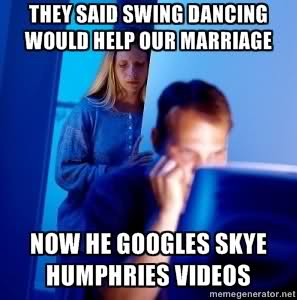
fankids gonna fansquee


(Curveball225 winning the yehoodi swing dance memes thread)

That about sums it up. Aren’t too many people who don’t google Skye videos. 90% of those discussions about competitions involve people trying to set aside their Love Of Skye so they can assess the dancing they’re watching. 99% of people have given up trying to set aside their Hero Worship Of Frida.
That was all running through my brain, and then I saw this cute post about heroes on Rantings of a Lindy Hopper.

Link round up: competition and lindy hop


Giselle Anguizola & Chance Bushman vs. Hyunjung Choi & Soochan Lee, ULHS 2011 prelims

I don’t have time/brain to make this a proper story right now, but there are some interesting bits and pieces about judging dance comps floating about at the moment:

Bug’s Question of the Day (on FB), Friday 11 Nov 2011 9:38am:

As a judge, if you knew a dancer had a long standing condition that prevented him/her from making nice lines, or having proper posture, would you consider that during a prelim or final? Some examples of long standing condition might be bow-leggedness, back problems, etc

(with only 9 comments)

The September edition of the Yehoodi talkshow (September 18, 2011) features an interesting discussion about the 2011 ILHC competition and the “top 5 lindy hop showcases of all time”. Here, one of the key points seems to be how judges (or audiences) assess competitors’ performances in reference to their previous work. In other words, how or should you judge competitors you know are brilliant dancers but aren’t bringing their A-game in this moment? There seems to be a tension between ‘dance skills’ (eg straight up technique, fitness, understanding and use of musical structures, lines, etc etc) and ‘performance skills’ (eg a clever, crowd-pleasing choreography, mugging (or not) for the audience, etc). A general idea raised here (and elsewhere) was that dancers who put in lots of time and work on a routine were more deserving of a win than dances who just threw it together at the last minute. My thought was a lot like Manu’s, but I’ll be blunter: quit your bitching and bring your shit. If you don’t have it, practicing for weeks will bring you closer, but you’ll still get pwnd. It’s a competition; it’s not designed to be fair and equitable.

There’s an interesting post over at Wandering and Pondering about ILHC 2011: Frida & Skye Déjà Vu (31 August 2011). This raises some of the key contentions taken up elsewhere: that Skye and Frida don’t actually prepare their routines. The implication in other places is that this somehow makes them less deserving of competition wins. I say: there are different ways of preparing for a competition. If you’re as fully sick as Frida and Skye, you’ve spent your whole lives preparing, and you’re never not preparing. Your competition is an extension of your social dancing. Your ‘routine’ is a series of moves and ideas you’ve been working on for a while, but strung together to suit a song you know very well. In this scenario, you don’t micromanage everything from costumes to facial expressions. You just get your mad skillz and bring your hot shit.
[And that’s why you PWN ALL]

This of course takes us to the heart of the matter: different dancers value different things in a competition dance.

This Wandering and Pondering post Back in the Day (10 October 2011) lists a whole heap of routines Jerry loves. This gives you an idea of his ‘dance values’ and the stuff he likes to see in a competition.

That post was responding to another Bug’s Question of the Day on FB people’s favorite competition videos from 2000-2004.

There’s a longish discussion about Camp Jitterbug 2010 over and Wandering and Pondering, mostly in the comments of the Camp Jitterbug 2010 Roundup post (1 July 2010) which was picked up at Follower Variations, and led to a talk about how to talk about dance critically (as in actively engaging with a dance rather than just dissing or lurving it). I have to note here that my comment about Frida and Skye linked here was misread. I was being quite sarcastic: I thought Frida and Skye’s 2009 ILHC routine was quite amazing. The thing I liked most about it was that they went with a slower song at a time when everyone else was going CRAZY FAST. I really liked that they took a slower song and showed that they can dance orsm at any tempo. You can’t hide your fuck ups in a slow song. I think this might have led to the mixed responses to this routine at the time – peeps were digging on the faster music with the higher energy and this 1943 Roy Eldridge song ‘Jump Through The Window’ felt slower. It’s also a 40s song when most peeps were still trailing along behind Naomi and Todd and the rest of the Silver Shadows who were bringing the hot, fast action in 2005.

I think this last little chunk of linky lays out the way musical and performance tastes and trends change over time. I think 2005 was a turning point for lindy hop competition in that we saw hot, fast, early (as in late 20s, very early 30s), often small group music replace slower, bigger, later recordings. The Silver Shadows pwnd all. And ULHS set the balls-to-the-wall agenda which has really dominated lindy hop since. Not to mention stripping the weight off every competing lindy hopper in the world. But Jerry does a much more thorough job of outlining these changes in his Back in the Day post than I can.
I want to say, though, that this is a story of American lindy hop competition culture, and the Australian story is very different. Mostly, we’re lagging a few years behind the US, and we still haven’t reached the highest international standards when it comes to dance quality in competitions. Australian competition dance as a whole isn’t really representative of the Australian lindy hop dance trends and quality any way – there are plenty of very good Australian dancers who don’t compete at all. But enough! More links!

Finally, Bobby has written three posts on judging dance competitions. He is the king of clear, simple language, so he’s worth reading just for that refreshing break from too-long sentences and cluttered adjectives. :D The first post On Judging (Introduction): A Few Questions was written on the 28th September 2010, the second On Judging, Part 1: The Basic Competition Blueprint was written on the 18th January 2011, and the third On Judging, Part 2: Watching and Note-Taking Technique was written on the 10th November 2011. Again, it’s interesting to see how people develop these ideas over longer periods of time.
This post is sweet for its discussion of the nitty gritty of judging, stuff I know nothing about, because I don’t compete (though I’m happy to speculate). I think the thing we can all take away from those posts is: Sylvia Sykes, queen of ALL.

That’s about all I’ve got to say about competitions and ‘dance values’ in competitions right now, so I’m going to end with some unrelated dancespam. Sylvia Sykes, pwning all:

Dancing with Maxie Dorf, old timer balboa king, in 1993.

Sylvia making Nick’s tricks possible in 2007 (note Frida’s inability to clap whilst watching. International symbol of pattern-matching dancer watching mad balboa patterns).

I was going to finish off with a brilliant clip of Sylvia and Manu competing in a jack and jill together because it clearly demonstrates dancers’ respect for Sylvia and Manu’s general awesomesauce, but the user had taken it down. Boo!

[EDIT: Doh. I forgot add some links about ILHC 2011 from Jo’s blog. I like her posts because they give you an insight into her thinking about her own competition dancing (well, that’s the first reading; it could all be a clever PR plan :D ): Highlights from ILHC, ILHC 2011 – solo charleston, ILHC 2011 – strictly lindy, advanced and open and ILHC 2011 – classic division. Do also look for her posts on the inaugural European Swing Dance Championships.]

Dance competitions and policing public space

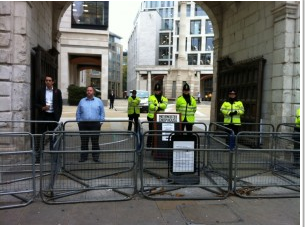
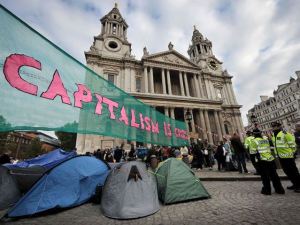
(tent image from here, police image from here)

I’m really interested in the discussion of official versus community policing of public space in Chris Brown’s article ‘The Occupy Movement and the Battle for Public Space’. One point I took from this was Brown’s juxtaposition of the formal, highly ordered occupation of public space by the police and ‘official’ entities with the informal, collaborative and negotiated management of public space by community groups. I think that both types of management of public space happen in all sorts of communities, and that they’re really just two points on a broad spectrum of behaviours. I want to spend the rest of this post taking this idea and applying it to dance competitions. Competitions which can be at once ‘officially’ managed public spaces and also collaborative or informally managed public spaces. At the same time!

I’ve always been interested in the way dancers regulate the social dance floor (which I’ve always thought of as ‘public space’ or public discourse). One of my favourite topics is derision dance. Or using dance to deride someone (using the dictionary definition “contemptuous ridicule or mockery”). This can be as simple as directing a crude gesture to your opponent, but it is often more complex, involving layers of imitation, impersonation and subtler mockery. This last type is what really fascinates me. I wrote about derision dance and layers of meaning in what again?! I’m still crapping on about dance, power, etc; I used derision as a tool for understanding blackface in blackfaces and performing identity. again. (again using the idea of layers); and I talked about cake walk as an example of derision in hot and cool.

I keep coming back to the idea of dance as a forum or tool for deriding or subverting authority or an opponent because it’s a contribution to public discourse which doesn’t use words. I get a bit frustrated with work on public discourse which prioritises the written word, as there are all sorts of dodgyarse power dynamics happening there. Not all of us have literacy and linguistic competency on our side; class and race and ethnicity are pretty important factors here.

Of course, I’m not alone in talking about bodies in public space. That’s why I like that Chris Brown article. It describes the way non-verbal occupation of public space is regulated by official and community powers. When I think about dancers regulating the public space of the dance floor, I think about official ‘laws’ or guidelines like a sign forbidding aerials in a particular room for safety or heritage-building reasons. Or a more experienced or authoritative dancer telling an idiot lead to stop tossing follows into the air. But I’m also quite interested in the unspoken, unofficial and less overt management of public space in dance communities. It’s a little too far along the spectrum to ‘official’ to really illustrate my thoughts, but I want to begin with (and probably end with – as I’m off to the beach in a tick) dance competitions.

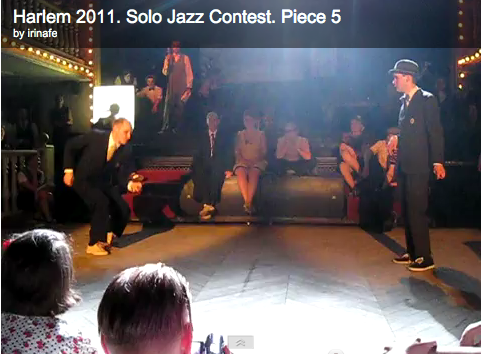
I’ve just been watching this clip from the studio we use of ‘The Crossover Popping Battle – Finals’:

There are all sorts of cool things to say about the way the studio uses Youtube and faceplant, where I found the clip, and which is so central to the studio’s promotional and community development work. But I’m not going to do that here. I want to start with the dancing itself.

… suddenly, I’m realising that this might be beyond me right this second. I want to do a close textual analysis of what is happening on the dance floor. There’s lots to be said about the mise en scene of the film itself as well. I think this type of close analysis of the dance-as-public-text requires a certain about of specialised knowledge. If you can’t read bodies as a dancer, you can’t really understand the power plays. More specifically, if you can’t read popping, you can’t really understand who’s the more proficient dancer, the intertextual and historic references in each movement, the etiquette for this sort of battle type competition. To add a few extra layers of meaning, this is a battle hosted by one particular dance studio, so you’ll see institution-specific action and ideology at work here. Not to mention the fact that these kids are from all across Asia, speaking a number of different languages as well as English. I’m a white Anglo-celtic girl living in Sydney and I only speak English. I’m going to miss most of the more nuanced physical gestures and postural moments. So my analysis is really only a beginning place, and I couldn’t possibly see all the detail at work here, least of all because I’m not into popping.

This is a pretty important point. I can’t see all the regulation and management of this public place – this moment of discourse – at work here. So I’d be bound to make mistakes. But because I am a babby, I’d probably be excused quite a few mistakes. So long as my participation improved. These guys are really friendly and welcoming, and I know I’d be cut a fair bit of slack. But eventually, even the most tolerant teachers and peers lose patience with social ineptitude and rudeness in a public forum.
Interestingly, the dancers at this studio encourage new dancers to enter battles almost from the very beginning. I’ve sat in on a casual battle, and a lot of leeway is granted for new dancers. In contrast, there’s a real sense in Australian lindy hop that only the ‘best’ dancers enter competitions, unless the competitions are for ‘up and comers’ or ‘amateurs’. Of course, definitions of ‘best’ vary between cities, and don’t match up comparatively. And, really, the most successful dancers have a very strong sense of self worth and faith in their own abilities. They really believe they are – if not the best dancers – in with a shot at becoming the best. That’s just how competition works. If you don’t really believe you have a chance, you won’t work hard in preparation, you won’t devote time and effort to the project, and you won’t bring your A-game in the final moment.
So this means that we don’t see lindy hoppers developing performance and competition skills in a relaxed, welcoming and informal setting as very new dancers. I’ve noticed the dancers at Crossover develop a real sense of self-awareness and understanding of lines and visual presentation far earlier than most lindy hoppers. They work with mirrors right from the get-go. They spend a lot more time looking up and making eye contact (particularly in battles). In brief, ‘their movements go right to the end of their finger tips’, whereas a lot of lindy hoppers don’t even really know they have hands.

So, when you go to a battle with these guys, there’s rarely an explanation of the ‘rules’, beyond the very basics. This confused me when I first saw them in action. How was judging decided? How long did dancers have to perform? How did they decide who danced in what order? You’ll find rules for competitions on websites before the event, but mostly you just have to figure them out. And of course you won’t be in the competition if you haven’t at least acquired even that much cultural knowledge.
The same sort of thing happens with lindy hop competitions. Though most of the more popular recent comps have far more implied than stated rules. In fact, there was a conscious movement away from prescriptive rules in the US at some point in the early 2000s (I can’t really remember the details, sorry). Most Australian competitions followed this American trend largely as following a trend (rather than as a critical engagement with existing competition culture) a few years later. The exception is Hellzapoppin’, which was deliberately developed as a lindy hopper-run and regulated competition advertised as having ‘no rules’. Though of course it does have rules, and these are listed quite clearly.

These rules are just a little different to other more prescriptive events like the ASDC and rock n roll or ballroom competitions. The inaugural Western Sydney Swing Dance Competition had quite strict, ballroom/rock r roll type rules, but I found it really difficult to discover much about the competition beyond this flyer. I ended up messaging the organisers on faceplant to find out more, then had a fairly long list of rules emailed to me as a pdf (which you can have a look at here). I found these rules really difficult to understand, in part because I’ve done very little competition, but also because I’m not a part of the rock n roll or ballroom dance scenes, which are far more tightly structured and formally organised than the lindy hop scene. I simply don’t have the language tools or cultural knowledge to navigate this sort of text.
The Crossover competition, though, is far more familiar. Rules for larger battles are often discussed in an informal way on faceplant, but more usually discussed in person. But learning the rules of competitions is more a matter of enculturation. The competitive space is as highly regulated as the WSDC, it’s just that the regulation is managed in a different way.

I’ve spent quite a bit of time in the past analysing lindy hop competition footage in close detail (‘lindy hop followers bring themSELVES to the dance; lindy hop leaders value this’ is probably the best example of how I approach this). It’s a very common practice for most lindy hoppers, and learning how to read dance (whether in footage or in person) is an ongoing process. Dancers are also on the lookout for different things. Leaders and followers often read a dance clip in quite different ways. I look for gender stuff. Someone else might be looking at shoe types. A DJ might be listening for new songs.

I’m going to get completely off-track here with a reference to a very famous dance clip.
This is a still from the Big Apple scene from Keep Punchin, featuring the Whitey’s Lindy Hoppers:

I’ve heard (second-hand, unfortunately), that Frankie Manning described this scene as a dance competition. In fact, the MC in the film introduces it as “The Big Apple contest”. Frankie explained that not only were couples competing against each other, but that individual partners were competing against each other. I’m not sure whether I’ve gotten that story right – it does come to be second-hand. But it’s an interesting idea. Competitors are working in pairs, focussing their performance on each other, as well as on those around them.
This is a bit like the Crossover battles (as far as I can tell – I’m not 100% sure about this next bit). In these battles competitors may enter as teams of two, but they dance alone, focussing their attentions on a particular member of the opposing team. There’s lots to say about focussed competition, and about how dancers in these battles turn their aggressive (yet never violent) competition on when they begin dancing, and then off when they move off the floor. I’m particularly fascinated by the way the non-dancing team member stands in a decidedly ‘I’m not dancing’ pose; they turn off their competitive dance energy, often by not making eye contact with their opponents. That’s some pretty basic non-threatening body language right there.

Right, back on-track, now…

It was quite interesting to see the new competition format for the Harlem 2011. Solo Jazz Contest held in Lithuania. It looks a lot more like the Crossover popping battle than other solo jazz comps in the lindy hop scene. How?
Firstly, here are some screenshots from those clips to illustrate my points:


(Harlem 2011, one of the rounds)


(Crossover popping battle, final)

  • The three people sitting in the middle at the back are the three judges. We see this in the Crossover battle. They don’t write things down or discuss the competitors in detail, they just point to the dancer they think should win (or cross their arms to indicate indecision). In every other lindy hop competition the judges walk around the floor with clipboards, staring intently at competitors and writing things down before going out to another room to discuss the competition and arrive at a collaborative (or comparative) decision. Sometimes there’s an audience appreciation component. ULHS has a very strong audience appreciation component.
  • Competitors can dance as long as they like to the song before ceding the floor to their competitor. This is very unlike most other competitions in the lindy hop scene. The ASDC gives each couple one minute from the beginning of a recorded song to do their thing, followed (or preceded) by an ‘all-skate’ where they share the floor with other dancers. The more organic ‘jam format’ gives dancers a phrase (or two) of music each, and each couple or dancer must enter and leave the floor at the beginning/end of that phrase. Failing to do so is read as a failure in basic musicality. The Crossover format assumes that a dancer will dance for as long as they need to bring their best shit. Failing to cede the floor is perceived as a failure to judge their audience, the tone of the competition, and a display of egotism. This is where my understanding of the format ends – I don’t know how dancers know when they should bow out, or when everyone knows too much is too much. This format was also used by the Harlem 2011 competition, and it’s interesting to watch all the clips and see how competitors, audiences, judges and MC negotiate an understanding of these rules. Collaborative meaning making or what?!
  • Audiences cheer and yell out and otherwise engage with competitors, indicating their approval, admiration, disappointment, awe and so on. This participation is often very important for a dancer making a joke, referencing an historic or iconic move or dancer, or engaging in a little derision, mockery or impersonation. Dancers are focussed on their opponents, but they rely on the audience audibly signaling their engagement with the performance. This all means that the best audiences for these sorts of competitions are also dancers.

There’s so much more to say about this. I’d like to go through and carefully analyse what’s going on in the Crossover clip, and to compare it with various lindy hop and solo clips. There are interesting things to say about the placement of DJs in the competitive space. Or how competitors in a pro or invited jack and jill comp sit in a line at the back of the competition space (they are often actually formally judging each other). This demands comparison with the way lindy hop couples line up in order along the back of the competition space waiting to enter the jam, and are far more actively engaged with the dancers currently on display. And of course, I want to talk about the way the competition space is delineated by these lines of competitors, by the audience, by lighting, by the dance floor itself.
All of these things relate to how the physical competition space is regulated and negotiated by the community, and also by official forces. The ultimate authority is the individual or organisation running the competition. Yet one of the greatest delights in watching street dance (or vernacular dance) competitions is waiting for the moments where rules and authority are deliberately contravened, or at least stretched. When judges request a rematch. When competitors physically touch each other (forbidden!) When competitors touch the audience (doubly forbidden!)

I’d also like to talk about how conversation is managed, both formally and informally. There’s lots of lovely stuff written about all-male and all-female conversation and how formal turn taking dominates all-male talk and interrupting and collaborative meaning making (eg women saying ‘oh no!’ and nodding or saying ‘yes’ regularly interrupt but do not disrupt the speaker) characterises informal all-women talk. I think of dance as discourse, and occasionally use this idea of dance as conversation to explore dance as discourse. It’s not a unique idea – dance teachers use this idea all the time. But while I might have begun thinking of dance partnership in particular as conversation with formal turn taking, I’m now a lot more interested in a model of high level partner dancing as more like collaborative, overlapping conversation. And of course, I extend this idea to include jazz music, with its sections of structured unison, its layers of individual, interrupting parts, and its moments of solo improvisation. I probably like New Orleans stuff because it favours layers of improvisation instead of carefully choreographed unison and demarcated solos.

But enough! I must swim!