Cook: crap

So, after Kate asked for an actual source for James Cook raping people, I’ve been doing some ‘light’ research trying to find the original twitter thread where I read about this.
This thread was between a few first nations women (Australia, Hawai’i, NZ, etc), and they dropped some sweet links.

Anyway, I can’t find the original twitter thread (😭) but I have read a lot of interesting things.

Key was that Cook and his crews knowingly carried disease (TB, syphilis, gonorrhea, and lots of other lovely things) to the people of the pacific region (NZ, Hawai’i, Australia, Tahiti, etc). They knew they were sick, but they still had sex with local people. They also stole stuff, beat people, raped people, and were generally shitty guests. Eventually the people of Hawai’i had jack of Cook and his bullshit, and killed his arse.
There are lots of primary sources (journals, stories, drawings, paintings, etc) about this. It wasn’t a secret.

– Cook was a bad person. He did three major voyages, getting progressively more violent and aggressive, and eventually getting killed on the final voyage (12 Feb 1779, Hawai’i).

– His violence was expressed through increasingly violent (and quite horrific) ‘punishments’ for indigenous people who broke his ‘rules’, and for his own crew.

– His crews were allowed to interact with various villages as they travelled, including sexual relationships.

– Cook declared Australia ‘terra nullis’. He knew that people were living here, but because he didn’t count anyone who wasn’t European as a human, he decided that no ‘people’ lived in Australia.

– The people of Hawai’i (and other places) got increasingly shitty with Cook and his crew. They’d pass through their harbours to restock water and food, and to do some R&R. At first the Hawai’ian people were ‘yeah, ok’ and because women were considered sexually and socially autonomous people, they would have a root with the visitors. For fun. And also for economic gain. Sex work (giving sex in return for things like european goods) was culturally ok at the time. But after a while Cook and his mates became less fun. And they were riddled with disease.

– Lilikalā KameÊ»eleihiwa (a scholar from Hawai’i) explains that Cook and his men brought TB and STIs like syphilis to the people of Hawai’i. Who were NOT impressed by these dirty europeans. Cook also had sex with local women.

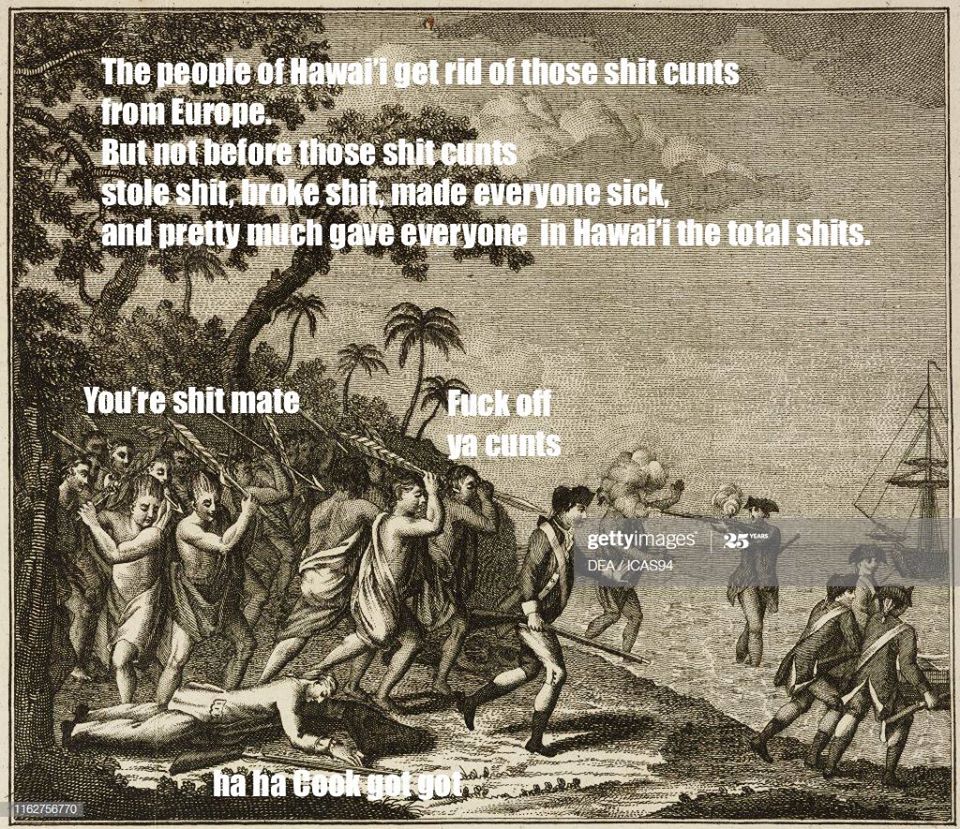
– Eventually Cook got got by the Hawai’ian people for trying to kidnap the aliÊ»i nui (king/god/leader) KalaniÊ»ĆpuÊ»u. He and his marines laid hands on KalaniÊ»ĆpuÊ»u, and tried to drag him away, in punishment for the theft of a jolly boat.
The especially bad bit of this was that Cook disrespected the aliÊ»i nui body and spiritual/god status of KalaniÊ»ĆpuÊ»u by laying hands on him.

In sum, Cook did not consider people of colour ‘human’, and if you don’t consider someone human, you don’t believe they have bodily autonomy, and therefore cannot give consent to sex. By this logic, if they can’t give or not give consent, they can’t be raped.
This sort of logic isn’t new, and I’m not the first person to draw these connections; there’s other (better) research about this stuff. But we can see these sorts of patterns of behaviour today in sexual offenders: men who regard women, girls, and children as less human and less important than their own desires, and do not respect their bodily autonomy*.

But I haven’t yet found specific primary sources detailing Cook’s sexual assaults. Mostly because I couldn’t read any more about him without feeling sick.

Here are some sources:

– Catherine ‘Imaikalani Ulep, ‘Women’s Exchanges: The Sex Trade and Cloth In Early Nineteenth-Century Hawai‘i’
(https://scholarspace.manoa.hawaii.edu/bitstream/10125/62478/2017-05-ma-ulep.pdf?fbclid=IwAR3YmGPe8ZC7YZ7Rm6h6oFw5BLO4WgmhHnVWjfD_wiRck7-3x02FaNo2pZE)

– Kerri A. Inglis, ‘Kƍkua, Mana, and Mālama ‘Āina: Exploring concepts of health, disease, and medicine in 19th Century Hawai’i’
(http://ulukau.org/elib/cgi-bin/library?e=d-0hulili05-000Sec–11en-50-20-header-book–1-010escapewin&a=d&d=D0.18&toc=0)

– Accounts of disease in Cook’s crew, and on the population of Hawai’i before and after his visits are plentiful. You can find zillions with a google search, from his crew’s journals to oral histories from Hawai’i people and so on. It’s not a contested idea; it’s a fact.

*’bodily autonomy’ is the right to make choices about your own body, what it does, how it looks, how it works, and who gets to touch it. It’s a useful phrase and concept for talking about sex, reproduction, imprisonment, and health. It’s also a powerful phrase for talking about children and their rights.

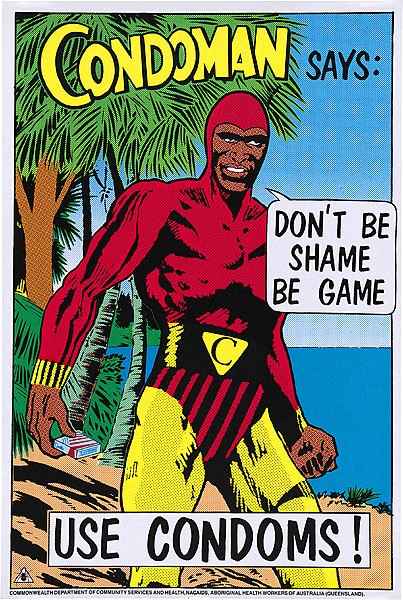
Condoman

I was living in Brisbane, and about 15 when I first saw Condoman. This was mid-AIDS crisis, and the Brisbane AIDS team was based in the Valley, where my mum worked, and where we went out to see bands and get hassled by junkies.

Condoman was invented by Aunty Gracelyn Smallwood and a bunch of other good peeps from Townsville, who wanted a figure who would empower black kids and get them to use condoms. This poster was designed by and printed by Michael Callaghan and Redback Graphix in 1987.

Redback Graphix (1979-1994) was an independent printing cooperative based in Wollongong, and focussing on politically minded, community-centred posters. Their posters are most excellent.

I for one would welcome an anti-Rona poster that was a bit more empowering, and a bit more block colour than the pissweak govt publications we’re seeing.

But Redback were funded by state and federal arts grants, and the coalition governments (both state and federal) today have decided the arts can go and get fucked. So there’s no covid bailout for them (us) and funding for the arts generally has been gutted.

I’m nuts for posters, playbills, and printed ephemera. Particularly hand-printed, or short-run printed material. There’s a great book about Redback Graphix, which I strongly recommend.

What’s with that Captain Cook cunt?

So, today is the 250th anniversary of Cook’s claiming he’d discovered Australia. He and his crew were driving the Endeavour round the world stealing stuff and killing and raping people for the British empire. They bumped into Australia, home to the oldest living culture in the world (40 000 years), 700 distinct languages, extensive complex land management traditions… basically it was bigger, fancier, and culturally rich.

Former PM Tony Abbott and his mates had planned an epic big series of expensive public thingies to commemorate Cook ‘circumnavigating’ the continent. The best bit of COVID19 is that it fucked up those plans. The best bit of history is that Abbott will be remembered for that particular nugget.

Why do we think Captain Cook was shit?
– He killed and raped a bunch of people;
– He claimed Australia was ‘terra nullis’ – there were no people living here or using the country;
– He defined ‘people’ as white people, and ‘using’ as european style intensive agriculture;
– He kicked off 250 years of invasion and attempted genocide.

He was fucken wrong.

What happened to Cook?
– He killed and raped some people in Hawai’i, tried to kidnap their leader, KalaniÊ»ĆpuÊ»u, and got FUCKEN KILLED.

James Cook was a bad person, and he got pwnd.

THE END.

Buy this shirt and be useful.

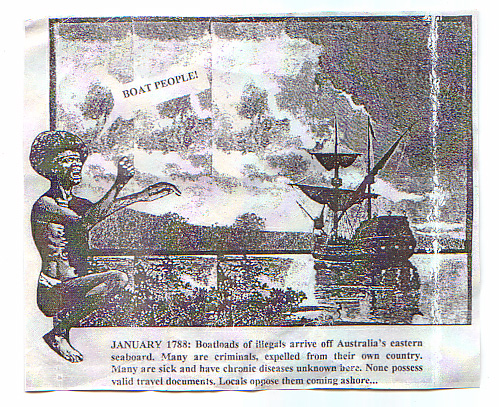
The above image was a bit of paper circulated at UQ when I was there in the early 90s. It was a photocopied thingy pinned up on someone’s door, so I took a photocopy of it.
I have no idea who made it, or where it came from

how do you get women leads?

Sydney now has a very strong culture of ‘anyone can lead or follow if they like, and it’s ok if you just want to do one and it happens to align with your gender ID’.

There are a number of reasons for this – a queer swing dance school who also run a big event; women leads on the floor; women teachers who teach as leads; people being publicly intolerant of anti-social behaviour; a growing ‘be good to each other’ discourse in event promotion, etc.
And where I write ‘women’, please include transwomen. I’ve noticed it’s easier for normcore folk to include transmen in their ideas of ‘men’, than it is to include transwomen in their category ‘women’.
It’s also been super important to see how welcoming and supportive our scene has been of people who’ve transitioned while being in the scene. ie they first presented as one gender, then transitioned to another. On the whole, teachers and dancers have been openly supportive, and more importantly, no-big-deal about changing pronouns, etc. It may have been harder for them one-on-one (all new things are tricky), but on the whole, it’s been ok. Not perfect, but ok. More work to do there.

Note: if a scene is ok with women leads and men follows, it is more welcoming to transpeople and queerpeople. Because a scene that has flexible ideas about gender and dance is a more welcoming, safer place.
If my leading has ever helped pave the way for a shy dyke lead or transwoman follow, then I feel very proud. It was worth it.

etc etc

One of the most interesting things I’ve noticed, is that this general trend has been working in concert with peer-motivated anti-sexual-harassment actions. ie women are more likely to say no when a creeper asks them to dance, and they will also step in and check in on other women if they see creepers maccing on them.
There’s also been a scene-wide ‘fuck that; we do not tolerate harassment or assault’ public discussion from teachers (even if the organisational policies haven’t been in place).

And _this_ trend has seen us get a more ethnically diverse cohort of dancers. In part because one of the main creepers was targeting asian women. Boy, did he get his arse handed to him. And because women of colour just get fucked off by carrying the double burden of racism and sexism.

I noticed that once he and his gross mates were absent from events, we saw an increase in men following. It seems that this racist creeper was also intimidating other men _implicitly_. And that the men who liked to follow also liked women who lead (or the women who’d had a gutful of that creeper).

So when we addressed all these issues – sexuality, ethnicity, gender, etc – at the same time, we saw a general improvement in the vibe of parties and classes. People felt more comfortable being themselves.

And then it snowballed, and we saw exponential improvements.

So if your goal is ‘more women leads’, you need to address a range of issues. You’ll get a bunch of lovely good results as a consequence.

But speaking as a woman lead, things that were important for me:
– Teachers who openly said ‘women are leads as well as men’. The importance of this cannot be overstated. I remember the handful of times I’ve heard teachers say it in the last 20 years. But don’t be afraid to be pro-active on this. Not just saying ‘anyone can lead’, but “Women can lead.”

– Teachers saying to me “Don’t ever stop leading.” A woman teacher said this to me quietly one night after class, and it was the most important thing anyone has ever said to me about dancing.

– Seeing women teachers lead socially.

– Seeing other women ask women teachers to lead them socially.

– Having women teachers ask me to dance (and lead)

Things I wish people had done:

– Stepping on students in class who say ‘you’re being the man/boy?!’ with surprise.
I’ve never heard a teacher say this, but it would be solid gold if they said “hey, follows, don’t say this to your partners. It makes them sad.”
I’ve only ever been at two weekend events where no one has said this to me. In 22 years of lindy hop classes and workshops. Each time someone expresses surprise and expects me to justify leading, it wears me down just a little bit. So a) fuck you women follows, and b) teachers, get your students’ backs.

– Never used gendered pronouns in class, or used gendered language and concepts to describe leading.

Things that shat me to tears:
– Male teachers who try to make me try a move as a follow in class, when I’m leading. Sure, it might help my learning, but would you ask a male lead to do this, even if you knew they followed? And also, whatever your norm is, do this thing: treat women leads like they are leaders, not follows who sometimes lead.

– Teachers who kept ‘forgetting’ to use gender neutral language.

– Teachers who use sexy jokes in class, because most of those jokes were heterocentric and/or relied on the idea of a lead being a straight man.

Black lindy hop matters


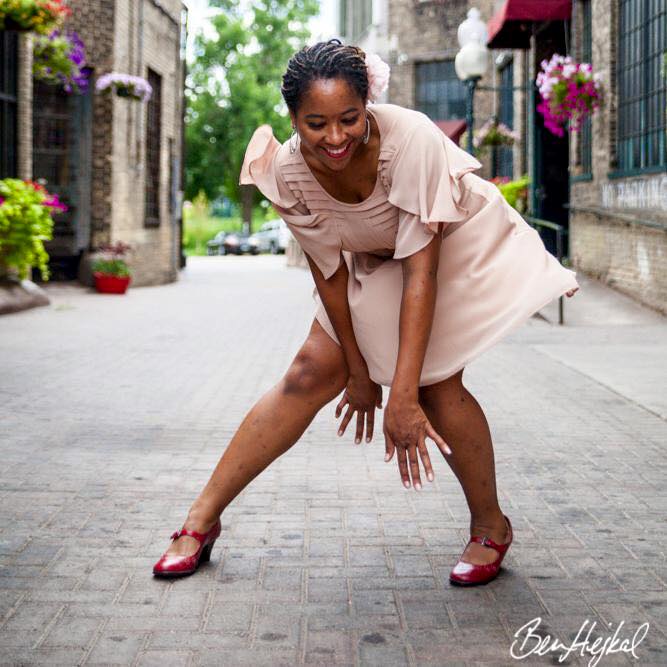
(Dee Daniels Locke, teacher at HJDF, pic from the event’s fb PR, photo by Ben Hejkel).

While bunches of white people were organising dance events to celebrate the white revival of lindy hop day with a bunch of white teachers this year, Tena Marales-Armstrong was bringing the shit in Houston.

The Houston Jazz Dance Festival is run by Tena, a black woman living in America, it features poc in all the promo material, and it stars a team of black teachers (and Mike Pedroza, so I guess we’re talking poc :D ), TWO BLACK WOMEN MCS, a black DJ, and a black band. It’s a part of Tena’s bigger event, the International Swing Dance Championships, a project which celebrates the living dances of black communities in America today.

This is vernacular dance.

Let’s stop and talk about Tena Morales-Armstrong. She’s not only a great dancer and all round impressive woman, she’s also the co-manager of some of the biggest events in the lindy hopping world. ILHC. Swing and Soul. Lindyfest. International Swing Dance Championships. The modern dance world likes to talk a lot about competition winning dancers, young and flexible performers, popular teachers. But the people who help build these careers are the business people and organisers behind the huge events that employ them. Tena is one of these people, and she is important.

Let me spell it out.

A black woman runs some of the biggest name lindy hop events in the world, and she is running an event with an all-black list of artists, as part of a dance event which proves, definitively, that lindy hop didn’t die and need reviving. It just grew up into hand dancing, fast dancing, Houston Two-Step, Chicago Stepping, Detroit Ballroom… living, healthy black dances in black communities.

And I want to go back to that teaching team.
Latasha Barnes, Mike Pedroza, Josh McLean, Dee Daniels locke, Michelle Stokes, Laurel Ryan, Alexis Davile, Cyle Dixon, Nel Lopez. Two of those (Alexis and Cyle) were junior lindy hoppers at ILHDC a few years ago. Michelle and Laurel were the MCs (I saw them MC at Focus. They are the BEST). These are some big names, here. Just try getting Latasha for your event any time in the next twelve months. The woman is seriously popular at the moment. So this isn’t just a random grouping of dancers. This is some top shelf talent.

If you are interested in the ‘decolonising lindy hop’ project that’s gaining ground in the US, you should probably have attended this event. Yes, it’s all very nice and well to attend a panel session at Lindy Focus, or to drop some cash on the Frankie Manning Foundation. But actually putting money down on an event like this – black owned, black run, black attended, black community – is important. I so wish I could have gone. It kills me that I couldn’t. So, NEXT YEAR. I will put my money where my mouth is.

on bodily autonomy and abortion

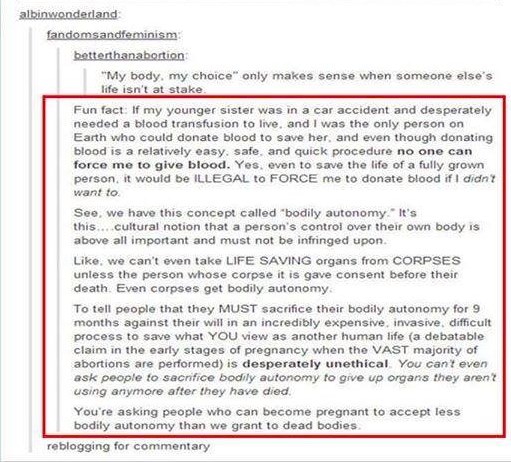
I’ve seen this image being circulated a bit on facebook this week.

[Text reads:]
“My body, my choice” only makes sense when someone else’s life isn’t at stake.”
reply:
Fun fact: If my younger sister was in a car accident and desperately needed a blood transfusion to live, and I was the only person on Earth who could donate blood to save her, and even though donating blood is a relatively easy, safe, and quick procedure, no one can force me to give blood. Yes, even to save the life of a fully grown person, it would be ILLEGAL to FORCE me to donate blood if I didn’t want to.
See, we have this concept called ‘bodily autonomy’. It’s this…cultural notion that a person’s control over their own body is above all important and must not be infringed upon.
Like, we can’t even take LIFE SAVING organs from CORPSES unless the person whose corpse it is gave consent before their death. Even corpses get bodily autonomy.
To tell people that they MUST sacrifice their bodily autonomy for months against their will in an incredibly expensive, invasive, difficult process to save what YOU view as another human life (a debatable claim in the early stages of pregnancy when the VAST majority of abortions are performed) is desperately unethical. You can’t even ask people to sacrifice bodily autonomy to give up organs they aren’t using anymore after they have died.
You’re asking people who can become pregnant to accept less autonomy than we grant to dead bodies.

[/]

I have a few problems with this chunk of text.
The first is that it’s based on a false premise: that ‘we’ all have the same bodily rights, and that these rights are applied to us equally. I’m going to assume that the author was writing in, and about the US. And I want to state, very clearly, that even beyond the world of childbirth and reproductive medicine, we do not all have the same bodily autonomy. Women of colour, people of colour, first nations people, women, children, gay men living with AIDS… basically everyone other than straight, white, wealthy men have their right to bodily autonomy curtailed by the law, by the state, by medical institutions.
The history of the US is based upon slavery, the clear legal fact that some people can be owned by other people. First nations people were not (are not?) considered people at all by invading colonisers. People of colour are more likely to be incarcerated. Women’s accounts of their own physical pain or illness are less likely to be taken seriously by doctors than men’s accounts. Children are legally not capable of bodily autonomy.
..and so on.

We cannot talk about abortion without also talking about social context. Women and girls are not considered capable human adults or citizens in the way that white men are. We are not considered capable of making sensible, logical decisions. About anything. Let alone our bodies.

I feel that a debate about abortion is a misdirect.
Access to free, safe contraception and good sex education are the demonstrably better way to reduce abortion rates. And incidentally increase women and girls’ autonomy and social power.
By focussing on abortion, rather than sexual health, the discussion is framed as one of individualism, rather than collective responsibility. If we focus on women’s choices, we can avoid a discussion about the state’s role in health care. If we suggest that women’s bodies and their choices are the problem, the we don’t have to talk about the importance of the welfare state in caring for children. Because there, of course, we are reminded that women were once girls, and girls’ education and bodily autonomy is the real issue here.

The abortion debate is about legislating women’s bodies, but more importantly, it’s also about restricting women and girls’ knowledge of their own bodies. I want to expand from this to tie contraceptive rights to access to education generally in a more direct way.
We know that access to education – going to school – generally reduces birth rates (ie girls are less likely to have babies, and fewer babies). For a range of reasons including (but expanding far beyond) knowledge and tools for preventing pregnancy.

The thing I’m often struck by in this sort of debate is the implication that the only reason women and girls have lots of babies is that they don’t know how to stop themselves getting pregnant. Or that they don’t know penetrative vaginal sex with a man leads to pregnancy.

But we know that choosing when and how to have a baby is about more than knowing how to stop sperms get into eggs. It’s also about having a range of choices and options for employment, education, community participation, etc etc etc.
Good education isn’t just about ‘not getting pregnant’ it’s about being able to choose when and how we do have children.

An educated girl is a mighty person. She knows how to access all sorts of resources. She’s not confined to a domestic space and domestic isolation. She’s a _citizen_. This is far more frightening for fundamentalist christians and other patriarchal institutions.
As an addendum, I’ll also note that good sex ed isn’t just about how not to get pregnant or STDs. As that story about the young Swedish men who intervened in a rape in America shows, good sex ed also teaches men and boys about how to communicate with and empathise with their partners’ needs and desires. I think that this is the other thing that terrifies the patriarchy: that men and boys might begin to think of us as humans.

What next after Codes of Conduct?

A few years ago, in 2015, I did a survey of Australian dance events, to see if they included a code of conduct on their event websites. There were mixed results, including a fairly unpleasant email from the organiser of an event which did not have a CoC at the time, and has since folded.

I (or someone else!) should at some point revisit this survey, to see if things have changed much in Australia. Do we see CoC at all Australian events? If not, which events don’t have them, and why not?

But that’s not the topic of this post.

Now I’m wondering if events (including local party nights) have follow-up processes to accompany their CoC. It’s all very well to have a list of things attendees cannot do at the event, but I have some questions.

  • Does the CoC provide specific examples of what constitutes sexual harassment or assault in a dance setting?
  • What are the consequences for people who break the rules?
  • Who enforces the rules?
  • Is there a spectrum of responses from warning, through banning, to calling the police or evacuating a building?
  • If these responses exist, are they listed in the CoC?
  • What is the in-house process for these responses?
  • Who has the authority to call for a consequence and then enforce them?
  • How are these actions documented?
  • How are these documents stored?
  • Who has access to them?
  • Is there any follow-up on these actions?
  • Is there any scope for the repatriation of banned offenders?
  • What are the terms for their return to the event?
  • Who monitors this process?
  • How is information about who is banned passed between generations of staff at an event?
  • How does this communication of knowledge account for Australian defamation laws, which would deem this publication of a potentially defamatory statement?
  • If a banned person does decide to sue for defamation, who would they sue – the organisation/business? An individual working at the event? If the latter, how does the host organisation respond to and support this person?
  • How does the host organisation ensure that staff are not exploiting their power to break the CoC rules? What measures are in place to police the policers?

I feel at this point the majority of events have gone no further than simply cutting and pasting a CoC. These later questions all ask for a fair bit of work. And I know there are some organisers which do not prioritise safety to the extent that they would invest in this sort of labour.

Who is responsible for fighting racism in dance?

White people, particularly white people of influence (like dance teachers) need to get their learn on. Rather than placing the burden of policing racism on the backs of people of colour, white people need to listen to people of colour, and start policing their own behaviours.
Just as men need to be responsible for policing their own sexist behaviour, rather than waiting for women to do all the labour of speaking up.

We can be certain that the preponderance of white faces in lindy hop today is a result of the white mainstream’s appropriation of black culture. Being able to steal-and-sell a cultural practice is a mark of power and privilege. The repackaging and ‘toning down’ of the black racial markers of lindy hop (and other dances) is part of this process of appropriation. Insisting on using counts, focussing on biomechanics rather than music, enforcing white middle class gender roles, and so on are all markers of white appropriation of black dances. These dances are made palatable (and marketable) for white middle class audiences through this ‘whitening’ of black dance.

If we _don’t_ address this matter in our classes, and in our own thinking, we are perpetuating it. We are doing racist stuff. We are shoring up racism.

Breai Mason-Campbell has asked people “What are you doing to decolonise lindy hop?” Because that’s how we address racism in this dance. We, white people, do something about it.

A lot of white people will be uncomfortable.

Nathan Sentance’s piece Diversity means Disruption (November 28, 2018) is important. It addresses the experiences of people of colour (specifically first nations people) within arts and information institutions – libraries, museums, galleries. My own background is in universities and libraries, with my information management postgrad work focussing on the management of first nations’ collections and access to collections.

In this piece Sentance makes it clear that diversity in itself is not useful. Just having people of colour on the team does not provoke institutional change. Representation is not enough; we need structural, institutional change to disrupt the flow of power and privilege.

In this post I’ve taken some lines from Sentance’s article (in green italics), and I’ve responded to them with specific reference to the lindy hop and swing dance world.

Why a diverse teaching line up will change the culture of lindy hop. And a lot of white people will find that uncomfortable.

Or

Having black women teach at your event is radical.

Why hire First Nations people into your mostly white structure and expect/want/demand everything to remain basically the same?

Why hire people of colour to teach at your dance event within your mostly white structure and expect/want/demand everything to remain basically the same?

Why don’t libraries, archives and museums challenge whiteness more?

Why don’t dance events and dance classes challenge white, middle class modes of learning and learning spaces more?

As result of the invisibility of whiteness, diversity initiatives are often about including diverse bodies into the mainstream without critically examining what that mainstream is

As a result of the invisibility of whiteness within lindy hop, diversity initiatives are often about just hiring black teachers at big events, without critically examining the way the classes and performances at these events construct a white ‘norm’ that reinforces the mainstream.

Kyra describes this “When we talk about diversity and inclusion, we necessarily position marginalized groups as naturally needing to assimilate into dominant ones, rather than to undermine said structures of domination”

White lindy hoppers ask ‘why aren’t there any black dancers in my local lindy hop scene?

I have seen a high turnover of staff from marginalized communities, especially First Nations people, as well as general feelings of disenfranchisement.

Black dancers get tired of being the only person of colour, asked to ‘give [themselves, their time, their energy] a talk about black dance and black culture’ to white audiences, to give, to work, to be visible, to represent blackness. Tokenism is tiring. Tiring.

1.Don’t let white fragility get in the way of change.

….[white people] need to understand that [their] discomfort is temporary, oppression is not and as organisations we need to create more accountability.

It is difficult to be told you are racist, when you are pretty sure you aren’t. It’s difficult to be criticised, as a dancer, as a person, by someone you feel you are including as a charitable act of ‘diversity’.

Ruby Hamad wrote about this and how the legitimate grievances of brown and black women were instead flipped into narratives of white women getting attacked which helped white people avoid accountability and also makes people of color seem unreasonable and aggressive.

If you feel attacked, perhaps it is only that you are being disagreed with?

3. Support us.
…Being First Nations person in a majority white organisation means a lot is asked of you that is not in your role description. This needs to be acknowledged.

Being a black teacher at a majority white events means a lot is asked of you that is not in your role description. This needs to be acknowledged.

Your extensive planning and carefully structured workshop weekend might seem very good and progressive to you. But it might be alienating, discomforting, and marginalising for people of colour. You might feel your black guests are ‘helping white people learn’, but they may feel set up as a ‘great black hope’ on an inaccessible stage. When what they might prefer is to spend time with other dancers as a new friend, as a peer, and to teach using other models.

If all you’ve changed in your program is the colour of the skin of the people presenting, then you haven’t changed anywhere near enough.

Additionally, support should include providing First Nations only spaces when necessary as well as supporting staff with time and resources to connect with other First Nations staff in other organisations and to connect with different community members as part of our professional development.

Support should include providing black teachers and performers with black only spaces. …and the time and resources to connect with other black teachers and performers.
Hire more than one black person at a time.
Give black women time with other black women; ‘black girl talk’ is important.
Hire black dancers from different styles, black singers and musicians, black artists and writers, and give them time to talk and make friends.

4. Remember it ain’t 9-5 for us

Dance teachers at events are ‘on’ all the time they are in front of other people. Black dancers are black all the time. Their experiences of race shape their whole lives.
Black dancers often consider themselves part of a bigger black community, to whom they owe loyalty and responsibilities. They don’t owe you a complete and full history of everything black about lindy hop. Some things are private, and some things should remain secret. They don’t owe you all their time and energy to ‘help white people learn’. They have and need time in their own communities and families.

A useful analogy:
The Savoy ballroom was an integrated space. That means that white people had access to black spaces*.
Some spaces need to remain black spaces, where white people cannot go.
Some dance history and dance knowledge needs to remain black culture; white people aren’t owed all of black dance.

This is what it means to decolonise black dance: to take back physical and cultural space. To say “No” to white bodies and voices. And for white people to accept that.

Nevertheless we cannot have change or meaningful diversity without disruption.

Having a black teacher at your event will not change the status quo.
You will need to change the way you structure your event. The way you speak. The pictures you show. The language you use.

Having a nursing mother teach at your event will not change the status quo.
You will need to change the way you structure your event. The clothes they wear. The way you speak. The start and finish times of your classes. Their bed times.

Representation is not just about black bodies or female bodies being present. It is about disrupting the status quo – making structural change – to accommodate change.

To have more women teach at big events, to have black women teach at events mean something, you will need to change the way you run events. You cannot simply slot a black or female body into a space a built for a white man and expect to change your culture. You will need to change that space completely.

A lot of your usual (white) students and attendees will feel uncomfortable with a space that privileges black culture and black people. This won’t make these students and attendees happy. They may not have a ‘nice’ time. They may find classes challenging or upsetting. They may not like the way black teachers talk to them, or that they don’t have 24/7 access to black teachers’ time and energy. They may be angry that their previous knowledge and skills weren’t valued as highly as other (black cultural) skills and knowledge are at this event.
This will be difficult for many white organisers to deal with, both in the moment, and in feedback after the event.

Are you prepared to deal with that?
No?
Then it is time you started taking classes with teachers who ask you to learn in new ways. It is time for you to humble yourself. To do things that are difficult and confronting. To be ok with feeling uncomfortable. Practice. Because you need to be ok with this. You are going to have to give up ownership of some of your most valued possessions.

Lindy hop wasn’t dead, white people. It wasn’t dead and waiting for you to revive it. It was alive, it was in the bodies and music and dance of a nation of black people. Modern lindy hop culture is marked by white culture and race, by class and power.
This is why black lindy hop matters.


*Marie N’diaye, LaTasha Barnes, and I were in conversation one night at a bar. Marie made this point. It made a profound impact on me, to have a black woman say this to me, at a white-dominated event that purported to be all about African American vernacular dance. “The Savoy ballroom was an integrated space. That means that white people had access to black spaces.”

It made me realise: I do not deserve or am owed access to all black dance spaces and culture. I do not have a right to learn all the black dances, to acquire all the black cultural knowledge. It is not mine. And it is important for me to remember that a desegregated Savoy in the 1930s gave white people an even greater degree of access to and ownership of black culture and black bodies in motion. A key part of decolonising lindy hop, is for me – a white woman – sit down, and accept that I don’t get everything I want. And in that particular moment, I needed to know when to get up and leave the conversation.
Because black girl talk is important. Black vernacular is important. And I shouldn’t assume I have an automatic right to participate in it, even if it’s happening in desegregated places.

This is made explicit in Kyra’s post, How to Uphold White Supremacy by Focusing on Diversity and Inclusion:

Closed spaces for marginalized identities are essential, especially ones for multiply marginalized identities, as we know from intersectionality (not to be confused with the idea that all oppression is interconnected, as many white women who have appropriated the term as self-proclaimed “intersectional feminists” seem to understand it). Any group, whether organized around a shared marginalized identity or not, will by-default be centered around the most powerful within that group. For example, cisgender white women will dominate women’s groups that aren’t run by or consciously centering trans women and women of color. A requirement for all groups to be fully open and inclusive invites the derailment and silencing of marginalized voices already pervasive in public spaces, preventing alternative spaces of relative safety from that to form. Hegemony trickles down through layers of identity, but liberation surges upwards from those who experience the most compounded layers of oppression.
cotton, blackness, art

Black history, America, art.
‘These Works Demand You to Confront Them’: How Artist Kevin Beasley Transforms Cotton Into Social Commentary (February 7, 2019)

If you’re an Australian, cotton is equally loaded, particularly for environmental reasons (cotton is a hideously resource-intensive crop, and cotton farming has fucked over acres and acres of (colonised, slave-worked) land in places like central Queensland).