What is Black?

A friend on fb mentioned that it’s tricky to get a handle on how words can be used in different ways in activist literature, and it’s even harder to negotiate this stuff when you’re trying to learn about a particular social justice topic with the goal of doing activist work. She made a really good point: if you want to be an ally you want to understand and use the definitions and language of the people you’re working with. You don’t want to impose your own beliefs.

This is the sort of thing I’ve taught undergraduates quite a few times, and it’s one of my favourite topics. How do you read and evaluate a source, when you have a political goal in mind? It’s a skill, and one we can learn. Anyhoo, here are some of my thoughts.

How To Read Stuff
When we do a literature review widely on a topic, we find lots of different opinions and ideas, and many of them clash. In fact, it’s also totally legit to change your ideas about words or topics over the years… or months or days… as you read more, and learn more. And the very best part is that new things are being written all the time. New ideas to stimulate your brain and get you excited about the world.

Asking Questions About The Text
Something that helps us evaluate each text (each book, article, post, etc), is to ask some questions about the text itself. This questions is also called ‘textual analysis’.

  • Who is the author?
    What is their gender? Their ethnicity? How do they identify themselves? Do they identify themselves? What else have they written? Are they associated with a particular institution (a university, a government department, a think tank)?
  • What is the context of this text?
    Where did you find it? Is it a magazine article? A journal article? A book? A tv series? A film? A speech? When was it produced?
  • What ideology does it express?
    What are the values it portrays? Does it respond to other ideologies? Is it feminist? Activist? Racist? Does the author say things like ‘I position myself within Black radical feminism?’
  • What other texts and authors does it reference?
    Does it say good things about Martin Luther King? Does it talk about Stuart Hall? Are its references all white? All male? All straight?
  • Does it drop any jargon?
    Does it use words that have particular meanings, eg ‘Black’; ‘gender’; patriarchy’; the ‘establishment’; ‘rational thought’?
    All these words are used in different ways by different discourses and ideologies.

Go In With A Goal
There is a lot of fun stuff to read and watch and listen to. But it helps to stay on track. Ask yourself:
What do you want to learn?
What are your goals?

Discourse: The Relationships Between Texts, And Sharing Ideas
In my area (of cultural studies), the word ‘discourse’ means ‘all the words and articles and tv shows and songs and stories on a topic’. So when we talk about the discourse of ‘Blackness’, there are a trillion different texts involved. Some of them agree, a lot of them don’t. And we will argue a lot about what is relevant.

Academic discourse encourages disagreement or critical discussion. It’s common for a specific journal to have an author publish an article, then someone else publish a response article in the next issue. There are famous fights between authors that have led to screaming matches at conferences. But there have also been excellent discussions where authors have gone on to work together and do great work that changes the world.

Now, this friend was referring to two different texts, and was wondering how to read these two different ideas when they seemed to be very different. I think this is a brilliant question. It’s the core of critical thinking, I reckon. So I had a go at answering. The next section of this post uses some close textual analysis to see what each text is saying, and how we might read them together to develop our own ideas about this topic.

Ideology: The Ideas That Explain The Connections Between Texts
The next useful term is ‘ideology’. Ideology is, basically ‘ideas about the world’ and there are lots of competing and contrasting ideologies at work in any one discourse. So in this ‘Blackness’ discourse, we can see the queer Black American masculinity of DeFrantz’s ideology, but also the feminist Latina ideology at work. They have common elements (they both talk about gender, about ethnicity, and about race), but in different countries and cultures. If the two authors met at a party, they’d probably have a lot to talk about and agree on.

How can both these articles be ‘true’ at the same time?
Let’s do some textual analysis.
The articles we’re looking at are:

  • Who is the author?
    Tommy DeFrantz is an American man who identifies as black and gay.
    In the second piece you’ve referenced, the author is ‘Collaborator Sally’, and we can’t find out much more about them than that.
    If you do a search for DeFrantz’ work (in academic publishing, youtube videos, etc), you’ll find a bunch of articles, books, videos and so on. And you’ll discover he’s a university-based academic, working at a very prestigious American university.
    This doesn’t mean that DeFrantz is a ‘better’ source than Collaborator Sally, but it does mean that we know _more_ about him. And his position as a peer-reviewed author means that his work has been interrogated and discussed and thought about by a lot of people.
  • What is the context?
    The DeFrantz text is a section in a book, published by DeFrantz. The second is a post/article in a Spanish language magazine that has a range of articles discussing gender, politics, and ethnicity. One is written in English, the other in Spanish.
    Neither is more important or more valuable than the other, but they are writing for different audiences. While they’re both talking about the African diaspora, one is talking about being a Black man in America today (and during slavery), and the other about being a Black woman in Latin America today.
  • Which is ‘true’?
    It’s a trick question. Both definitions of ‘Black’ can be true at the same time. For a Latin-American woman the word ‘Black’ can be something she reclaims from negative use in her country/region. For DeFrantz, ‘Black’ is a word he uses with other Black folk, often in a casual setting.
    The supercool thing about this, is that they both understand that words are tricky, and don’t have fixed meanings.
    This idea has its roots in cultural studies: the idea that words are just sounds or marks on a page, until someone reads them and interprets them. The _way_ we use them is informed by who we are. So as a white, middle class Australian woman, I don’t feel any ownership (or right to ownership) of the word ‘Black’. For authors like DeFrantz, ‘Black’ is a powerful word for identity and culture, and when he uses it, he’s saying something about who he is, and the culture he belongs to.

So what do we do with this analysis?

Ideas or Practice?
Some academic discourse is all about theory. Some is more practical. For example, I tend to think of myself as a ‘pragmatic feminist’, a term I borrowed from Nancy Fraser. She argued in one of her books that ‘women’s studies’ as a discipline has no value if it doesn’t involve practical activism – feminism. So, for me, ‘doing feminism’ is about doing political activism. And in this case, doing what I can to improve the world for people who are marginalised. As Maya Angelou once famously told a bunch of graduates: now that you are empowered, you have a responsibility to empower others.

You can see in that last paragraph how I took the ideas of two different feminists (one Black and one white, both women, both American and writing in the 80s) to develop my own political ideas. My choosing these two tells you something about me – my age, my background, etc.

I found Tommy DeFrantz’ work very inspiring when I wrote my PhD on dance. Who he is as a person was important to this.
I met him at a conference, and speaking to him was extra inspiring: he’s a dancer. He wanted to go out to dance and to hang out and socialise. He didn’t mind that I was just a student and he a visiting scholar. He was a gentle, clever man with a great sense of humour. And the things he said in his paper about Afro-futurism and film and dance were exciting. I’m not a Black, gay, American man, but I can find his ideas and ways of thinking useful and exciting.

Back to the original point: how can I use the different definitions of ‘Black’ in my practice, as an activist, and an ally?

The word ‘praxis’ is a combination of this thinking and ideology and actual practical work.

What is Black?
The nice thing about all this is that the word ‘Black’ can be used in lots of different ways.
It can be a powerful political and ideological tool. eg in Australia, Black or Blak is a political and cultural way of talking about being Aboriginal or Torres Strait Islander. It can involve ethnicity (ie culture and identity – who you are, what you wear, the language you speak, the way you were raised, your beliefs, the food you eat, etc), politics (who you identify as and with as a citizen, whether you engage in activism or political action, etc), etc. Lots more than just skin colour.

I read a really nice article the other day where a Samoan woman was explaining to her son that he wasn’t ‘part Samoan’; he _was Samoan_. I’ve also heard Aboriginal and Torres Strait Islander people say the same thing: you’re not part Aboriginal, you _are_ Aboriginal. You _are_ Blac(k).
This is very powerful and important because white colonial powers spend a lot of time and energy dividing people of colour into groups, and then trying to ‘breed out’ the blackness. Racism is about believing one ‘race’ is better than another. White supremacy is about believing that whiteness and white culture is better.

In Australian history, ‘integration’ policies were about ‘breeding out’ blackness. Children with lighter skin were taken from their Black parents and fostered with white people, while their darker skin siblings were not (there is a great film called Sapphires which has the most touching, wonderful scene at the end where a girl is reminded of this by her grandmother). This ‘Stolen Generations’ of Australia is an example of how white governments tried to break Black culture by removing Black children from Black parents and ‘making them white’.

The phrase “I’m Black and I’m proud!” in 1960s civil rights discourse is a good example of how identifying as Black can be empowering. This reclaiming of a word is a bit like saying ‘queer’ in the queer community in the 80s. A term of insult becomes a shout of pride:
“Yes I am Gay! And it’s beautiful!”
“YES, I am BLACK, and I am PROUD of that, not ashamed!”
Sit down, white people.

So it seems that white people are having trouble dismantling racism in the lindy hop world.

Despite at least 30 years* of hard work, we haven’t seen dancers deconstruct systems that privilege white men (for DJing, teaching, MCing, band, and other high profile gigs).
Because the people with the power are white men, who, when it comes down to it, just don’t want to give up their own spot on a prestigious teaching/DJing/band/event team.
I can count on the fingers of one finger the number of times I’ve seen a white person give up a high profile gig _publicly_ for a person of colour. And that was a genderflex person. I know people** surely do this stuff in private…

…wait. Do they? I know women and trans folk who do. But straight white cismen? Hm.
Basically, if we want shit to get sorted, white bros have to sit the fuck down. Or better yet, book the room, put the kettle on, and get in the kitchen to keep the cake coming, so everyone else can get shit done.

You know, watch and learn, rather than trying to manage other people into doing what they want. Again.

I know that my job, as a white woman, is to shoosh. It’s to be that person who clears the path so that Aunty can get to her seat and sit down comfortably before bringing the smackdown. I know that my job is to get people of colour – particularly women of colour – onto stages, with microphones in their hands to talk about anything they like. To give them the physical space in a class to do and say and teach anything they want. I also know it’s my job not to interrupt a group of black women deep in conversation in the bar, even if I really want to hang out with them.

Sit down and listen, white people. The adults are talking.

I’m actually a fan of letting go of how we (white people) have been doing things _generally_. Maybe waiting for black leadership to get behind isn’t the way forward?
It’s something I’m really interested in.

Instead of assuming that things are basically ok as they are, they just need more melanin, we could start by assuming that we’ve been making a mess here, white people. So stop with the white supremacy. White ideas do not reign supreme; white ways of doing things are not the best.

White people: instead of pushing for assimilating poc colour into white institutions, why not just assume the institutions are inherently racist, and learn something from Black culture about how to do things in different ways?

It’s an idea I’ve been chasing in my thinking about gender roles in lindy hop.

White people: instead of trying to salvage 1950s gender roles and the way they’ve been mapped onto lindy hop, why not just assume _these_ institutions are hopeless, and learn something from Black culture about how to do gender? I mean, Black dancers have been trying to tell us for years and years: we don’t do gender like that, so don’t go reading Black heterosexuality like it’s white heterosexuality. So, white people, why don’t we just believe them? Is it that we just don’t trust Black people to truly be right?

So I’m thinking (especially in this moment of pause, where covid19 is giving us a chance to reboot), why don’t we just assume the way we’ve been doing things in lindy hop is dumb and restart?

I know white people and especially white men, abhor a power vacuum, and perceive alternative modes of interaction as vacuum (do straight white men see in the egalitarian spectrum?), but hold off trying to fix things for just a tick.

Nathan Sentance wrote a great article called ‘Diversity Means Disruption’, and I went to town on it here, so I won’t go into it again now. Also it is bedtime for me

*People have been talking and acting on this same old shit since lindy hop got popular with white people (again).
**And by people I mean white cismen.

Slavery in Australia

CW: slavery, race, violence. This article contains disturbing images. Aboriginal and Torres Strait Islander people should be aware that this article contains the names and images of people who have died.

The Australian PM Scott Morrison said on Thursday morning (on 2GB) that “It was a pretty brutal place, but there was no slavery in Australia.”

This is a big fat lie. It’s such a bald faced lie, it’s beyond laughable. It’s… shocking.

Slavery in Australia:

  • ‘Blackbirding’, where people from Pacific Islands were kidnapped, transported to Queensland, and forced to work on cane farms. With the introduction of the White Australia policy, any of the survivors (many died) were deported.
  • Indentured labour on properties.
    Black men were forced to work for rations on rural properties. The most famous example of this is the Gurindji people (Northern Territory) who were forced to work for white pastoralists on Wave Hill Station with no pay, unable to leave. In 1967 Vincent Lingiari led a walk off, where Black workers started protesting. This eventually led to the Aboriginal Land Rights Act in 1976.
  • Indentured domestic labour.
    Black women and girls were forced to work for rations in white people’s homes. They were unable to leave, and were frequently the target of sexual assault.
  • The Stolen Generations.
    Black children were taken from their parents and institutionalised (placed in ‘care’) or with white families. In both cases they were physically restricted from leaving.
  • Stolen Wages.
    Black adults and children were forced to work for whites, and told their pay had been taken into care by their ’employers’. To quote the attached article,

    …the Queensland “Protection Acts” in force between 1939 and 1972 required the wages of Aboriginal and Torres Strait Islander workers be paid to the protector or superintendent of an Aboriginal or Torres Strait Islander district, reserve, settlement or mission.

    This money has never been received by black workers or their descendants.

  • Protectorates, Reserves, and Missions.
    Aboriginal people were forcibly restricted to white-run institutions, where they worked for nothing, were not able to marry who they choose, were separated from family, and brutalised by white staff. These institutions continued until the 1970s.

they are not shocked

They are no ‘outraged’ because they are not ‘shocked’. There is nothing shocking about racist violence perpetrated by police because it is normalised. It is seen as legitimate violence. It is this legitimate violence that was not only used to steal the country and assert white dominance but also maintain it through the oppression of Aboriginal people.
source

Bunya pines and murri knowledge

There are a bunch of bunya pines in Ashfield park, and a huge one up on Charlotte Street. The pine cones are epic huge. HUGE. And edible.

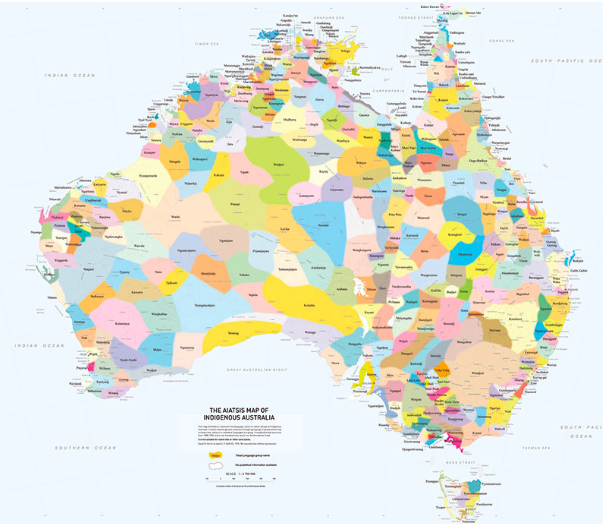
They only grow wild in Gubbi Gubbi, Waka Waka, and Yuggera country, places which have been called South East Queensland since invasion.
A story about Bunya Dreaming festival.

Queensland is a huge state, and the land it covers now is the country of a whole host of Aboriginal and Torres Strait Islander people.
The Bunya Pine grows in only a small part of this territory, in country cared for by three people (Gubbi Gubbi (aka Kabi Kabi), Waka Waka, and Yuggera.
I used the AIATSIS map and the The Australasian Virtual Herbarium map to figure this out.

There are other stands of Bunya Pines in other parts of Australia, but they are much smaller.
Bunya pines fit into the ‘bush tucker’ family of noms, and I know my local Sydney foody friends have been experimenting with using their nuts to make pesto.

This website is a useful tool for learning about agreements treaties and negotiated settlements in Australia.

Landrights in Western Australia and the Yindjibarndi people

Some very good news.
The High Court has upheld the Yindjibarndi people’s native title rights to their land.
Fortescue Metals Group applied to appeal these rights, and got a big ‘nope’ from the High Court.

The Yindjibarndi people live in what has been called Western Australia since invasion, but has been black country for 40 000 years. If you look it up on this great map, you’ll find them in blue on the far left of the continent, above the most eastern most bit.

You can read about the Yindjibarndi languages here, on this epic good map.

Languages are important, because you can trace who lived where by the languages they speak. A people will share some linguistic elements (and languages) with neighbouring people.
Language is culture, and the number of people speaking a language can tell you about that people’s history.
The Stolen Generations interrupted the transfer of language and culture between generations in many areas. Reconciliation Week is supposed to be (in part) about making amends for the Stolen Generation.
You cannot understand Australian history without reading the Bringing Them Home (1997) report.
Please note: this Report warrants a Content Warning for sexual violence, neglect, persons who are deceased, and so on. If you are an Australian, particularly if you are not a Aboriginal or Torres Strait islander Australian, you should try to read this Report.

What is Native Title?

Useful things to think about in regards to native title today:

  • water rights (who owns them, who can buy or sell them);
  • mining (who has access to land to mine);
  • continuous occupation of land (and proof thereof, including rock paintings and burial grounds).

    Note: native title is determined by the High Court. There are 7 High Court judges, 3 are women, none are Aboriginal or Torres Strait Islander. It’s worth noting that one of them, Justice Virginia Bell was a volunteer at the Redfern Legal Centre in the 70s, a centre that provided legal support for the 1978 Mardi Gras protesters (the first mardi gras march), for local Aboriginal community members, and other civil rights activists.
    Read more about the Redfern Legal Centre here.

Mervyn Bishop and Vincent Lingiari

I like to think of Frankie Manning’s birthday as the day we white people kick off a week of deep diving into supporting black civil rights. Here in Australia, it’s reconciliation week. This land is home to the oldest culture on earth. And some of the most persistent and terrifying racism.

If you don’t have the stomach for reading about the horrors of black history here and in the US, focus on digging out and supporting black artists, thinkers, activists, workers. Be the person who clears a space so they can stand. Still your voice so they can speak.

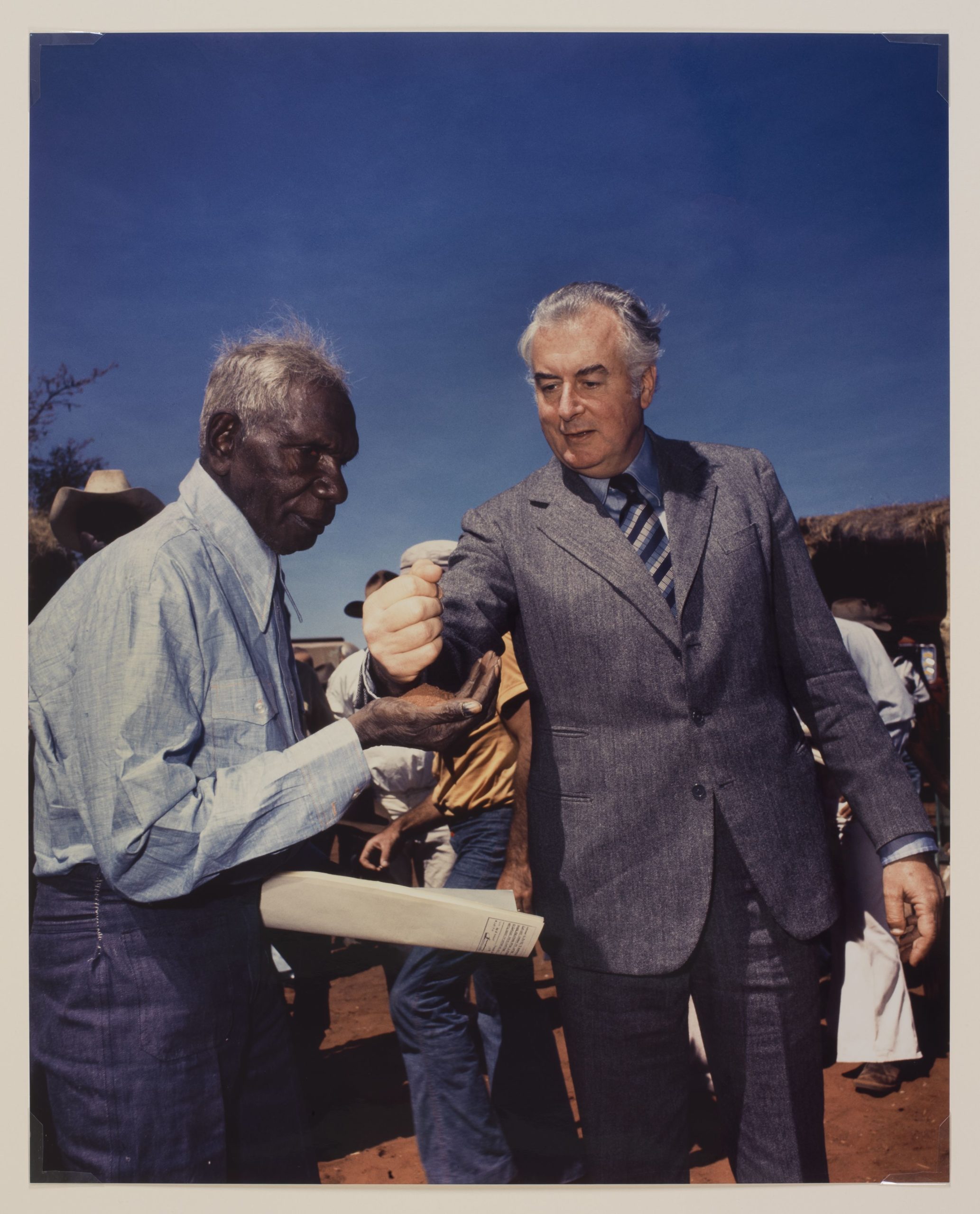
This iconic image is by aboriginal photographer Mervyn Bishop. He composed and shot the image.

…on 16 August 1975, he covered a historical event at Wattie Creek in the Northern Territory. This significant moment in Australian history followed a nine-year strike over the working conditions and request for traditional lands to be returned to the Gurindji people. This photograph captures Prime Minister Gough Whitlam pouring soil into the hand of Aboriginal rights activist, Vincent Lingiari on the occasion of the successful passing of the revolutionary act of parliament.
(source)

-> land rights + labour rights + black civil rights
Useful topics to follow up:
– Wave Hill Walk-Off (1966-1975)
– Gurindji people
– Vincent Lingiari
– Aboriginal Land Rights (Northern Territory) Act (1976)

Sorry Day

Today is world lindy hop day and Frankie Manning’s birthday. But it’s also Sorry Day.

For me, Sorry Day is the more important occasion. But I think that Frankie would be down with that: apologise, remember the past, move forward with hope and good will.

[edit 10 minutes later]…maybe do a bit more than ‘move forward with hope and good will.’ Me, I’m adding ‘Do what you can, when you can. Because life is short, and we should take care of each other. And take care of the music.[/]

Will we be running dance events in May 2021

We’re still in iso here in Sydney. And while Morrison is talking about and early opening, even if the states do go ahead, we will see a second wave before the end of 2020.

Even if we do get out of iso, we will be adhering to safety measures (washing our hands, covering our mouths, not touching people, keeping 1.5m apart) for a much longer time.
Dancing is a high risk activity: all that touching, but also the respiratory droplets blown everywhere by all the panting and puffing and open mouths. Not to mention musicians and their germ-blower instruments.
We won’t be lindy hopping (or solo jazzing) until we get a vaccine, and we’ve seen that vaccine work reliably.

Beyond that, we don’t have the infrastructure to support weekend events. Private venues (eg dance halls, etc) are just devastated by the iso restrictions. Public venues (town halls etc) will either be closed and repurposed, or under extremely strict rules (eg no more than 10 people at a time, hardcore hygiene and cleaning, etc). The people who run events will still be recovering financially (eg we still have outstanding debts from Jazz Bang), and will need to develop new seed money sums, or new sponsorship options.

Music and the arts generally are fucked in NSW and Australia. No sound engineers, lighting specialists, etc etc – all those people who support the artists on stage. They’ll have all started looking for other work and have other commitments to support families and pay rent.

Insurance will become a serious issue. I’ve already had emails from my insurer about new conditions. I personally don’t want to risk legal action for endangering people. And if we start doing things like taking temperatures at dances, we take responsibility for health, and open ourselves to legal action. And I know I don’t want to have to face the Worksafe issues of putting volunteers and staff in unsafe conditions.
Beyond that, the market for big dance events will change. The bulk of the market for these events are those ‘intermediate’ dancers – people who aren’t new, and aren’t super long time dancers (though JB is an exception on this – this older/newer group is our market). We’ll need to find new ways of targeting those markets.

But those avenues of advertising and market development will have changed. Dance schools will have gone out of business, and/or teachers will have had to redirect their energies to things like working from home, new jobs, etc. If we do start up classes again, it’ll take a few years to get up to speed and redevelop the labour force (unpaid volunteers, primarily) to run regular and big events. It’ll be like starting new scenes.

Five years is a long time in dance world. That’s a generation of dancers. I’ll be 51. All our dancers generally will be older – the difference between 22 and 27 is huge when it comes to family and day job commitments.
And of course, my greatest fear is our OGs. Older black Americans. Black americans are four times more likely to die of COVID19 than white americans. And older people are even more vulnerable. I personally cannot countenance the thought of dancers starting dancing again and deliberately endangering the communities that gave us these dances and music.

I’m wondering whether we’ll see people super-keen to do dancing after covid19, or if we’ll see people too afraid to touch other people after covid19. To be honest, I suspect (considering things my epi friends say), we won’t have ‘after covid19′ for many many years. It will be how we live. A seasonal disease that we manage with degrees of isolation and quarantine until a vaccine is found, and then administered to the entire population.
We may be able to start doing smaller events in privates spaces (eg our homes) in 2021, but only mid-way through.

But it’s not all tears.
I’ve been thinking about alternative models for delivering jazz dance and jazz music. Unlike the 1980s, before we saw this new generation of dancers, we have the internet. It’s the perfect tool for delivering audio and audio-visual content. And if we get to the point of small groups gathering in private spaces, we’ll have bands again. And if we can get a few dancers in there, then the bands will be able to learn and relearn playing for and with dancers. So I think the pre-pandemic move towards smaller events will stand us in good stead in the coming years. We’ll get really really good at doing small, quality events that value safety like Jazz BANG.

The saddest thing of all, is that jazz is social. It invites us into each other’s company. To hold each other close. And breathe wet air in each others’ faces :D

Cook: crap

So, after Kate asked for an actual source for James Cook raping people, I’ve been doing some ‘light’ research trying to find the original twitter thread where I read about this.
This thread was between a few first nations women (Australia, Hawai’i, NZ, etc), and they dropped some sweet links.

Anyway, I can’t find the original twitter thread (😭) but I have read a lot of interesting things.

Key was that Cook and his crews knowingly carried disease (TB, syphilis, gonorrhea, and lots of other lovely things) to the people of the pacific region (NZ, Hawai’i, Australia, Tahiti, etc). They knew they were sick, but they still had sex with local people. They also stole stuff, beat people, raped people, and were generally shitty guests. Eventually the people of Hawai’i had jack of Cook and his bullshit, and killed his arse.
There are lots of primary sources (journals, stories, drawings, paintings, etc) about this. It wasn’t a secret.

– Cook was a bad person. He did three major voyages, getting progressively more violent and aggressive, and eventually getting killed on the final voyage (12 Feb 1779, Hawai’i).

– His violence was expressed through increasingly violent (and quite horrific) ‘punishments’ for indigenous people who broke his ‘rules’, and for his own crew.

– His crews were allowed to interact with various villages as they travelled, including sexual relationships.

– Cook declared Australia ‘terra nullis’. He knew that people were living here, but because he didn’t count anyone who wasn’t European as a human, he decided that no ‘people’ lived in Australia.

– The people of Hawai’i (and other places) got increasingly shitty with Cook and his crew. They’d pass through their harbours to restock water and food, and to do some R&R. At first the Hawai’ian people were ‘yeah, ok’ and because women were considered sexually and socially autonomous people, they would have a root with the visitors. For fun. And also for economic gain. Sex work (giving sex in return for things like european goods) was culturally ok at the time. But after a while Cook and his mates became less fun. And they were riddled with disease.

– Lilikalā Kameʻeleihiwa (a scholar from Hawai’i) explains that Cook and his men brought TB and STIs like syphilis to the people of Hawai’i. Who were NOT impressed by these dirty europeans. Cook also had sex with local women.

– Eventually Cook got got by the Hawai’ian people for trying to kidnap the aliʻi nui (king/god/leader) Kalaniʻōpuʻu. He and his marines laid hands on Kalaniʻōpuʻu, and tried to drag him away, in punishment for the theft of a jolly boat.
The especially bad bit of this was that Cook disrespected the aliʻi nui body and spiritual/god status of Kalaniʻōpuʻu by laying hands on him.

In sum, Cook did not consider people of colour ‘human’, and if you don’t consider someone human, you don’t believe they have bodily autonomy, and therefore cannot give consent to sex. By this logic, if they can’t give or not give consent, they can’t be raped.
This sort of logic isn’t new, and I’m not the first person to draw these connections; there’s other (better) research about this stuff. But we can see these sorts of patterns of behaviour today in sexual offenders: men who regard women, girls, and children as less human and less important than their own desires, and do not respect their bodily autonomy*.

But I haven’t yet found specific primary sources detailing Cook’s sexual assaults. Mostly because I couldn’t read any more about him without feeling sick.

Here are some sources:

– Catherine ‘Imaikalani Ulep, ‘Women’s Exchanges: The Sex Trade and Cloth In Early Nineteenth-Century Hawai‘i’
(https://scholarspace.manoa.hawaii.edu/bitstream/10125/62478/2017-05-ma-ulep.pdf?fbclid=IwAR3YmGPe8ZC7YZ7Rm6h6oFw5BLO4WgmhHnVWjfD_wiRck7-3x02FaNo2pZE)

– Kerri A. Inglis, ‘Kōkua, Mana, and Mālama ‘Āina: Exploring concepts of health, disease, and medicine in 19th Century Hawai’i’
(http://ulukau.org/elib/cgi-bin/library?e=d-0hulili05-000Sec–11en-50-20-header-book–1-010escapewin&a=d&d=D0.18&toc=0)

– Accounts of disease in Cook’s crew, and on the population of Hawai’i before and after his visits are plentiful. You can find zillions with a google search, from his crew’s journals to oral histories from Hawai’i people and so on. It’s not a contested idea; it’s a fact.

*’bodily autonomy’ is the right to make choices about your own body, what it does, how it looks, how it works, and who gets to touch it. It’s a useful phrase and concept for talking about sex, reproduction, imprisonment, and health. It’s also a powerful phrase for talking about children and their rights.