lots of talk about exercise

Another long post!
I’m making sure there’s more talk about feelings and gender and power in DJing and dance. Even if they’re just mine. :D

I’ve been doing some pretty hard core exercise lately, which you’d know if a) you follow me on twitter, b) are a real live hooman friend of mine, c) I’d kept up with posting my dailymile posts here.
I guess I’ll get on that last one soon.

So what’s the deal? I started running in March or so this year, loved it, and used to run three times a week and go social dancing once. But that hurt my knees. So I dropped one run and added in yoga. Didn’t help. I went to see my podiatrist/physio (bless his blessed cotton socks), he gave me some exercises to toughen up my knee, and I started back at running twice a week with an aim for three. Sore knees. I started doing dance work on night a week, properly, in a hall and everything. Then I started swimming laps twice a week at the pool to complement my two runs per week, my one social dancing night and my one night of dance work.

It’s gold.

I love swimming. I used to swim a lot, doing swimming club in school until puberty put a stop to that, we grew up swimming a lot, and I’ve done laps at various points. But this is different. It’s so wonderful. I love the way it’s not impact exercise – no knee or joint pain. Just lovely stretches and a serious arse-kicking. Right now I’m running Mondays and Fridays, swimming Tuesdays and Thursdays, dance work Wednesdays and social dancing Friday or Saturday night (with the odd Sunday session) and lots of incidental walking and the odd long walk in between. It’s perfect. I love it.

It’s the perfect balance, so long as I don’t push the swimming too much. Right now I’m really not swimming as hard as I could. I do 1km in 30minutes and I could do more. I did more on Tuesday and ended up with a sore shoulderback (I think it was my trapezium, on the left side) on Wednesday. So I’m taking it easy, working up to more laps gradually. Unlike running, I have some swimming Skillz, what with that swimming club work as a youngun and some sort of bizarre genetic predisposition towards it (I think it’s actually the strength in my shoulders). So I feel good about swimming.

I still love running. I love the way it seriously kicks my arse and leaves me all tremble-muscles and sweaty. But it’s rough on my joints at the moment. I have added in lots of stretches and strengthening exercises, but I’m not quite there yet with those. I don’t want to suggest that running itself is bad for you or your joints. The issue is that it’s a repetitive exercise – you do the same exact movements – over and over again. And gravity is involved. And if you’re heavier, and without proper muscle tone, you tend to just flop down into your joints. That’s me. I’m pretty fit from dancing, but I’m not running fit. And you do need to strengthen your muscles for running.

Hellz, you should really be doing lots of stretches and strengthening exercises for sitting on your arse all day. I’m 36, so I’m not at my prime, running wise. But that’s ok. I think it’s a good idea to work up to being a ninja runner. I’m gradually strengthening my muscles so that I am more efficient. That means making sure the muscles in my legs work properly, so I’m not knock-kneed any more.

That’s a real issue for a lot of women, especially ones who don’t do much exercise – arses out, no core strength, knees falling in towards each other. The opposite is often true of many men – crotch forwards (so it looks like they have no arse), no core strength (but too much upper body strength), knees opening out like bow-legged cowboys. These sorts of physiological (should that be biomechanical?) issues are party socialised, but also to do with the physiological differences between men and women. And you do get men with the ‘female’ issues and vice versa.

I’m focussed on getting good at running because running is really good for basic aerobic fitness, and also for being efficient when you’re moving quickly. Which is perfect for cross-training for lindy hopping. Which is really just lots of running. With lots of jumping and leaping and bending and stretching and…
I love swimming because it makes me apply the same principles of biomechanics I use in dancing and running, but to my body while it’s suspended in a resistant environment. Gravity doesn’t kick my arse (especially not mine – I’m still ridiculously buoyant), so I’m free to experiment with movement in new ways. It’s kind of like yoga – when you’re inverted, you get to see how your everyday movements and muscle use are shaped by gravity and habit. Tipping all that upside down, literally, helps you become aware of your habits and also more aware of how your body works. Swimming is kind of like that. But you’re in WATER.

As per usual, I’ve thrown myself into this routine with somewhat obsessive enthusiasm. I am a little ob-con, which means I’m good at things like PhDs, exercise programs and other tedious tasks with perceivable goals. You usually see the results of a new regular exercise routine at six weeks or so. Provided you’re actually doing the exercise regularly and with some sort of discipline. And I am.

My results? Dancing is much easier – I can breathe and jump and leap with more energy and control. But my improved fitness and muscle and control means that I can actually do more while I’m dancing. I can experiment with new ways of moving. Which was one of my main reasons for doing this in the first place: decreased fitness and increased physical girth (as in not-muscle but just generous flesh…ooo, I do like that thought – generous, bountiful flesh!) make it difficult to do some movements. They also prevent you doing movements for longer periods of time with more repetitions. Which is what you need to practice something. I find my decreased size means I have a greater range of movement – I can move my legs at the hip within a greater range, I can bend further, extend further and jump higher. It’s quite exciting. It’s also very interesting.

I want to make it clear. I’m not rushing this. We started changing our lifestyle a couple of years ago. I don’t want to ‘drop a lot of weight’ or suddenly get really fit really quickly. I wanted to make slow, gradual changes so that they could be sustainable. It is nice to be slimmer – it simply feels better to be able to do more exercise with this increased fitness and smaller physical size. It’s less weight on my poor foot and joints, and it means I do have that greater range of movement and flexibility and strength in my joints.

I also want to be clear: you can carry lots of flesh and be fit and healthy. But you can’t be fit and healthy if you don’t do at least five 30minute blocks of sustained exercise per week. That means a brisk walk (not a slow stroll) FIVE times a week. One of the consequences of this exercise, though, is that your muscles develop. That means you get stronger, not just in the muscles your body is using to move you around, but also in other systems – respiratory, digestive, pulmonary. You also use food more efficiently – you use food. So you’re less likely to ‘put on weight’ because your body isn’t storing as much ‘excess’ calorie as it was when you were spending your whole day on the couch.

And – best of all – exercise fires up your body-chemicals, and improves your mood. Exercising regularly just makes you feel good. It’s really hard when you’re weighed down with depression or caged in by anxiety to get out there and walk or run or swim or cycle or dance or stretch or tai chi or yoga or whatever. But once you do get out to it regularly, your general mental wellbeing improves. I find I have far less trouble with anxiety when I’m exercising regularly. Without it I can find it difficult to leave the house, to go do social situations, to even catch a godDAMN bus without freaking about missing it.

Exercise sort of dissolves those feelings. It lets me out. I think that this is the part I like the most. It’s like exercise makes me strong enough to do things I can find very difficult. It makes me strong, emotionally, but also socially. It helps me free my sense of humour and my wit. I make better jokes when I’m exercising regularly. It also lets me do creative things like dancing or telling stories or whatevs.

For me, this is where exercise becomes a feminist issue. Because happy, healthy women with confidence and creativity and happy, healthy bodies are in a very good position for fucking up the patriarchy. And because happy, healthy men with confidence and creativity and happy, healthy bodies are also in a very good position for fucking up the patriarchy.

At this point I want to write about wellness and (dis)ability and health and feminism, but I don’t have the space. I have a post brewing, though. But let me state this, very very clearly:

The ‘right’ amount and type of exercise for YOU is determined by your body and by your self. There is no point whatsoever in comparing your exercise with someone else’s because:

  • you are unique;
  • you have a unique genetic makeup, therefore your physical/emotional/mental potential is unique.
  • your lifestyle is unique – you might be a mother like other people, but you are mother to your children, living your lives, not someone else’s; you might be a student like other people, but you are student in your body, not their’s;
  • Your body and your brain – the way they work together – is unique.
  • You are the sum of your life to this point, and that means you have to take that into account. You might have had some troubles with alcohol or with depression or with your parents. You might have been a hardcore sprinter as a teenager. You might be wondering where your gender is at, and what or who you are. You might have broken a bone years ago and have it left more fragile. You might have some serious long-term illness. All this stuff comes with you on every run and every swim and every walk. So you have to be gentle with yourself.
  • You’re here for your whole life, not just a weekend of it, so you have to plan your exercise for your whole life. Don’t think “I have to lose weight for my wedding” or “I have to get fit by christmas”. Think “I deserve to feel really good, and I deserve to feel better every single day” and work on that. Long term goals, short term pay-offs.

So my fitness and exercise plans aren’t ones that will work for everyone. You have to find your own balance point. That might mean yoga once a week or it might mean cycling to work every day. This brings me to my other serious point:

Exercise should be fun. If it’s not, change what you’re doing. Really, seriously, it should make you feel fucking AMAZING. It might pound and pummel you, but not in a bad way. It might leave you buggered and breathless, but it should also leave you thinking “YES! I am doing that again tomorrow/next week!” You mightn’t have any interest in exercise that’s hardcore – that’s also cool. It might be the way your gentle yoga leaves you feeling light and calm and centred and full of happiness. But it should be good feelings, not guilt or frustration or shame or anger or unhappiness.
For me, dancing is the very finest thing on earth. When I’m dancing, when the music is good, and I’m feeling good, it is the best feeling I’ve ever felt. It can be any music and any dancing. But the way I feel at that moment is beyond words.That’s why I run and swim and stretch – because it improves that. Sure, I enjoy running and swimming and cycling for their own sakes as well, but dancing gives me direction. It’s the payoff. I also find that fostering that part of my life – with its creativity and physical challenge and partnership with other dancers – fosters the other parts of my life which are about stillness and calm and quiet.

So I think we should all seek out exercise that pleases us. Running isn’t for everyone. You mightn’t be a runner or swimmer. You might be a trapeze artist or a juggler or a ninja or a climber or a hiker or a gardener. Keep looking until you find that thing that makes you feel that good. And the best part is that the more exercises you try, the better able you are to try more exercises, and more things generally!

For me, that’s the other best bit. Hurting my foot made me suddenly think “oh shit, I might never be able to run/dance/garden/hike again!” so when I did get some mobility and freedom from pain I was NOT going to put off trying new things. No fucking way. Our bodies are phenomenal things – there is no way I’m going to miss out on trying as much as I can.

This is another thing that makes exercise feminist. It makes us strong and convinces us to seek out good stuff. Good stuff that mightn’t have anything to do with heterosexual monogamy or buying shit.

Here’s another thing I want to mention. Being fat does not equate to being unhealthy. I actually don’t like to use the expression ‘being fat’, because it’s meaningless – it’s relative and requires comparison with other bodies. And that way leads bullshit self-loathing and division between women. Not to mention paranoia, depression and unhappiness. Exercise is about being strong – physically, mentally and emotionally. It’s about feeling good. It is NOT about comparing yourself with other people. So you can have lots of lovely booty – you can be a lushly fleshy creature – and still be fit and healthy. But not if you don’t get your heart rate up, work your lungs and muscles and sweat a little. Sorry, sex, heavy drinking and sixteen course banquets do not qualify. :D

I want to end with another point. One that’s really at the heart of this. Simply ‘being skinny’ – ie just some bones covered in skin – is not a good goal. Aim to be ‘healthy’, and aim to be well. I wish some of the women I know would realise that muscle tone is the sign of good health. Every now and then I see a sister cringe when I talk about my muscles. It’s not ‘mannish’ to have muscles. And, to be honest, ladies, you’re going to have to work really hard, for a really long time to even approach a man’s musculature.

I really think of my muscles as proof of my strength. Not just of my physical strength, but of myself. I’m strong enough to get out the house, or to make a joke or to tell a story or to manage a relationship or to run my household or hold down a job. I’m strong enough to know how to ask for help, and I’m strong enough to help other people. I think this idea of strength is the opposite of what a lot of women are raised to think. We’re raised to think – constantly told by telly and advertising and almost every single relationship we have with other people – that women are physically weaker than men, and that we aren’t strong enough to make decisions or to run our own lives.

I also see a lot of women using ill health or physical weakness – pain in particular – to gain control of their lives or relationships. If you have a headache you don’t have to go to work/deal with that conflict/solve that problem. You have permission to go to bed or to be looked after. I mean – most women I know carry pain killers in their bag. How many men have pain killers on them all the time?

This was a big one for me, because I used to get horrid headaches which were stress related. I find exercise keeps anxiety and stress headaches at bay. I’ve also learnt that when I feel a headache brewing I can reach for a painkiller (because sometimes you just need to), or I can go for a walk or get a massage or choose to let go of that trigger point (saying ‘no’ to a responsibility, for example).

I think that my relationship with medical professionals is a good example of this. Pain in my foot or knee? I could take a bunch of pain killers or stop running. Or I could go see my physio, who then works with me to set up a strengthening program where I work to manage my pain. This is the sort of pro-active, empowering relationship many men have with their sports coaches, but which women don’t have because they don’t do sport, competitive or otherwise. For me, this is the most exciting part of all. Having a ‘bung foot’ doesn’t mean not dancing or not walking or taking lots of pain killers. It means getting orthotics, doing an hour of strengthening and releasing exercises per day and managing the amount and type of sport I do.

Yoga taught me: you don’t skip yoga because you’re injured. That’s when you most need to go to yoga. So exercise has taught me that your physical (dis)ability is not about opting out. My physical limitations aren’t actually limitations – they’re just part of how my body works. So I need to work with that, rather than in spite or or around that. Dancing helps with that thought too – an unusual body shape is a very useful and creative thing.

I’m not really sure how to end this, other than to say that I think it’s a very great shame I didn’t do much exercise between 15 and 25. A very great shame.
8 tracks: songs by singers with bands

(Image from Shorpy (woman drummer!); go direct to the 8tracks site)

These are some songs that I really like. They all feature singers, and they’re all (mostly) smaller bands. A few of these are songs that have more commonly known versions. These are the versions I like at the moment. I’ve picked songs that are a little salty – not too sweet.

title artist(s) album bpm year song length

Some Of These Days Julia Lee, Clint Weaver, Sam ‘Baby’ Lovett Kansas City Star (disc 1) 210 1946 2:02
Shake It And Break It Joe Turner Complete Jazz Series 1938 – 1941 177 2:59

That’s What You Think Putney Dandridge Complete Jazz Series 1935 – 1936 185 1935 2:43

Swing, Brother, Swing Willie ‘The Lion’ Smith and his Cubs) Willie ‘The Lion’ Smith 1925-1937 231 1935 2:52

Knockin’ Myself Out Lil Green (acc. by Simeon Henry, Jack Dupree, Big Bill Broonzy, Ransom Knowling) 1940-1941 104 1941 3:03

If You’re A Viper Rosetta Howard acc. Harlem Hamfats (Herb Morand, Odell Rand, Horace Malcolm, Joe McCoy, Charlie McCoy, John LIndsay, Ransom Knowling, Fred Flynn, CHarlie McCoy) Let Me Tell You About The Blues: New York (Part 2) 126 1937 3:13

Stop It, Joe Rosetta Crawford acc. by James P. Johnson’s Hep Cats (Tommy Ladnier, Mezz Mezzrow, Teddy Bunn, Elmer James, Zutty Singleton) Mezz Mezzrow: Complete Jazz Series 1936 – 1939 158 1939 3:17

That Too, Do Bennie Moten’s Kansas City Orchestra (Count Basie, Jimmy Rushing) Moten Swing 123 1930 3:20

How Do They Do It That Way? Henry ‘Red’ Allen and his Orchestra (JC Higgenbotham, Albert Nicholas, Charlie Holmes, Luis Russell, Will Johnson, Pops Foster, Paul Barabarin), Victoria Spivey and the Four Wanderers Henry Red Allen And His New York Orchestra (disc 2) 139 1929 3:20

On Revival Day (A Rhythmic Spiritual) (06-09-30) Bessie Smith acc by James P. Johnson, Bessemer Singers Bessie Smith: Complete Jazz Series 1929 – 1933 1930 2:56

I haven’t chased down the year for that excellent version of ‘Shake It and Break It’. That song came to my attention via an ILHC youtube clip of Andreas Olsson and Crista Seipp competing in the showcase category. I adore this version of this song.

It reminded me of that Julia Lee song, which is super awesome. I adore ‘Some Of These Days’, and that is currently my favourite.

I’ve just bought a bunch of Putney Dandridge, and some of it is a bit lame. In the earlier days he just rocks his awesome timing and lovely, bouncy style. Not to mention the badass vibrato, but after a while he’s obviously trying to cash in on Fats Waller’s vocal style. Laaame. But I like this song, and I quite like this version.

‘Swing Brother Swing’ is great, though we usually hear the Billie Holiday version(s). I like Willie the Lion Smith a whole lot, and I like this version. I’ve played it for dancers quite a few times and they like it too.

Lil Green is rockhardawesome, and responsible for the best version of ‘Why Don’t You Do Right?’ This song ‘Knockin’ myself out’ is one the Asylum Street Spankers do, and it’s about drugs. I like her delivery.

‘If You’re A Viper’ is also about drugs. Rosetta Howard is the foshiz. The Harlem Hamfats had a bit of popularity with American dancers a little while ago, but I’m not convinced they’re all that. I like Howard, though. She actually did some neat stuff with Henry Red Allen, Barney Bigard and Sid Catlett in 1939, but I like the viper song.

‘Stop It Joe’ has one of those melodies that just gets stuck in your brain. The band is pretty spankingly good.

‘That Too Do’ is one of my favourite Bennie Moten songs. Jimmy Rushing’s lyrics include bits of a song which most people know as ‘Every Day I Have the Blues’. But ‘That Too Do’ has someone playing piano accordion and has a sort of droning, miserable style that suits the lyrics. The best bit is nearer the end, where the band shouting and the muted trumpet do some awesome call and response.

Victoria Spivey. And Henry Red Allen. That’s all I need to say, really.

And, of course, Bessie Smith, shouting.

some thinking about recorded jazz music

Albums.

A recent post on Melissa’s blog has made me think about jazz recordings again.

The album is a relatively recent phenomenon – the 50s or so is where it really happened (I think – I’m a bit fuzzy on this). We’ve really started thinking in new ways about collections of songs since digital downloading became a real possibility, and itunes recent reworking of their logo and approach to playing songs suggests that they think we don’t care about CDs or ‘albums’ the way we do. So now, in the 2010s, 50 years after albums became mainstream, we could say that we’ve gone back to thinking about individual songs rather than songs are part of albums.
I’m not sure I actually buy that idea. There are lots of people who, I’m sure, still think about albums, including the artists recording them, the record companies selling them, and the people who buy them on CD. This seems especially relevant for smaller independent bands who’re producing their own albums. But digital downloads – particular the legit sources where you buy songs individually – have reminded us of the significance of a single song as a stand alone recording or text.

I listen to jazz almost exclusively these days, and usually jazz from the 20s-40s, so I rarely think about that music in terms of albums. Unless I’m listening to a CD by a modern band. Or rather, I think about individual CDs or ‘albums’ of older jazz as just that – albums of individual items. They’re usually ‘curated’, by record companies or another third party, long after the song was originally recorded, released, played on the radio, forgotten and then dug up again by record companies looking to make a buck. The original artists didn’t think of these songs as part of an album of songs intended to be consumed as parts of a single, whole release. They thought of each song as a text that would be released on one side of a record and then bought by people who’d listen to them over and over until the grooves wore up and they had to buy a new one.

Individual releases of songs were often not even decided by the musicians themselves – the record company would choose the song they’d play, and the choose how and when and if it would be released. The ‘B-side’ song on the record could be from the same session or something completely different. The big sellers, particularly in the early days, were sheet music. A single song could also be recorded and ‘released’ by a number of bands in the same year, so the arrangement of the composition (the way the different instruments’ parts were organised within the performance of the song) became much more important than the original composition in many cases. Fletcher Henderson, for example, had a career as an accompanist for blues singers, as a big band leader and as an arranger for Bennie Goodman, and it was is arrangements with Goodman that really saw the largest, most rabid audiences. Really, the song itself (however it was arranged) was the important part, and audiences would hear it played not only on their records and in live radio performances, but by their local bands playing ‘the hits’.

Most of the songs I have bought recently from emusic are from ‘collected’ ‘albums’. The Chronological Classics ‘albums’ were just groups a series of recordings featuring one particular artist in chronological order on one CD. They’re really hard to buy on CD these days as they were produced by a now-defunct French company, so the downloads are invaluable. The Mosaic Records box sets are similarly just a series of recordings by one artist or band, usually listed on the CDs in chronological order. Even cheaper sets like the JSPs or Proper sets are much the same. The recording date becomes the organising principle.
I don’t think about them as ‘albums’. With jazz I tend to seek out recordings by a group of musicians (eg the young Chicago guys in the 20s) or by a particular musician (eg Bunny Berigan) sometimes grouped under a particular band leader (eg Count Basie or Artie Shaw), but not always. Or I’ll seek out different versions of a particular song, recorded literally hundreds of times by dozens of groups. Songs are often recorded more than once by the same artist or group, so you get revised versions of the song, where, once again, the recording date is the most useful piece of information for organising your listening and cataloguing of the song. The date, of course, also tells you who was in the band when it was recorded.
So ‘album’, again, doesn’t really work. Though there are some really good releases of remastered collections of songs. The Mosaic sets are a good example.

If I’m following a particular band chronologically (eg all the recordings by the Mills Blue Rhythm Band), the personnel in the band often changes according to location. These bands toured all the time so they recorded in a number of cities during a year. And the personnel would vary depending on where they were, who made it to the studio on time, which local musicians could be roped in to do a solo, or which stars were in the city and could be convinced (read: paid) to sit in.
This means that you often get wonderful little 3 or 4 song (possibly with 1 or 2 out takes) sessions recorded in one city by one incarnation of the ‘band’ on one day. Or, if you’re lucky, across two days. The term ‘band’, here, tends to fall apart. Some key artists played with the same band for years (Basie’s rhythm section in the 30s and 40s, Fats Waller’s small groups, Cab Calloway’s bigger bands), but it’s unusual to find a big band with exactly the same personnel for more than a year or so. If that. Individual musicians would drop out to do gigs with other bands, or wouldn’t be able to travel for a show. The musicians’ or band leader’s contract with a label or venue or promoter was renegotiated. The money ran short and some musicians had to be excluded. A musician was too hung over to get to the studio on time. Or too drunk to do more than one song. All sorts of things determined who sat in on a recording session.
And, most importantly, these bands were performing bands, doing live shows all the time, all over America. So recordings were complementing the live shows, not replacing them. As radio really took off in the late 20s and more in the 30s, live radio shows were often recorded and released years later. These shows yielded amazing clumps of songs recorded live, in one take. This emphasis on live performances actually affected the recordings they did. Bands would often rehearse relentlessly (especially if they were led by taskmasters like Goodman) so that their live performances were absolutely spot on. This meant that they were often so well drilled that their recordings were done in one, or at most two, takes. But recording was much more expensive then than now, and paying 15 men for more than an hour or two of recording in an expensive studio with an expensive engineer was beyond the budgets of many bands in the middle of a tour during the depression.
So those little 3 or 4 song sessions are absolute gold – the product of relentless practice and performance, tight arrangements and the unity of skilled musicians working with people they really clicked with. But you also get sessions of utter crap, with missed notes, rubbish arrangements and totally bullshit tired, cheesy instrumentation. These are all factors that often make it much easier to judge a session’s worth ahead of time if you know the musicians involved, and what they were doing with their lives at that point in time.
So these days I tend to think about those sessions as groupings reflecting that band at that moment. But they’re definitely not albums, as they were released as ‘singles’ or ‘sides’ – 2 songs, one on each side of a record. And the earlier stuff was limited to about 3.5 minutes.

It’s all very interesting. I have a lot more to write, including some stuff about who got to record what and how live gigs were parcelled out in cities like Chicago in the 20s. But I’m only just a little way into Kenney’s Chicago Jazz history which discusses these issues as they relate to Chicago specifically. I’m sorry this is such a crappy post, and I will try to rewrite it as something a bit more readable and interesting. Possibly with some nice 8track action to illustrate my points.

8track: Teddy Wilson plays piano

I’ve made a new 8track.


Here’s a direct link to the mix.

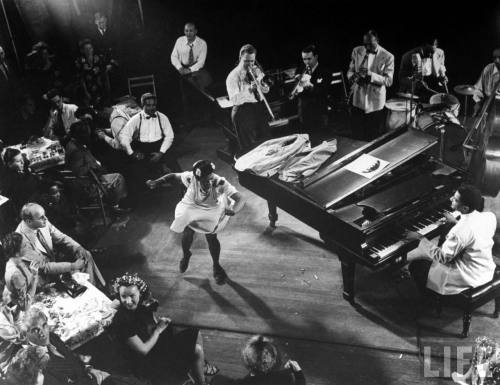
I stole the photo for this mix from here, the Life Magazine site. The photo is actually taken from one of the Benny Goodman Madhattan Room gigs, and I’ve included one of the live recordings from that gig in this mix.

Ok, so this 8track is Teddy Wilson themed. I love this man. He played in so many bands, doing all sorts of stuff from hot New Orleans revivalist action to scorching 1930s big bands. He was also the king of precise, beautifully delicate solo work, and of course, his work with Billie Holiday is beyond compare. I’ve chosen a few songs from 1932 to 1946, with a range of bands. Here’s the track list:

(title band album bpm year song length)

I’ve Found A New Baby New Orleans Feetwarmers (Tommy Ladnier, Teddy Nixon, Sidney Bechet, Hank Duncan, Wilson Myers, Morris Morand) The Young Bechet 269 1932 3:14

High Society Louis Armstrong and his Orchestra (Teddy Wilson) Louis Armstrong and his Orchestra 1932-1933 250 1933 3:27

Swingin’ With Mez Max Kaminsky, Freddy Goodman, Ben Gusick, Floyd O’Brien, Milton ‘Mezz’ Mezzrow, Benny Carter, Johnny Russell, Teddy Wilson, Pops Foster Mezz Mezzrow: Complete Jazz Series 1928 – 1936 139 6th November 1933 3:05

Easy Like (Take B) Wingy Manone and his Orchestra (Dicky Wells, Artie Shaw, Bud Freeman, Jelly Roll Morton, Teddy Wilson, John Kirby, Kaiser Marshall) The Wingy Manone Collection Vol. 2 1934 2:38

In The Slot (Take A) Wingy Manone and his Orchestra (Dicky Wells, Artie Shaw, Bud Freeman, Jelly Roll Morton, Teddy Wilson, John Kirby, Kaiser Marshall) The Wingy Manone Collection Vol. 2 243 1934 2:50

Jungle Love Teddy Wilson and his Orchestra (Bobby Hackett, Pee Wee Russel, Johnny Hodges, Allan Reuss, Al Hall, Johnny Blowers, Nan Wynn) Teddy Wilson (disc 2) 190 1935 2:50

Chimes At The Meeting Willie Bryant and his Orchestra (Teddy Wilson, Cozy Cole) Willie Bryant 1935-1936 245 1935 3:01

Long Gone From Bowling Green Willie Bryant and his Orchestra (Teddy Wilson) Willie Bryant 1935-1936 201 1935 2:51

Warmin’ Up Teddy Wilson and his Orchestra (Roy Eldridge, Buster Bailey, Chu Berry) Classic Chu Berry Columbia And Victor Sessions (Disc 2) 241 1936 3:20

Bei Mir Bist Du Schoen, Part 1 Benny Goodman Quartet (Teddy Wilson, Gene Krupa, Lionel Hampton, Martha Tilton) RCA Victor Small Group Recordings (Disc 2) 176 1937 3:27

Avalon Benny Goodman Quartet (Teddy Wilson, Gene Krupa, Lionel Hampton) Benny Goodman: The Complete Madhattan Room Broadcasts (vol 1: Satan Takes a Holiday) 258 1937 2:47

Let’s Call The Whole Thing Off Billie Holiday and her Orchestra (Buster Bailey, Teddy Wilson, John Kirby) Lady Day: The Complete Billie Holiday On Columbia (1933-1944) (Disc 03) 124 1937 2:38

Honeysuckle Rose Teddy Wilson Quartet All Star Jazz Quartets (disc 1) 168 1937 3:13

Just A Mood (Blue Mood) Parts 1 & 2 Teddy Wilson Quartet All Star Jazz Quartets (disc 1) 88 1937 6:48

Practice Makes Perfect Billie Holiday and her Orchestra (Roy Eldridge, Don Redman, Georgie Auld, Don Byas, Jimmy Hamilton, Teddy Wilson, John Collins, Al Hall, Kenny Clarke) Lady Day: The Complete Billie Holiday On Columbia (1933-1944) (Disc 06) 153 1940 2:37

Gloomy Sunday Teddy Wilson and his Orchestra (Billie Holiday) The Lady Of The Blues 1941 3:12

Flying Home Teddy Wilson Sextet (Emmett Berry, Benny Morton, Edmond Hall, Slam Stewart, Big Sid Catlett) The Complete Associated Transcriptions 1944 198 New York, 15th June 1944 4:56

Indiana Teddy Wilson Sextet (Emmett Berry, Benny Morton, Edmond Hall, Slam Stewart, Big Sid Catlett) The Complete Associated Transcriptions 1944 217 New York, 15th June 1944 3:11

Cheek To Cheek Teddy Wilson Teddy Wilson (disc 5) 1946 2:25

The New Orleans Feetwarmers stuff is interesting, but it’s not my super favourite. And that Louis Armstrong Orchestra track is a bit ordinary. But – Sidney Bechet and Louis Armstrong!
‘Swinging with Mezz’ is a cool one – Wilson is playing with a bunch of Chicago doods.
The Wingy Manones are good ones, and it’s a mixed race band – check out the lineup!
I quite like the Teddy Wilson Orchestra ‘Jungle Love’, though I think ‘Warmin’ Up’ is better.
The Willie Bryant stuff is rocking, and of course Wilson is responsible for the gorgeous introduction to ‘Viper’s Moan’, a song that’s overplayed (to wonderful effect) in lindy hopping circles, but which I haven’t included here, because I actually prefer ‘Chimes at the Meeting’. I once played that song for a crowd of beginners. I remember the expression on the face of one of the few experienced dancers (and DJs) in the room that night. And I _really_ remember the way the dancers (who were pretty much all noobs) went NUTS for this song.

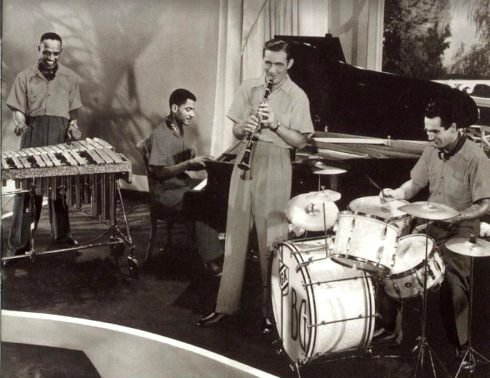
GBsb.jpg
(that’s a pic of the Goodman Quartet – Wilson on piano, Goodman on clarinet, Hamp on vibes, Krupa on drums. I’m not sure who took that pic, but it gets used a LOT and is on the RCA small groups CD cover… It’s actually a still from this amazing clip).

After ‘Warmin’ Up’, things change a little because I visit some of the Goodman small group action. I adore this version of ‘Bei Mir Bist Du Schoen’ with Martha Tilton’s gloriously laid back vocals. This is one seriously awesome song. It’s really tight, precise, perfect (in typically Goodman style), but it’s also swinging like the proverbial.

I followed this with another song by this group (minus Tilton), because it’s a live recording from the Madhattan Room. These gigs were important because they were the first time Goodman took his mixed race small group on the stage, admittedly for a white crowd, but still. This was 1937, and that was some crazy arse shit to pull in segregated America. But this was Benny Goodman, a super extremely major rock star. And this band was phenomenally popular. Not to mention rockhardawesome. I adore the Lionel Hampton (vibes) and Gene Krupa (drums) combination. They were pretty badass percussionists, often known for a kind of blunt object approach. But Wilson and Goodman had a sort of powerful precision that seems to temper them. I adore this group and I think I have everything they did (not counting the harder to find live ones).

A note about those Madhattan gigs: apparently the crowd of star-struck teenagers kind of mobbed the stage, not really dancing, but kind of going ape shit. There are, however, some pics of kids dancing the Big Apple at this gig in the Life Magazine collection on Google.

From here, of course, I slide over to the QUEEN of everything, Billie Holiday. I love love love her work with the Teddy Wilson Orchestra. The songs they did together were attributed either to his band, or to a band under her name. Either way, the musicians they worked with were wonderful, and this combination of Wilson’s wonderful precision and gorgeously delicate piano matched with Holiday’s amazing delivery (the timing! the delays! the phrasing!) is beyond amazing. I’m also interested in John Kirby’s presence in some of these sessions. He also did some pretty nifty small group stuff, in a similarly precise ‘chamber jazz’ style – he, Goodman and Wilson had much in common in their small group recordings.

I haven’t got the details for the ‘Teddy Wilson quartet’ recordings in there, but I’m not sure that’s Hampton in there on vibes. I’ll have to look it up. I do like that song ‘Just a Mood’, and I suspect the trumpeter is Buck Clayton (who did so much work with Count Basie, with Billie Holiday and with Benny Goodman’s small groups, in the same year these were recorded.

Then I squeeze in some more Billie Holiday. Because I can. I do like ‘Gloomy Sunday’, in part because I first heard it on Sinead O’Connor’s album Am I Not Your Girl? which introduced me to jazz in 1992. That wasn’t a terribly great album, but I bought it because I was into Sinead, and that’s (partly) how I got into jazz, though I didn’t start dancing until 1998.

tw.jpg
(this image is from the Life collection and features Sid Catlett, but isn’t the band I’ve included here… but the pic is GREAT, right?)

The Teddy Wilson Sextet stuff from 1944 is my current favourite band. Hot diggedy. Slam Stewart! That is some extremely hot shit, right there. I love that entire album and I thoroughly recommend it. It’s a bit fiddly and probably in the chamber jazz category, but it’s hotter than the Goodman stuff, and that version of ‘Flying Home’ shits all over the Goodman one that has a similar small group feel but is perhaps a bit too mannered to really pwn all. I love the song ‘Indiana’, though I most like the 1935 Mound City Blue Blowers version with the lyrics… gee, to think that that version was recorded only 2 years before Goodman did his Madhattan stuff… I think of the Mound City Blue Blowers as kind of the punkers of jazz – white boys with attitude, stuffing about with hot jazz (there are some good clips on Youtube which are really fun).

And then the last song is a solo piano piece. The song is one we tend to associate with Billie Holiday, Ella Fitzgerald, Louis Armstrong and other vocalists, particularly from the 50s. So it’s kind of nice to hear Wilson do a fun, jumpy version. It’s not the best quality, though, as it came from a cheap 4CD set. But it’s definitely worth a listen. I think it best shows Wilson’s style, so completely different from people like Fats Waller or Count Basie or Duke Ellington… I tend to associate Wilson with Woody Allen films, though he’s not over-represented in the soundtracks.
I love Teddy Wilson. And I adore the variety of bands he’s been in.

djing for noobs

Tim has asked about DJing for beginners, so I’m going to talk about the set I did last Friday at the Swingpit here in Sydney. Once again I’ll disclaim: this is just my opinion, not gospel, people will disagree and that’s a good thing, etc etc etc.

DJing for new dancers: my approach, and a case study

Firstly, my general rule for DJing, for anyone, is “everyone should dance, and everyone should have a really good time.” There are other rules: “make it easy to have fun” and “don’t try to ‘teach’ anyone anything or ‘test’ dancers”. Just get up there and DJ that badass shit, motherfucker.

I find that DJing for new dancers is a bit like leading a new dancer. Do your very best work. And make it easy for everyone to have fun. So avoid the stunts, avoid the tricks, play good songs, do nice stuff and enjoy yourself. There’s a reason we have favourite songs, and a reason we have ‘basic’ or foundational or fundamental steps. The swingout is generally considered the ‘foundational’ step for lindy hop (this is of course debateable, but let’s talk about that another time, huh?), and I take it as a model for my DJing.

It should swing.

I wouldn’t play neo for advanced dancers, so why would I play it for new dancers? It’s shit. Don’t play it. Same goes for rock and roll, slow groovy blues and so on. Play good, solid swinging jazz. Because it’s both awesome and also challenging and interesting. It’s also new to new dancers, for the most part, so introduce them to your very best friends. Your best friends are the ones you like the most, the most forgiving, the kindest and the funnest. You have other friends, but these are the ones you’ll take to this particular party.

There are no rules about tempo.

Some people think you should only play slow songs for new dancers. I think that’s bullshit. You wouldn’t play only fast songs for experienced dancers, so don’t insult your noobs. But this does highlight an important point: new dancers don’t have good lindy hop fitness. Even if they’re super fit athletes already. Lindy hop kicks your arse and requires good motor skills, balance and coordination. All with a strange person. So it’s quite tiring when you’re just beginning. So remember when you’re DJing for new dancers, that they’ll get tired quickly. This brings me to the next important point…

Work that goddamn wave.

Move through the tempos (120-140-160-180-200 and down again) quickly and efficiently. Don’t do crazy jumps (120-200), but don’t linger at a particular tempo. You can do a bit more time in the < 160 territory if people are especially tired, but don't sit down there too long. You might want to restrict your highest tempo if you're DJing a particularly tired group of new dancers, but do NOT assume that they don't want to dance fast. No one's told them a song is 'too fast' yet, so they'll have a go at anything. Which is WONDERFUL and something experienced dancers don't do any more. All this is really just good DJing practice. Working the tempos helps you work the energy in the room, and also the emotions in the room. I like to build to a crescendo (to a climax, or to the punchline of a good joke), where half the pleasure lies in the expectation. So building up is as important as arriving. Work with emotions and energy.

I do tend to avoid the overly sexy songs or songs that feel sexy, mostly because new dancers are often uncomfortable dancing close to strangers and sexy songs adds to that discomfort. Especially in mixed age groups. I also lean a bit on the cheery songs (rather than the moodier stuff), but then, that’s lindy hop. It’s meant to be a big, fat kick of adrenaline and happyjoyjoy. It could be manic or kind of arsekicking happyjoyjoy, but it’s still a good feeling. I take Frankie as a model: he used to aim to make a woman laugh when he danced with her. And I reckon it’s a good approach. He might’ve been doing it to get laid, but I’m doing it to have a good time for a more ordinary sort. I want to see dancers on the floor and sidelines laughing and smiling. Not cranky.

Play your best songs.

Not your newest, strangest songs or songs you’re not really sure of. Play your best songs. This can be a hard one, especially if you’re a new DJ and not really sure what constitutes ‘best’. For my money, the ‘best’ songs are often the favourites. The Lincoln Centre Jazz Orchestra playing ‘C Jam Blues’ is a best song. It’s a bloody good band recorded live, playing a bloody good song at an accessible tempo. It has lots of energy. It has fun breaks. It’s good. It’s ok to play old, overplayed favourites for new dancers. They’re favourites for a reason. And they’re not ‘old’ to new dancers – they’re new. You’re introducing new dancers to your best friends, right? So introduce them to the songs people love. As The Squeeze says “I’m here to have a good time. Play good songs, and play some songs I know.”

I’m not saying don’t ever play a new or untested song to new dancers. I found, DJing the Funpit in Melbourne, that I’d often test my newer stuff on those guys because they were up for ANYTHING, so long as it was fun. But I try to cushion the songs I’m not sure of. Build up with a safe song, follow up with a safe song. So I’d prepare the crowd for something new and strange with ‘C Jam Blues’ and have something like ‘Apollo Jump’ on hand in case it bombed. If it went well, I’d follow up with something else, perhaps go in a new direction stylistically or otherwise take another risk. Try to figure out what they liked in the song.

Try to go easy on song length.

This isn’t a hard and fast rule. But newer dancers do tend to lack stamina, and new leads can get a bit sick of their same 3 moves, and new follows can suddenly figure out 1 minute into a song why no other woman will dance with that unpleasant older man. So cut them some slack and play shorter songs.

Live bands.

I do not, however, support the suggestion that live bands should follow any of these rules (except for the neo one – don’t play that shit. It’s nasty. Unless you are actually a neo band. Then I probably won’t be at your gig). Long songs = important for bands because they give musicians a chance to improvise and shine. I tend to drop the 2-dance rule when I’m dancing to really long songs.

What else? Hmmm. Be prepared for new dancers to come running up to say “What was that song?!” and then to have to explain who Ella Fitzgerald is.

Oh yeah.

Be aware of the music in the class before the social dancing, if you’re DJing after a class.

This is a big one. I try to give half an ear to what they’re teaching in the class, and what music they’re using. This can be hard if they’re using neo to teach dodgy stuff. But what I might think is ‘oh, I’ll play hi-fi stuff with lots of energy and probably vocals’. Because that’s what people like about neo. They also tend to like its non-swingingness because it’s familiar (and more like rock n roll or punk or whatever). But I won’t pander to that. I will perhaps play some upenergy jump blues, but I won’t play neo. Yucky.

If they’re teaching with really really really slooooow music, then you’re going to have some trouble getting the tempos up later on. If you come in with something at 160 after they’ve been learning at 112 (welcome to my recent DJing life), you’re going to scare them. So come in a bit slower. But get the tempos up. Don’t sit down there on 112. That’s bad news. Because you’re introducing new dancers to your best friends, remember? And you have more friends than just ‘Night Train’, right? RIGHT?
I try to match the feel and the energy and the style of the last song they play in class. Which is where I segue to my last set….

First set @ Swingpit, Friday 13th August 2010

title – artist – album – bpm – year – song length

My Baby Just Cares For Me Nina Simone The Great Nina Simone 120 3:38

Let’s Do It Terra Hazelton (feat. Jeff Healey, Marty Grosz, Dan Levinson, Vince Giordano) Anybody’s Baby 126 2004 4:28

Massachusetts Maxine Sullivan With Buster Bailey, Milt Hinton, Jerome Richardson, Osie Johnson, Dick Hyman, Wendell Marshall A Tribute To Andy Razaf 147 1956 3:19

For Dancers Only Jimmie Lunceford and his Orchestra Swingsation – Jimmie Lunceford 148 1937 2:41

Walk ‘Em Buddy Johnson and his Orchestra Walk ‘Em 131 1946 2:53

Cole Slaw Jesse Stone and His Orchestra Original Swingers: Hipsters, Zoots and Wingtips vol 2 145 2:57

Jump Through The Window Roy Eldridge and his Orchestra (Zutty Singleton) After You’ve Gone 154 1943 2:42

Big Fat Mama Lucky Millinder and his Orchestra (Trevor Bacon, Buster Bailey) Apollo Jump 135 1941 3:09

Leap Frog Louis Armstrong and his Orchestra (Luis Russell) The Complete Louis Armstrong Decca Sessions (1935-1946) (disc 7) 159 1941 3:00

Stuffy Jonathan Stout and his Campus Five Jammin’ the Blues 153 2003 3:46

Blues In Hoss’s Flat Count Basie and his Orchestra Chairman Of The Board [Bonus Tracks] 144 1958 3:13

Blue Monday Jay McShann and his Band (Jimmy Witherspoon) Goin’ To Kansas City Blues 125 1957 3:40

Gimme A Pigfoot Lavern Baker La Vern Baker Sings Bessie Smith 120 1958 3:11

The Spinach Song Terra Hazelton (feat. Jeff Healey’s Jazz Wizards) Anybody’s Baby 165 2004 4:57

San Francisco Bay Blues Lu Watters’ Yerba Buena Jazz Band with Barbara Dane Blues Over Bodega 160 1964 3:42

You Can Have My Husband Tuba Skinny (Erika Lewis, Todd, Kiowa, Shaye Cohn, Barnabus, Alynda Lee, Robin) Tuba Skinny 144 2010 3:49

Bizet Has His Day The Solomon Douglas Swingtet Ain’t No School Like the Old School 155 2010 3:44

Twenty Four Robbers Gordon Webster (with Brianna Thomas, Jesse Selengut, Matt Musselman, Adrian Cunningham, Cassidy Holden, Rod Adkins, Jeremy Noller) Happy When I’m With You 209 2009 2:39

Yacht Club Swing Echoes of Swing Harlem Joys 164 2008 3:20

Be Careful (If You Can’t Be Good) Buddy Johnson and his Orchestra Walk ‘Em 121 1951 3:09

Long Gone John Gordon Webster (with Brianna Thomas, Jesse Selengut, Matt Musselman, Adrian Cunningham, Cassidy Holden, Rod Adkins, Jeremy Noller) Happy When I’m With You 140 2009 3:57

Solid as a Rock Count Basie and his Orchestra with The Deep River Boys Count Basie and His Orchestra 1950-1951 140 1950 3:04

The teachers had been using CW Stoneking’s ‘Don’t Go Dancin’ (from King Hokum) which I initially thought was a bad idea, until I saw the routine. It was Friday 13th and they were doing a ‘spooky’ routine which was actually quite fun. The students were _really_ enjoying it, and would go from quiet and attentive during demonstrations to raucous and rowdy during rotations to new partners.

So I began with ‘My Baby Just Cares For Me’ because ‘Don’t go Dancin” is just vocals + a bit of rinky tink uke action. Difficult dancing. I chose ‘My Baby Just Cares For Me’ because it’s also sparse instrumentation. The piano dominates, with a nice, simple walking bass line and the vocals are delivered quite simply and plainly. It’s a mood change, but it still works in much the same ways as ‘Don’t Go Dancin”. I wanted to change the mood because I couldn’t stay down there in moody land. But I did want to use the clutch while changing gears. ‘My Baby Just Cares For Me’ about the same speed, but it builds in energy. It’s an old favourite. It’s fun to dance to because of the breaks, and because the piano is actually quite clever (go Nina, Go!) and allows room for jokes. I like it. It’s overplayed because it’s good. New dancers love it. They also recognise it because of the claymation video clip that used to get played on Rage a lot.

I played ‘Let’s Do it’ because it’s another iconic jazz song. Most people know it. It’s saucy, but not in an up-in-your-grill way. This version is hi-fi and fun. Same slow tempo, because I’m still prepping the room. I’m playing nice, to get everyone up and feeling good and comfortable. This song went down really really well.

‘Massachusetts’ is another overplayed gem. It’s good. It starts simply, but it has a lovely, chunky rhythm that’s easy to dance to. It’s a little faster, but not crazily so. It’s funness and easiness actually makes people dance, even though it is faster. With bubs, at this point, I want to convince them to try to dance, to get some endorphines, and then to decide they like dancing. So I play nice at this early point.

All three of these have lyrics. Which is good for people who never listen to jazz. They’re all women, so they link. They all have quite conventional deliveries, which is also useful (no Cangelosi Cards just yet). All this action is safe. But there’s no fucking Buble here. This is good stuff. I’m warming the room.

‘For Dancers Only’ is a switch to a big band, because I wanted a bigger sound. It’s another old favourite. It’s also overplayed. It went well. It also worked as a trigger for the social dancers who’d arrived (and I noticed there were quite a few there that night – far more than the students from the class).

I wanted to play nice, so I went down a few bpm to ‘Walk em’, which is a song I think of as a ‘beginner song’, partly because of Johnson’s comments in the liner notes of that album about playing slower songs for inexperienced dancers. It worked, and filled the flor a little more.

‘Cole Slaw’ – more overplayedness. But clapping. At an easy tempo, but a little higher than ‘Walk em’.

‘Jump Through the Window’. Yes, just assume that I’m playing all overplayed favourites unless I say othewise, ok? This had mixed results. The squawky trumpet kind of blew up the sound quality and this song really demonstrated the limitations of the sound gear at that venue. Boo. It sounded squawky and without enough sound in the mid range. I fiddled with the equaliser, but it wasn’t really going to do much good. I resisted the urge to pump the volume so I could ‘hear’ the mids, because that doesn’t actually work.

Back down the tempos again, but playing ‘Big Fat Mama’ because it has vocals and is fun and accessible. Still a big band.

….I’m losing interest in this post, actually, so I can’t really be bothered writing any more. The only thing worth pointing out is that I should have skipped that version of ‘Yacht Club Swing’ (or replaced ’24 Robbers’ with it) and gone straight to the lower tempoed Fats version of ‘All That Meat and No Potatoes’ I’d intended, instead of pushing a smart arse Fats theme (they’re all Fats Waller songs). Too fast.
Also, that version of ‘Bizet has his day’ bombed. I thought it might work because it has clapping. And I remembered it as being the most appropriate from Sol’s new album for this crowd. I was wrong. I had set it up properly with the upenergy ‘San Francisco Bay Blues’ and then the mellower ‘You Can Have My Husband’, as ‘Bizet Has his Day’ starts mellow and then builds. But it just bombed. Listening, I thought ‘oo, this isn’t that good a song’. I find the solos a bit intrusive and annoying and the transitions between solos are a little clunky. It’s a bit of an unusual song, but I had set it up properly. I’ll try it again, but not soon (sorry Sol).

The second half of the set was mostly newer or less familiar songs, and they had mixed results with the new dancers. But by that point there was a more mixed crowd, so I wanted to change things. the Terra Hazelton and Tuba Skinny are going down really well (both here and at Canberrang) and they’re a nice combination.

We ended on a birthday/farewell jam and then I danced a couple of songs before suddenly discovering I had A SICK STOMACH and having to rush home to bed. That sucked ARSE and was entirely unexpected. I was feeling fine and wanted to DANCE. A big BOO to that.

my concerns about burlesque

I’ve written about this before, but not in a proper post. In this post I try to articulate some of the reasons why burlesque performances at swing dance events (lindy hop and blues) make me feel uncomfortable. This isn’t the end of my thinking, and I do want to make the point, first, that badass burlesque performers are seriously badass.

Continue reading “my concerns about burlesque”

new orleans jazz?

I’m interested in the way dancers and DJs use the term ‘New Orleans’ when they’re talking about music. Different dancers use the term in different ways. There, are, for example, a number of dancers who’ve moved to New Orleans itself, and use the term ‘New Orleans music’ (or NOLA music or whatever) to refer to all the bands currently playing in that city. The expression is used to refer to a geographic and cultural grouping of bands and musicians. Not all of these are jazz bands. In this post I’m going to try to explore some of the ways ‘New Orleans’ is used in swing dance discourse, and how it carries so many different connotations and functions in so many ways.

Continue reading “new orleans jazz?”

Canberräng report and djing

th.png

Well, it’s been a bit of a long time since I’ve written anything here. Boo to me. I’m really not sure why. I think it’s a matter of being busy with other things, and with simply not writing a lot _generally_. Which is a Bad Thing. But this is a post about Canberräng, the DJing I did there, and the dancing I almost did.
(That’s Terra Hazelton in the pic)

Continue reading “Canberräng report and djing”