omg: jazz oral histories!

Reading yet another article (Peretti’s “Oral Histories of Jazz Musicians: the NEA transcripts as texts in context”), I found a reference to the Jazz Oral History Project, which is a collection of interviews with jazz musicians. The collection includes both oral and transcript records. The paper is centrally concerned with the challenges of working with oral histories (which of course is related to the idea of the ‘history’ and telling the history of jazz).
The JOHP was begun in 1968 by the National Endowment for the Arts, run by the Smithsonian, and after 1979 by the Institute of Jazz Studies at Rutgers University-Newark. Many of the musicians were not applying for or receiving financial support from the NEA, so it developed the interview project as a way of ensuring older jazz performers received money. Each subject was paid $2000 for a minimum of five hours speaking. The project’s funding was cut by two thirds by the Reagan government in 1983. Musicians were chosen from a range of groups, and were both big names and smaller sidemen(and women). Elderly or unwell musicians were targeted in particular. Almost fifty of the 123 subjects had died by the end of 1991.

The JOHP’s main goal was to capture the reminiscences of older jazz musicians in substantial and serious interviews (Peretti 120)

I’m particularly interested in this process of interviewing older musicians because of the importance of older dancers in the swing dance community. Dancers such as Frankie Manning (who passed away a couple of weeks ago, and who is deeply mourned by thousands of dancers) have been an essential part of contemporary swing dance culture. Not only as a source of story and recollection, but as a dance teacher and as a cross-generational mentor and role model for younger dancers.
But back to the JOHP. As soon as I read that there were audio records, I thought ‘Oh baby, this has to be on the internet! How fully sick would that be?!’ So I gave it a good google, and found the Institute of Jazz Studies’ JOHP site. If you follow the links, you can listen to some sample audio files or read some transcripts. My initial reaction is: where are the rest of them?! There are heaps, according to the Peretti article. The site says:

The condition of the original reel-to-reel and cassette tapes and some of the service copies had deteriorated to the point where the Institute could no longer offer access to large parts of the collection. With recent funding from the National Endowment for the Humanities, all 120 interviews have now been preserved in digital format. The digital versions of the interviews are currently stored in various media forms, including multiple sets of CD’s for archival purposes as well as for client access at the Institute. The digital versions of the interviews are also being ingested into a new digital library repository (RUCORE) under development as part of the Rutgers University Libraries new digital library initiative, which will provide another form of archiving as well as enhanced means for access by users.

I’ll investigate and see what I can find.
*This institute was founded in 1950 by Marshall Stearns, John Hammond George Avakian. Stearns was the author of Jazz Dance (which he cowrote with his wife Jean), and he also conducted some very famous interviews with Al and Leon. John Hammond was, of course, the famous jazz promoter (who was also involved with the Newport Jazz Festival) and George Avakian was a promoter and music producer. His son is a lindy hopper and DJ.
Peretti, Burton W. “Oral Histories of Jazz Musicians: the NEA transcripts as texts in context” Jazz Among the Discourses. Duke U Press, Durham and London 1995. 117-133.
Related projects:

video in the desert; youtube in the cities

As you probably know if you’ve read some of my earlier posts, I’m fascinated by indigenous media use as a model for community media practice. Whatever that means. So I was struck by this bit of a book I’m reading at the moment:

It was costly and difficult to bring hired videotapes almost 300 kilometres from Alice Springs to Yuendumu and to stop them from being scratched or damaged in the sandy desert camps and few commercial videos in the video shops in Alice Springs were attractive for the Warlpiri to hire. So the community came up with the idea of connecting all the video recorders in the camp a low-frequency, low-powered community television ‘station’ and using it to distribute a single videotape to all the sets in the community (Bell 80)

Firstly, I thought, ‘This is Youtube – this is what Youtube does for dancers.’ Before Youtube, dancers would distribute edited bits of archival film (featuring dance, of course) via video, and later as digital clips on CDs. Then Youtube happened, and suddenly all those locally distributed clips were online, available to everyone. Previous networks of exchange and the associated hierachies of knowledge and supply were dismantled. Everyone could watch archival clips, could see the original lindy hoppers (and balboa dancers and blues dancers and charlestoners and black bottomers and…) and experiment with the movements they saw. In my thesis I wrote about the way this upset hiearchies of knowledge in the local Melbourne scene, and how it had the potential to disrupt the commodification of dance (and knowledge) by dance schools and teachers.
Of course, the results weren’t quite so radical. Learning moves from grainy, downloaded Youtube clips is difficult, and many people would much rather just be taught the moves by some dood in a class. Many people don’t know where to begin when searching for archival clips online – you need to know terms (black bottom, lindy hop, charleston, Al Minns, Frankie Manning…) before you can search effectively. And of course, dance classes serve a range of functions beyond the transfer of dance knowledge – they socialise new dancers, they provide peer groups for the lonely, fellow addicts for the junkies and so on.
But Youtube is fascinating for the way it changed how dancers acquire and watch archival footage. Within a year, things I’d written about in my thesis were changed, utterly. And in the last year, Faceplant has changed things again. The most important part of faceplant for this particular community is the way it’s integrated and conglomerated a host of different media. Audio files, youtube clips, online discussion, blogs, newsletters, event notices, email: all of them centralised in one site. Facebook, though it is effectively a gated community* has also suddenly connected thousands and thousands of dancers all over the world. And in a very public, collaborative way. I’ve been fascinated by the way ‘being friends’ with a few key, well-traveled dancers can connect you up to a host of international scenes.
This was proved most clearly in the recent passing of Frankie Manning, just a few weeks before his 95th birthday. I’d like to write more about that, but I don’t feel up to it, really. And I think Frankie deserves more than one poorly written post on my blog; I’d like to write something properly. But this one event illustrated most clearly the connectedness and sheer speed of communications within the online swing dance community. It has also pointed out, thoroughly, that my ideas about localised communities are still very important: we might all be online, but we are still thoroughly grounded, embodied and localised by dance.
Of course, we can still make the point that this sort of media use – as with the Yuendumu example – is not like traditional broadcast media. The difference is not so much that we aren’t really working with the ‘few-to-many’ model of distribution, but that these are smaller groups taking up ‘new’ media and adapting them to their own particular circumstances. Wether those circumstances require dealing with dust or a way of seeing elders.**
*Thanks for that term, D4E.
**And of course, here is where parallels between Yuendumu and swing dancers arise again: the Warlpiri media collective has been very concerned with filming and then distributing the filmed image of elders. Just as swing dancers have been focussed on distributing filmed images of elders – swing era dancers. Both, of course, are managed by extensive social and pedagogic networks. And both rework ‘pedagogy’ for their particular contexts.
Bell, Wendy. A Remote Possibility: the Battle for Imparja Television IAD Press: Alice Springs, 2008.

every day is blog amnesty day for me

…because I feel no shame, and publish every entry I begin. For which I apologise.
I was just thinking: why do I alway recognise an Ellington song? Is it the arrangements or the soloists? Ellington’s band carefully showcased each soloist with personally tailored and arranged solos/parts for specific people. So I guess it’s a combination: parts and whole.
Then I was thinking about my obsession with various jazz pianists. I thought I might do a post with little bios and pics of each one. Then I got distracted. But here are some I love:
Willie ‘the Lion’ Smith. Wasn’t a big band leader, but did a zillion songs with a zillion bands. One of my favourites is a song called ‘4,5, and 9’ with Leadbelly in 1946 from a CD my mum bought me at the Smithsonian in Washington. It’s (the song, not the Smithsonian) fairly sparse – piano, guitar, harmonica, male vocals. It has a rolling, rollicking rhythm that makes me want to roll and rolllick around the house. You can’t lindy hop to it. You can only roll or rollick.
Fats Waller Duh. Was a band leader. Died younger than we’d like, but not surprising considering his lifestyle. His band was famously loyal and stayed with him for a very long time. He began his career with bands like the McKinney Cotton Pickers in New York. I love his light, tinkly playing, his chunky left hand rhythms and his lovely lyrics. I love the combination of light-hearted humour and melancholy.
Mary Lou Williams You tend to find women in jazz bands at the piano or behind the microphone, mostly because they were considered ‘ladylike’ musical pursuits. No tubas here. Williams was in Andy Kirk’s band, and was important not only because she could play like a demon, but also because she was a badass arranger. She didn’t sing (that I know).
There are plenty more, but these are the ones I’m currently interested in.
I was going to write something else about something else, but I’ve forgotten what it was.
Oh, that’s right. I’ve been playing Flight Control on The Squeeze’s ipod touch. I’ve been getting quite high scores. I don’t like any of the other games. I don’t play computer games at all, usually.
I was hardcore into sourdough recently, but my interest has waned. I am now interested in … well, nothing much else, food-wise.
On other fronts, I’ve been doing an awful lot of reading about jazz, jazz history and jazz studies. Soon my brain will blow up. I think I’m procrastinating about another book I have to read and review for a journal. I’d better get onto that one quick-smart. But I just can’t be arsed – I know how it’ll end, it’s not hugely well written, and while the content is very interesting, I just can’t stick with it.
My foot has been much, much better. But yesterday and today it was a bit sore. Podiatrist in about a week for an update, and a verdict on whether or not there’ll be dancing again in my future, ever. Let’s cross our fingers, shall we?
There is a cafe on the main drag of Newtown called Funky which made me a freaking wonderful prawn raviolli the other night. It was home made pasta, in large sheets, folded around some perfectly prepared prawns, in a light, fresh tomato, tiny-bit-of-cream and smidge-of-butter sauce. It was simple and perfect. I was amazed. The manager is a lovey and always seats me carefully when I come in on my own every other Friday evening for a quick before-DJing dinner. It is a delight to eat there. Especially as the cafes on that strip can suck bums. But it’s really too nice to be called a cafe. And on the last few Fridays they’ve had a small, very excellent latin combo playing in their tiny restaurant. They had a double bass, guitar, bongos, vocals and … something else last Friday. They were so good I wished I could dance salsa. I didn’t even feel I needed to read my book, they were so nice to watch and listen to. And I do like a quiet sit-and-read on my own over a nice meal in a restaurant. I know it’s not cool, but it’s one of my greatest pleasures – eating alone in a restaurant.
That’s all I’ve got for now, I’m afraid.

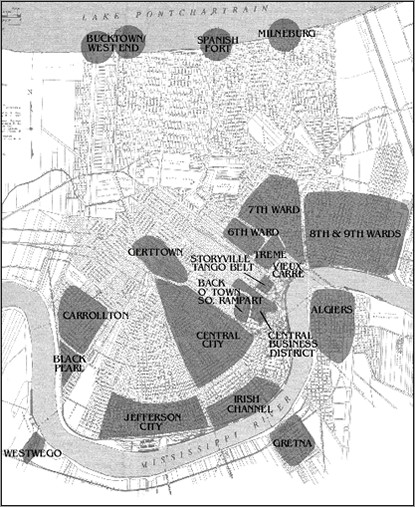
map of new orleans jazz neighbourhoods

nom2.jpg
This will make a lot more sense if you read more about it over here at the National Parks Service site. Yes, jazz + parks. It’s a strange American thing. Remind me to post about the Century Ballroom and its interesting relationship with the NPS.
If you’re digging on these maps, make sure you also check out the Louisiana maps, especially the historic ones.
I have been trying to ‘tour’ New Orleans via googleearth, but can’t quite figure it out. Will report back.
Can I add: MAPS! SKWEEE!

the trouble with linear jazz narratives + more

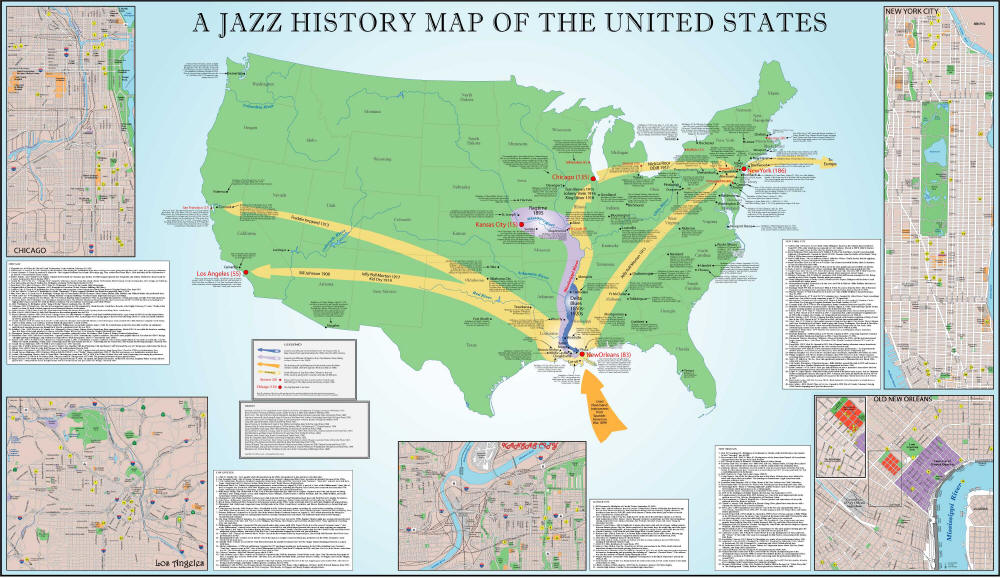
In the earliest parts of my researching into jazz history, I tried to set up a sort of ‘time line’ or map* of musicians and cities and bands. Who played with which band in what city at what time? Then where did they go? This approach was partly based on the idea that particularly influential musicians (like Armstrong) would spread influence, from New Orleans to New York and beyond.
But drawing these time lines out on pieces of paper, I found it wasn’t possible to draw a nice, clear line from New Orleans to New York, passing through particular bands. Musicians left New Orleans, went to New York, then back to New Orleans, then off to France, then back again to New York. The discographies revealed the fact that a band recorded in different cities during the year – they were in constant motion, all over America. Furthermore, musicians didn’t stick with one band, they moved between bands, they regularly used pseudonyms and even the term ‘band’ is problematic. The Mills Blue Rhythm Band, with its dozens and dozens of names, was in fact a shifting, changing association of musicians, and did not even have a fixed ‘core’ set of players. Perhaps this is why the MBRB is so important: many people played with them, and they were a band(s) which moved and changed shape, a loose network of musicians who really only existed as ‘a band’ when they were caught, in one moment, on a recording. Or perhaps on a stage (though that’s far more problematic). I wonder if that’s why it’s so hard to find a photo of them? Perhaps the ‘Mills Blue Rhythm Band’, as a discrete entity didn’t really exist?

The more I read about jazz and ‘jazz’ history, the more convinced I am by the idea of ‘jazz’ as a shifting series of relationships. I think about cities not as fixed locations, but as points on a sort of ‘trade route’ or even as a complicated web or network of relationships between individual musicians (which is, incidentally, how I think about international swing dance culture – the physical place is important, but it’s not binding).

Right now I’ve followed some references backwards to an article by Scott DeVeaux called Constructing the Jazz Tradition, which is really interesting. It not only outlines some of the political effects of a coherent ‘narrative’ history of jazz, but also the economic and social effects of positioning jazz as a ‘black music’, with interesting references to consequences of the ‘jazz musician as artist’ for black musicians. Read in concert with David Ake’s discussion of creole identity and ethnicity in New Orleans as far more complicated than ‘black’ and ‘white’, this makes for some pretty powerful thinking.
wm.jpeg
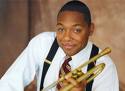
I’m very interested in the idea of a ‘jazz canon’ and of the role of people like Wynton Marsalis, the Ken Burns Jazz discography, jazz clubs and magazines developing during the 30s and 40s devoted to New Orleans recreationism and the whole ‘moldy figs’ discussion. The tensions surrounding the Newport jazz festival also feed into this: the Gennari article (which I discuss in reference to its descriptions of white, middle class men rioting at Newport here) pointed out the significance of a festival program loaded with ‘trad’ jazz – for black musicians and for the popularising of jazz generally. I’ve also been reading about the effects of this emphasis on trad jazz for superstar musicians like Louis Armstrong.

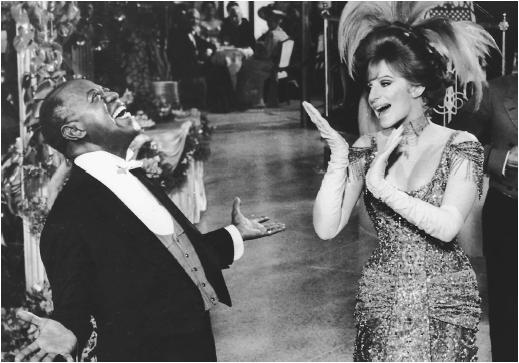
O’Meally and Gabbard have written about the way Armstrong’s public, visual persona is marked by ethnicity.
la.jpg
Armstrong was known for his visual ‘mugging’, or playing the ‘Uncle Tom‘ for white audiences, particularly on stage. Eschen writes

…as the struggle for equality accelerated, Armstrong was widely criticized as an Uncle Tom and, for many, compared unfavourably with a younger, more militant group of jazz musicians (193)

This, as Eschen continues, despite the fact that Armstrong was actually an active campaigner for civil rights in America, and overseas.

The trad jazz movement – or ‘moldy figs’ pushing for the preservation of an ‘authentic’ jazz from New Orleans – effectively pushes Armstrong to continue as Uncle Tom – unthreatening black man clowning for white audiences. A narrative history of jazz which emphasises a beginning in New Orleans and a consistent, clearly defined lineage of musicians and styles also, more subtly, relies on an idea of the black musician as powerless or unthreatening. DeVeaux makes the point that positioning jazz (and jazz musicians) as artistic loners who do not ‘sell out’ with commercial success:

Issues of ethnicity and economics define jazz as an oppositional discourse: the music of an oppressed minority culture, tainted by its association with commercial entertainment in a society that reserves its greatest respect for art that is carefully removed from daily life (530)

In this world, the ‘true’ jazz musician is ‘black’ (in a truly singular, homogenous sense of the world), he is poor and he is mugging for white audiences.
bh5.jpg
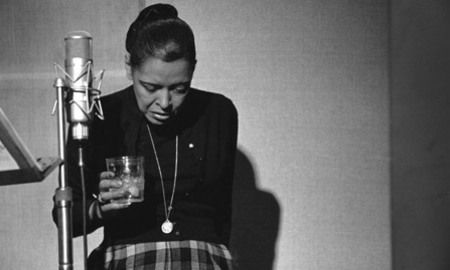
Billie Holiday becomes a particularly attractive representation for this idea of the ‘jazz musician’: poor, black, addled by drugs and alcohol, a history of prostitution, yet nonetheless, a creative genius pouring out, untainted in recording sessions (and I’m reminded of the ‘one take’ stories) and tragically cut short.
All of this is quite disturbing for someone who really, really likes jazz from the 20s, 30s and 40s. Am I buying into this disturbing jazz mythology? It’s even more disturbing for someone who found similar themes in contemporary swing dancers’ development of ‘narratives’ and geneologies of jazz dance history. As DeVeaux writes (about jazz, not dance), though, this is

The struggle is over possession of that history, and the legitimacy that it confers. More precisely, the struggle is over the act of definition that is presumed to lie at the history’s core (528)

I wonder if I should suspect my own critique of capitalist impulses in contemporary swing dance discourse?
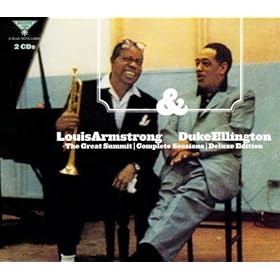
I don’t think it’s that simple. Gabbard discusses Armstrong’s work with Duke Ellington, including the filming of the 1961 film Paris Blues (in which Armstrong starred, and for which Ellington contributed the score) and the recording of the ‘Summit’ sessions:

…at those moments in the film when he seems most eager to please with his vocal performances, his mugging is sufficiently exaggerated to suggest and ulterior motive. Lester Bowie has suggested that Armstrong is essentially “slipping a little poison into the coffee of those who think they are watching a harmless darkie”.Throughout his career in films, Armstrong continued to subvert received notions of African American identity, signifying on the camera while creating a style of trumpet performance that was virile, erotic, dramatic, and playful. No other black entertainer of Armstrong’s generation “with the possible exception of Ellington” brought so much intensity and charisma to his performances. But because Armstrong did not change his masculine presentation after the 1920s, many of his gestures became obsolete and lost their revolutionary edge. For many black and white Americans in the 1950s and 1960s, he was an embarrassment. In the early days of the twenty-first century, when Armstrong is regularly cast as a heroicized figure in the increasingly heroicising narrative of jazz history, we should remember that he was regularly asked to play the buffoon when he appeared on films and television (Gabbard 298)

You can see a clip from Paris Blues here.
Armstrong’s performance gains meaning from its context, from the point of view of the observer, from his own actions as a ‘real’ person (Armstrong was in fact openly, assertively critical of Jim Crowism and quite politically active) and from its position within a broader ‘body’ of Armstrong’s work as a public performer. Pinning it down is difficult – it’s slippery.

The idea of layers of meaning is not only interesting, it’s essential. This physical performance of identity, tied to the physicality of playing an instrument reminds me of the layers of meaning in black dance. And of course, of hot and cool in dance, and the layers of meaning in blues dance and music. Put simply, what you see at first glance, is not all that you are getting. Layers of meaning are available to the experienced, inquiring eye. Hiding ‘true’ meanings (or more subversive subtexts) is important when the body under inspection is singing or dancing from the margins. Tommy DeFrantz discusses meaning and masculinity in black dance during slavery:

serious dancing went underground, and dances which carried significant aesthetic information became disguised or hidden from public view. For white audiences, the black man’s dancing body came to carry only the information on its surface (DeFrantz 107).

Armstrong’s performance is more than simply its surface. As with any clown, the meanings are more complex than a little light entertainment. Gabbard continues his point:

In short, Ellington plays the dignified leader and Armstrong plays the trickster. Armstrong’s tricksterisms were an essential part of his performance persona. On one level, Armstrong’s grinning, mugging, and exaggerated body language made him a much more congenial presence, especially to racist audiences who might otherwise have found so confident a performer to be disturbing, to say the least. When Armstrong put his trumpet to his lips, however, he was all business. The servile gestures disappeared as he held his trumpet erect and flaunted his virtuosity, power, and imagination (Gabbard 298).

This, of course, reminds me of that solo in High Society that I mentioned in a previous post. There’s some literature discussing the physicality of jazz musician’s performances, but I haven’t gotten to that yet (though you know I’m busting for it). I have read some bits and pieces about gender and performance on stage (especially in reference to Lester Young), and there’re some interesting bits and pieces about trumpets and their semiotic weight, but I haven’t gotten to that yet, either.

Sorry to end this so abruptly: these are really just ideas in process. :D
To sum all that up:

  • The idea of a jazz musician as ‘isolated artist’ is problematic, especially in the context of ethnicity and class. Basically, the ‘true jazz musician who doesn’t sell out by making money’ is bad news for black musicians: it perpetuates marginalisation, not only economically, but also discursively, by devaluing the contributions of black musicians who are interested in making a living from their music. Jazz musicians are also members of communities.
  • Linear histories of jazz are problematic: they deny the diversity of jazz today, and its past. Linear histories with their roots in New Orleans, insisting that this is ‘black music’ overlook the ethnic diversity of New Orleans in that moment: two categories of ‘black’ and ‘white’ do not recognise the diversity of Creole musicality, of the wide range of migrant musicians, of the diversity within a ‘white’ culture (which is also Italian and English and American and French and….), of economic and class relations in the city, and so on.
  • ‘linear histories’ + ‘musician as artist’ neglect the complexities of everyday life within communities, and the role that music plays therein. These myths also overlook the fact that music is not divorced from everyday life; it is part of a continuum of creative production (to paraphrase LeeEllen Friedland and to refer to discussions about Ralph Ellison – which I will talk about later on).
  • Music and dance have a lot in common. They carry layers of meaning, and aren’t simply discrete canvases revealing one, singular meaning to each reader. They are weighted down by, buoyed up by a plethora of ideas and themes and creative industrial practices and sparks.

References
DeFrantz, Thomas. “The Black Male Body in Concert Dance.” Moving Words: Re- Writing Dance. Ed. Gay Morris. London and New York: Routledge, 1996. 107 – 20.
DeVeaux, Scott, “Constructing the Jazz Tradition: Jazz Historiography” Black American Literature Forum 25.3 (1991): 525-560.

Eschen, Penny M. “The real ambassadors”. Uptown Conversation: the new Jazz studies, ed. Robert O’Meally, Brent Hayes Edwards, Farah Jasmin Griffin. Columbia U Press, NY: 2004. 189-203.

Friedland, LeeEllen. “Social Commentary in African-American Movement Performance.”
Human Action Signs in Cultural Context: The Visible and the Invisible in
Movement and Dance
. Ed. Brenda Farnell. London: Scarecrow Press, 1995. 136 –
57.

Gabbard, Krin. “Paris Blues: Ellington, Armstrong, and Saying It with Music”. Uptown Conversation: the new Jazz studies, ed. Robert O’Meally, Brent Hayes Edwards, Farah Jasmin Griffin. Columbia U Press, NY: 2004. 297-311.

Gennari, John. “Hipsters, Bluebloods, Rebels, and Hooligans: the Cultural Politics of the Newport Jazz Festival.” Uptown Conversation: the new Jazz studies, ed. Robert O’Meally, Brent Hayes Edwards, Farah Jasmin Griffin. Columbia U Press, NY: 2004. 126-149.

Lipsitz, George. “Songs of the Unsung: The Darby Hicks History of Jazz,”Uptown Conversation: the new Jazz studies, ed. Robert O’Meally, Brent Hayes Edwards, Farah Jasmin Griffin. Columbia U Press, NY: 2004: 9-26.

O’Meally, Robert G. “Checking our Balances: Louis Armstrong, Ralph Ellison and Betty Boop”. Uptown Conversation: the new Jazz studies, ed. Robert O’Meally, Brent Hayes Edwards, Farah Jasmin Griffin. Columbia U Press, NY: 2004.
276-296. (You can see the animated Betty Boop/Armstrong film O’Meally references here.

*The jazz map was found via jazz.com, but they don’t list the url for the map in context.
There’s something seriously addictive about historic ‘jazz maps’. I think it’s because they’re imaginary places. My latest find: New Orleans ‘jazz neighbourhoods’.

magazines, jazz, masculinity, mess

This is another in-progress bit of writing in response to things I’ve been reading lately. I’ve found some nicely critical engagments with jazz and jazz study, and am suddenly wishing I was in the US. This isn’t the most coherent of posts, partly because I lost part of it with an inadvertent page refresh. Shit.
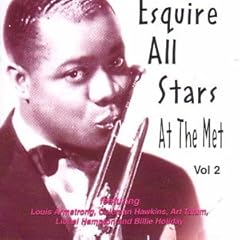
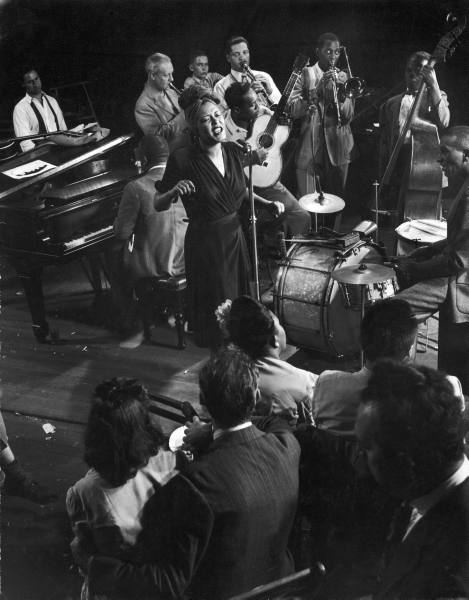
I’ve been thinking or wondering about the relationship between Esquire magazine and jazz, partly as a result of my work with the jazz discography (and following Billie Holiday). There were a few concerts in 1944 and 1945 featuring the ‘Esquire All Stars’ – a group of truly big names: Roy Eldridge, Jack Teagarden, Barney Bigard, Coleman Hawkins, Art Tatum, Louis Armstrong, Billie Holiday, Mildred Bailey and others.


There are some albums released from these concerts, including one interesting one called At the Met, the cover of which is particularly provocative when you consider the issues I raise below.

I’ve just found this in a paper about Miles Davis:

By the 1950s, American had become aware of subtle shifts in social and gender roles. Sociologists and psychiatrists were talking about men trapped in gray flannel suits, the age of conformity, the weakening of the superego, the other-directed person. The concern was that a new postwar economy was creating a society in which people were externally motivated, too well adjusted, too sociable. Scarcely concealed behind the jargon of social science was the fear that it was not women who were changing, but men, who were becoming soft, emotional, and expressive – that is, more like women rather than like the rational and task-oriented patriarchs who had built and protected America. More often than not, such ideas were dressed up as if they were the received wisdom of the ages, but their sources were transparently pop.
Elsewhere, Playboy magazine was wrestling with the same anxieties and assuaging them with a particular kind of male hedonism, promoting the good life for the single man: money, imported cars, circular beds, top-of-the-line stereos, chicks. And like Esquire before it, Playboy championed jazz, as a male music, to be sure, but the music of a certain kind of male, as the couture, decorations, and genderized illustrations of the jazz life in its pages made clear. Then there were the Beats, detested by Playboy, but sharing some of its fantasies by celebrating freedom, male bonding, drugs, art, and the hip lifestyle, one of their inspirations being the nightlife of the black musician (Szwed 183).

This article “The Man” discusses Miles Davis’ masculinity, positioning him in the 1950s as both ‘a man’ and as a jazz musician. There’s lots of talk about ‘masculinity’. We can also draw some conclusions about white, middle class men and their interest in black masculinity as some sort of ‘free’, ‘sensual’ and ‘vibrant’ ideal. Particularly in reference to the Beats.
It’s been interesting reading this article after one about the Newport Jazz Festival, “Hipsters, Bluebloods, Rebels, and Hooligans: the Cultural Politics of the Newport Jazz Festival” by John Gennari. Particularly in reference to this section:

At the Newport Jazz Festival on the fourth of July weekend in 1960, thousands of white youths described by Life magazine as “more interested in cold beer than in hot jazz” spilled from the jazz concerts into Newport’s downtown, attacking policemen, kicking in store windows, and manhandling the town’s residents and visitors. Press reports noted that many of the drunken rioters screamed racial epithets while rampaging through the town. State police used billy clubs and tear gas to stem the riot, then called on the marines for help in restoring order. When the air cleared, over two hundred of the marauders found themselves in local jails, while more than fifty of their victims required medical attention. One witness told the Providence Journal: I’ve experienced fear twice in my life. Once was in combat during World War II; the other was Saturday night in Newport.
Scheduled to end on Sunday night, the festival was ordered shut down on Sunday afternoon by the Newport city council. The last act was a program of blues narrated by Langston Hughes. Anticipating the city council’s action, Hughes penned a set of lyrics on a Western Union sheet. He handed them to Otis Spann, who sang them slowly as the crowd quietly departed.
Among a rash of press reports on the riot, one commentator blamed the allure of Newport, a “resort area which hold[s] a fascination for the square collegian who wants to ball without running the risk of mom and dad stumbling across his prostrate from on somebody’s lawn.” Mordantly noting the contrast between the Newport gentry “in the front row with their Martini shakers” and the youngsters “squatting in the back, their heads between their knees, upchucking their beer,” journalist Murray Kempton wondered, “Was there anything in America at once so fashionable and so squalid?” To many who had embraced Newport as jazz’s City on a Hill, a sterling model of New England Brahmin philanthropy, more disconcerting than the spectacle of loutish yahoos profaning the festival was the rioter’s identity. These were not switchblade-wielding rebels without a cause, nor pothead beatnicks in overalls. These ‘young hooligan herrenvolk of the Eastern seaboard,” as Village Voice jazz critic Robert Reisner dubbed the rioters, were students from the elite colleges, fraternity brothers on a fast track to the corporate boardroom. “You could tell the students from Harvard and Yale,” wagged one man on the street: “They were throwing only imported beer bottles.” (Gennari 127)

I’d previously thought about the Newport Jazz Festival in reference to the film High Society and the documentary film Jazz on a Summer’s Day, both of which suggest class tensions, but in the politest way. Neither references these sorts of middle class men rioting (!). In fact, JOASD is, as Gennari discusses, a more than a little arty, genteel and restrained. Here’s a gratuitous clip to illustrate:

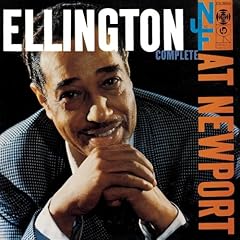
For many dancers Newport is significant for the albums recorded there by Count Basie and Duke Ellington. Gannari discusses the racial tensions at work in the Newport Jazz Festival, particularly in its later years and in reference to Louis Armstrong’s performance in JOASD which is a little too uncle Tom to be precisely comfortable (and Gannari complicates this with references to Armstrong’s own ability to subvert this stereotype). Unlike the idealised descriptions in Beat literature (including some sections in On the Road, which have always bothered me, especially when read in conjunction with Anne Petry’s novel The Street), in JOASD black masculinity is carefully contained.
I guess what I’m trying to do here is make some distinctions about representations of race and class in mens’ magazines, in music magazines and in films like JOASD. Mens’ magazines and Beat writers presented an idealised black masculinity with was free, undomesticated, independent – an artist unbound. Films like JOASD and High Society present black masculinity as safely contained as an item of novelty by the bandstand or (as in JOASD) safely receptive by chairs in the audience. Both of these disconnect them from the broader community of which they were a part… the communities, I should say.
I always think about stories about Nat King Cole in these sorts of discussions. About an anecdote I heard on a TV doco. Cole, financially and artistically successful, bought a large house in a wealthy white suburb. His lawn was set on fire/painted with racial epithets. Though he sought the trappings of middle class security, he was still tagged as ‘other’.
Let’s talk a bit more about High Society.

linky

This is my favourite part of the film. Armstrong is, effectively, the narrator of HS. It is his voice which anchors the film. I like the way he introduces us to Newport, and his presenting jazz as the most important part of this narrative. I like the casual setting of their playing – playing for fun, for their own enjoyment rather than for an audience. Armstrong’s story is for the guys in the band. I kind of like the idea of the band on the road because it echoes the idea of bands and jazz as music in transit. Travel and jazz are also buzzing about in my head at the moment (and I’ve talked about it before). Their place on a bus is interesting, too, as it clearly marks their class later on, when we see characters like Samantha zipping about in their flash, private cars. Again, buses are a space I think of as ‘public’, and I’m really interested in the way musicians and dancers make public places ‘space’ – they occupy it aurally and physically and socially, cutting down invisible lines between individual people with a song or a dance step.
But this contrasts with the following clip (one described in Gennari’s article).

linky

This is such a great song. And a fascinating scene. Armstrong and the band are actually introduced to the very white, very upper middle class Newport gentry by Crosby (I can’t remember why, exactly). The point is that they’re introducing this crowd to jazz. And, we can assume, to black musicians as more than servants. It’s pretty radical to have a white singer on stage with a black band, but not that crazy. The band are, of course, matching in their suits. The part I like most is where Crosby’s perfectly articulated, wonderfully modulated voice is upstaged by Armstrong’s badass trumpet solo. Crosby is perfect; Armstrong is perfectly badass.
This song is popular with dancers, but this version isn’t so great for dancing. It’s a little too mannered. There’s another version where Armstrong sings all the lyrics and the song, generally, has a little more kick. It makes you want to dance. I wish I could find it on the internet, but I can’t. Having Armstrong sing as well as play trumpet anchors the song in quite a different way. Armstrong is more comfortable with improvising, and the subtext feels a little saucier. There’s a greater element of call and response. And improvisation, of course, is the best way of escaping and adding creatively to a song without it collapsing into random noise.
This clip is significant for its role in introducing the Newport Jazz Festival to a white, straight crowd. And Newport was largely, as one of the promoters George Wein insisted, about popularising jazz. Or about introducing jazz to mainstream America. Debates about the types of jazz on display at Newport, about work practices, pay and the general culture of the festival during a period of Jim Crow legislation make it particularly interesting. Because, remember, the fact that Louis Armstrong and his band are sitting at the back of the bus is very important. Segregation meant that where they traveled and how they traveled and how they played music was managed by law. In this context, what does it mean for Armstrong’s solo to bust right out of the carefully mannered, modulated frame set up by Crosby and his ‘introductions’?
Of course, in the film HS the white crowd return immediately to ‘not-jazz’ music and dancing after the performance; this was a moment’s entertainment.
I’m not really sure where I’m ultimately going with all this, but there’s something niggling me about the connection between men’s magazines, masculinity in the postwar (1940s-60s) period, jazz and jazz performances – big jazz concerts in particular.I’ve also come across an interesting discussion of gender and masculinity in jazz by David Ake in the article “Regendering Jazz: Ornette Coleman and the New York Scene in the Late 1950s”. I’m also thinking about jazz clubs in the 40s and 50s, their (predominantly male) membership and their effects on the jazz scene. There’s something about big jazz concerts in there too, I think, that I have to follow up. Especially since I noticed just how many live recordings Billie Holiday did in the last decade of her career. The 50s saw her do a whole lot of television shows as well as large concerts, and recordings made from these. I want to follow up these ideas about the ‘popularising’ of jazz in regards to the status of jazz as ‘art’ music today. There’s a tension between ‘classic jazz’ as ‘art’ and later jazz (from bebop to avant garde) in the jazz literature that I want to explore, especially in regards to the Ken Burns’ documentary film Jazz. In fact, I always have something to say about that film, especially in regards to its positioning of the jazz musician as isolated ‘artist’, and jazz history as one of artists prompting cultural change. I am, of course, far more of the opinion that jazz was and is very much a product and process of community and local cultural context.
I know that there’s something to be said about individualism and masculinity and the freedom from consequences that comes from the idea that ‘jazz’ is about isolated artists without community responsibility and ties. How connected was that rioting by young, white middle class college men with a ‘freedom from responsibility’ associated with the black jazz musician by mens’ magazines and writers?
George Lipsitz presents the book Songs of the Unsung as an alternate history of jazz, one firmly embedded in local community, with jazz musicians as necessarily participating in everyday community life, rather than isolated with their ‘art’ in some rarified space:

Songs of the Unsung presents jazz as the conscious product of collective activity in decidedly local community spaces. The modernist city and the nation pale in significance in Tapscott’s account in comparison to the home, the neighborhood, and the community. Physical spaces far more specific than the ‘city’ shaped his encounter with music, and these spaces had meaning because they were connected to a supportive community network (Lipsitz 17)

I think I like this approach because I want to talk about jazz in the context of contemporary swing dance culture, where dancers read a history of jazz not as a history of art, but as a history of music for dancing. And this history of music for dancing as a collaborative, community history, perhaps too complicated to be told with a simple temporally linear narrative.
I was absolutely delighted to find this section in Lipsitz’s book:

Instead of modernist time, this would be a history of dance time, starting with ragtime, not as a showcase for the personal ‘genius’ of Scott Joplin but as a site where African attitudes toward rhythm (and polyrhythm) became prominent in U.S. popular culture. The difference between the rhythmic concepts in ragtime’s right-hand melodies and left-hand bass accompaniment and the genre’s additive rhythms (eight semiquavers divided into 2/3s and 1/2s) evidenced a tasted for multiple patterns at the same time that it opened the door for future rhythmic innovations. Rather than the era that gave to Dixieland and swing, the 1920s and 1930s could be see as a movement from the fox-trot to the jitterbug and the lindy hop. More than a away to distribute music more effectively to a broader audience, the development of electrical recording techniques would be seen as a shift that enabled bass and drums to replace tuba and banjo as the key sources of rhythm. Such a story would feature the tap dancing of John “Bubbles” Sublette, who was dancing “four heavy beats to the bar and no cheating” fourteen years before the Count Basie band came east and popularized swing. This narrative would honor the moment in 1932 when Bennie Moten began to generate a different kind of rhythm and momentum for dancers by replacing the banjo with the guitar and substituting the string bass for the tuba. The transition from swing to bop in this story would not focus on the emergence of the saxophone over the trumpet or the small ensemble over the big band as much as it would highlight how string bass players and frontline instrumentalists began to assume responsibility for keeping time so that drummers could be free to experiment with polyrhythms and provide rhythmic accents for soloists.
The distinctive creators of ‘dance time’ would not be the virtuoso instrumentalists of modernist time but rather virtuoso ‘conversationalists’ like drummer Max Roach and dancers Earl Basie (better known by his stage name, Groundhog) and Baby Laurence. (Lipsitz 22)

I’ll see how we go after a bit more reading…
Ake, David. Jazz Cultures. U of California Press: Berkely, 2002.
Gennari, John. “Hipsters, Bluebloods, Rebels, and Hooligans: the Cultural Politics of the Newport Jazz Festival, 1954-1960.” O’Meally, Robert, Brent Hayes Edwards, Farah Jasmin Griffin, eds. Uptown Conversation: the New Jazz Studies. Columbia U Press, NY: 2004. 126-149.
Lipsitz, George. “Songs of the Unsung: The Darby Hicks History of Jazz” O’Meally, Robert, Brent Hayes Edwards, Farah Jasmin Griffin, eds. Uptown Conversation: the New Jazz Studies. Columbia U Press, NY: 2004. 9-26.
O’Meally, Robert, Brent Hayes Edwards, Farah Jasmin Griffin, eds. Uptown Conversation: the New Jazz Studies. Columbia U Press, NY: 2004.
Szwed, John. “The Man” O’Meally, Robert, Brent Hayes Edwards, Farah Jasmin Griffin, eds. Uptown Conversation: the New Jazz Studies. Columbia U Press, NY: 2004. 166-186.
Many of these books are produced by members of the Jazz Study Group at Columbia. You can find some of their articles in full-text form online here at jazzstudiesonilne.org. It’s a fab resource.

waiting to understand what the other is doing

In the comments to my last entry, Jac writes that she likes the Billie/Louis duet:

It’s like listening in on a conversation… :)

And I replied

Yeah – that’s what I like about it. I think that’s what people like about the Ella and Louis duets as well – a conversation between really gifted musicians.
This is something I like about really good small group instrumentals as well – it sounds like a conversation between friends. The better the musicians, the better it sounds; they can echo and build on the contributions of others, keeping or building on the feel and topic. The Oscar Peterson trio do some really good stuff like this.

Reading through Ake’s book Jazz Cultures I’ve found this quote from Sidney Bechet about rag time:

Bechet made it clear that his joy and creativity were piqued when playing among musicians like those mentioned above who were his peers in improvisational-interplay abilities. And it was the continual challenge of creating sounds that complimented and inspired bandmates that he found to be most satisfying.

That’s the thing about ragtime… It ain’t a writing down where you just play what it says on the paper in front of you, and so long as you do that he arranger, he’s taken care of everything else. When you’re really playing ragtime, you’re feeling it out, you’re playing to the other parts, you’re waiting to understand what the other man’s doing, and then you’re going with his feeling, adding what you have of your feeling.

(Ake 33)

This is exactly the way I feel about lindy hop. When you’re working in a partnership, it’s not a matter of performing or completing choreographed moves. It’s about responding to your partner, ‘waiting to understand what the other is doing’. That’s what makes social dancing to live music so freaking damn good. You don’t know what’s happening next. You don’t know what the musicians’ll do next. You just have to listen and move and make it up and respond. It’s wonderful. Just wonderful.

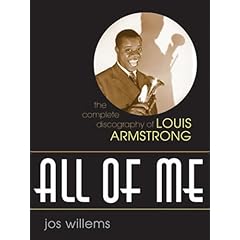
All of Me: The Complete Discography of Louis Armstrong

The Louis Armstrong bit of the jazz discography is really, really big. And that’s not counting all the entries with bands other than his own.
They have this neat discography in the library: All of Me: The Complete Discography of Louis Armstrong and I want it. It’s a beautifully produced book and something I know I’ll keep and use forever. It’s just a bit expensive (even in paperback).

billie and louis again

LA-BH.jpeg
In the spirit of my last post, have a listen to this lovely version of ‘My Sweet Hunk O’Trash’. It’s Billie Holiday and Louis Armstrong singing together a couple of years after that film New Orleans was released.

Recording details:
Louis Armstrong and Billie Holiday with Sy Oliver’s Orchestra: Bernie Privin (trumpet) Louis Armstrong (vcl) Sid Cooper, Johnny Mince (alto sax) Art Drellinger (tenor sax) Pa Nizza (tenor sax, Baritone sax) Billy Kyle (piano) Everett Barksdale (guitar) Joe Benjamin (bass) James Crawford (drums) Billie Holiday (vocal) Sy Oliver (arranger, conductor)
New York, September 30 1949
7543 My sweet hunk o’trash De 24785, DL8701, Br (E)05074, De (F)MU60363, AoH AH64, Br (G)10159LPBM
It’s a lovely example of two musicians playing with timing and phrasing. It’s a nice song, but it’s their delivery, their to-and-fro that makes it nice. The rest of the band isn’t terribly interesting; this is a song showcasing the vocals.
I probably wouldn’t play this song for dancers. The emphasis on the vocals means that you really have to listen properly to what they’re saying and how they’re saying it, and that’s not really something you can do when you’re dancing. It’s also really slow, not juicy enough for blues dancing, far too slow for lindy hop. The vocal showcasing means that the rest of the instrumentation is understated. There’s not much going on behind Louis and Billie. This can make for fairly dull dancing; when you’re dancing, you look for a range of rhythmic and melodic layers. The more aural interest, the more interesting the dancing. Sometimes it’s nice to dance simply, but when the tempos are this slow, you’re really looking for something more.
Having said that, there are worse songs you could play for dancers.
Btw, if you’re as concerned about the racial subtexts at work in New Orleans as I am, check out this article, which goes a little way towards addressing those issues (let’s not talk about my desire for ‘owning’ jazz just yet. This white girl knows she’s got some work to do).
I am currently reading my way (very, very slowly) through David Ake’s book Jazz Cultures. There’s a refreshingly sophisticated approach to race and ethnicity in this book, and though I’m only in the first chapter (I keep stopping to chase and note references), he’s already upsetting black/white dichotomies with a discussion of Creole music and culture in New Orleans and complicating issues of whiteness and blackness which are going a long way to reassuring me about jazz studies literature. I don’t have much to write about that yet, but I will eventually.

billie holiday and louis armstrong

This is a nice clip of Louis Armstrong (and amazing band) playing ‘Dixie Music Man’ from the 1947 film New Orleans.
The woman with the flowers in her hair is Billie Holiday. The band features Kid Ory, Bunny Berigan and Zutty Singleton (with others) – musicians I’ve been following through a range of bands lately.

This clip was posted by Rayned on faceplant, and it’s timely because I’m obsessed by Armstrong and Holiday at the moment. Yesterday I photocopied all the bits of the Discography referring to Holiday. I’m not going to even try that with Armstrong – there’s an entire, huge book devoted to his recordings alone.
bh.jpeg It’s fascinating to follow these guys through different bands. Both were really amazing musicians with a sense of swing that’s really incomparable. You can pick Armstrong’s trumpet in any recording, no matter how crappy and crackly. and Billie… her later stuff is really tricky to dance to because she’s so clever with phrasing and timing. Sometimes she’s so way, way back there behind the beat you’re sure she’s just about to be out of time completely. I like listening to the way she shapes a band when she’s singing with them – with live recordings. She can work around a straight, uptight band and make them sound like they’re actually hot. Same goes for Louis – these guys have a sense of timing that’s impeccable. Like really good comedians.

(‘Fireworks’, Louis Armstrong & His Hot 5 with Earl Hines, Zutty Singleton 1928)
For my money, Armstrong was really rocking with this small groups in the late 20s. This was a collection of great New Orleans jazz musicians, many of whom began with King Oliver, and most of whom moved on to Chicago and then New York (and further afield). I’m a massive fan of Kid Ory, but I’m also digging Zutty Singleton. I’m a bit of a nut for rhythm sections generally (I think it’s because I listen to this stuff as a dancer), and Singleton just keeps popping up in the bands I like.
hotfive.jpg

(That pic of the Armstrong Hot Five is from the Louisiana State Museum site, which is just fascinating.)
I was a little sceptical of the claims made about Armstrong’s Hot fives and sevens until I actually sat down and listened to them in chronological order – after the stuff he did supporting singers like Bessie Smith (! powerhouse combo, much? An example: St Louis Blues 1925)), after his work with King Oliver. But before his Orchestra stuff of the 1930s (some of which is a bit dodgy, I’ve found). I’m not really interested in his stuff after the 50s (though I bet I’ll change my mind on that too), and I really don’t like ‘Hello Dolly’ and all that vocal rot. I quite like him doing nice, silky groovy duets with Ella Fitzgerald (many of which included Oscar Peterson), but my real interest in his music is in his late 20s and early 30s stuff when you really hear his approach to timing and nuance signaling musical change: the swing era’s coming. But nobody else is really there yet.
hot5.jpg
(That pic of the Hot five to the right is from this interesting blog)
These Hot Five and Seven bands were really one of the the first real opportunities for Armstrong to experiment with music and musicians on his own terms in his own bands. I think the smaller group allows the sort of group or ensemble improvisation that you just can’t keep under control with a big band. The best example of this sort of improvisation usually comes in the final chorus when it sounds as though everyone’s doing their own thing (because they are), but are still working together, playing within a particular framework. That’s the sort of thing I LOVE as a dancer and DJ because it reminds me of lindy hop – improvisation within structure. I love playing this sort of stuff for dancers because the energy suddenly leaps in that final chorus, and you can end a song (or a set) on a high energy point. I especially love Fats Waller for this. He might begin with a quieter song whose clever lyrics make you listen up carefully, but he ends with a loud, raucous shouting chorus that makes you bust out like a fool on the dance floor.
In a smaller group, Armstrong lets the musicians play in their own ways, but still works as the lynchpin in a fairly complicated musical machine. The ensemble improvisation allows each musician to shine with improvisation, but still maintains a sense of group or collaborative wholeness; it’s not just random noise. The musicians were all amazing, including Louis Armstrong on trumpet, Lil Hardin (who became Lil Hardin Armstrong) on piano, Johnny Dodds on clarinet, Kid Ory on trombone and Johnny St. Cyr on banjo. The band’s membership changed a little, and the group also recorded as the Hot Seven (there are a range of other names for similar groupings, including a special Savoy small band). Additional musicians included Kid Ory (cornet), Lonnie johnson (guitar), Earl Hines (piano), Zutty Singleton (drums) and a few different vocalists (May Alix is one who catches my eye because she also did work with Jimmie Noone, who I love). The Hot Fives and Sevens recorded between 1925 and 1928 (you can read more about the Hot 5 here on redhotjazz.com).
Just in case you’re wondering where the Billie Holiday talk is…

I really like this recording of ‘Fine and Mellow’. The musicians are, of course, amazing. It’s from 1957, when Billie was already more than a little trashed by drugs and alcohol. But she really was a phenomenal singer. Even as her voice became more and more ragged, her technique and sense of music were indefatigable. The Decca collection liner notes mention that she was the sort of musician (or artist is the term I think they use) who used one or two takes to record songs. She could simply get it right the first time. As the liner notes say, she had an idea of how she was going to do the song, and then she did it. Holiday didn’t have the length of career that Armstrong did (he was recording from 1923 (at least) til 1971), she had only a couple of decades), but her music spread from that hot, swinging jazz moment in the 30s and the pop/ballad/jazz feel of the 50s and 60s.
And of course, I’ve just written a post which presents the history of ‘jazz’ in terms of two ‘artists’. But I think it’s important to note that Armstrong’s Hot Five were just that – five (or seven, or six) musicians working together. The collective improvisation is really important, this isn’t the showcasing of solos of the swing era. This is a group of people working and listening together to make something together. Holiday’s work as a vocalist was primarily as a response to the bands and musicians she was working with. Her close friendship with Lester Young is perhaps the best example. There’s plenty of anecdotal (and evidence based) discussion of their musical collaboration as a process of listening to and learning from each other. Young is often quoted as being most inspired by vocalist’s technique. Holiday is often referred to as emulating Young’s saxophone technique. Their musical relationship was indubitably one of collaboration and mutual inspiration. After all, it’s very difficult to be a jazz musician all on your own.