sour grapes

Reading this rant here (and it is a rant, and I do think we should all allow ourselves the luxury of ranting on our blogs – that’s the delight of self-publishing, no?), my immediate thought was “that’s a bit rich.” I mean, the author is one of those young-gun rock star type American academics. She’s sporting a whole lot of academic and social privilege which plebs like myself really don’t have access to.
I also thought “hey, I have a paper in that journal!” And I am, I must admit, extremely excited about my article (it’s a nice one about YouTube and dancers and I’m quite proud of it). It’s not in that special issue of the journal, though it was initially accepted and later politely knocked back (I guess it was bumped for some rock star, right?). As I said, I’m feeling quite chuffed about being in this journal – it’s an International, donchakno? So I’m not all that cool reading that post – what does that make me, sister? Some sort of publisher’s stooge (I wish, I wish – I am so ready to be some publisher’s stooge).
So reading that article, I was a little bit… pooped. I mean, I don’t really think it’s all that cool to snub the very source of a serious part of your cred and status. That’s the action that’s getting her a career. That’s the action that’ll help me get a permanent job (anyone else just loving these semester-by-semester positions? Empowering, no? Terribly punk, yes?) and fund my future jazz spending (wait, I’ll tell you about today’s presents later). That’s the stuff that’ll make the past…15 years of work mean something.
I’m sorry, homegirl, you can’t go making those sorts of calls without expecting some sort of kick up the bum… or perhaps just a polite throat clearing and measured response.
This one by Anne is my favourite so far. I also like Jason’s comment on the original article and his blog entry. You can chase the other responses around the internet yourselves, but you can see the sorts of responses that sat bestest with me.
I think, from my position here, as:

  • casually employed lecturer
  • unemployed researcher
  • just-finished-(no corrections! – sorry, but I need to remind myself at times like these) PhD-person
  • self-employed article-writer and book-maker (oh yes, I can’t help but squeeze those papers out – it’s like blogging: must share, look-at-me-look-at-me-look-at-me!, God, am I the only one?)
  • serial paper-giver/self-humiliator

I’d be kissing internet arse, making like I was the biggest bitch o’ the establishment ever if I was in that position.
I mean, isn’t that the scam? We get in there, softly, softly, then we make with the rabble rousing on the quiet, like?
And, finally, the other immediate thought that I had when first reading that initial post was, “hells bells, woman, we’re working in universities, not Médecins Sans Frontières“. Yes, it’d be really nice to think that we were actually out there making people’s lives wonderful, fighting the good fight and all, but at the end of the day we’re working within institutions whose primary goal is to institutionalise people. And to make money. I think it’s a little naive to think that universities now – if ever! – have ever really been about freeing minds, making jiggy with the knowledge and all. I know it’s a wonderful idea, but in practice… let’s be realistic here. Researching and writing in universities is privileged stuff. It’s not easy – it’s damn hard work, especially for n00bs – but it’s pretty freakin’ good work.
And sure, let’s say our academic articles are suddenly free and available to the whole universe. Does that mean that they’re suddenly also well written, accessible and meaningful to most people? I don’t think so… There’s far more to be done to make academic work the people’s work than simply avoiding old school journals. And I do feel that there’s some sort of …arrogance? to the idea that just because our academic work’s out there in the ‘public sphere’ that people’d actually want to read it. Pft. I don’t think so. You know they’d really rather look at kitties. I had that idea when I started in on my PhD work. But maybe that’s just dancers – no time for academic wankery.
…I can’t help thinking about this as I type this. I might be one of those types.

(insert dumb pun about listening to me here)

I’ve been thinking about this in relation to dancers. I’m not sure if dancers are really where they’re heading with that project thought – I think that’s a bit serious and got some political work going on. Dancers just seem kind of … frivelous in comparison. But perhaps that’s interesting in itself. Perhaps it’s worth talking about listening as ‘fun’ as well in terms of participation in serious public discourse.
But I’d like to write about ‘listening with the body’ and the way dancers (especially DJs) listen to music with an ear to dancing. And how partner dancers share the way they hear the music by getting in closed position (and open! because lindy hoppers are badass and don’t need closed to communicate!) and just feeling the way the other person is moving their body. And the truly wonderful, amazing thing about partner dancing is that this isn’t conscious – if we had to stop consciously think ‘hm, how is my partner feeling the beat here?’ the whole thing would collapse. It’s about training your muscles to respond automatically to physical stimuli.
Here’s an example: one of my first ever yoga classes the instructor was pushing on my back, right about where the leader puts their hand. He said “stop pushing back – let me push you into place”. I didn’t even notice that I was pushing back – it was just a matter of, as a follow, my ‘giving back what I was getting’ – returning equal pressure to make a nice connection. So I had to learn to let him move my body about without returning pressure.*
Any how, when you’re partner dancing, you’ve got all this stuff going on in your body, unconsciously. And then the music starts. And your lead ‘sets the tone’ of the relationship/partnership for the dance – they tell you how they feel the bounce (nice and big and Swedish? Miserly and American? Horrifically absent?), and that bounce is the easiest way for you to keep in time – you bounce along to the beat. The harder the music swings (ie the less on-the-beat-abrupt-yuck it is – the longer the delay between beats, the more time squeezed out of every beat), the more time you have to do deeper bounces (this is where I just can’t articulate it – it’s something you have to see and feel), etc etc.
And because you’re a team, you give back an idea of how you’re feeling the music. If they’re a great lead (which is congruent to being a great person in this instance), they’ll respond and incorporate your feeling into the partnership, so it’s not all one-way.
And all this before you even move! You’re still in place just checking each other out, ‘listening’ to the music.
And it’s even more complicated it it’s live music – the band is feeling each other out, they might be checking out the dancers…
It’s all very interesting. Improvisation makes music so much more fun and challenging – anything can happen. So you all have to have really nice connection so you can communicate. You’ve all got to be giving back what you’re getting. Equal pressure.
Any how, I think it’s interesting. And I’m going to send in an abstract, but I’m not sure they’ll dig it. We’ll see.
I’m finding people think my dance stuff is kind of hippy dippy. I feel like one of those fruit loops you meet at conferences who give papers about…, well, that weirdo, completely off-the-wall, nothing to do with anything stuff. I think people hear ‘dance’ and think the way they do when they hear ‘ficto-critical’. But most academics simply don’t dance, ever. And most have never partner danced more than once or twice. And that’s especially the case as the last generation of ackas retire. It kind of proves my point, though – anyone who dances regularly doesn’t think ‘woah, fruit loop’. They give dance as much importance as music or visual texts…
…after all, how come we’re all so keen on words and less interested in nonverbal communication? I mean, I’m not that much of a hippy dippy type. I don’t have any time for crystals or faith healing or past lives. I mean, I even find improvised ‘arty’ dance discomforting (“I’m a tree, I’m a flower!”).
…ok, now I’m ranting and being mean about hippies. I guess I can’t get on that wagon if I grow my own veggies (go tomatoes (even if you are eating my clothes line)! go mutant lettuce refugees! go unbelievable amounts of passion fruit!) using compost from the compost bin (go incredible fertiliser!), don’t bother with makeup or leg shaving (w the goddamn f?), don’t understand high heels and take less time getting ready to go out than The Squeeze. And that no car/love bike thing? Not exactly pushing me to the mainstream.
But come on – you know what I mean when I’m talking about the fruit loop types. That’s not me, ok? I’m, like, TOTALLY normal! Rrlly!!1!!
*aside: this is where I feel ‘compression’ comes from – you give back the pressure your partner gives you (unless they’re super-tense, but that’s a different story). For the equilibrium made by that equal-return of pressure to become them actually moving you, you allow the pressure to build up until it sort of ‘tips’ you over into moving. It’s really hard to explain, but it’s not a matter of just immediately doing as your partner moves you – you have to return the pressure until you reach the point of ‘critical mass’ where they then initiate movement. There are all sorts of other things going on (including what they’re doing with their bodies – are they moving their body weight?), but it’s sort of working around that idea.

teaching tools

So I’m all lined up to do some serious teaching next semester. The bit that I’m most interested in is coordinating the subject I did last semester. I’ll be able to put together a reader that suits what I’m teaching, I’ll get to rework some of my weaker lectures and tutorials, and I’ll be able to redo the assessment. There’s lots of admin work involved, but I’m actually not too bad at that stuff – MLX has made me strong. Plus I quite like the ob-con-ness of sorting and organising and making lists.
One of my first jobs will be getting some feedback from the sessional staff who taught with me on that subject last year. I want to know what worked, what didn’t, what they’d like to see on the subject (or ditched).
The next job will be working through the lectures and reworking the weeks – dumping the dumb stuff, strengthening the good stuff, adding in some useful stuff that was missing last year. I’m aiming for your basic intro to media studies/communications/cultural studies subject, including some really safe, useful ‘textual analysis tools’ (this is something the department really wants), some stuff about media industries and some stuff about audiences. I’m (mentally) dividing the subject up into those three parts (n those that order), and hoping to have three manageable (and hopefully cumulative rather than discrete) pieces of assessment to go with each (though that’s something that needs to be discussed).
I’d like a reader that had a greater emphasis on Australian cultural/media studies (especially in reference to the industry stuff… for obvious reasons), and including some more up-to-date readings (ie not stuff from the 80s… unless it’s something particularly important or awesome).
I’m also keen on strengthening the weekly tutorial exercises. I’m ordinarily not the hugest fan of this stuff, but this type of weekly mini self-assessment is important and can be really useful. Putting together a comprehensive weekly exercise (which isn’t too long) is also a nice way of making sure I structure my lectures properly (which I’m kind of anal about anyway), make the readings really relevant and giving the students an idea of the most important points in that week’s topic.
All this is for a first year subject, so I have to keep it pretty simple. It also has to work as a ‘teaser’ for later subjects – it has to convince these guys in the general arts degree that media studies/cultural studies/communications is fun and interesting and useful.
I’m a big fan of multimedia components in the teaching and learning tools, but I was very unhappy with webct last year. I’m not sure it’s a good idea to get into moodle or another hardcore online teaching tool. But I do think it’s important to have some sort of online component, particularly for teaching across campuses, and teaching students who don’t spend much time on campus.
I am thinking about just using a plain, simple blog. Something like this one (but obviously not this one) which is super easy to navigate, allows me to embed youtube clips, add in useful links, upload lecture notes, etc. I do have reservations about uploading lecture notes to a public forum, though. This is where it’s actually a good idea to have a site where you must log in to get the good stuff.
I have considered other options like druple (bllurgh) and plone, but if I’m going that way, I really think I should use something designed for teaching – like moodle or webct. But I don’t think it’s a good idea to have students learn how to use a whole new system/site, just for one subject. And I’m not keen on learning myself – it’s not really worth the effort.
I also think it’s a good idea to use sites that students are already comfortable with. For obvious reasons. This of course leads us straight to faceplant and myspace. But I’m not happy with faceplant. I don’t want to encourage students to use such a massive data-gathering business tool.
There is, however, the google option. Google docs is something we’re considering using for MLX this year – a central collection point for files and discussions and email and things. But once again, it does require students learning a new system, signing up for new accounts and so on.
So my questions are:
– is it ok to use a blog where the lecture notes are public? My feeling is no.
– should I use something like plone which can have a public ‘face’ yet also requires students to log in to access notes?
– should I just suck it up and use webct?
All of this is very interesting and quite exciting. I’m looking forward to teaching with confidence material I know well, and to being able to strengthen what I’ve already done without starting from scratch. It’ll also be nice to not be working to such a full-on, heinous schedule, writing lectures as I go through the semester.

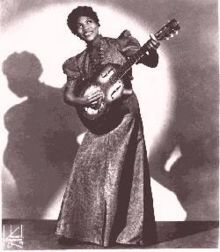
retuning for white audiences – more sister rosetta tharpe

RT.jpg
Helen has asked for specific details about the tuning of Tharpe’s guitar in her comment here. Below is a big fat quote from an article called ‘From Spirituals to Swing: Sister Rosetta Tharpe and Gospel Crossover’ by Gayle Wald (published in ‘American Quarterly’, vol 55, no.3 September 2003), pgs 389-399. This is where I read that note about Tharpe’s tuning – hope it’s useful, Helen.
Wald’s article is mostly about Tharpe’s movement from black gospel music to the white jazz/blues/pop mainstream. Tharpe is taken as an example illustrating wider points about culture and music during this period. It’s a really interesting read.

Although Tharpe arrived in New York already highly credentialed in Pentecostal terms, Sammy Price, Decca’s house pianist and recording supervisor at the time Tharpe recorded “Rock Me,” apparently wasn’t feeling any of this joy. Tharpe, he recalled in his 1990 autobiography, “tuned her guitar funny and sang in the wrong key.” In all likelihood Price was referring to Tharpe’s use of vestapol (sometimes called ‘open D’) tuning popular among blues musicians in the Mississippi Delta region. (Muddy Waters is among the many blues guitarists, for example, who learned vestapol technique in the 1930s, when he was growing up in Clarksdale, Mississippi.) As common as it was in the South, however, vestapol tuning could sound distinctly crude and out-of-place in the context of northern jazz bands. By his own account, Price, who later went on to record several hits with Tharpe, refused to play with her until she used a capo, the bar that sits across the fingerboard and changes the pitch of the instrument. “With a capo on the fret,” he explained, “it would be a better key to play along with, a normal jazz key.”

Price’s brief story of the carpo as a normalizing technology is rich with implications for the discussion of what ‘crossing over’ to the realm of popular entertainment might have meant for Tharpe. Resonant of southern black communities and of musicians who honed their craft in churches as well as on back porches – musicians Hammond quite unself-consciously called ‘unlettered’ – Tharpe’s ‘funny’ guitar playing introduced, to Price’s ear, an apparently unassimilable element into the prevailing sounds of urban jazz. It’s also possible that Price was demanding that Tharpe sing at a higher pitch, to conform with popular as well as commercial expectations that high pitch evidences a correspondingly ‘higher’ degree of femininity. In any case, and as Price suggests, Tharpe quite literally had to adjust her guitar and singing techniques to make commercially popular, ‘secular’ records that would earn her an audience beyond the relatively small market of consumers of ‘religious music.’ The ‘makeover’ of Tharpe’s sound also has important gender and class implications less obvious from Price’s comment. In bringing her sound more into line with the sounds of commercial jazz, Tharpe would not only have to change her tuning, but ‘change her tune’ as far as her performance of femininity was concerned.

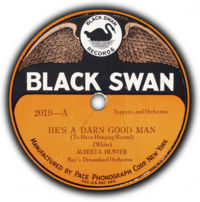
bslabel.jpg
The ‘Hammond’ referred to in the article is John Hammond, an important figure in the promotion and management of a number of big jazz musicians. Gunther Schuller’s book ‘The Swing Era’ reads almost as a history of Hammond’s career. I think it’s important to note that this one white man was important for his influence on the developing jazz and swing music industry. His selection and then promotion of specific artists shaped the recording industry, popular tastes and the white mainstream’s understanding of and access to black music during this period. As the race records and black-run radio stations were forced out of the industry by white competitors and blatantly racist media regulation, black artists had less and less control of their own representation in mass media, and black musical culture was mediated by white corporate and cultural interests.
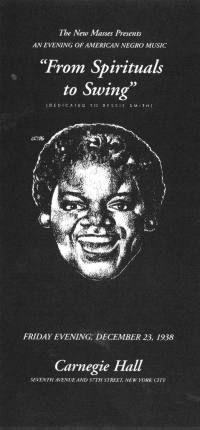
fsts.jpg
All of this makes for fabulous, fascinating reading. It is, though, all about America. I’m not sure how much (if any of it) can be translated to the Australian context. But that would make for interesting research in itself, particularly when you keep in mind that jazz in Australia is necessarily the product of cultural transmission – black music filtered through mainstream American recording and sheet music industries to white mainstream audiences and musicians and white Australian musicians and audiences. Sure, there were musicians making jazz in Australia (people like Graeme Bell of course), but I’ve been thinking about ‘authenticity’ and jazz in such a transplanted context… particularly as I’ve read recently somewhere (goddess knows where – I’d have to retrace my steps) that music tends to reflect the vocal patterns and intonations and rhythms of the culture in which it develops. So, we could draw from this the conclusion that we Australians would play jazz with an Australian accent. It wouldn’t sound like American – or black American – jazz. I’m hesitant to make comments about the relative value of localised jazz, but it’s an issue hanging in the background there…
But back to Hammond. John Hammond of course organised the concert ‘From Spirituals to swing’ at Carnegie Hall in New York in 1938 (you can see the artists here, in a recording of the concert) . This concert featured a bunch of super big artists (Jimmy Rusher, Joe Turner, Mitchell’s Christian Singers, Albert Ammons, Sidney Bechet, Count Basie, Benny Goodman). It’s goal was a combination of musical ‘education’ for the white mainstream and – indubitably, considering Hammond’s impressive business sense – promotion of black music to new white audiences/consumers.
I’m interested in this concert and in Tharpe’s cross-promotion to the mainstream as an example of cultural transmission – I’m fascinated by the way music and dance move between cultures. I’m also really interested in the uses of power in this process. Is it appropration? Stealing? Poaching? To quote (ad nauseum), Hazzard Gordon, we have to ask “who has the power to steal from whom?” when we’re looking at this process.
I”ve been writing about the way different cultures not only ‘take’ dance steps or songs from other cultures or traditions, but also the way they then adapt these ‘found’ texts to suit their own cultural/social needs, values, etc.
I’ve argued all through my work that we can see the social heirarchy of the US in the reworking of dances and songs. What did they need to do to make these texts palatable for white audiences? With Tharpe it was ‘retuning’ her guitar and voice. With lindy hop, it was ‘desexualising’ and ‘tidying’ up the basic steps. Or at least presenting a different type of sexual performance.
Some interesting references
There’s a really great page discussing race records that includes audio files, images and written text here on the NPR site.
There’s also a pbs (US) site attached to the Ken Burns Jazz doco discussing race records.
For a (very nice) academic discussion, see David Suisman’s article called ‘Co-workers in the kingdom of culture: Black Swan Records and the political economy of African American music’ (The Journal of American History vol 90, no.4, March 2004, p 1295-1324) which discusses the ‘race records’ of the period and the racialised nature of the American recording industry.
You can also walk through this article via the JAH’s fantastic site (complete with images, sound files and other wonderful things). This is one site that really ROCKS.
Derek W. Vaillant has written a really interesting article about black radio in Chicago in the 20s and 30s which discusses these issues in greater detail (‘Sounds of Whiteness: Local radio, racial formation and public culture in Chicago 1921-1935’, American Quarterly vol 54 no. 1, March 2002 p25-66).
Katrina Hazzard Gordon has written quite a bit about African American dance culture. Here are a couple of references:
Hazzard-Gordon, Katrina. “African-American Vernacular Dance: Core Culture and Meaning Operatives.” Journal of Black Studies 15.4 (1985): 427-45.
—. Jookin’: The Rise of Social Dance Formations in African-American Culture. Philadelphia: Temple University Press, 1990.
Read more about John Hammond, look at photos and listen to music here on this Jerry Jazz Musician page.
Wald, Gayle. “From Spirituals to Swing: Sister Rosetta Tharpe and Gospel Crossover” American Quarterly vol 55, no.3 (September 2003): 389-399.

i can has female role model?

My hormones are rumbling, and I’m beginning to feel a little self-doubting.
This year’s plan is as follows:
1. (semester one): make book.
2. (semester two): make teaching and/or research.
But things have gotten complicated. I’ve been offered different work by different university departments. Teaching? I has it. Exploitative first year tutoring? I choose not to has it. Researching? Hmmm. Interesting repeat teaching of last semester’s Mega Teaching Experience, offering op to rework lectures and tutes and general Make It Gooder? I think I choose to has it.
Book? Oh, yeah, it’s harder than it seemed. Rewrite? Why? It was a perfect thesis – there were no corrections needed! And what if I break it? Rewrite? But how? I mean, what exactly should I do? How should I do it? This rewriting – what exactly do you mean by that? Publishers. Yes, well. I choose Routledge. I choose them because it is an Impossible Dream, and we are in proximity to the Big Dream type stuff. Don’t hold your breath though, homies – could be a long wait. There may be some resistance to my Choice.
And then, of course, there’s the long, unbroken future spent tappa-tapping away at home, on my own, far, far away from other academic types. Trapped in a kind of netherworld, the Land of Far Far Away from Institutional Support. But also the land Relatively Close To (but not actually in) An Early Career.
I’m finding I’m more than a little needy with middle aged women academics. I’m looking for validation. For direction. For sound advice and useful criticism of my written work. I want pencilled comments in the margin of my work. I want an hour of uninterrupted Me Time with someone I admire and respect (and whose entire function, during that hour, is to listen to me, be interested in me, and most importantly, let me know how I’m going). I don’t really know how to do this sort of larger project all on my own. Not only is the writing style I’ve spent 4 degrees and about 15 years perfecting almost completely inappropriate, every word I write seems to scream ‘Feelings of inadequacy! Lacks confidence in own thinking! Overly defensive!’ It’s like I’m reading the internal monologue of a young woman dancer from the local McDance school. GoDAMN this whole over-achiever thing. I am hopelessly institutionalised and no longer capable of functioning on my own without a role model.
All these feelings are of course the product of my rampaging hormones. Premenstrual anxiety and self doubt? I HAS it.
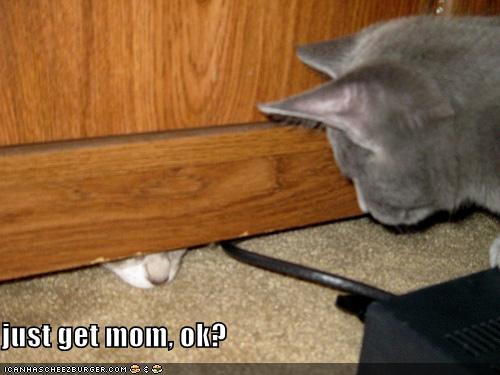
This lolcat has, consequently, assumed disproportionate importance in my life:
matriarch.jpg

feeling a little traumatised

by difficult French films?
There is only one solution:
noflavah.jpg
Also having difficulty imagining the dissertation as a book, so rereading markers’ comments, just to remind me that I don’t completely suck. Academia = way great fun.
…and I’m finding editing the Transformers pages on wikipedia very satisfying. I know nothing about the Transformers universe, I can’t figure out what the articles are actually about because they’re so badly written, but I am feeling immense satisfaction in rewriting them. Soon, though, I will know everything about the Transformers. Just ask me.

let’s say no to perforations

Three interstate trips in one month. No more, thanks. Conference, christmas and a funeral. Brisvegas was interesting and I quite liked seeing it – it’s changed, I’ve changed, so it’s kind of nice that we could get together again after seven years and find that we had lots to talk about and quite liked each other.
Acclimating to mega-humidity? Tick.
Family visited, without incident? Tick.
Old mates visited. Tick.*
It is hot today, and I have cleverly booked in an appointment with the doctor for another ear inspection. It’s becoming an annual thing. Well, something I do a few times a year, actually. I have had enough of not being able to hear properly – it makes me irrationally furious, inciting Shouting, Stamping and Offensive Language. So I will have them irrigated today at 3. When the ambient temperature is about 40 degrees C. I’m hoping it will soften the wax and aid its removal.
I have plans for films to see, and I have started thinking about redoing the thesis. I have decided that it will now be known as The Book rather than The Thesis. I will start thinking about fonts immediately, as that is obviously the most important part of the process. Pav articulates my current feelings about the project quite nicely. As an ob-con type person, proof reading and editing is really the best place to site my natural abilities and interests. Serious Tidying will commence in a few hours, once this post is written, a cup of tea made, and a little clothes mending completed.
What fillums have I seen lately? Well, one of the most pleasing was Paul Verhoeven’s Starship Troopers. I hated this when it came out, but now, after a few years of Howard government, it makes a lot more sense. It’s also part of a recent spate of early 90s sci-fi fillum delightfulness, after we watched Total Recall the other night. In discussion with a fellow nerd yesterday afternoon, I realised that they’re both actually Verhoeven fillums, and that’s probably why they’re both so wonderfully specrappular. Having read this type of SF as a Young Person, first discovering the Adult part of the family bookshelves (at about the age of 11, when carefully scanning the Adult stuff for the least hint of sauciness), these two fillums really capture the mood of terrible authors like Peirs Anthony. It’s lovely, teenage stuff, and absolutely low-brain. So that’s a tick tick and a V.G. from us.
ITMFL.jpg
Last night on SBS I also stumbled over In the Mood for Love, a Kar Wai Wong film that I absolutely love. I keep hoping their relationship will end well, but it never does, no matter how many times I watch the film. I love the obvious stuff – the colours, the framing of shots, the slo-mo, the soundtrack, the almost-love-affair ness of it.
Let’s have a look at a couple of PR shots:
ITMFL2.jpg
ITMFL3.jpg
And just in case that’s not enough, here’s the trailer:

I think I might have a Thing for Tony Leung. My Thing for Maggie Cheung continues.
This new Thing is only fuelled by the immanent arrival of Ang Lee’s latest film, Lust, Caution, which I’ve heard has heaps of hot sex, which I know will be an absolute visual feast, and which I’m terribly excited about. I’m thinking about special preview sessions on Friday day. It also stars Leung, which is very nice, and Joan Chen, who I also love (you might remember me crapping on about this stuff a little while ago in this post). I have rewatched Lee’s Sense and Sensibility in preparation. Because no one does suppressed lust and caution like Austen.
The nicest part about catching this film last night was discovering it’s part of an SBS series screenings of films by the cinematographer Christopher Doyle. The worst part was realising I’d missed Hero. Dumplings is on Wednesday 23rd January. I’m not sure if the others have already been on or not, but the SBS search function on their site sucks a bit, and I can’t be bothered figuring it out. Guess I’ll have to go to the video shop. Oh wait, our video shop SUCKS, so that won’t work. Guess I’ll be the last kid on the block to get into it, and use Netflix/Quickflicks.
Additionally, I also missed the first episode of Skins, a new series by the doods who made Shameless. And that’s a big poo.
Well, think of me as I make it by PT (it’s probably too hot to ride) to the doctor this afternoon, and pray for my ear drum. Let’s say no to perforations.
*twice in a year! Dang, we’ll have nothing left to talk about next time!

acma’s report on families, gender and media technology

I’m sorry I don’t have time to write something clever, but I thought some of you would be interested in this. It’s ACMA’s “Media and Communications in Australian Families 2007” report. I’d seen a few news articles about it, but have only just had time (because it’s boxing day and I’m home alone while the family are out buying stuff) to actually look through the report. If you can’t be bothered reading the whole report, check out the the press release for an overview.
There are, of course, some concerns about the sample size, etc, though it’s presented as a having used a representative sample (only 750 responses, but that’s actually not too bad, considering), I’m concerned about the issues of class etc tied up in the sampling process.
But if you read the report, there are some interesting points:

  • Around 70 per cent of girls aged 14–17 have a MySpace or similar profile,
    compared with 50 per cent of boys.
  • Almost two-thirds of girls use a mobile phone, but less than half of boys do.

Interesting stuff there, about gender and media use. My interest is caught by the fact that girls are more likely to use technology with an emphasis on communications. I do think, though, that it’d be worth exploring the communicative, collaborative potential of gaming. Apparently boys spend more time gaming than doing things like MySpace, and one of the definite appeals of things like WOW is the option of real time, collaborative play. Which of course, involves real time, collaborative problem solving and communicative ‘work’. Which is, of course, one of the functions of ‘gossip’ – real time, collaborative communicative work where participants explore potential ‘solutions’ or ‘answers’ or ‘reasons’ for interpersonal ‘problems’ (ie ‘maybe he cheated on you with her because she puts out?’).
I also wonder about the significance of literacy. Young people make greater use of online technologies as they get older – as their literacy skills improve. And I wonder about girls’ preference for text-based media. Is there perhaps a correlation between girls’ literacy and their social media use?
It’s all very interesting and definitely worth exploring.
The report itself has some problems – the same comments about ‘watching violence on telly making kids violent, which is actually quite difficult to substantiate. Violence is far more complex an issue than can simply accounted for by watching violence on telly. So, you might be more likely to ‘use’ violence on telly (whether for models for your own violence, or as inspiration or energiser) if you’re already living in a violent home, if you’ve had experience with violence, or if you’re otherwise vulnerable. So there’s a confluence of factors contributing to incidences of violence, and it’s inaccurate to say that ‘watching violence on telly makes you violent’. So this report doesn’t seem to have taken that into account.
There are also a few, similar problems about ideology and lifestyle – still the idea that ‘technology has an effect’ or that there’s a causal relationship between media technologies and social behaviour. We don’t approve of that, over here in the lefty cultural studies media studies feminist corner.

copying is easier than creating

Mz Tartan has posted a post about conferences that applies quite nicely to lindy exchanges. So I will now infringe her intellectual copy rights with some select copying and pasting.

  • thinking of holding a conferencen exchange? Best not. It is a far, far better thing to receive conferences exchanges than to give them. I can’t really remember what people actually said the dances I had, in most cases. I do vividly remember various people telling me that it is incredibly anxiety-producing to organise a conferencen exchange. That’s the truth. And all the while one is industriously producing anxiety one is well aware that the anxiety is ridiculous: one is not actually the person whose academic standing DJing or dancing has attracted people to this event, nor the one behind the microphone giving the talk good oil which is being intently listened danced to, let alone the person who wrote these exquisite novels songs and/or dances in honour of which everyone has gathered.
  • But here is a specimen of the type of situation which feeds anxiousness. I did not mention this en blog at the time, but back in April of this year, I came into my office one morning to find six or seven messages on my answering machine from a person who seemed to be saying she’d showed up at LTU on the weekend for the conference, and she was standing outside the venue right now and could I call her back straight away to tell her why nobody was around – where it had been moved to? Oh, and she’d come from Italy to attend. FROM ITALY. I was DJing at set in one room when the DJ from the other appeared at my side to ask where the DJ for the set following his was at. Can you imagine the abyss of horror which opened up beneath me? Can you? I’m sorry, but you can’t. The original call for papers, sent out eighteen months earlier, had indeed mentioned this weekend as the probable date, but we’d changed it very quickly to coincide with the English Teachers’ meeting. And of course nobody else had turned up. And of course ALL the subsequent promotional stuff very clearly gave the proper date. And of course it is incredible to simply turn up to a conference without at least re-checking that it’s on, or even attempting to register, or looking at the conference website. Yet, still, here she apparently was. FROM ITALY. All of the DJing rosters had been sent out ages ago and approved by all DJs concerned. We did manage to find the DJ (asleep somewhere), but it was a near thing, and yet another opportunity for public humiliation before an audience of my peers and international and interstate guests.
  • She apparently turned up again last Friday afternoon. The person on the conference desk said she’d appeared and wanted to know where her name tag was. Then we lost track of her again. I would have liked to sight her, from a safe distance (from inside a bird observation hut perhaps) but it was not to be…next time, no doubt.
  • If, in spite of this potent warning, you still want to do a conference n exchange, overbook your speakers DJs. Out of thirty-five two dozen, two will withdraw for good reasons and in plenty of time for you to make other arrangements; two will courteously let you know that they won’t be coming in time for you to pull them out of the program, one will pull out a week before, and one will pull out by email at 6:24pm on the evening before the day their paper set is scheduled at 10:45 1:30 am. This person will be emailing you not from the Australian city where she resides, but from a country that is nine hours’ flight away. How did she get there? you will wonder. Didn’t it occur to her as she got on the plane….etc
  • The sick feeling you will acquire as you contemplate what looks like the complete disintegration of your carefully assembled program will make it impossible for you to write play your own paper set with any degree of competency, so you will withdraw it, bash it out any way thus making you feel like a total hypocrite and poser. Nevertheless, there will actually be more than enough papers DJs, and you will eventually realise that all the agonising and your own self was were unnecessary.
  • Don’t cancel the wildlife tour/shopping tour/olden days architecture tour. It is what the internationals are looking forward to. You may think possums/shopping/old buildings are boring, but they do not.

Despite the extreme anxiety of previous MLXs, this year wasn’t actually all that bad. The above are really just par for the course, and what I think of as ‘inevitable screw ups’. The issue becomes not whether or not they happen, but how you deal with them when they do happen. The difference between a conference and an exchange, though, is that a couple of hundred dancers are there to have fun, and it takes quite a bit to dissuade them of their intent. Conference attendees, however, have a few more issues going on, and can be far less forgiving.
I only had one freak out during MLX, and that was on the Thursday of the weekend. My good friends and hostees took me for cake and I got over myself and it.
I find that the very most important thing about coordinating a dozen or so events over one weekend for a few hundred visitors is to remain calm. Freaking doesn’t help. I also have a rule: “no shouting”. Unless you’re shouting with delight. Shouting at people is never productive, and definitely not when the shouter is feeling angry/upset/etc. Remain cool. If you do feel a good shout/cussing out is in order, take it out the back so as to avoid broken furniture, exorbitant bar tabs and embarrassing guest DJs.
I have another solid rule: say thank you to anyone who has in any way been helpful, kind, accommodating, interested or otherwise a force for good rather than a force for inertia*. It doesn’t hurt to say thank you three or four times, but it does hurt if you don’t say it at all. Saying thank you makes you feel good, too, and so it’s a win-win deal for everyone involved.
And another rule (which is related to the previous): volunteers are the most valuable creatures at your event. DJs are generally a bit precious and high maintenance (with exceptions!), rock star dancers are a pain in the freaking arse (organise exchanges for beginners – they’re far less annoying) and fellow organisers can drive you nuts. But volunteers are gold. Love them, respect them, buy them drinks, thank them, squeeze them and underwork them. They will come back next year and figure out how to work the vacuum cleaner all on their own again.
*yes, I know.