
We’re teaching a bunch of Al Minns and Leon James stuff at the moment, so I’m revisiting a lot of fun footage. Al Minns worked with people like Lennart Westerlund in the earliest days of the lindy hop revival. We hear a lot of stories from these revivalist dancers about how they discovered the old timers, so I especially like the way that story is tipped upside down in Al’s description of the Swedish Mafia in this video: (linky: Al Minns Part 2 (the story of the Sweds))
Category Archives: academia
want play music
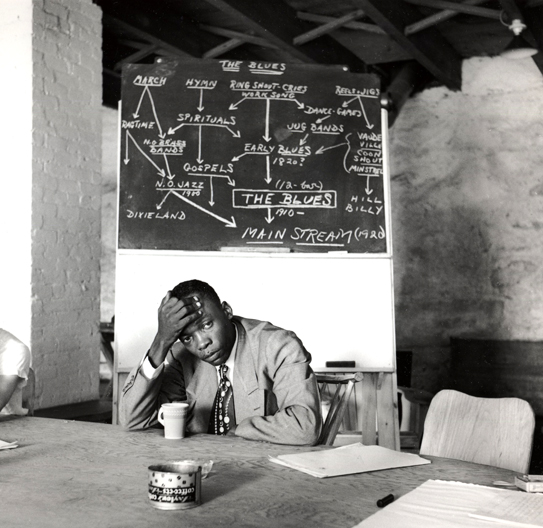
(John Lee Hooker, 1951, photo by Clemens Kalischer, found on Chasing Light)
[I’m DJing at the Jook Joint on Thursday. It won’t be like this. Bedlam Bar, 2 Glebe Point Rd, social dancing starts 8.30.]
stamp stamp (clap clap) jump jump
The ordinaryness of the everyday and blues dance
In a post on FB, Chris asks
Charm’s Question of the 1st of June:
Blues dance draws from a rich cultural well, a constant evolution of the dance and rapid socio-economic changes.What elements of vintage Blues dance culture (sordid and scandalous though they may be) need to be incorporated into the modern dance form while coupled with more professional dance training?
Disappointingly, I think I’m more interested in children’s rhyming songs, skipping ropes and household chores.
I read this as I was writing that last post The Rules of Connection: I think about pedagogy, lindy hop and ideology, so I ended up replying to Chris with this fairly off-topic and annoyingly preachy comment:
I have some troubles with the way ‘professional dance training’ is often defined or practiced.
I don’t accept the premise of this question: that ‘professional dance training’ (as it is defined and practiced in most of the modern swing/blues/whatevs world) is an integral part of blues dancing or learning to dance. I’d probably ask ‘how might dance pedagogy and learning dance (the two are not necessarily codependent) today draw on the history of blues dance (and music)?’ or, in SamTalk: “What can I use from the history of blues dance to become a moar orsm dancer?”I’m actually very interested in dance as a point on continuum of everyday rhythmic movement, rooted in history and culture (which I think dance is often separated from by ‘professional dance training’).
So I like to chase down ideas about moving your body in rhythmic ways which aren’t necessarily dancing. It’s about training your brain and training your body.
eg I think this video is a good tool for thinking about and physically learning about rhythm, swing, delay, etc: http://youtu.be/2vy0dMXhlWI
This one for thinking about rhythm, timing and performance: http://vimeo.com/20853149
Or this one for ideas about rhythm, partnership and athleticism: http://youtu.be/bDOBcBKRENw
It’s an interesting question, because it’s actually asking (I think):
How can we use history (of blues dance and music) in modern teaching practice?
Which is almost exactly the question I ended up asking in that last post (The Rules of Connection: I think about pedagogy, lindy hop and ideology). How do we use history in modern dance teaching? This is something I’ve written heaps about. Heaps and heaps. I’ve gotten angry about the way some dancers and teachers insist on male/female partnerships because ‘that’s how it was in the old days’ (yes, there were male/female partnerships in the old days, but ALSO LOTS OF SAME SEX PARTNERSHIPS). I’ve gotten angry about dancers and teachers insisting that we should wear vintage clothing (shoes, dresses, suits, whatEver) because ‘that’s how it was in the olden days’ and ‘it makes you dance more better’. My standard response, at a higher level is ‘I can dig historical stuff, but I don’t want to recreate all of the history. I like having access to a good doctor, a dentist, clean drinking water, the right to own property and fucking awesome running shoes.
So I reckon we can assume that ‘just recreating’ the past isn’t really what we want to do. Well, it’s not what I want to do. That last post began to explore how I think about using history in teaching actual dance movements: I am unsure and still figuring things out.
As a dancer myself, I use historic photos, stories, footage and music to help me think about how to move my body, and what my body looks like.
- In Things I want to talk about: #dance I mentioned the way I use historical dance to empower me, as a woman dancer.
- I’ve started thinking about costume (specifically wearing menswear, as a woman) lately in posts like Totes dandy worthy, right? (helped along by fellow dandy-philes and peeps like lindy shopper who did this sweet post How to be a lady dandy).
- I talked about learning solo dance as empowering in I vant to be alone.
- And I found the Women’s History Month posts from 2011 very exciting, because they gave me a chance to focus on women dancers through history, finding excellent role models, but also excellent examples of different types of dancing bodies to learn from.
- And then I’m really into copying male dancers (like Al Minns or Frankie Manning) as a way of playing with gender as a woman.
- I’m also 100% into learning historic solo jazz routines, not only to develop my dancing skills, but also to furnish me with a wider, more historically grounded repertoire of moves. And these moves, of course, teach me how to move, and how to think about movement in more sophisticated ways. Mostly because, those olden days dancers? They were fucking hardcore, and everything we do today is pissweak in comparison.
In all these examples, historical footage, photos and stories are really important to how I think about learning to dance, how I think about choreography, how I think about music and how I think about getting DOWN on the dance floor. I can borrow from history (textual poaching, yo!), but I don’t have to seek to recreate it exactly.
So in that response to Chris’s question on FB, I wanted to side-step a discussion of formal teaching processes by referring to LeeEllen Friedland’s discussion of a continuum of cultural practice.
I can’t find a copy of her article online, so I had to look it up in my thesis notes. This is what I wrote about learning to dance in vernacular dance cultures:
In vernacular dance culture, acquiring dance knowledge and learning to dance, developing “new steps” and becoming conversant with dance floor politics is not a formal process conducted in dance studios, but a matter of acquiring life skills particular to a community. Sheenagh Pietrobruno argues that vernacular dance is created in a “lived context”, and is:
not formally learned but…passed on from generation to generation. Most people who grow up with the dance acquire it in childhood, its movements often taught indirectly through the corporeal language of the body, so that those raised with the dance may not have a sense that they have learned it. Dancing usually is done to music: there is no separation between the rhythm of the music and the steps of the dance (1).
Pietrobruno’s discussion of salsa is equally relevant to a discussion of African American vernacular dance, particularly as salsa – as a Cuban-identified dance – has strong cultural links with African American dance, as do many other vernacular dances of the Americas.
Pietrobruno introduces her discussion of teaching and learning salsa in Montreal by emphasising the position of vernacular dance within the everyday, and learning to dance as an everyday activity, rather than a ‘special’ event bracketed off into designated dance spaces. In this way vernacular dance across cultures is bound to live music and other vernacular cultural practice, it is communicated across generations and it is an extension of ‘wider cultural expression’:
The salsa that develops in a lived context involves more than a series of steps and turns: dancers execute movements with their entire bodies. The subtle, but essential elements of the dance, such as how dancers hold their bodies, move their heads, position their hands and isolate various body parts are rooted in motor control and movements that are extensions of wider cultural expression…A child may be formally taught specific footwork and turn patterns of salsa, but picks up body isolations by experiencing the family dance culture, similar to acquiring everyday gestures. Although these subtle separations of parts of the body may seem effortless to the outside viewer, their performance involves a great deal of skill and dexterity. Individuals of Latin descent, who are dispersed throughout the Americas, often learn the dance as an extension of their heritage (1).
Learning to dance in a vernacular dance culture is a process akin to learning to speak. Children acquire ‘vocabulary’ – dance moves – through imitating adults, through play, and everyday activities. The process of gaining discursive proficiency requires constant and everyday experiments with communication. Families, peers, and other groups and individuals in day to day life contribute to a child’s acquisition of dance skills.
Friedland explores the acquisition of dance skills in vernacular dance culture in greater depth in her article “Social Commentary in African-American Movement Performance”, where she discusses the role of dance in urban black children’s lives in Philadelphia. Though researched in the 1970s and 80s, Friedland’s work is as applicable to communities of dancers in the 1930s in Harlem as it is to black dance culture in Los Angeles today. Friedland makes several key points in her work. Firstly, and most importantly, she states that dance in African American communities is not segregated from everyday activity. Dance movement itself is part of a “complex of interrelated communicative and expressive systems that constitute a whole world of artistic performance” (138). These systems include body movement, sound (including music), visual forms (including drawing and wall art, costume and hair style), language (including slang, rap and poetry) and ‘attitude’ (including ethics, creativity, aesthetics and social behaviour). Participating in all these systems is central to black children’s lives, Friedland argues, and is, it is implied, equally as important to black adults.
This continuum of creative cultural practice, and the continuity of themes and interpretive and creative practices across media and practices is reflected in the cultural practices of contemporary swing dance communities. Study of contemporary swing dance culture suggests that the older a community, the more varied its inter-community networks, the more diverse its borrowing from other cultures, the more sophisticated its own cultural practices and shared systems of meaning. This point has directed my attention towards DJing, audio-visual media and dance pedagogy in contemporary swing dance culture, as an exploration of the ideological relationships between cultural practices and media use in a particular community. As Friedland suggests, systems of meaning in dance are not discrete. They are constructed intertextually, echoing broader ideological and discursive structures within that community.
It is therefore unsurprising to find vernacular dance, as part of a system of cultural practices connected by ideology and social networks, is not only ‘performed’ on stages, but also in competitions or even on the dance floors of balls or social dances. Friedland makes her second, and perhaps most important point, that dance and dance movement are part of everyday life and movement in vernacular dance, and that dance carries with it social and cultural meanings and relationships. Both Friedland and Pietrobruno therefore argue that ways of dancing are extensions of cultural ways of being. Friedland in particular extends Pietrobruno’s point that dance “movements …are extensions of wider cultural expression” (Pietrobruno 1). The discussion of dance movement as a subclass or an extension of the notion of ‘dancing’ in Friedland’s work encourages us to expand our conception of ‘dance’. Movement – ‘body language’ – is not simply a visual illustration of spoken language. Dance and rhythmic movement are part of a wider system of cultural production and communication as viable discourse and communication in themselves.
Dance and rhythmic movement are therefore as important in the African American culture Friedland describes as spoken and written language is in mainstream Australian culture. She discusses a range of categories of dance movement, from ‘being rhythmic’, to ‘dancing’ and ‘movement play’. These categories are seen as testing grounds for children’s developing ‘dance’ or ‘movement’ repertoire, and concurrently, their social and cultural repertoires. Friedland discusses black children’s ‘learning to dance’ as a process of enculturation, where children are not only taught formal steps from older children and adults, but also encouraged to move in particular ways, and to read the movements of others on particular terms. This approach encourages us to think of dance and movement not as innate or essential abilities, but as learned cultural expressions.
The mythic association of African Americans with ‘natural rhythm’ and expressions like ‘white men can’t jump’ (as discussed in Jade Boyd’s article “Dance, Culture, and Popular Film: Considering Representations in Save the Last Dance”) are reframed by Friedland’s work as racialised, essentialist statements about ethnic identity and culture. Dance discourse and ways of moving are learnt rather than innate. They are culturally determined. With this in mind, we can draw on a range of dance studies literature to make observations about how dance movement and dance culture cross-culturally function as discourse.
So, with all that in mind, I figure that to really understand blues and lindy hop and all those historical dances, you really have to think about everyday cultural context. As a white, middle class woman living in Sydney in the 21st century, I’m never going to be able to truly recreate those original cultural conditions. And it’s a bit silly to try, as I don’t want to, not even if it meant becoming a brilliant dancer. But it does mean that I’m very interested in childrens’ games and videos like Stop Clap Go:
I’m also interested in adaptations of children’s games like doubledutch in a postcolonial/multicultural/disapora context:
And I think we can learn useful things about rhythm from everyday movements and activities:
(linky)
References
Friedland, LeeEllen. “Social Commentary in African-American Movement Performance.” Human Action Signs in Cultural Context: The Visible and the Invisible in Movement and Dance. Ed. Brenda Farnell. London: Scarecrow Press, 1995. 136 – 57.
Pietrobruno, Sheenagh. “Embodying Canadian Multiculturalism: The Case of Salsa Dancing in Montreal.” Revista mexicana de estudios canadienses, Vol. verano, No. 3, Jan. 2002, pp. 23-56.
The Rules of Connection: I think about pedagogy, lindy hop and ideology
Once again, Bug’s Question of the Day has my brain working.
Recently there was a paper published in Research and Dance Education on “frame matching” where it is proposed that there is a “universal” methedology of lead/follow that can apply to all partner dances.
http://www.joeandnelle.com/assets/frame_matching_and_pted_by_joe_demers.pdf
However is it really Universal? I often hear complaints from blues dancers about “Lindy Connection”, and likewise from Lindy Hoppers about how “heavy” blues connection is.
Likewise, some say that the concepts of frame matching are different for different dances anyhow.
So, do the concepts of frame matching really apply universally to all partner dances?
Do these efforts help codify Lindy and Blues at least to the level of tango, or at least is a step in the right direction?
Or is it simply another step in the evolution of partner dancing in the swing/blues genres?
Wednesday 30th May
(full article reference: DeMers, Joseph Daniel, “Frame matching and APTD: a framework for teaching Swing and Blues dance partner connection,” Research in Dance Education (2012).)
I have lots and lots to say about this article. But I can’t fit them all into one post. Well, I could, but this post is already reeeeally long for a blog post. Only 2.5 thousand words, which is way short for a journal article (~5000 words). So I (may) return to this topic later, in other posts. Or not.
Sadly, DeMers’ article triggered my ‘marker’s brain’. Reading this, I’d assume the author was an undergraduate or in the early stages of a postgraduate degree (in the arts or humanities). But the author has a background in science, education and educational psychology, so I should be a little easier on him, as those fields don’t pursue such rigorous approaches to critical inquiry. But if you’re publishing a journal article, you really need to step up, yo. There are some problems with written expression which occasionally obscure the author’s point. There are problems with the construction of the argument as well as with the communication of this argument: it is too simple, and does not exhibit sufficiently rigorous critical engagement with the topic.
In other words, it is thinking in short, straight lines, rather than around corners and back and forth. My background is in cultural studies, which is all about thinking round corners. Further, I was into feminist cultural studies, which is about thinking around corners, asking difficult questions and refusing to shut up when some fuckwit tells you you “think too much.” So I’m sorry, DeMers, but this is going to be a fairly close criticism of your piece. But, before I get into it, I need to ask: “should I read scholarship from the dance world the way I read academic articles?”
I think there’s a clear cultural divide between the way arguments are constructed and communicated in the university world and in the dance world. In the latter, consensus, cooperation and empathy are valued far more than a ‘right’ answer. I think that this is – largely – a result of the influence of Frankie Manning, a man who was determinedly disassociated from local scene politics. His emphasis on the idea that ‘for three minutes you are in love with your partner’, on ‘bowing to the queen of the world’ and on humility make it clear that he felt dance (‘as the happiest thing on earth’) is about peace and fraternity, not conflict. I’ve found this approach frustrating when reading about his responses to racism in the American south in the 30s and 40s in particular (because I do think dance is a vehicle for radical political resistance as well), but I also deeply admire it as a truly pacifist response to cultural and physical violence. What better way to combat hate, than with love?
Writing this response, I was struck by a conflict in the two methods of discursive engagement I’ve used in the past. In the academic world, a forceful, even aggressive tone was important as a woman writing in a patriarchal, highly regulated and heirachical discourse. But in the dance world, where a harsh word or aggressive line has immediate real world consequences and runs in direct conflict with the ethos of international lindy hop ideology (ie Frankie would not have liked it). I’ve lately decided that one of the reasons I didn’t like academia very much was that it privileged aggressive, combative discourse. I feel that part of being a feminist is (to clumsily paraphrase Germaine Greer) to practice fraternity as a response to patriarchy.
So I’m going to try to do like Frankie did. But I’m also going to remember Norma Miller and her fury. Speak up, but be gentle. Mostly.
So let’s get to it. Let me engage with the article, point by point, with the fundamental premise of this article (this has gotten too long for just one post, so I’m just going to do one thing here).
The piece presents “frame matching” as a
codified theory of partner-dance connection (abstract, pg 1)
. Ok, yeah, that’s not such a problem. If you’re ok with the whole concept of ‘codified’ dance practice. In this context a ‘codified theory’ is a ‘set of theoretical rules or guidelines’. So this paper is establishing a set of rules for teaching and practicing partner dance, specifically in terms of connection (part of me wants to argue that there’s very little in partner dancing that isn’t about connection, whether you’re touching your partner or not). There are some useful aspects to this approach. As DeMers points out, adopting a code
…gives instructors a framework for creating a well-organized partner-dance curriculum, and gives them a means of assessing students’ working knowledge and execution of connection (pg 3)
This is such an appealing notion. Right now, as I’m trying to figure out exactly how I teach, and what I want to teach, the thought of a formal, fixed and reliable teaching tool kit is just so tempting. It’d be so much easier to just discover this foolproof, ‘right’ way of teaching the ‘right’ stuff. But this sort of approach also rings my alarm bells. I’ve done a heap of courses focussing on pedagogic practice in tertiary education over the years, and one of the most exciting ideas was that of the teacher as a guide to learning. Rather than adopting a ‘chalk and talk’ approach (where the teacher stands at the front of the room, dispensing knowledge), the student-centered class room sees the teacher (or tutor) as facilitating the student’s discovery of knowledge. Inherent to this approach is the idea that each student learns in different ways, and has different interests. By god that’s hard work. It’s really hard to work with thirty unique hoomans with thirty different ways of learning (all of which are changing constantly). Teaching would be SO MUCH EASIER if I could just pretend students were standardised units. And yet, that idea is also REALLY SCARY because it means that there’re also very wrong ways of teaching. PRESSURE!
Most usefully for me – as both a postgraduate learning to tutor and lecture and now as a dancer learning to teach dance – this student-centered model does not assume the teacher carries all the learnz around inside them. Rather, the teacher encourages and assists students in their discovery. For me, this means that I don’t have to be the cleverest person in the room, or the best dancer on the dance floor. I do have to be the person who manages the group, who guides the discussion of concepts and challenges (whether in verbal discursive exploration or in physical exploration), who encourages and supports new ideas and new ways of thinking. Granted, it’s fairly important for a teacher – in both a dance class and a university tutorial – to know a heap of things. But there will always come a point where the student reaches the edges of the teacher’s knowledge, ability, or experience.
For me, the most empowering thing I learnt about teaching was that it’s totally ok to say “I don’t know the answer to that. Why don’t we find out together?” It’s the same with dancing: I need to know some things, but it’s ok for me to reach a point at the limits of my physical ability or experience and then say “I don’t know why that works like that. Why don’t we find out together?” The delightful thing about dance is that it requires whole-bodied experimentation through play: lindy hop and swing music are all about having fun while learning stuff. One of the things I like most about lindy hop (and I extrapolate from DeMers’ work to assume that he feels his code can be used across the panopoly of jazz and swing era dances) is that it prioritises individual improvisation. Making stuff up. Breaking rules. But in a social way.
This is why I’m not entirely ok with the idea that we need a codified approach to dance practice or dance pedagogy. It presupposes a final, finite rule book for how we teach, how we learn, and how we dance. And that doesn’t sit well with me. I’d be heart broken to discover that everything there is to know about dance had already been written down. For me, the very best part of teaching has always been that moment when a student presents an idea that had never occurred to me (or anyone else), or moves their body in a way that is utterly unique. Suddenly I’m inspired and excited about teaching and learning. Hoomans are amazing: we are wonderful and surprising. I don’t want to forestall that with dancing rules.
In a practical sense, though, accepting that different teachers teach in different ways, and different students learn in different ways makes good financial and promotional sense. I work within a large dance scene with lots of teachers. I’ve realised that students don’t come to class and stay with that class just for the dance knowledge they’re developing. They come because they like that class’s culture (the people in the room, the way they interact, the physical space, the music, and so on and so on). In a market crowded with ‘dance experiences’, it makes sense to differentiate, to offer something unique. We are all teaching lindy hop (well, mostly… :D ), but we all teach in different ways.
The most powerful promotional tool we have at our disposal is the effective communication of that difference. Dancers’ best promotional tool is their own dancing body: we attract new students who see us dancing at public gigs; we attract existing dancers who want to learn ‘new’ things when they see us dancing in competitions or performances or on the social dance floor. But we also make extensive use of online, paper and face to face media and promotions. We have developed a language for selling our teaching, and this language is not politically or ideological neutral or ‘just descriptive’. The way we talk about dance and articulate what we feel in dance expresses the way we think about dance, and about our dance partners.
Arthur Murray’s pedagogic practices worked on a premise in direct opposition to this ‘diversity rocks’ idea. The assumption was/is that dance a) could be codified; and b) that it could be sold as a consistent, quality-controlled product in many different venues by many different people. It was a profoundly effective way of selling dance. But it was also a profoundly effective way of stifling individual creativity and the development of social dance practice as a living, breathing, changeable art.
I think about this approach as being the McDonalds approach to dance. Sure, you get the reassurance of consistent ‘food’, no matter where you are in the world, and the model ensures a high food safety standard. But that consistency has led to a preponderance of factory-farmed product where that quality is controlled by chemicals and cruel farming practices. The mundaneness of this consistency is countered with unnatural sensory experience: extra salt, extra sugar, extra fat, all efforts to replace the pleasures of a simple, authentic ‘flavour’ with artificial ‘taste’. Sometimes that’s how I feel about aerials: if your basic swingouts and footwork and rhythms are dull and pedestrian, you need air steps to make it interesting. This is why Skye Humphries and Todd Yannacone and Naomi Uyama and Ramona Staffeld and Frida Segerdahl and Lennart Westerlund are so amazing: they don’t need air to excite your palate (though they can certainly bring it if they need to).
I’m a big fan of the Montessori or free school learning and teaching model. I’d like to be able to encourage students to discover their own way of moving and expressing themselves, where they try to figure out what they love, and how they feel, and then work on expressing that with their bodies. There are physiological limits to what we can do with our bodies, but because all our bodies (and lifestyles) are unique, the bodies we work with are all unique. So the dancing we do, and the ideas that we have, are all unique. And that is what I think we should be working towards.
I have similar feelings about teaching dance. I recently organised a workshop weekend here in Sydney with some visiting teachers. We had one day of general workshops, and one day of ‘teacher training’. The teacher training was set up in two parts. One session where dancers worked on their own dancing specifically to improve their teaching (eg looking at how clearer lines or sharper footwork made it easier for students to see how the movement worked in demonstrations). The second session more a ‘skill share’ session where everyone shared their favourite teaching tools, asked specific questions about how other people taught particular things, and then experimented with these.
The presumption in this day of ‘teacher training’ was that the dancer/teachers involved were all skilled professionals with unique ways of working. The session was not to enforce a ‘preferred’ teaching code or to ‘improve the standard of teaching’, but to encourage reflexivity in teachers’ practices. To share ideas so that each teacher (and teaching partnership) could refine and develop their teaching practice in their own way. Inherent to this was the idea that teaching practice is mutable, flexible and responsive to the students’ needs, and to the teachers’ interests and needs. In other words, teaching different things in different ways to different people by different people. The end goal was of course unique pedagogic cultures and practices within the broader dance scene. Organic, gmo-free, visually unique, sensorily exciting.
I think the sessions went well, for a first-run. I had good feedback from participants (and I like to encourage all sorts of feedback), and from what I observed in the session, people enjoyed the experience. I do think that it takes time to learn how to participate in this sort of session, and that it takes a degree of trust: you need to trust your peers to support your ideas and not dismiss them. So I’d think that you’d really need to do this a few times to get the best results.
I have seen this approach used by other dance scenes and at other dance events. But my problem with some of those models is that though they ostensibly encourage individualised teaching practice and dance, they effectively maintain hierarchies and power. Most specifically, some of the people involved are established as ‘authorities’ and the collaborative setting is ultimately working to shore up the power of the organising person or ideologies. I’m certain this (inevitably, perhaps) happened in our setting this past weekend. But I’m hoping the organising ideology was ‘diversity and flexibility through collaboration’ not ‘uniformity and ‘correctness’ through collaboration.’
I do think that the best way to encourage a diverse, lalala learning environment is not to preach about it explicitly, but to sneak it into the process. So Herrang, for example, encourages dancers to interact in casual, friendly ways with old timers, with teachers, with each other not through formal ‘sessions for hiearchy-free interaction,’ but by setting up large communal eating areas where people share tables. I do think the shared table is an excellent metaphor for community, and it’s not just pragmatics that encourages many dance events to build meals into their programs.
Having said all that, part of me wants to know how can we do all this lovely hippy work and still be involved in a project of historical recreation and preservation? In a practical example, my teaching partner and I are currently figuring out exactly what type of swingout we want to teach to our class over the next month or so. We both have different preferences and ideas, but we’re both dance supernerds with an interest in biomechanics, a commitment to individual self expression, an emphasis on safety and pleasure, and we’re both guided by history. In a perfect world we’d work with the students to develop their awareness of their own bodies and and their basic skills so that they can choose how they dance their swingouts. In that same perfect world we’d introduce them to particular swingouts from lindy hop history, working with examples by particular dancers at different times. The ultimate goal would be to have each dancer being aware of what they’re doing in the swingout, and consciously choosing the way they move and respond to their partner. We both have particular favourites and dancers (both historic and contemporary) which we admire and want to emulate. But we also want our students to develop their own flavah flave.
The challenge, of course, is this: how do you actually run a class (or classes) which are historically grounded (and preserving/recreating lindy hop from the past) and also encouraging and allowing students to follow their own interests and personal creative instincts?
Interestingly, dance teachers like the Harlem/Rhythm Hot Shots are in an easier position: they are determinedly into historical preservation, and they position their classes and performances this way. They often say “This is our way of dancing a swing out, which we learnt from/modelled on Al Minns/Frankie Manning/Anne Johnson/Norma Miller, so we want you to learn to swingout this way.” The caveat is of course that once you’re done with the class you can just put aside that particular swingout and never do it again. But actually learning to dance precisely that way has taught you something about your body (and history) and more importantly, given you the ability to choose the swingout(s) you will do.
But my dilemma is this: how exactly do you do balance historical recreationism/preservation with student centeredness and principles of ‘natural’ movement and biomechanics in a weekly one-hour class that really has to be promoted in a clear, simple, accessible, totally-fun way, with a goal of maximum student numbers possible and mad dancing skillz? Week after week after week.
I guess the answer is that you don’t. Unless you really are a high-status, highly-skilled dancer like (my heroes) Asa Palm or Lennart Westerlund. In those cases what you are selling is historical accuracy, and students may choose to attend or not attend class. And as highly skilled, well respected dancers, students are likely to attend just because you’re teaching.
Or are they?
This is where we must balance pedagogic ideals with promotional and economic sustainability, individual creative self expression with historical preservation. To pull this stuff off, you just have to be one shit-hot teacher. Which is what the Hot Shots are: they are shit hot teachers and dancers.
Ok, so you can see, right here, that I’m going to have trouble with DeMers’ article. I can’t accept the basic premise of the thing: that there is a single codified theory for teaching connection, and that this is desirable, useful thing. I just don’t think that this is a useful approach: it doesn’t accommodate the complexity of hoomans in motion. But that doesn’t mean I’m not interested. I discovered the other day that Al Minns used a swingout that didn’t involve triple steps. This makes me freak out a little in my brain, but it also makes me intensely curious. HOW EVEN DID IT WORK? If I rely on triple steps to generate and maintain momentum and stuff syncopation into a swingout, if I rely on triple steps for covering more ground, how did Al Minns and his partners achieve all these things without triple steps?! I NEED TO KNOW. I MUST ACQUIRE ALL THE LEARNZ.
That’s how I feel about this article. The basic premise unsettles me, but it also invites my engagement.
notes
John Lomax
Alan Lomax
Library of Congress’ Archive of Folk Culture
The American folk music revival (NB the blues revival, and the American musicians touring Europe)
the Jelly Roll Morton Library of Congress recordings
The Smithsonian folkways label
Things I want to talk about: #dance
Things I don’t have time to write about, but want to:
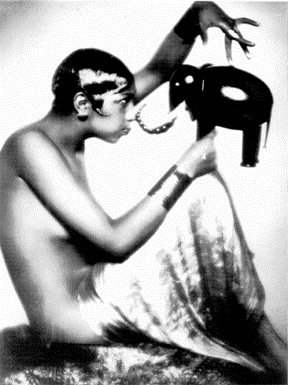
1. Creating your own personal flava flave as a dancer. Not in the sense of ‘finding your own style’, but in the sense of finding your unique body part/shape/movement/whatever, refining and exaggerating it. I want to talk about this in terms of gender and bodies, because in lindy hop women feel pressured to become invisible – to become yet another skinny, white, conventionally attractive, made-up, ordinarily-fashionable bit of scenery. I think it’s far more exciting for each of us, as dancers, to really look at our bodies and the way we move, to pay attention to the things we love doing, and to work from there. Rather than letting our eyes slide past the body part that makes us unique because it feels ‘too big’ or ‘too small’ or ‘too fat’ or ‘too skinny’ or ‘too not like everyone else’, we should try to look at it. We should really look at our body, and the things that make it unique. And we should try to emphasise those ‘too not like everyone else’ parts with movements and framing and rhythm. Because it is those things that make us memorable.
Women are encouraged to become invisible in our culture. Jazz dance – real jazz dances – requires the unusual. It asks us to become memorable.
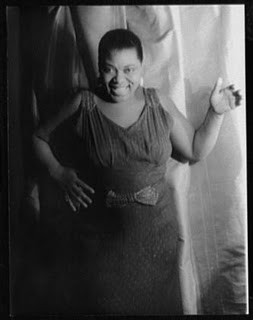
(Bessie Smith)
2. Teaching dance using interesting approaches. This is a big one, but basically I want to spend some time thinking through teaching practice for dance. I am heartily tired of the ‘chalk and talk’ approach to teaching. It’s rubbish in universities, it’s rubbish in dance classes. It sets up stupid hierarchies that ultimately benefit no one and produce ordinary, unimaginative dancers.
I also want to talk about teaching groups where students have different levels of skill and experience. There’s this insistence in dance that we must teach classes of particular levels, at though every class of ‘beginners’ or ‘intermediates’ or whatever the fuck you decide to call them (because these words really have nothing to do with the students themselves) were a homogenous blob of boringness. No! Every single class is made up of people with different skills and abilities. And it does us all a disservice to teach as though they weren’t.
I want to look at alternatives to the ‘teacher pair’ model as well.
And in relation to all this, I want to talk about the challenges of marketing dance classes that don’t conform to these conventions.
But no time, no time! ARGH!
Some links from this afternoon
This playlist:
These lyrics from ‘Honeymoon Suite’
Music & Lyrics by Suzanne Vega
the ceiling had a painting on it
in our room in France
so we were living underneath
some angels in a dancemy husband was not feeling well
and so we went to bed
he woke up complaining
of an aching in his headhe said a hundred people
had come through our room that night
that one by one the old and young
asked if he was all rightone by one the old and young
lined up to touch his hand
he spent the night explaining
they had come to the wrong manthe concierge was less than helpful
when we asked her the next day
with coffee and a magazine
we went to the desk to pay“what happened in that room?” he asked
“a death or something strange?”
she smiled at him politely
and returned to him his changewell, what I’d like to know
and this will be a mystery,
is with all the people in that room
why none appeared to me?when we sleep so close together that
our hair becomes entwined
I must have missed that moment
in the gateway to his mind
This article ‘Local Economic Implications of Urban Bicycle Networks.
This article about the Guggenheim’s Stillspotting project in New York.
And an (ongoing) idea about place, music, sound, dance and history in a city.
Dance is like a block of chocolate
I have some things I want to say about the intersection of dance and audio-visual media, but I don’t have time to make a whole, proper argument. Fuck, I took 100 000 words to talk about these issues in my phd dissertation, so I’m not sure I’ll ever be able to write about this succinctly.
But let me note the ideas that happened to me today. Firstly, someone else made a very interesting observation.
Jerry linked up an interesting video on Facebook.
MOTION #04 – Ledru Rollin by motionparis
And he wrote:
Via BrotherSwing. This is a pretty slick video featuring Melanie Ohl. However this does highlight an interesting conundrum with these kinds of videos in that the editing is so quick that it’s hard to get a sense of how well the dancer is actually moving. I’ve seen other videos of Melanie, and she is pretty good, but the camera doesn’t stay on her for more than a few beats at a time. On one hand it does keep the casual viewer engaged, but it makes it difficult for someone trying to enjoy just the dance itself.
I’m starting to pay attention to more of this stuff as I’m making my own foray into the netherworld videography with my new camera. Plus a lot of Lindy Hoppers are now getting the opportunity to be filmed all fancy like, I’m actually working on a short video which I may post very soon.
Also, this seems to be a part of a series of videos focusing on different dancers doing different dances, so if you enjoy this, check out the user’s main page for more.
I’ve been paying (some) attention to the way dancers’ve been getting into vlogging lately (eg Mike Pedroza is using youtube and Jerry is making interviews and other fun things (again via youtube, but with his blog and FB page as the key delivery tools)) and I’m always interested in dance-musician video projects.
This is partly because I’m a dance nerd, but much more because I spent a really long time learning and reading and thinking and writing and teaching about media and audiences at uni. I’m really, really, really interested in audiences and modes of participant-consumption (no, I am not ok with the term ‘produceage’). That’s really how my phd began: how do dancers use digital media in everyday dance practice? I wrote about AV media, DJing, email lists and discussion boards, and I can’t seem to stop thinking about this stuff. I guess I just can’t get away from the idea that dancers are all about the body – the face to face interaction – and yet swing dancers are very into digital media. There are all sorts of interesting class, culture and ethnicity issues at work here.
In my own work I carefully avoided talk about Cartesian splits, because I don’t think it’s a terribly useful model. Dancers don’t divide their brains and their bodies, and to insist that dancing is always and forever a thing of the senses and the body, is to devalue the work of choreography and the social labour of production and consumption surrounding the dance floor… or those three minutes on the dance floor. Just as I feel that it does musicians a disservice to dismiss the best jazz as ‘creative magic’, I think it is a mistake to talk about dance only as creative magic happening in the body.
I think that the dancers who achieve the greatest things do spend a lot of time thinking about dance, and how dance works, but they spend even more time on the dance floor, moving, and finally (and always?) they are thinking with their bodies. So I don’t like that idea of a mind/body dichotomy. And we do need to consider the idea that thinking about dance can happen via digital media as well.
I know I’m not the only one who can’t watch dance videos before bed because they keep me awake. I’d always joked about ‘Pavlov’s lindy hopper‘, but then I came across an article by Beatriz Calvo-Merino, Julie Gre`zes, Daniel E. Glaser, Richard E. Passingham, and Patrick Haggard called ‘Seeing or Doing? Influence of Visual and Motor Familiarity in Action Observation’. Basically, if you wire up a dancer’s brain and then observe them watching a particular dance choreography, the same bits of their brain fire as they would when that dancer was themselves dancing that choreography. CRAZY. So – and I extrapolate wildly and without substantiation here – when I’m watching solo charleston videos before bed, my brain starts firing, and it’s as though I’m dancing that charleston. And then we all know how long it takes to calm down after a bit of crazy charleston. I’m also beginning to suspect that a DJ (who is also a dancer) experiences the same brain-work while they’re DJing and watching the floor. So a DJ who watches the floor should – boy, this is getting precarious – should be a better DJ for this doppelgängering effect. Yes, I know doppelgänger probably isn’t the right word or term to describe this. Mirroring – the term Calvo-Merino et al use – is far more useful.
So, yes, let’s talk about this in terms of ‘thinking with the body’. That idea is useful when we think about choreography – and probably even teaching dance – because it gives the observer a way to feel what is going on in the body of the dancer who is being observed.
Yes, yes, but what has this to do with Jerry’s original post?
This is what I wrote in response to Jerry’s facebook post above:
Oh Jerry, I think I love you. This is so totally up my (media studies) alley!
There’s quite a bit of literature in cinema studies about filming dance. I guess the tension lies in filming dance-as-spectacle in itself (where you basically just set up the camera to film dancers’ whole bodies from a fixed position) _or_ filming dance-as-narrative, where you cut, pan, edit, etc to tell a more complex story about dance and through dance.
I saw a very interesting conference paper by Tommy DeFrantz a few years ago, where he talked about Hype Williams and a “black visual intonation” in music video (Believe the Hype: Hype Williams and Afrofuturist Filmmaking’, ‘Refractory’, Thomas F. DeFrantz, Published Aug 27th 2003). This was basically looking at how we might make music video (featuring black music and dance) in a way that reflects the rhythms and intonations of black music and dance itself. In the simplest terms, that might mean cutting and editing film in a particular rhythm. This immediately makes me wonder what a film cut in a ‘step step triple-step’ rhythm might look like.
Another fascinating example of this sort of thing is the Two Cousins video:
On one level the choreography has been put together as a response to the song. The first ‘scene’ gives us Ryan dancing ‘in time’ to the song ‘Two Cousins’. The film then cuts immediately to a slow-mo pulled-back shot of Ryan dancing, with a busier, more exciting part of the song overlaid. There’s an interesting tension between the more exciting music, the exciting dance steps and the effect of slow motion itself.
I think two of the reasons so many people were irritated by the Slow Club video was that it cut and edited the choreography ‘out of sync’, and it also messed with the speed of the choreography – slowing things down and speeding them up. So our dancer’s eye was continually frustrated by an inability to follow the patterns of the choreography ‘in real time’. Lindy hoppers are pattern matchers, and it’s very frustrating to not get to see the entire pattern of the choreography laid out in real time, so we can comprehend the ‘story’ of the choreography itself – the repeating patterns and rhythms. Refusing to let us see the pattern builds tension (and frustration); we never get the release of closure or pattern-repeating.
In contrast, lindy hoppers tend to really love films like the original Al and Leon videos:
(Charleston — Original Al & Leon Style!!)In these videos there are no cuts, just a few very slow pans. With no cuts, we don’t get that feeling of anxiety about ‘missing’ something that’s been ‘cut out’ of the film: we see the whole thing, in real time. We get to see the patterns and rhythms.
I’m totally fascinated by all this. I’ve written an article about how dancers’ use of AV media changed the way the original films worked as texts. We cut out the ‘dancing bits’ and watch them in isolation from the broader film narrative (which films like Hellzapoppin actually were designed for – censors cutting out the bits that broke race laws). But then we also do things like watch and rewatch, and then watch and rewatch _parts_ of that original scene, out of order. Dancers: we’re all about imposing our own narrative flow. Just like all audiences, really.
Now, to tie all this together. I think, when I wrote about this frustration that dancers feel watching the Two Cousins video, I was referring to a sort of tension (yes, I do overuse that word, but it’s a good one to describe this feeling) that you might feel if you watched this video as a dancer. The Pavlov’s lindy hopper effect kicks in, but then it’s not taken to completion; we don’t get that good old adrenaline contact high from watching this video. Mo frustration!
But this is of course all just speculation on my part. And even I’m highly skeptical. It seems far more likely that the negative comments about the Two Cousins video stemmed mostly from an intellectual and creative frustration with the cutting and ‘obscuring’ of these two gifted dancers. Finally – a high quality video of two of the most difficult-to-catch-on-film, most talented male dancers of our era – and we can’t even SEE THEM! And I’m sure we don’t even need to go into the aesthetic and creative frustrations we feel watching the Two Cousins clip.
Here is where I might insert a bit of talk about the perils of narrative cinema, Laura Mulvey, the male gaze and avant garde cinema. I could go on about how we should be deeply suspicious of submerging ourselves into narrative cinema, and how it is the opiate for our active, interrogative minds. But I can’t support that argument, because I am – unashamedly – a fan of the good story well told. And as someone getting interested in choreography, I’m extra interested in how story structure can work with music and dance to convince audiences they like what they see. I could quite happily go on and on about repetitive structures and just how useful they are for telling stories in dance, but that is way too far OFF THE TRACK even for me. So it’s back to dancers bitching.
So, really, there were lots of reasons for dancers to find the Two Cousins video frustrating. As audiences with shared values (which I guess is how non-corporeal audiences are determined – individuals become audience through shared viewing and shared viewing practices and values), it’s not surprising so many dancers were narked.
But then, it’s also possible to write about the Two Cousins video with some degree of joy as a dancer. I wrote about some of my good feelings about the video in my Two Cousins post.
But even I can’t maintain that blissed out lindy love feeling. I tried to discuss some of the issues of race and discursive and mediated power at work in this and other video performances in ‘Historical Recreation’: Fat Suits, Blackface and Dance. And I went over the details in Another look at appropriation in dance.
That last post about cultural appropriation draws on Tommy Defrantz‘ work, implicitly if not explicitly. Tommy’s work has had a profound effect on my thinking about gender, class, race, dance and power. He is one of the few academic scholars whose work on black dance history can be trusted absolutely. And he’s a dancer himself.
This whole post is leading me to the point where I link you up with this lovely video, Thomas F. DeFrantz: Buck, Wing and Jig:
Which you should then follow up with Thomas F. DeFrantz: Dance and African American Culture:
I especially like the part where he says:
Social dances are hugely important to help us understand how people live their lives. Because in the social dances we see the transformation of physical gesture that people do every day into creative practice, but we also see the fantasy life of social gesture that people don’t get to do in their everyday. …we might see social dances that let people… release all that energy in really unexpected ways.
So Defrantz at once describes social dance as a place where everyday movement is transformed into dance (this is something that gets talked about a lot in other discussions of vernacular dance – especially in LeeEllen Friedland’s work), but also as a place where fantasy lives can be lived out. So we put our ordinary everday into our social dance, but we can also make social dance a place where we live out our fantasies.
This makes lots of sense when you think about gender and dance, and I’ve written before about how social dance might give young women in particular a place to play with gender: femininity, sexuality, desire, and public displays and enactions thereof. But I have always really liked Paris is Burning as an example of shared, public, social, collaborative, creative – fantasy – play in dance. In that film, a ballroom becomes the place where any fantasy about sex, gender, power, beauty, desire, grace, creativity and artistry can be played out.
In an extension of that final point, then, when dancers get to see films like the ‘My Baby Can’t Dance’ video (which I describe in New Chic in Jass), you can see how the camera’s longer, lingering ‘gaze’ upon those dancing bodies (those talented, well-lit, well-dressed, well-known dancing bodies) provides a sort of visual and physical pleasure. I’m not talking sex, here. I’m talking about that Pavlov’s lindy hopper effect. We get the pleasure of seeing someone talented doing a choreography we really like, and we also get the physical/mental pleasure of our observing brain firing and delivering up a good dose of adrenaline.
Now, I’m treading dangerously (frighteningly) close to phenomenology here, and I have to say: do NOT want. I also think that the arguments or ideas I’ve set out here are HIGHLY spurious. You should be very, VERY skeptical of the things I am saying.
But at the same time, aren’t these very tempting, very delicious ideas? Isn’t the thought of getting a ‘contact high’ from watching a dance video a little like an unwrapped block of best Swiss chocolate? Don’t you just want to get all up in its grill?
YES.
The influence of Frankie Manning on my lindy hop history
As I mentioned in the Frankie Fest post the other day, we’re teaching Frankie Manning themed classes this month at our weekly class. That means Frankie Manning themed lindy hop in the first class, and then Frankie Manning themed solo dance in the second class. Although making the distinction between the two seems to deliberately misunderstand exactly what Frankie Manning – and jazz dance – are all about.
I’m going to see if I can write a few blog posts about Frankie Manning, or, rather, using Frankie Manning as a jumping off point for some ideas. We’ll see how well things go – I’m not all that together in the longer-form writing way at the moment.
This is a post about how Frankie Manning moved into and out of my understanding of lindy hop. This is a story of personal growth (goddess, how I hope it’s about growth), not really about Frankie himself. If you want that story, you should read his autobiography.
Oh, yeah, Frankie Manning IS the best!: late 2000s and early 2010s
Frankie95, the massive birthday party for Frankie Manning, which he just missed out on seeing, seemed to suddenly change everything. It’s true, you know, you don’t know what you’ve got til you lose it. You don’t miss the water til the well runs dry. And the Silver Shadows, the most popular, and one of the most highly skilled lindy hop performance groups in the world at the time reminded people that Frankie was wonderful:
Frankie95 day3 Performance Silver Shadows tribute to Frakie Manning:
It feels, now, that the generation of international teachers being flown to Australia to teach (people like Thomas and Alice, for example, who taught a ‘Frankie class’ at Jumptown Jam last month), who mightn’t have been into this stuff in a big way before, are suddenly falling in love with Frankie Manning all over again. Or for the first time.
I’m feeling a profound sense of déjà vu. The steps that I first learnt to dance with – pecks, stomp offs, mini-dips – are now chic again. I’m not complaining. But I think that for a lot of dancers, the technique-heavy smooth style phase and then the popularity of blues dancing gave them the technical skills to really appreciate what Frankie Manning was doing, particularly in his later years. And I also think that the influence of Steven and Virgine in Melbourne (particularly during that 2000-2004 period) was very important. While their dance style was definitely juicier and groovier, their experience with Frankie Manning definitely informed their teaching, and Frankie’s understanding of music and rhythm and dance shaped the Melbourne lindy hop scene, even indirectly.
For myself, I think that Frankie himself makes it very clear that to be able to dance well, it’s just as important to able to shake your arse for Shiny Stockings at 120bpm as it is to move your arse at 230bpm with Jumpin’ at the Woodside.
Understanding Frankie’s bum and feet and hands and everything: early 2010s Sydney
Now that I’m teaching (again – the last time I taught was ~2002), I amazed by the content Frankie was teaching beginners:
Frankie Manning teaching in Denver, CO 2007:
That little sequence is quintessential Frankie Manning. He just assumed that if you were learning lindy hop, you were going to learn a complex sequence of rhythms and steps, and that that was going to be the heart of your dancing. Most lindy hop classes I see these days assume that beginners will be learning simple movements and that this sort of rhythmic work is a ‘variation’, an optional extra for more advanced dancers.
When I first started learning, this little film shows the sort of thing we learnt – in fact, I can still remember learning pretty much this exact sequence way back in about 2000. I strongly believe that this stuff – these rhythms, this use of open position, this combining partner work with individual improvisation – is the very core, the absolute essence of lindy hop. Without it, you’re just… well, you’re just doing something else. You’re not lindy hopping.
I know that right now, I’m really only beginning to properly understand just how amazing he was, even in his 90s. There are no modern dancers today who can approach his skill level. Let alone his choreographing ability. I think we are so lucky to have had him, not just in the early days of lindy hop, but most especially in the revival, when we really needed, as a community, to be taught not only how to dance, but how to love dancing and to be good to each other.
I think these interviews with today’s lindy hoppers talking about Frankie Manning at 90, at the 2004 Herrang Dance camp make all this clear: