(The Snowball 2011 – Performances – Two Cousins)
A performancing referencing
Which is of course referencing

(The Snowball 2011 – Performances – Two Cousins)
A performancing referencing
Which is of course referencing
Lots of women dancing together.
At some point I’ll put together all the stuff from the 1939 World Fair.
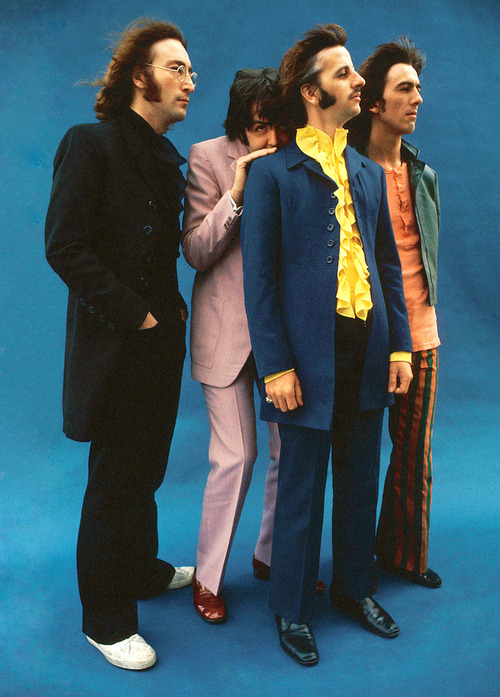
It’s because I’m totally lame that I looked at John Lennon and thought “Typical lindy hopper. Ruining a nice outfit with scruffy dance sneakers.” (image c/o mindlessmunkey)
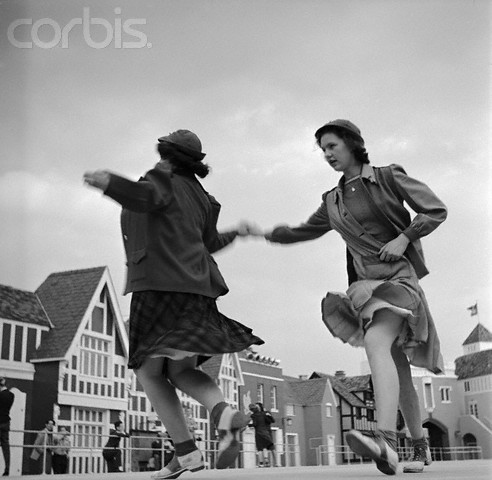
(A 1940 photo by Lucien Aigner from the corbis collection)
You know, photos of women dancing together are so common, I’m certain women dancing with women was far more common in the 30s and 40s (and 20s too I’d guess) than it is today. Y U SO BORING MODERN DANCERS?!
I bless the popularity of solo jazz dance, as it finally brings women back together on the dance floor. That whole period of _just_ man/woman lindy hop in swing communities only was just some weird aberration. Good riddance.
Now I’m not bragging, but it’s understood, that everything I do, I sure do good.
The Mills Brothers – How’m I Doin’, Hey, Hey
I love this song, but I’d never seen this clip before.
I vant to be alone (with all my friends):
A bunch of Sydney peeps have just left for Korea. Because that is where the lindy hop is at. So this nice little drawing from a Korean kid is appropriate:
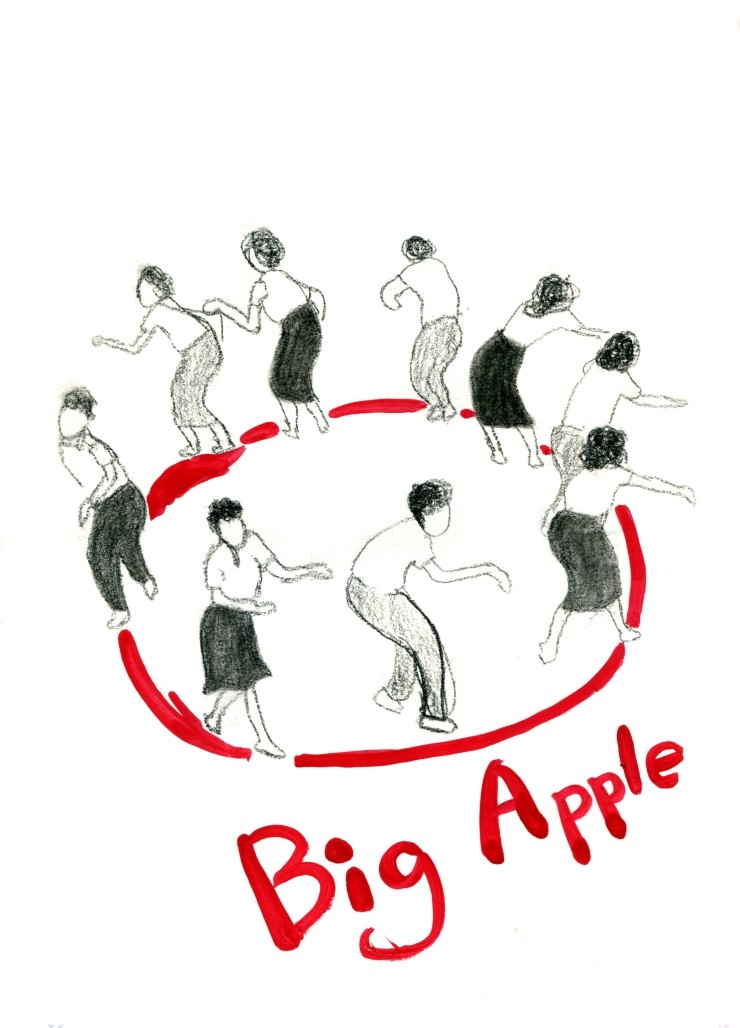
Image from inseduck.
And I liked this one:
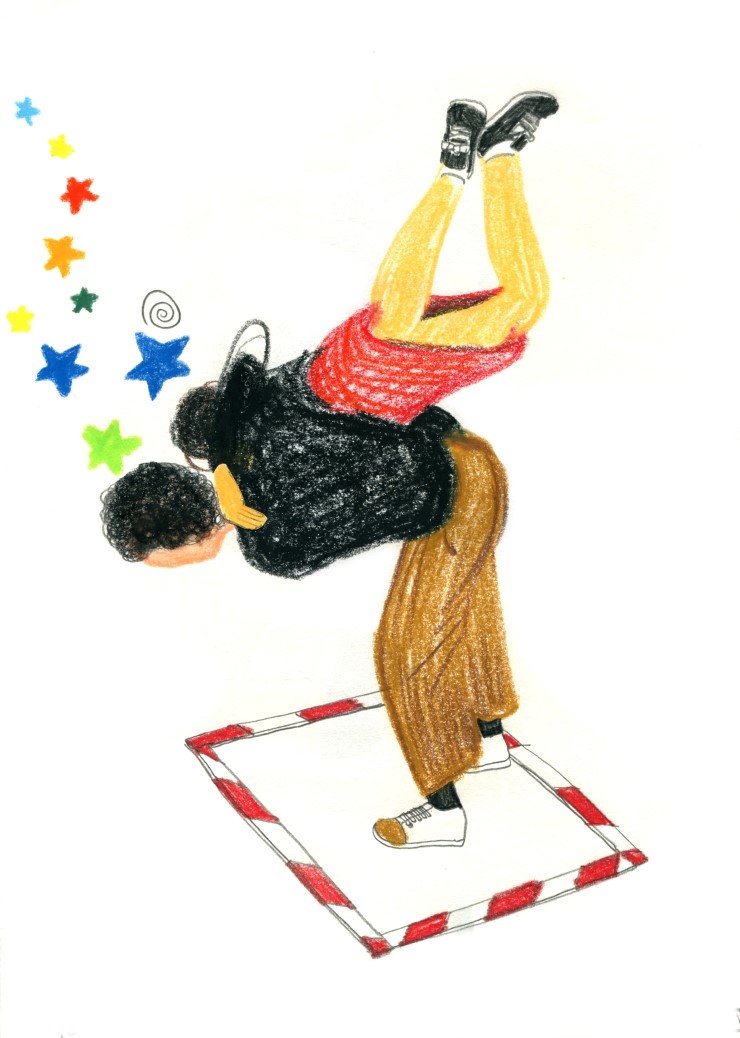
It captures the feel of one of the best bits of this ‘RTSF 2012 Instructors Jam’ video:
I really like that little performance with the square because it’s a game, and I love dancing games. And it demonstrates how you really need to take some risks to be hot shit, and if you take a few risks (I am thinking of that little bit of air that Laura and Jeremy – the third couple – pull) and combine them with skillz, you really are rocking the lindy hop. To me, this is what lindy hop competition is all about: skillz + taking a few risks + showing off. I do like the way the first couple play it safe and really do good work (I like their type of balboa), the second show it’s not that simple a challenge with a few mistakes, and then the third couple rocks it. I think the success of L&J’s work is partly a result of this position as third couple. ‘Third time’s a charm’ is particularly apt for lindy hoppers with our jazz roots.
If you scroll through that block of little drawings and paintings, they seem to be mostly moments from videos. Which fascinates me, because I love the way dancers use digital media to do all sorts of creative things.
(NB the swing daily and Wandering and Pondering on FB hooked me up with these images and clips respectively)
So you might have noticed a lack of WHM posts lately. Here is my litany of excuses:
– Hayfever has put me down for the last few days. Big time.
– We discovered a leak into the concrete slab of our flat last week, and have spent a week moving our ONE HUNDRED BOXES OF BOOKS and associated bookcases UPSTAIRS so we can then rip up the carpet in smaller sections to expose the slab. It is now ‘drying’. Sydney has had a spectacularly damp and mild summer, so this ‘drying’ is not happening. We will not discuss leaks, mould and allergy connections.
– I have some other projects on the go which have sucked up my spare brain time. I have, however, quite sore shoulders from so much computer work, so that’s a good thing. I guess. Writing: I did it. Websites: they are maintained!
– The theme I set myself just didn’t inspire me the way the month of women dancers did last year. It seems I am a dancer first and a music nerd second.
– I have a limited block of time set aside for dancing during my day/week, and that block has been filling up with teaching, admin for the classes, various DJing gigs, getting rid of some dance commitments (why is that harder than actually doing the jobs in the first place?), a workshop thing I’m running in May (which will be SQUEE), thinking about promotions and advertising in a long term way (rather than just responding to things), trying to sort out new sound gear for one venue (gee, that task has totally not been done), and then I take on ANOTHER DJing project, which will be super fun, but is perhaps overly ambitious for someone who is supposed to be giving up ocd impulses.
I told you it was a litany.
I had some ideas for posts:
– the role of all-women bands in the first fifty years of the 20th Century, and the contribution they made to jazz (big);
– women in the early days of the recording industry (in which vocal blues and blues queens played a big part, and in which race records are really important, because they marketed those blues queens to black audiences so effectively the white labels started trying to screw them over and steal their ideas and artists), most especially the women working for record labels;
– other stuff.
A couple of books have just arrived from teh interkittens, so I will read some of those and then forget to write anything down. But first, I’m going to ramble on with a long, poorly-referenced bundle of ideas which really need some proper thought. I should really have written about women in jazz history, shouldn’t I? But this is an interesting topic, and one I keep coming back to in my own reading. When I get done with two of my new books, I’ll have some more cleverly thought out things to say. But for now, here’s a big ramble.
I’ve also wanted to comment on Peter’s Jazz and the Italian connection post because it touches on some issues that I’ve thought about for a while. And that are bizarrely relevant to Australian mainstream politics at the moment.
To sum that one up, I’m not suggesting that this is what Peter is doing (because the man knows his shit), but I do think it’s misleading to argue that the exclusion of the ODJB was a consequence of ‘reverse racism’ or ‘political correctness’ favouring black artists. Which is what is argued by a number of truly dodgy scholars in jazz studies (I’m going to have to check my notes more thoroughly for those references – bare with me, k?)
From what I can tell, however, Peter is arguing something slightly different: that it is important to discuss the ODJB in a history of jazz. For all sorts of reasons. I’d certainly agree.
My interest would be in how the ODJB presented a more palatable ‘white’ jazz to mainstream audiences at the same time as race records (labels targeting black audiences) were selling ‘black’ jazz to ‘black audiences’ and live music venues were also presenting jazz in quite racialised terms (the Cotton Club itself is a good example – black musicians presented for white audiences). As Peter also implies, the ‘white’ and ‘black’ dichotomy isn’t all that useful. The Italian musicians (and French and… everyone else) were definitely ‘othered’ at the time – they weren’t ‘white’ (ie Anglo celtic), but they read or looked white, and that was important when the look of an artist was being established as a key marketing tool. So my question would perhaps be ‘What was to be gained by, and what were the consequences of making the ‘otherness’ of non-anglo celtic musicians invisible in jazz histories?’
What I think happened is that the favouring of black artists was a consequence of racism in the 1930s and 40s. In those moments when ‘the origination of jazz’ was first being written (by white authors) the ‘popular jazz press’ (ie newsletters, magazines, etc) and other writing about jazz favoured black musicians because this approach favoured myths about race and creativity.
Just like the Ken Burns ‘Jazz’ doco, this approach follows particular individual musicians, positioning them as unusual, almost magical figures who overcame poverty/geography/BEING BLACK because they were somehow touched with a magical gift. In reality, these few figures were hard working people who worked within black communities, and then the wider American culture, experiencing racism every day. Their skills weren’t ‘god given gifts’ but the fruits of hard labour as well as talent and community support, and the advantages of being male musicians in an industry that made it very difficult for women to get gigs. This is something George Lipsitz discusses in his work “Songs of the Unsung: The Darby Hicks History of Jazz.”
This approach to jazz history – telling stories of miraculous black achievement as an aberration from the norm – reinforces racist archetypes. If the stories were told as stories of hard work, the musicians positioned within communities which fostered and encouraged their creativity – the authors would have to revise their ideas about black and white creative practice. They’d have to accept the idea that musical genius happens in all communities, regardless of race or class or gender. But that the factors which make it possible to realise this genius are absolutely defined by class and privilege and power and opportunity. Here’s a long quote from Lipsitz discussing these things:
The story of jazz artists as heroic individualists also overlooks the gender relations structuring entry into the world of plying jazz for a living. Women musicians Melba Liston, Clora Bryant, and Mary Lou Williams can only be minor supporting players in this drama of heroic male artistry. Bessie Smith and Billie Holiday are revered as interpreters and icons but not acknowledged for their expressly musical contributions. Although [Ken Burns’] Jazz acknowledges the roles played by supportive wives and partners in the success of individual male musicians, the broader structures of power that segregated women into ‘girl’ bands, that relegated women players to local rather than national exposure, that defined the music of Nina Simone or Dinah Washington as somehow outside the world of jazz are never systematically addressed in the film, although they have been investigated, analyzed, and critiqued in recent book…” (15)
The ODJB was one of a number of white bands working at the time, and they were well positioned to take advantage of a new recording industry and the possibilities of clever promotion. I think that they are/were glossed over by many music historians not because they weren’t black, but because they didn’t shore up racist archetypes.
The other interesting part of Peter’s post discusses the role of Italians in the early days of recorded jazz (and jazz history). This is much more interesting. There’s a chunk of scholarship about discussing the role of jewish musicians in early jazz and radio, which I think can be helpful. And cities like New Orleans (and New York for that matter) had large migrant populations: jazz is (as Winton Marsalis goes on about, ad nauseum), a gumbo. It is a mix of cultures and musical traditions. So it makes perfect sense to explore the Italian contribution.
Lipsitz, George. “Songs of the Unsung: The Darby Hicks History of Jazz,” Uptown Conversation: the new Jazz studies, ed. Robert O’Meally, Brent Hayes Edwards, Farah Jasmin Griffin. Columbia U Press, NY: 2004: 9-26.
worst. allergies. ever.
Sarah wrote this post Dance Teachers Shape the Lindy Hop Community in August last year, and it’s getting quite a bit of linky at the moment (mostly c/o Jerry’s FB page). I can’t believe I missed it when she posted it, but then I’m not really that surprised as I wasn’t exactly in the most organised state of mind at the end of last year.
At any rate, that post is just rippling with issues that resonate with me, here in my seventh week of teaching weekly classes and co-managing my own teaching venue, as well as continuing with my usual dancing commitments. I haven’t really read that post with a sensible brain yet (though that didn’t stop me launching in with a swear-laden comment – sorry Sarah), but I want to address some of those issues. I’m going to have to think carefully before I write, though, because teaching politics are far more complex than DJing or social dancing politics. I did do a chapter of my thesis on teaching dance, mostly making the point that the commodification of dance through classes (ie packaging up dance and selling it to punters in classes) is ideologically loaded, and I saw gender as a key part of this. How surprising, patriarchy and capitalism holding hands. Or they would, if they weren’t afraid they’d get gay germs. One thing’s for sure: the money involved in teaching makes it a far more laden topic than DJing. So I’ll certainly be coming back to stick my foot in it. And then in my mouth. Or my desperately over-laden metaphor.