The usefulness of being specific

Kathleen Rea’s piece “That lady”: The story of what happened when a woman put up a boundary in the contact improv world is a great post by a woman about her experiences setting up ‘boundaries guidelines’ for her dance session.

I especially dig her points about using specific language:

My guidelines evolved over the years, but have always been very clear and direct in their language and guidance. I have faced both praise and critique for this direct approach. I think one of the reasons they have been controversial is that I leave little room for misinterpretation. In the guidelines, I say things such as, “Do not intentionally caress another dancer on their breasts or genitals”, and, “Non-consensual pass-by pokes, kisses, tickles, caresses, massages or pats while dancing or passing by someone in the studio or hallway will not be tolerated”. I think this approach was unusual in the contact dance improvisation world. I had said something which is usually not said, and as well I was a woman saying these things.

I’ve tried to be specific in our Code of Conduct, because I think that being coy can lead to problems. It also suggests that if actually saying ‘groin’ or ‘breasts’ is impossible, then talking about someone touching your groin without permission is utterly anathema.

If we use precise terms simply and casually, we make it clear that it’s ok to talk simply about our bodies and what we do and don’t like. It gives women the language tools to speak up about what’s happened: “He grabbed my breast.” If we don’t have these tools, it’s even harder to actually explain what happened and why it wasn’t ok.

Of course, using appropriate language tools is also a very good way to be specific about how you do like to be touched, or how you would like to touch someone: “Could you grab my breast, please?”

If we get used to speaking about our bodies like this, it’s even harder for offenders to claim they ‘misunderstood’.

Sexual offenders know what they are doing

Don Burke, recently reported as a serial sexual offender, has defended his actions as the symptoms of Aspergers syndrome. Neurodiverse peeps (including those living with Aspergers) may have difficulties understanding social cues, or managing social interactions.
Men like Burke, who repeatedly offend, target specific women, and conduct ongoing, sophisticated campaigns of manipulation, exploitation, and terror, are very very good at understanding social cues and managing social interactions. They are highly manipulative and say and do things in specific ways to provoke particular responses. In simpler terms, they say and do horrid things to women because they enjoy frightening and controlling other people. They know exactly what they are doing.

In the dance world we have see these same patterns of behaviour in men like Steven Mitchell, Max Pitruzella, William Mauvais and many more. Sexual assault and harassment are about control and power. Controlling social situations and controlling other people.

Sexual offenders and rape are not random, wild, or unpredictable forces of nature like bears or earthquakes. They are calculating, deliberate individuals. And you can see them coming, identify patterns in their behaviour. One of these markers of offenders is ‘gaslighting’. Convincing women and others that they are imagining this behaviour. Convincing women to doubt themselves, and to accept the offender’s version of events.
We should not be changing our behaviour to accommodate their aggression; they should be changing their behaviour.

It is important to recognise the signs and patterns in these men’s behaviour. It is important to believe women who report them, and to support these women.
You do not need to ‘hear his side of the story’. Because he will lie and manipulate in a sophisticated way.

Monstrous

Claire Dederer’s ‘What Do We Do with the Art of Monstrous Men?’. Once you get past the Woody Allen stuff, she asks:

It might sound as though I’m conflating two things—male predators and female finishers—in a troubling way. And I am. Because when women do what needs to be done in order to write or make art, we sometimes feel monstrous. And others are quick to describe us that way.

This resonates with me. Because doing ‘the right thing’ and tackling sexual harassment (taking on that feminised role of caring) has had direct consequences on my own creative work. Less time to write, to DJ, to work on my own dancing, to work with musicians. My energy and health spent on tidying up after bastard men rather than fostering my own work.
Men are largely absent in the Australian dance scene’s responses to s.h. There are _some_ very good men squirrelling away, but for the most part it’s women writing codes and policies (for which male organisers are happy to take reflected credit). Women who could be dancing or playing music. It’s a second subtraction from our creative lives: we pay once when we fight off these arseholes, and we pay again when we pick up our sisters and chase down the offenders.

Yes, this caring labour does build skills and networks and confidence. But it also detracts. And choosing _not_ to step up and help is a bastard act. Monstrous. As this writer notes, choosing to pursue our own goals, to set aside that role of carer is monstrous. It feels that way. And it is oftenmen who are quickest to dismiss the woman lindy hopper’s failure to ‘help’ their lead as a moral failure.

Things male lindy hoppers have done this year in Australia

  • Sexually assaulted women, girls, boys, and men;
  • Sexually harassed women, girls, boys, and men;
  • Deliberately derailed OH&S processes;
  • Discouraged societies or committees from developing codes of conduct;
  • Actively argued against the introduction of codes of conduct in their local scene;
  • Covered up for offenders;
  • Defended offenders in public and private;
  • Witnessed assault and harassment in person, but failed to prevent or act on it;
  • Failed to support women stepping in to stop harassment as it happens;
  • Deliberately attacked and discredited women reporting assault;
  • Deliberately attacked and discredited women and men reporting assault on behalf of others;
  • Hired known offenders for teaching and management roles in large scale events;
  • Discredited individuals and groups working on safe space policies;
  • Used their power and status as international teachers, DJs, and organisers to discredit women reporting offences, and derail the development of safe space policies;
  • Verbally, legally, physically threatened women who are discussing these issues (let alone working on them actively);
  • Taken credit for the work of women in their organisation who have improved safety at their events;
  • Failed to assist in a material or organisational way to improve conditions at their own events or in their own businesses;

I wish this was a hypothetical list. But I could give you names and dates for all of these.

Can you just fucking step up and do something GOOD, for once, lindy hopping men?

So, we’re continuing to wade on with the work on sexual assault and harassment in the dance world. There have been great strides made. By women. At this point, men are continuing to offend at the same rate as before, men are covering up and enabling other offenders, whether deliberately or by neglect, and almost all of the work on codes of conduct, safety committees and cultural change is done by women.

Even more significantly, women are doing all the emotional labour of convincing men we need these things. There are still plenty of men in the international dance scene who don’t think we need codes of conduct (when your mates stop raping us, we won’t need a list of rules that say ‘don’t rape us’), think we should leave all this to the police (when the cops and legal system actually prosecute and punish offenders, we won’t need to police this shit ourselves), and think we should just leave all this to ‘common sense’ (when men actually have the sense to see that raping and harassing women isn’t ok, we’ll actually accept that they have any sense at all).

At this point, years after Bill Borghida was jailed for possession of child pornography, two years or more after some very brave women outed Steven Mitchell as a violent sexual offender and pedophile, a year after more brave women outed Max Pitruzella as a violent rapist and offender, and as every day we see more and more women reach out for help from anyone who shows even the smallest hint of empathy, women are still doing all the goddamm work.

And here’s the deal: men are still doing all the goddamm raping and assault. Yes, there are some women who offend. But at this point, I’ve come across dozens of male offenders in the past two years, and only two women. And those women’s offences were far, far less severe than the things men have been doing to women dancers.

Yes, all men. All men are responsible for their own behaviour and for the behaviour of their male friends. But they aren’t stepping up and taking on that responsibility. In this sense, men are failing to do community, and women are doing all the labour. Maybe we should just ban all men from lindy hop events. At this point, that seems the only way to put a stop to all the sexual violence.

But some people actually quite like having men around. So, men, if you want to prove that you actually deserve a place in our communities, you’re going to need to step up.

Yes, there is some emotional labour for YOU to do.

We’ve done a pretty good job of getting women up and engaged with safe space policy to deal with sexual harassment and assault. And they’re engaged as agents of prevention and response, rather than as ‘potential victims modifying their behaviour so they don’t provoke men into raping them’.

But we don’t have many men involved.
We’ve tried a range of strategies, from the ‘most offenders are male, so you need to step up’ offence, to the ‘we need you to be there for us’ to …. well, all sorts of things.
Getting organised as allies, and as actively engaged in preventing sexual assault is straight up emotional labour: thinking and planning, using empathy, working to discourage other men from offending, reducing micro-aggressions, dismantling less overt elements of rape culture.

And we’re just having no luck.

I don’t want to micromanage …work. I want a partner with equal initiative (ref).

So now we need real strategies for getting men to get involved. Because the women on committees and so on are bloody tired of this shit. We’re basically now 100% responsible for responding to and preventing men from raping women.

Things I’m having some luck with:
– pushing the ‘we are looking out for each other’ line, and having short examples in our PR copy, our speeches, etc etc (eg ‘see someone looking crook? Offer to sub in for them for a break’).
– coming at it indirectly in class by having all students learn and practice asking their partner ‘does this feel ok?’ and then being constructive (rather than defensive) with responses.

But this is not moving fast enough. And I’m just too tired and busy fielding emails from frightened women, producing documentation, and looking after my own health to actually do all the work for men too. Can you just fucking step up and do something GOOD, for once, lindy hopping men? Because I’m beginning to despair of you.

What are some useful suggestions for getting men to do this sort of emotional labour? Because unlike neglected house work, neglected violence kills people.

How gentle classes can fight the power

I was thinking about this this week. When it’s hard for peeps to get to class, if our classes are extra welcoming and embracing diversity, we make it easier for marginalised peeps to get to class and learn to dance.

I think it’s important for us, in this political climate, to do what we can to counter the horrible sadness and anger we feel about injustice. And I think we can do that by doing positive, excellent stuff that makes people feel good and happy. Including us. And lindy hop is just perfect for this.

This is my back story:
Our country is currently embroiled in a very nasty public shitstorm about a survey asking whether or not the laws should be changed to include same sex marriage. It’s not a referendum or a binding vote. It’s just a huge, expensive, shit-stirring survey intended to stir up distress and foment conflict. All because our spineless government didn’t want to allow members of parliament to vote on a new bill according to conscience (rather than party lines).
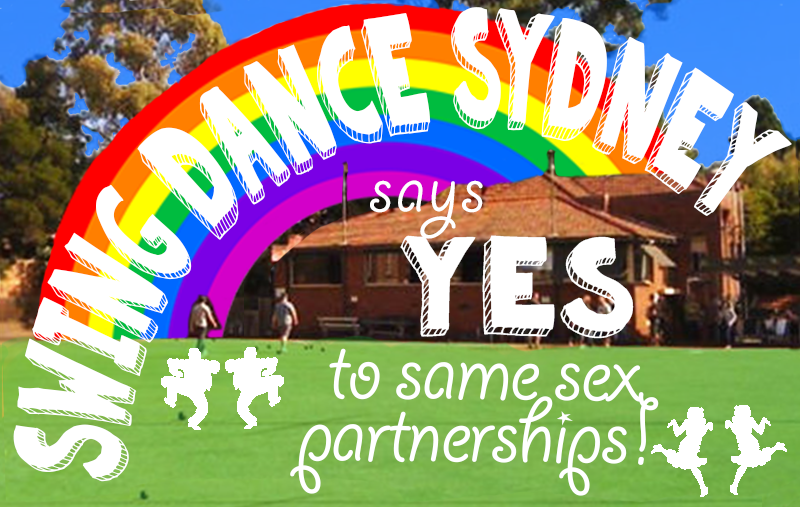
Last week in class we had a few same-sex couples come to class for the first time. Our door person was wearing her excellent ‘YES’ tshirt*, and I’d reposted this the previous week:

The couples felt a bit nervous about class (usually first time beginner stuff). And today I was thinking, ‘I’m so glad we were making it clear that anyone can lead or follow. I’m so glad we had a same sex teaching couple that week. I’m so glad we have a friendly class that focuses on looking after each other. I’m so glad our usual students are so welcoming and nice to each other.’
It’s hard enough coming to class for the first time as a shy noob. But if you’re someone who’s used to be marginalised, it’s even more important that you’re met with a welcoming class environment.
Because I believe, so strongly, that happy students do better learning. And we can do very good, important things for the world just in teaching dance. It’s not ‘just dancing’. It’s important.

*meaning ‘vote ‘yes’, let’s change the laws.

Why teaching is important to feminism

James recently made this comment in response to some interesting comments by Kathleen in the fb teaching group:

I would do anything for them to let me teach lessons in my scene the way you do up there! When I tried I encountered surprising resistance. People are weirdly attached to their 6 count triple step highly gendered rotation classes.

I think my response pretty much sums up my ideas about the relationship between teaching (which is so central to contemporary lindy hop culture – for better or worse) and the broader cultural and social power structures in our community. I believe that we build cultures of exploitation or empowerment in our classes.

Traditional class models are very easy to teach (because you teach to that imaginary ‘average’, rather than to different students’ needs); very easy to promote (this is exactly what you get *lists moves in sequence*); and are a very powerful ‘add on’ promotional model, where students start at level 1 and then add 2, 3, 4, 5. You keep adding levels/products to retain that market.

As you’d expect, you end up retaining your ‘average’, losing diversity in your cohort, and churn out students who all dance the same way, and can’t count themselves in. Which is ok if you want to build a very big scene very quickly. Not so good if you’re looking for diversity. This sort of approach to ‘scene building’ promotes/builds very clear hierarchies of power and status, and consequently enables sexual harassment, exploitation of labour, and other status-related bullshit.

Also it’s boring to teach.

In contrast the ‘full hippy‘ teaching culture (which draws a lot from things like Montessori thinking and other independent pedagogic practice), hopefully enables personal empowerment and fights the fucking patriarchy. And gives us more interesting dancing and teaching :D

Good peeps are doing good work

I’m back from Herräng 2017, and feeling a bit better about the dancing world’s response to sexual harassment.

Just a reminder that there are a whole heap of organisers, DJs, volunteers, and generally good peeps who are watching and acting on information about men who’ve been reported as sexual offenders. Most of them aren’t famous or big names. Almost all of them are quietly squirrelling away on this issue.
Each time I travel I meet people who have incredibly good, well-thought out processes and plans. The international lindy hop community has leapt onto this issue.
They work hard to protect and maintain the anonymity of the women and men who report offenders. They’ll receive threats (physical, legal, emotional, financial), and will be snowed under with paper work and processes.
Almost all of the men who’ve been reported aren’t famous teachers or even well known dancers. There won’t be blog posts or well-trafficked posts about these men. Very few other men will even have noticed them, and it’s unlikely famous teachers will boycott events if these offenders attend. They’re all ages, all ethnicities, all classes, and all over the world. I have not come across a single incident in the last two years where the report has been unfounded. In most cases women are _under_ reporting or playing down the behaviour of these men. And there have been a lot of reports.
These men are almost comically similar in their behaviour and patterns. It’d be funny if it wasn’t so shitty. So offenders are relatively easy to spot. And people are watching, keeping an eye on each other.
These reports trickle in every week, all over the world, and the that network of organisers, DJs, volunteers, and good peeps will be keeping each other in the loop about their movements. Facebook has never been busier with messages organising meet ups and conversations, keeping people aware of which offenders are moving where and doing what.
You can bet your bottom dollar all the people who are working on these reports will get them out their dances and parties.
So if you do report once, and you don’t get a good result, please do try again. There are plenty of good peeps who have your back.
Men: stop that jerky sexist shit. Those sexist objectifying ‘jokes’ in dance contests, the jokes about ‘boob swipes’ in class, the laughing ‘games’ between higher profile men. All of that sends messages to other men that this behaviour is ok, and to women that they need to just tolerate this. Don’t offer to walk us to our cars. Just stop encouraging other men to treat women like jokes.
And all those people working on this issue don’t need your bullshitly immature behaviour muddying the water. Stop being jerks; get your shit together.

Patterns to watch out for. ie stuff I’ve seen or had reported as part of a report of assault or harassment. So many times it’s getting stupidly obvious:

Overly controlling, rough, or sexualised dancing on the dance floor.
– unwanted/non-consensual dips or movements where women are forced into positions;
– ‘blues dance’ moves/styles/steps in a lindy hop context. When women complain about these movements, these men almost always describe them as ‘blues dance’ moves, hence justifying their behaviour and delegitimising women’s complaints;
– ‘teaching’ or ‘telling’ newer or younger women dancers how or what to do during a dance or between a dance. This usually means these women are isolated from other people on the floor between dances as these men mansplain their rough or controlling behaviour.
– targeting younger or less experienced women (of all types of appearance) and asking them to dance repeatedly – they literally comb the room with their eyes.

Stalking:
– constant facebook messages, comments, emojis, photos, tagging in other people’s photos, requests for friending
– repeated requests for phone numbers relatively early in a friendship (eg the day they meet a woman), in person and via social media. Usually for an ostensibly legit reason – to clarify details of an event, find out where the party is, etc)
– constant text messages, phone calls, and pics via phone at all hours and times. Often with emotionally ‘sincere’ or ‘confessional’ tones – eg stories about their emotional vulnerability, their past relationships, etc. Basically, stories about _them_.
– repeated and intrusive invitations to dance – interrupting women’s conversations with other women (to isolate them) cutting in after one dance with another partner, multiple dances in a row at a single party, followed by invitations to ‘private parties
– invitations to ‘private parties’ or events that are presented as group events, but turn out to be just him. These are usually ‘blues’ parties at someone’s house or a secluded venue. The man is usually the only person with the details, and they may collect the woman in their car.
– dropping the woman home after a dance (so they know where she lives), then ‘dropping in’ repeatedly, or making sure they’re the only person who drops her home after a dance. And then keeping her in the car or coming up to her house with long ‘deep and meaningful’ conversations. Mostly about him.

Targets:
– younger, less experienced women dancers
– women with less confidence.
– often have younger girlfriends and keep the relationship secret ‘for privacy’. When other dancers discover the relationship, they are frequently surprised that such a ‘shy’ or ‘quiet’ woman is with such a socially outgoing or spontaneous man.

These men:
– all nationalities and ethnicities
– not incredibly handsome or attractive, but usually quite ‘ordinary’ or ‘inoffensive’ – ie strangers probably won’t remember them.
– not usually super fashionable, but often reasonably well dressed. This can really vary between scenes and dance styles, though. They tend to ‘fit in’.
– very rarely very high profile teachers or performers
– may describe themselves as ‘teaching’, but only teach privates or smaller events – usually blues or another niche dance (eg fusion, or another blended dance) which doesn’t have a big presence in that city
– may teach at smaller events, but don’t have a high profile, and aren’t terribly well regarded. May eventually become a standard face in a teaching cohort, but never at a highly respected level. May teach interstate or even internationally at very small scale ‘intimate’ events run by less experienced organisers.
– if they don’t have actual teaching gigs, they frequently teach on the dance floor, or offer to ‘work with’ or ‘practice’ with newer women dancers privately, and present themselves as specialists who like to dance ‘their own style’ and have no patience with formal workshops.

These men work the long game. They put in a lot of ‘ground work’ to groom a woman which they eventually sexually assault, or enter a relationship with where they assault their partner repeatedly. Within a relationship they gradually escalate the assaults, as they gain greater control of these women and isolate them. Women may begin by feeling a bit ‘pushed’ to do deep kissing at a party with other people near by, to ‘mess about’ with this man and another partner (often another woman), to have unprotected sex in otherwise consensual situations. But the sexualised coercion escalates and happen in concert with other controlling behaviours – belittling comments in public, isolation, etc. And then they become more clearly assault and often very violent. The women become ‘quieter’ and more withdrawn at social events.

These men:
isolate
(dominating women at dances, taking them out after dances)
doubt (degrade or critique until women question their own minds and decisions)

dominate
(stalking online with constant fb messages, text messages; dancing in ways that showcase his status and ability and allow her zero creative space)

avoid
(more confident women, figures of authority, and legit events)

It’s very unlikely you’ll ever see them offend at a public event. Even if you’re watching closely. If you do call them on a dodgy hand position, they’ll either make excuses or apologise profusely. Then avoid you.

Please note: it’s the relationship between these behaviours that make patterns. So there’s nothing wrong with asking for someone’s phone number, calling them up, having a D&M then getting together and having gloriously consensual sex. All within a weekend.

But the combination of factors is what we should be watching for.

So you can see why it’s important for us to address seemingly ‘small’ issues like non-consensual dips on the social dance floor, right?

Does everyone see that sexual assault isn’t just a random dood attacking a woman on the street, that we can prevent by having a famous dancer walk a woman to a car? Or by carrying bear repellant?

(This post and its comments brought to you by arriving home to yet another assault report, depressing in its familiarity. It’s as though these men have a manual and just follow it. PUA-style.)

In response to a comment from the ever-thoughtful Byron:

I’d like to find a way for that list of yellow and red flags to become something that’s shared readily within the dance scenes at large, maybe edited in a way that highlights what the dance scene SHOULD be like, and how to tell if someone is violating community standards in weird ways.

This is the sticking point at the moment. Most of the people I know are doing this very carefully, and mostly in person. Which of course is a challenge for scenes divided by geography.
But there is the risk of exposing yourself to legal action for defamation if you do share information publicly (even by email).

Yet it is possible: you just need to get good, solid legal advice. Which is what I’m currently doing. Costs a fair bit of money, and the laws are different between Australian states (let alone countries), so you need real, legit legal advice (not internet legal advice). And I certainly won’t advise on it. But lawyers specialising in defamation can simply and easily write up a template letter and advise you on how to send letters or emails to other organisers warning them about these people.

A very very important step: all events and organisers need a policy, a code of conduct (ie a list of rules posted publicly), and a practical process, and then a reporting process. If these are in place before communicating info about known offenders, then organisers can prove that their actions weren’t personal malice, but professional process (hence avoiding some legal action). It’s also important because it helps organisers develop a clear sense of their own values, and become confident in their thoughts and actions. And most offenders rely on a lack of confidence or clarity in people’s thinking.

This is also why it’s essential that we drum it into all dancers that we all have a right to a freedom from sexual harassment and assault, and that we are all the best judges of our own limits and personal space and liberty. Dance classes _must_ prioritise this.

I am becoming more and more certain that a student-centred approach to teaching lindy hop is central to this – we have to encourage students to trust their own decisions and thinking. Not just tell them ‘here is the answer’ and then demand they do things one single way (our way). The next teacher who starts a workshop saying “there are lots of ways of doing things, but this is _our_ way” gets a punch: there are lots of different ways of dancing. And they are all worth thinking about. Similarly, I am now 100% absolutely totally angry with teachers who forbid students ‘giving each other feedback’ or discussing how their bodies and they are feeling with their dance partners. It breeds a culture of silence and self-doubt in women.

Korean safe space policies

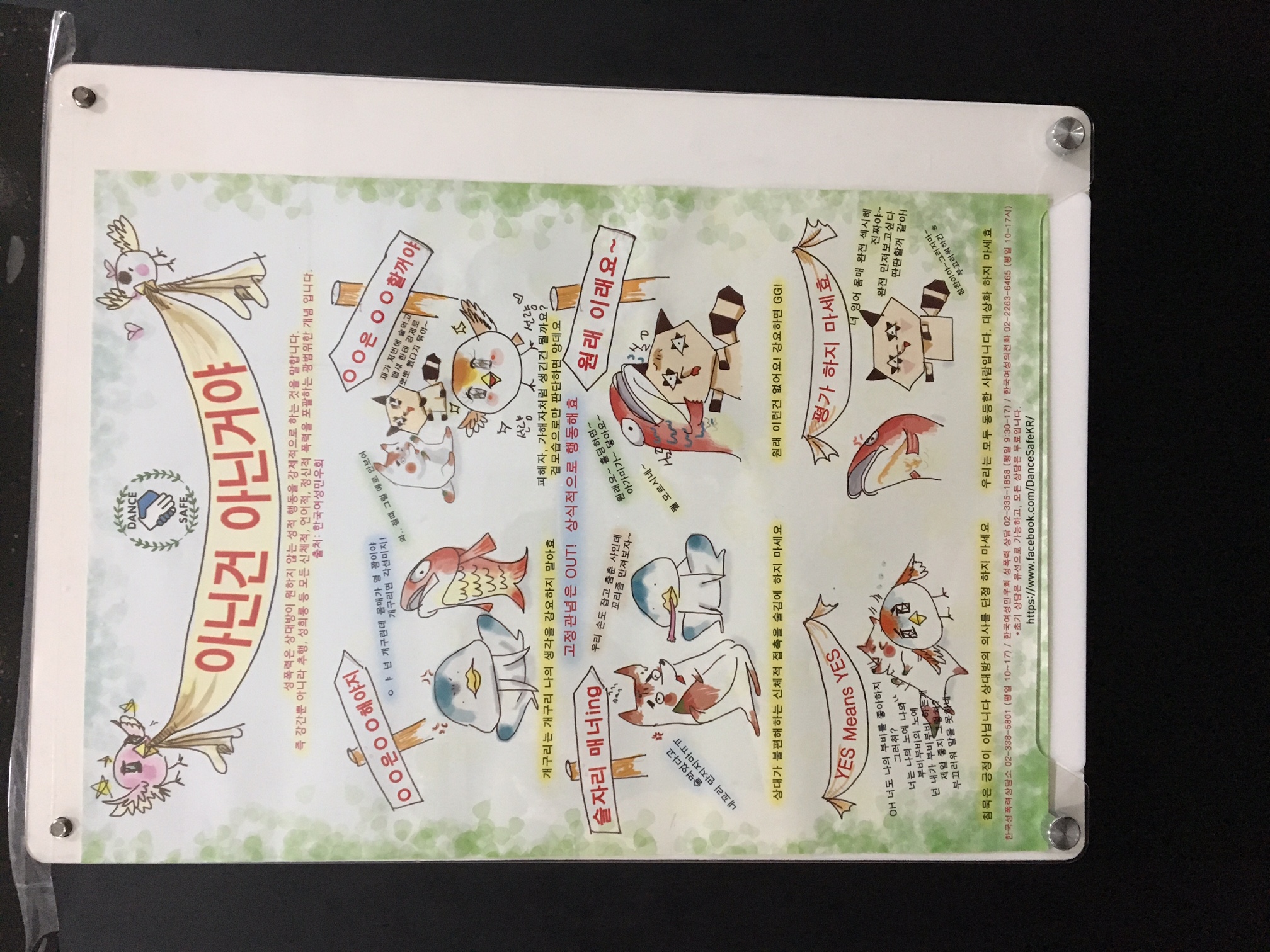
One of the things I like most about Seoul is the culture of visual information. ie signs with pictures. It draws on comic book culture, but also reflects, content-wise, Korean communitarian ethos and values. So informational signs like this one from the subway focus on individuals doing the right thing not for their own safety, but for the safety and comfort of others. Many of the signs also emphasise on younger people’s responsibilities to older people. It’s a really great discursive tool for peeps to have at hand.

Another thing I really like is the way the Dance Safe peeps in Seoul have used these practices to do some pretty impressive stuff. Here is one of the posters I saw stuck up outside SwingTime Bar in Seoul, above one of the benches where everyone sits to change their shoes (Seoul dancers change shoes before they enter the studio space). So, perfect placement.

The poster itself is solid gold. It has a light hearted, charming feel very much in keeping with Korean visual educational media texts. It uses animals rather than ‘women’ or ‘men’ symbols, which means it avoids gender binaries and norms. Even though I don’t read Korean, I can still get the message.

Dance Safe are a group of Korean peeps (men and women!) who’re working super hard to raise awareness about personal safety, sexual harassment, and mutual respect in the biggest lindy hop scene in the world. This is no mean feat, as the sheer scale of the scene means they need a zillion posters, pamphlets, and people involved. They’re doing some fund raising (with the support of various local organisers) to get $$ together to cover their printing costs.

My media studies/cultural studies brain is super interested in this project. This is almost exactly the sort of work I did in my Phd: how do dancers use media texts within a community so focussed on the body?

These guys are doing things that fascinate my academic brain, but also my activist brain and event organiser brain. How, _how_ are they pulling off this stuff?! I see some racist bullshit coming out of the English speaking lindy hop world about ‘Asian’, and ‘Russian’, and ‘French’ dancers, accusing them of not understanding ‘safe space’ ideology ‘because of culture’. But in my experience with dancers from these countries and other NES scenes, the activism is as exciting and engaged – if not more so – than the English speaking world.

Part of me thinks we need a conference to get all of the safe space activists in dance together to share this sort of information. How exciting!

Stalking is quite common and quite scary

In the past couple of years working on sexual harassment and assault in the lindy hop scene, I’ve realised that online stalking is a key part of male aggression towards women. Endless emails, fb messages, text messages, fb comments… and so on work to bombard women into compliance. All this added to constant invitations to dance and unwanted physical contact on and off the dance floor.

You can say no thanks to a dance with no explanation, and you can just block someone on fb. You don’t owe anyone your attention, and you shouldn’t feel guilty for just blocking Idiot Stalker Dood with no explanation.

More importantly, doodbros: no one owes you their attention. So stop with the weirdarse creepy messages.