Conflict or bullying?

As we move on with our responses to sexual harassment in the dance community (and I’ll brag about just how well Australia is doing), we’ve come across some stumbling blocks as well. This is something I wrote on fb today, thinking about how we think about conflict. I’ve written many times about my own approach (and why I’m ok with swearing).

What is the difference between bullying and just arguing or conflicting with someone? This issue is particularly relevant in the lindy hop world atm, as we are developing shared definitions of harassment, abuse, violence, and so on. Understanding the Difference Between Bullying and Conflict is a nice little reference for kids (which is always a good place to start, as it means the language is good and simple and helpful). I’ll draw on it below.

1. What is conflict?

Conflict is a struggle between two or more people who perceive they have incompatible goals or desires.
Conflict occurs naturally as we interact with one another. It is a normal part of life that we will not always agree with other people about the things we want, what we think, or what we want to do.
Most conflicts arise in the moment because people of the same relative amount of power see the same situation from two different points of view.

2. What is bullying?

Bullying behavior is very different from conflict. It is behavior that is intended to cause some kind of harm. The person doing the bullying purposely says or does something to hurt the target of his/her behavior.

There is always an imbalance of power (physical or social) or strength between the person doing the bullying and the target of the behavior. The person doing the bullying make be physically bigger or stronger or may be older or have greater social status or social power than the person being targeted.

Not bullying:
The last part – about imbalances of power – is the most important.
So if, for example, I and a woman teacher of my age and relatively similar status in the dance world have a shitfight on facebook, it’s not bullying; it’s conflict.
Unless one of us persists in attacking – again and again and again – even after the other has backed off.
It’s not bullying if we exchange a few barbs and then move on.
It’s not bullying if we both have access to influential modes of discourse (ie we speak and people listen), or if we both have similar financial or social influence in the same space.

Is bullying:
If, however, I started hassling a brand new woman dancer who was much younger than me, commenting on all her fb posts, sending her fb messages, and telling her she’s wrong, disagreeing with her, calling her names, being aggressive and patronising, then it is bullying. Because my status as a teacher, experienced dancer, DJ, organiser, and general Speaker of Opinions mean I have more support and power in the dance scene than she does.

Kate responded to my fb post with a link (and some qualifications) to this piece, The Bully Label Has to Go.

It’s a good follow-up piece. I responded

But the label is not likely to stick to anyone in a position of organizational power; it will stick to the person that those in organizational power want to eliminate — the whistleblower who is “too negative,” the high performer who is “too demanding,” or the target of discrimination who is “always complaining.”

This bit is interesting. I’ve been thinking about the effect s.h. activism is having on the women and men I know in the dance scene. Basically, it’s exhausting them. Because they face vicarious trauma (reading and hearing and listening to stories of quite horrific stuff), it sometimes feels like this is an un-stoppable behaviour in men; there’s so much resentment and refusal to act or change bigger organisation and institutional structures to make positive change.
So I’ve been seeing more and more of my activist friends all around the world, men, women and glorious other, reduced to illness, exhaustion and tears. Most of whom were never activists before, but are mostly just caring teachers who want to do something to protect their students.
Me, I’m bloody knackered, and increasingly less tolerant of people who refuse to accept that assault and harassment are happening and their behaviour or school or event contributes to it. I’m also made very angry by the more powerful members of the scene complaining when their privilege is curtailed by tactics of resistance. This line is in on my mind a lot these days: When You’re Accustomed to Privilege, Equality Feels Like Oppression

As a feminist, I’m so used to being dismissed as ‘never happy’ with the way things are, I hardly even notice it any more. But I’ve been expecting more serious repercussions for being vocal. More serious than the usual hate mail, threats of violence, verbal attacks and implied threats I get in person, by email, fb messages, blog comments, etc.

I genuinely figure it’s only a matter of time before some doodbro decides to ‘shut me up’. Especially lately, as I’ve realised just how prevalent men covering for sexual offenders and violent offenders is. At first I’d thought it was just me being paranoid, but I’ve actually realised lately that powerful white men are covering for offenders, because those offenders will work for free, for reduced wages, in shittier working conditions, etc etc etc.

Help the helpers

Hey there fronds. Are you working on sexual assault and harassment, safe space, and other issues relating to shit stuff that men to do women, children, and other men at dance events?
 
You may be feeling pretty fucking bad at the moment, what with Turmp, Max Pitruzella, Steven Mitchell, shit going on in your own scene, etc etc etc.
 
It can be a mix of total awful hearing terrible stories about awful men doing awful things, and total amazing fighting the power, kicking heads and taking names.
Either way: emotional roller coaster.
 
Please be looking after yourself and each other.
Keep an eye out for the symptoms of reactive depression, anxiety, and other illnesses, as well as just generally feeling poo. These don’t mean you are ‘nuts’ or going to be ill forever. It means you’re ill and run down and need to take care of yourself.
 
Me: I find working on this stuff pretty bloody depressing. I feel frightened for my own safety, for my friends’ safety, and very, very angry. I get particularly angry with men, because most of the people working on these issues are women, while almost (99%) of the people offending are men.
 
HOW DID THIS HAPPEN? Why are we once again picking up after you shits?
 
Me again: while the rage can keep you warm, it often dies down into depression (where I personally despair of humans), anxiety (being afraid of my email inbox as i receive another raft of vicious hatemail), frustration and irritation (fucking dancers, not being able to step up and help each other), and a general disinterest in dancing. The millionth time I read the same organisers or dancers list a million reasons why they can’t act on an issue (whether it’s paying people properly, banning a known rapist, or stepping in to tell some jerk to stop hurting women on the dance floor), I just feel like screaming. And then making good use of one of those bags of warm dog poo.
 
Things I do to manage these very normal feelings:
– set limits (what will I read, what won’t I read, how often will I read about these things)
– set limits (what am I prepared to act on? when will I stop acting?)
– set limits (no, I won’t talk to you about X, I’m sorry, because I haven’t the strength)
– set limits (soz, no known rapists, sexual assaulters, harassers or stalkers at my events. No excuses, no explanations, you’re just out on your arse)
– set limits (if I do think I might lose my shit and physically attack the next man I see hurt a woman on the dance floor, I take a deep breath, tell a friend I’m going in, and tell him politely to quit it. Talk before punching.)
– set limits (never too many beginner dancers; never too many dogs to pat, never too many early nights)
 
– get help. Talk to a GP (I love mine), talk to a counsellor (hey, they teach you how to respond to these issues). Talk to a professional rape counsellor so you know how to manage these issues and when to handball them to a professional. Tell a friend you feel terrible.
 
– pat more doges.
 
– remind yourself of the wonderful women you know. Then send them a message telling them that you think they’re wonderful. They need it, and it means you’ll be spending less time thinking at dumbfuck men, and more time thinking about wonderful people.


If you’re someone reading along who doesn’t help out on these issues, it’s time you did. And you should begin by finding out how. I’m talking to you, men. This isn’t our problem; men assaulting women is the problem. That’s you, and your male friends. If you don’t step up and do something, say something, you are complicit.
So share the load, hey?
And a general fb post where you offer to walk women to their car or to ‘talk’ to a doodbro on request is not helping. That just maintains the status quo. Instead, you could talk to doodbros when you see or hear them being dicks. Check yourself: what sort of jokes are you telling? How’s your gendered language? How do you proposition someone? Have you volunteered to help out at a dance event lately (no, not DJing or MCing, something actually essential)? Did you take your trash to the bin at the end of the night? Did you say ‘thanks’ to the vollies or staff at a local dance? Did you recommend a woman for a gig you wanted? Have you asked a woman dancer to show you that cool trick they just did?
 
Hell, start walking known or suspected offenders to their cars. Because they’re the ones who need watching. THEY’RE the ones who are trouble, not women.
 
 
Here is a useful resource: https://www.livingwell.org.au/professionals/confronting-vicarious-trauma/

Sydney is winning, you know

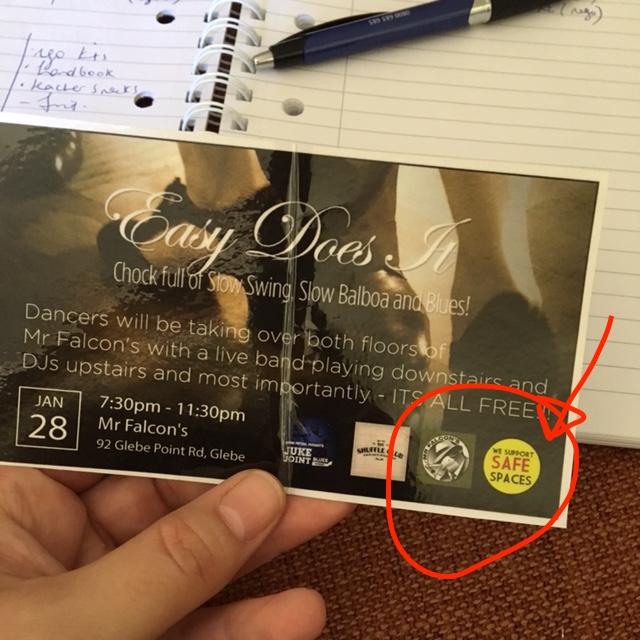
IMG_9080Screen Shot 2017-01-28 at 1.45.17 PM

Check out this simple little symbol on this event flyer.
It says ‘we support safe spaces’, and it’s slipped in there next to the venue, organising body logos. This placement says ‘this is as important as who runs this event’ and ‘we are proud of this’.
It’s not the perfect little symbol, and I’d probably say ‘this is a safe space’, but it WORKS.

Just like flying a rainbow flag or having a rainbow sticker in your window, just like the pink triangle, this little symbol says “We are onto this.”

I’ll be attending EASY DOES IT…. tonight. (well, I probably would anyway, because live band, two floors dancing in a squashy bar: my favourites.

I do have a question, though: this is a public event, and the venue is a bar. How will the venue be enforcing safe space policies? Legit question, and out of curiousity, as we work closely with the PBC, and rely on their own commitment to equity and safety.

Now I’m all excited about community partnerships in working for safety and equity at dance events. I’d be curious to see how Nevermore Jazz Ball and Jenny Shirar and Christian Frommelt approach these things in their very-community-focussed event.


Feminism as happiness

And as this week continues, we hear more and more brave women talk about being assaulted by Max Pitruzella. Even worse, we hear more and more men making excuses for why they didn’t step in and tell Max to stop that shit and quit being a fuckwit. It is difficult to stay positive in this climate.
One of the hard parts of feminism is that it often feels like we have to be continually angry and hating on things. But it’s not true. Feminism is very good stuff. It can bring you happiness and power.

I see the dance world’s action on sexual harassment as a very lovely part of feminism.

One of the ways I turn this issue around (and why I love teaching beginners so much), is by focussing on how to treat your partner with respect, but in practical ways. Our whole Swing Dance Sydney teaching and learning group has come up with very good, simple and practical ways to integrate respect and consent with old school lindy hop dancing. It’s easy, it’s FUN, and it makes classes rowdy, full of laughter and happiness. I do recommend.

What we did with our beginner (week 1) students this week was explain about how to ask for a dance, to introduce yourself before you touch someone, and how to make sure your partner was touching you in the right way, and to be sure your partner is ok with the way you touch them.
With the intermediates we talked about how to understand your partner’s body language as communicating their feelings: how a clenched hand and tight arm might mean an uncomfortable, worried, or nervous partner. And we talked about how to be nice so your partner feels safe. And we reminded both leads and follows that we don’t ever demand or tell our partner to do a rhythm step. We invite them to join us in that step. And that we should be totally digging their response, whatever it is! Even if they ignore us!
All of this was part of a very general discussion about having relaxed swing outs where we let go early, don’t yank in early, and take care of our own posture and rhythm. Leads don’t try to micro-lead, follows bring their shit. People dig that, because they see straight away that this type of partnership is how the jazz gets in.

Our intermediate students are already right on top of these issues. Most of them volunteer or work on our events, so they know our safety policies, and how to deal with reports, the police, etc etc. They are all very active about spreading the word to other people too.

I’m lucky. They are a very wonderful group of people. I’d hashtag this blessed but I’m too cynical for that.

I love the Petersham Bowls Club

I love the Petersham Bowling Club. They took a punt on us when we first starting teaching lindy hop there in 2012. They let us put on live band nights whenever we want (well, any Wednesday, and a lot of Sundays). They have air conditioning, and they don’t try to force us to make our dancers drink more. They are a community-run, pokey-free venue that has solar energy, tank water toilets, and are in the black. Their staff are lovely, and we love them. I love going every week and seeing Jon and everyone. I don’t drink, but I love their care and attention for quality beers, and will happily listen to a long story about the latest barrel, and even have a taste.

They are pretty much the perfect venue for our dance classes, and we love them. LOVE them. We ran the first weekly solo jazz class in AUSTRALIA there every week for years. The PBC was where I ran my first Sam-run live jazz gig. It has good acoustics. The musicians love it – we’ve had local bros, and big international acts play for our beginners, and it’s been wonderful every time.

I love the PBC.


Look after yourself, friends

Hello friends,
With yesterday’s report of another high profile dancer – Max Pitruzella –  sexually assaulting a woman, you may be feeling pretty awful. Terrible. Despondent. It’s exhausting stuff, and it can make you feel unsafe and afraid.
Remember you can call Lifeline any time on 13 11 14. https://www.lifeline.org.au

Something I’m trying to remember: if women are reporting assaults, it means they feel safe enough to speak up. There probably aren’t more assaults in our community than any other, but it is becoming clear that reports are met with positive action. Men who have been assaulted: you are not alone; men assault men as well. You may not want to make a public announcement, but you deserve safety and support. Please reach out to someone.

So take care of yourselves this week. If this incident is triggering anxiety, depression, flashbacks, or distress, do please reach out. You can speak to your GP, who can then referr you to a therapist under a mental health care plan. These appointments will be covered by medicare.
Treat this as you would another dancing-related injury, and act early. You deserve to feel happy and safe.

Boogie > Jump Blues > Rock n Roll

I was thinking about replacing some of my favourite 50s songs with earlier versions (when I DJ). eg Basie’s 50s Roll ‘Em Pete with this Joe Turner and Pete Johnson 1938 version. But this is too boogie, and not swing enough for lindy hop… or is it?
…this is related to my ongoing concern that I play too much jump blues.


linky

I often play the 1950s Joe Williams/Basie version(s), both live and recorded, because the boogie factor is pared back, and the bigger band setting gives it a proper swinging feeling. It’s super dooper fun…


linky

I also play this version with Big Joe Turner, because Big Joe Turner and Pete Johnson. I usually play the Basie if I want to transition from shouters to big band, or this one if I want to go the other way.


linky

…incidentally, the Hornsgatan Ramblers played a version of Jumpin The Blues (as sung wonderfully by Rikard Ekstrand) in Seoul, which was quite excellent. And they’re super old school nerds, so I’m a bit reassured.


linky

I have never played or even heard this Chuck Berry version of Roll ‘Em Pete before, but it does make the move from boogie to jump blues to rock n roll very clear.


linky

Patterns in behaviour: towards a discursive understanding of sexual harassment in dance

[note: this is a discussion that began as a fb post, then outgrew itself as I commented on my own post zillions of times.]

The list of people I’ve blocked on fb over the years correlates with the list of men who’ve been accused of sexual assault and harassment. This behaviour doesn’t happen in isolated incidents.

As R said on fb, “Scary stuff!”
…and yet kind of helpful. We can learn to identify the common traits of offenders.
This is one reason why we should be asking questions about events that don’t pay workers, don’t provide clear, written terms of employment/agreements, and don’t address other issues of equity and justice.

There is also often a correlation between exploiting workers (whether volunteers, paid employees, or contractors) and sexual harassment and assault. Which makes sense when you think of harassment and assault as being about power and control, instead of just being about sex (or even being about sex at all).
I’ve also noted that an insistence on not writing down terms and agreements also correlates with exploitation and harassment. If you don’t write down the terms of the agreement, then the worker (or the less powerful person in the relationship) can’t refer back to it to respond to questionable behaviour. It is much easier to gaslight someone (“It didn’t happen! You’re imagining it! You’re overreacting! It was just a joke!”) if you don’t have a clearly articulated list of what the job does and does not involve.

Incidentally, this is another reason why I actually explain what we define as sexual harassment in our code of conduct. So that people who just ‘have a feeling’ can follow up those ‘feelings’ with reference to a list of specific behaviours. When you have a list like this, and it’s in writing, and available to everyone, it’s much harder for someone to gaslight you, or pass off their behaviour as a ‘misunderstanding’.

I really like a code of conduct to be very specific.
And why I insist that people read it before they accept a job with me. If they read it, then we all know what’s on and what’s not on. And we remove that airy-fairy, amorphous confusion that benefits the people with social power (eg the power to physically intimidate).

A code of conduct is a way of empowering less powerful people. It gives them the tools to articulate their concerns, and to say, “Hey! STOP! I don’t like that!”

If you rely on ‘common sense’ or ‘the rule of law’ to determine how dancers treat each other, you assume that all parties have the same ‘common sense’ or the same understanding of the law and willingness to abide by this.
Which is obviously not the case.
In my case, I don’t think ‘the law’ actually does a good enough job of articulating behaviour I think is wrong or inappropriate. Nor does it deter men from offending.
And because dancers come from different cultures, different backgrounds, and share different values, we don’t have a ‘common’ sense of how we should treat each other. And it’s patently obvious that offenders do think it’s ok to harass and assault people.
So we need a clear outline of these values or sense or laws.

The truly terrifying thing is that I’m beginning to suspect that there’s a network of mutual protection between male offenders in the lindy hop scene.
As J said on fb, “I want so badly for you to be wrong about this…” Me too. But it’s logical. In many cases offenders don’t believe what they’re doing is wrong, so they don’t quash that behaviour in other men, and don’t manage their events to prevent it.

These thoughts were prompted by my going through my events for the rest of the year, and my DJing and traveling for next year. What are my limits as a punter and DJ. What events will I avoid? Do I need a written agreement and code of conduct to attend an event? If there is no explicit code, what sort of broader set of guidelines and strategies will I accept in substitute? If I do refuse to hire known offenders, how do I find out who these offenders are, if women are unwilling to publicise this knowledge, for fear of their own safety? And how do I develop the networks that can help provide this information?

All terribly cheering thoughts in this last, busy part of the dancing year.

New music: Cats and Dinosaurs

a3681886152_10

Hej hej, Sverige!

‘Swing på barrikaderna’ – Cats and Dinosaurs– 2016

Disclaimer: I was approached by Tove Casén Nylander to review this album, and provided with a digital copy of the album.
I then met 
Filip Bagewitz, another band member, at Herrang, and we made friends.

This is another of those happy stories of a band working with dancers, or being a band of dancers.
Cats and Dinosaurs are a Swedish band, based in Gothenburg. More importantly,

The socialist-feminist swing collective Cats & Dinosaurs plays original lindyhop dance music with political lyrics in Swedish.

I was approached by Tove Casén Nylander by email to review this album in month, and then I failed completely to write a review. I think I seem to do my reviewing when I’m stuck on a bus or a plane, and have time to sit and think about the music without interruption. So apologies to everyone.

This is an interesting one. First off, all the lyrics are in Swedish. Which is both excellent and frustrating. Excellent because SVERIGE! But frustrating because the musicians are politically engaged and vocal. The band members I met are all fairly lefty, and very much interested in issues of gender and sexuality (providing a neat dovetail with our feminist fika that year). And the lyrics of these songs, and their delivery, are informed by this thinking. But I don’t speak Swedish, so I don’t know what they’re talking about!
Ah, well.

They remind me a little, musically, of the Underscore Orkestra, for their inclusion of a range of European folk musical influences, mostly in the violin and a few percussive instruments. There are strong New Orleans street jazz influences in instrumentation, delivery, and intensity. Some of the vocal deliveries are similar as well – sort of shouty, again informed by lefty folk pop. I hear echoes of bands like Tin Pan in the earlier days in the discordant bits, and Choinure Boys in the shouty exuberance. These seem particularly relevant to a music which always had one foot in the popular, and the other in the political.
Unlike the Gamble and Doyle albums, this is not a carefully mainstream swing recording. It is not going to attract a huge mainstream lindy hopping audience.

I quite like it. I like the vocalist’s almost androgynous quality. Is this a man or a woman? Does it matter? Not so much. ‘Jobba Mindre!’ is a fun opening to the album, with a shouted, repeated chorus which makes for good singing-along, and there are shouting and clapping bits, which everyone likes. It gets in and out in 2 minutes, BOOM. Total pop song material.
I do like the combination of piano and violin. It very much positions it in European folk music, but by way of American street jazz. There are bits in songs like ‘Sång till valfriheten’ where the instrumentation is particularly awesome at the beginning (though sadly it lacks a bit of variety later). And ‘Sex timmars arbetsdag’’s use of the vibes is quite lovely. I think this band would be a lot of fun live, especially at a rowdy party. The feels are strong, and convincing. I feel, even without any Swedish, that the musicians are committed to the story their music is telling, the feels they are communicated.

It is, though, the album of a relatively raw jazz band. They straddle styles in a way which many dancers would find uncomfortable. Your hardcore lindy hopping purists wouldn’t enjoy this band, but the more relaxed jazz dancers and newer dancers would.

I’m off to DJ in Seoul this week, so I might see how this song goes down. There’ll be Swedes in the audience, so I’ll enjoy seeing how they respond to the radical left wing lyrics in a fairly politically conservative city. I have a feeling it would go down well with Japanese dancers who are used to bands like Choinure Boys.

I wouldn’t recommend this band for hard core lindy hop DJing, but I would recommend it to people who are interested in this particular type of ‘jazz fusion’ (ie street jazz + european folk music + radical politics + fun). Buy it to support and encourage the musicians, who are also dancers.

‘Swing på barrikaderna’ – Cats and Dinosaurs– 2016

New Music: Doyle and Gamble

doyle-too-hot michaelgamble4


Jonathan Doyle Swingtet – Too Hot For Socks
and
Michael Gamble and the Rhythm Serenaders – Michael Gamble and the Rhythm Serenaders

Disclaimer: Books Primo approached me to review the Doyle album, offering me a free download. I chose to pay for it (to support the band), but i took him up on the invitation to review. I saw it as an invitation to engage with his music, to share my opinions. The Gamble review, however, is unsolicited.

Both of these albums landed in my collection on the same day, both prompted by updates and dancers’ chatter on facebook. That in itself is an indication of how closely these two bands are connected to the lindy hop scene. And the importance of digital technology in securing the success of a modern jazz band. You have to have a) a good online vendor for download sales, and b) good social networks in the international lindy hop scene to promote your album by word of mouth.
Both of these bands are American, and both play for dancers, and that’s the other side of the securing-success equation. If dancers see and hear you playing live, and if they feel your feels, and if you’re looking up, at them, engaging with them, and doing that creative, collaborative improvisation that makes jazz jazz, then you’re going to develop a reputation that will help you sell albums and book gigs.

Right now I’m a zillion kilometres above the ground (still over my own continent, though), so I don’t have access to any other information either band. So stick with me, k?

These are dance bands, peopled by, and designed for dancers. Michael Gamble is a dancer and DJ, and his band includes dancers. He also manages the DJed and live music for Lindy Focus, an event fast becoming known for its live music – both in the ballrooms and in the informal jams. Jonathan Doyle is also closely connected with dancers, his band including Brooks Primo and others. Doyle, in fact, has recorded with Tuba Skinny, the Fat Babies, and most recently with Naomi Uyama’s Handsome Devils. All big names in the jazz dance world.

Both bands play regularly for dancers, and are prominent on the american dance event calendar. I’ve never seen either live, though I’m familiar with their recordings, know band members, and have DJed their work before. While they exist as real live people and musicians in American dancers’ lives, they are online people for me. Online friends. I won’t hear them play live unless I travel to America, something I’m not likely to do in the immediate future (guns, Trump, scary arse customs processes, etc). So I consume them as recordings.

For many American dancers, though, they are living, breathing people, friends they see on the stage from the dance floor. Friends they dance with on the dance floor. I think that this relationship is very important, and we all know that live music is now, more than ever, at the core of what we do as dancers today. There was that moment where bigger scenes focussed on DJs, while smaller scenes always maintained relationships with bands, when they had them. But now we are all about live music. And customising bands for our consumption.

Peter Loggins recently noted in a talk at Swing Castle Camp that DJs have both shaped and been shaped by dancers’ preferences, playing 3 minute songs in the 120-180bpm, swing-only, comfort zone. And this has shaped dancers’ expectations of live music. I’m not entirely on board with this argument, as there are plenty of scenes where DJs are playing more varied sets, and plenty of scenes where dancers gather at live music gigs because that is all they have for social dancing.
I’m also more interested in how a contemporary ‘dance band’ might have been shaped by these experiences with DJs. Do modern lindy hop and balboa bands consciously play in ways which reflect this ‘perfect’ dancing storm? If Loggins is right, and DJs have shaped modern lindy hopping practices, have these practices in turn then shaped the way ‘dance bands’ created by and for modern dancers, put together live and recorded sets?

Hm. If this is the case in the States (and I’m not entirely convinced it is), are the European, Japanese, and other regional jazz bands working with dancers reflecting this pattern? Is it the case in Japan, where jazz flourishes, but contemporary lindy hop culture lags a little? And what of bands like the Hot Sugar Band in France, who play for dancers, know dancers, but have a kind of take-no-prisoners approach to live music (and hotel rooms)? Even within America, it’s not an entirely accurate observation about New Orleans, where bands are engaged so actively with a diverse local live music culture.
I know that here in Sydney we have a rich and vibrant live jazz scene, and because bands are playing their gigs, for mixed crowds, they play a range of styles and tempos, and different songs lengths. Even when booked for dancers, and working with dancers to develop ‘dancer-friendly’ sets, they are still holding onto these jazz traditions: playing latin rhythms, playing a range of tempos, and songs of all lengths.
For the most part, dancers are happy with these arrangements. We’ve learnt to enjoy figuring out what to do with something latin rhythmed, or how to handle a super long song. And the strategies we use are similar to the ones Peter outlines in his talk, the sort of strategies that OGs used in the swing and jazz eras.
Interestingly, Sydney is home to the oldest lindy hop scene in Australia, local dancers travel extensively overseas, and we have flourishing balboa, lindy hop, blues, and solo jazz cultures. We aren’t a small, isolated scene with inexperienced dancers. We’re a large, diverse scene with fairly particular musical tastes.

Though we are an older scene, and we do have some exceptional dancers, our overall standard of dancing is a bit patchy, and we don’t have a huge DJing culture. We have some very good DJs, but we don’t have the pervasive ‘hard core DJing culture’ of the States. The organisers and DJs our bands do work with are often firmly rooted in live jazz history, and have a solid understanding of how to work with bands to encourage good dancing and satisfy musicians’ creative drives. Having said that, there are some truly terrible events in Sydney, with awful DJs, and poorly developed visions and guidance for live music. No one wins when the organiser doesn’t have a clue about music, or doesn’t have a passion for 20s, 30s, or 40s jazz.

Many of the better, more experienced Sydney musicians publicly question dancers’ insistence on shorter songs and ‘moderate tempos’. They’re a little more obstreperous, risking gigs because they aren’t as prepared to compromise. Though of course, that’s changing, as recent funding cuts to the arts in Australia (50%!) have sent a significant proportion of our musicians overseas seeking work. If you’re in Paris or the UK, you can catch some of Melbourne’s finest, and if you’re in the Asia-Pacific region, you can often catch a Sydney band touring.
I’m actually very interested in the way local Sydney bands have begun working with dancers for mutual pleasure and creative satisfaction. The Squeezebox Trio have a long standing relationship with balboa dancers at a Wednesday night bar gig, Andrew Dickeson’s Blue Rhythm Band is pursuing Basie’s dance band legacy, working with people like me in Sydney, but also playing at all the major Australian events in 2016. Swing Rocket has played for dancers here in Sydney, but has also played a number of shows in Guadalupe with French musician Tricia Evy and Stockholm based lindy hoppers Marie N’diaye and Anders Sihlberg.

All these bands are staffed by musicians who then go on to work with other local bands, spreading their experience and inspiration from working with dancers. Musicians have been enthusiastically involved with projects like my Little Big Weekend event, where we built tap dancers, singing dancers, and musician-dancers into the program. In my events, I am determined for the music to be more than a ‘background beat’ for dancers. I want musicians engaged with dancers (and vice versa), and I want to use live music in a lot of different ways. For example, earlier this year we had Georgia Brooks arrange a sung ‘word from our sponsor’ to perform with the band during our competition. I’ve also had the band do a ‘practice competition’ with our students at a local gig, so they could all learn how to do a competition with live music. The last was especially fun as we were all trying new things,from seasoned musicians to beginner dancers and organisers. And we went into the enterprise with a spirit of curiosity and determination. And a love of jazz.

I’m not sure how to get to my original point (I did get up at 5.30 this morning), but I wonder if all this means that Gamble’s band and Doyle’s band are perhaps too perfect for dancing? Has the close association with dancers moved them away from a jazz tradition and towards a contemporary lindy hop tradition? But a lindy hop tradition that is a little too carefully curated for the ‘perfect dancing experience’? It’s a tricky issue.
Michael Gamble has been heavily involved with promoting historical swing arrangements and recordings, as well as recreating those with the musical program of events like Lindy Focus, so we know his work is rooted in the past. Which I suppose is my point: is a hardcore recreationist project at odds with the spirit of jazz? If vernacular jazz is about change and growth, innovation and improvisation, does it lose its impetus when we focus on recreating a specific moment in time?

It’s all quite interesting and challenging. And the issue puts us at odds with the function of a dance band (make people dance; make it easy for people to have fun). Can a modern jazz band support that goal while also pursuing musical creativity and innovation which might make for awkward dancing? Can a band honour the past, while also moving forward?

I think it can. But as I’ve ranted in other posts about rhythm-first approaches to dancing, we can’t approach a ‘good dance’ as a series of moves perfectly executed. A ‘good dance’ should have two rules: look after the music, look after your partner. A good dance to a live band should involve an interruption of the sequence of ‘perfect moves’ to pause and just jockey in place, digging the band. Or simpler shapes which allow partners to turn and smile and cheer at musician for an especially excellent solo. Or joke. Just as a good DJ needs to look up from their computer, a good musician look up from their score, a good dancer should look up from their partner and engage with the band, and everyone else in the room.

This is an extension of my question: is it possible for a band to be too perfect for dancing? I’ve lately become a little tired of Gordon Webster’s band for just this sort of reason. The songs he plays are predictable in structure and emotional progression, and just a bit too ‘easy’ or ‘perfect’ for dancing. You can hit every break. You can hear all your favourite songs.

Really, though, this is a silly question. These musicians are working on projects they find satisfying and challenging, interesting and fun. And it gets them work, which is the point of jazz, really, isn’t it? Being socially and creatively sustainable. Earning a living wage and playing music. And the nicest part of swinging jazz is that this playing of music is social. It asks artists to play for and with audiences, rather than locking themselves away in a garret creating ‘art’ that no one ever listens to or engages with. Swing jazz, as dance music, asks musicians to work with dancers, and it asks dancers to engage with music actively, as dancers. Whether they are up on the floor dancing, or turning their ears to the music, breathing it in as people who dance, or feel rhythm in their feet and heart.

That whole issue aside, what’s to be said about these two albums?

Bluntly, Gamble’s album is accessible, and makes for good foot-stomping dancing.
Doyle’s album is more cerebral, more of a toe-tapper than a foot stomper.
Other than that, they’re very similar. Small, swinging bands playing fun swing music.
If I was writing from my gut, I’d say that the Doyle band is a bit squarer than Gamble’s. Which is a feeling I had about their previous recordings. I enjoyed the Doyle, but it doesn’t quite let loose. There’s something in the brass, and wind instruments which says square to me. I’m not a musician, and sadly too slack to educate myself on this point, but it sounds like there’s a lot of very controlled synchronised work there. I feel like things are a bit too safe, a bit too carefully planned out. To me, this sounds like they’re used to playing for each other, more than for dancers. Or if I picture them in my mind, they’re sitting in a circle, facing each other, making it a bit harder for the audience to get in. or they’re reading sheet music, eyes down. This could of course be a matter of the mix or recording technology, with something in Gamble’s recordings lending a warmth or accessablity to the album.
They actually remind me a bit of a band I saw at Herrang, Kinda Dukish. Fantastic musicians, but as a Swedish sound engineer described them, ‘very German’. In other words, very precise. Very good.

My favourite song from this album is ‘Good News, Bad News’. Probably for the muted trombone. ‘You can’t Take These Kisses With Ya’ feels a bit sprightlier, and funner. There are parts of ‘Comfort Zone’ which are especially good. The album does open with a bit of a bang with ‘Sugar Glider’, but even this song is a bit too polite. Though I begin to feel like all the musicians are politely ‘taking turns’, rather than clumping in to give us those layers of sound and aural colour that makes for good dancing.

One of the nice parts of this album is that the cover art features dancers I know (via the internet), drawn by dancers: what a lovely combination. And an example of how ‘swing’ isn’t just about dancing, but a cultural nexus, with dancing just one point on a continuum of cultural practice. A little as Lee Ellen Friedland describes hip hop. I really enjoy this little example of how the band is bedded down into its local dance community.

Gamble’s album, in contrast, comes in like they’re playing for dancers. I know it’s a cliche, but dancers do like vocals, and it provides a point of connection. It’s a bit of an overplayed favourite, but ‘I Left My Baby’ is a good opening song. It provides a point of familiar contact for newer dancers, and it makes experienced ears ask, “Ok, what’re you going to do with this old chestnut to keep my interest?”
‘Disorder at the Border’ comes in the way I like it, with a definitely Basie feel in the rhythm section. I think it has something to do with the sense of relative timing in that rhythm section. Where Doyle’s band feels very neat and in unison almost, here, the Gamble band has the guitar, piano, bass, and drums sitting in slightly different places.

You know what, I don’t know what I’m talking about. I can’t find the words to explain what I’m hearing.

One of the clever parts of this album, is the way it moves from that Basie-esque feel to a smaller, more uptight Goodman small group feel with ‘Airmail Special’, and then on to say hello to Andy Kirk with A Mellow Bit Of Rhythm. I love the version of ‘Seven Come Eleven’, one of my most favourite songs. I really dig that ‘Slidin’ and Glidin’’; I’ve DJed it a few times, and it goes down a treat.

I have to make special mention of Laura Windley’s vocals. I’ve enjoyed her work with her own band, the Mint Julep Jazz Band, and I’ve heard she’s grand live. But I really liked her version of ‘Fine and Mellow’ on this album. It’s hard to sing a song like this, which is so indelibly stamped by Mz Holiday’s voice. When you read the title, you think of that incredible live recording, and Lester Young and Holiday passing the feels back and forth. So to come to this song and give it new feels is a real challenge.
But I think this is my favourite song on the album. The one I’ve listened to quite a few times. Laura changes the vibe, gives it something interesting, and a little more energy, but keeps the clarity and brightness Laura’s band and style are known for.

Yes, it’s all really good dance music. It makes for great dancing. I saw John Tigert drop songs from it at Herrang, and people loved it. But that’s part of my issue with this album. I feel like I’m listening to a good DJ set. The songs are picked from different bands, with different feels, and it’s all great. But I don’t quite feel like the band is taking any risks. I know I’d almost certainly have a good time dancing to this band live. I’d enjoy the performances. I’d hear favourites, plus a few of the ‘currently cool’ ‘newer finds’. But I’d be left wondering exactly what the _point_ of it is. Yes, I do like eating potato chips (a lot). But occasionally I like something a little more challenging to the palate.

In sum, then, this is a very good album. Buy it if you want some easy ‘DJing wins’. Buy it if you want something simple and easy to eat/dance to. As I did, buy it if you want to support bands who play fun music for dancers. But it doesn’t take any risks.

Too Hot For Socks – 2016 – Jonathan Doyle Swingtet
and
Michael Gamble and the Rhythm Serenaders – Michael Gamble and the Rhythm Serenaders – 2016