black – white dance


This is a fascinating photo from this book:
Gottschild, Brenda Dixon. Digging the Africanist Presence in American Performance. Connecticut and London: Greenwood Press, 1996.
This photo rocks because it emphasises the different culturally informed aesthetics of dance, in different dance traditions.
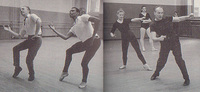
These dancers are George Balanchine (the white dood), Violetta Verdy and Arthur Mitchell. You may know Balanchine’s work from films like Cabin in the Sky]. He was a Russian-born American choreographer who revolutionised concert dance in the States (and internationally) by introducing Africanist themes to white dances like ballet (I have to note: this wouldn’t have been possible without the assistance of black dancers, and black dancers wouldn’t have been in white ballet schools if it wasn’t for the abolition of Jim Crow and other segregationist legislation).
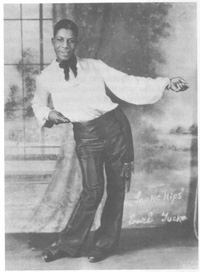
These photos absolutely fascinate me. Check out the angles at Mitchell’s hips in the left photo – more exaggerated than Balanchine. Its off-centredness really creates some excellent angles, breaking up the ‘straight lines’ which are characteristic of white performance dance. And that from a black dood with ballet training – think of Frankie doing a Shorty George for a far more extreme example (or go way extreme and check out ‘Snake Hips’ Earl Tucker).
Joann Kealiinohomoku reads ballet as a cultural discourse in her article An Anthropologist Looks at Ballet as a Form of Ethnic Dance, noting the ways in which “all forms of dance reflect the cultural traditions within which they developed” (533). She describes “the long line of lifted, extended bodies, the total revealing of legs, of small heads and tiny feet for women, slender bodies for both sexes, and the coveted airy quality which is best shown in the lifts and carryings of the female” (545) in ballet. Check it out – you can see those long lines in Verdy’s immitation of Balanchine on the right. Note her straight line from hip to ankle, versus Balanchine’s serious angleage.
Jacqui Malone writes:

Africans brought to North American were no doubt affirming their ancestral values when they sang a slave song that urged dancers to gimme de kneebone bent. To many western and central Africans, flexed joints represented life and energy, while straightened hips, elbows, and knees epitomized rigidity and death. The bent kneebone symbolized the ability to get down

Isn’t that the most amazing shit you’ve ever seen/read?!
It just blows my mind that you can see a culture’s values and ideology in the way people hold their bodies and move. That is SO amazing! It’s also very relevent to the way we Aussie kids learn dance today – how are our culturally inscribed ways of moving and dancing affecting the way we ‘recreate’ these dances? You just have to look at the difference between someone like Ryan Francois and one of the Hot Shots to see how ethnicity affects movement – both are amazing dancers, but quite different.
And I think it is absolutely ESSENTIAL to point out that these ways of moving are learnt. No essentialist stuff here, thanks. For evidence of that argument you can check out the Malcolm X bio for descriptions of how class affected dancing in black communities in Harlem in the 30s, or you can check out the last 2 refs at the bottom.
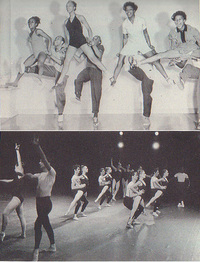
This one is just as interesting. That’s Whitey’s Lindy Hoppers rehearsing for Hellzapoppin’ (Mickey Sales/William Downs, Norma Miller/Billy Ricker, Frank Manning/Ann Johnson). Check out the individual variation on the same basic A-jump.
And below there’s a final ensemble scene from George Balanchine’s ‘The Four Temperamentals’. The ballerinas have just come down from a ‘scissor kick’ thingy and are rested on the men.
How’s that for another neat comparison?

  • Kealiinohomoku, Joann. “An Anthropologist Looks at Ballet as a Form of Ethnic Dance.” What Is Dance? Readings in Theory and Criticism. Eds. Roger Copeland and Marshall Cohen. Oxford: Oxford University Press, 1983. 533 – 49.
  • Malone, Jacqui. Steppin’ on the Blues: The Visible Rhythms of African American Dance. Urbana and Chicago: University of Illinois Press, 1996.
  • Friedland, LeeEllen. “Social Commentary in African-American Movement Performance.” Human Action Signs in Cultural Context: The Visible and the Invisible in Movement and Dance. Ed. Brenda Farnell. London: Scarecrow Press, 1995. 136 – 57.
  • Pietrobruno, Sheenagh. “Embodying Canadian Multiculturalism: The Case of Salsa Dancing in Montreal.” Revista Mexicana de Estudios Canadienses nueva época, número 3. (2002). (read it here)
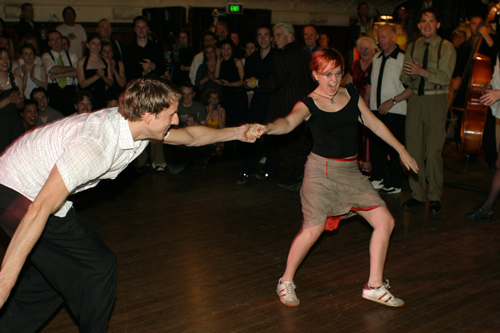
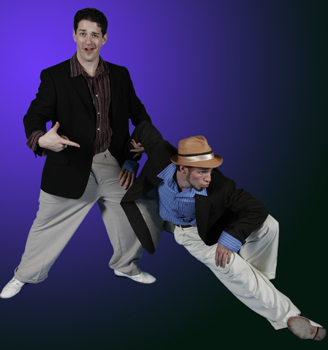
my first meme

A meme from Jac by way of Alison.

Instructions: Go to your music player of choice and put it on shuffle. Say the following questions aloud, and press play. Use the song title as the answer to the question. NO CHEATING.

How does the world see you?
Sepia Panorama – Duke Ellington
(an instrumental, kind of mellow, almost moody track – indicative of ellington’s later penchant for orchestrated swing in his later years. good slower dancing)
…ok….so I’m complex, moody, yet positive?
Will I have a happy life?
Hurricane – Vince Giordano
(crazy fast charleston music – fun)
So, fun, exciting, interesting yet tiring?
What do my friends really think of me?
Kickin’ the Gong Around – Cab Calloway
The lyrics are worth repeating. Bracketed sections are the chorus replying to Cab
(Yeah!)
(No!)
It was down in Chinatown,
All the cokey’s laid around,
Some were high, and some were mighty low,
There were millions on the floor,
When a knock came on the door,
And there stood old Smokey Joe.
He was wet and cold and pale,
He was looking for his frail,
He was broke and all his junk ran out.
Nobody made a sound,
As he stood and looked around,
And then you’d hear old Smokey shout:
“Tell me where is Minnie?” (where is Minnie?)
“My poor Minnie?” (your poor Minnie)
“Has she been here, kicking the gong around?
If you don’t know Minnie” (don’t know Minnie)
“She’s tall and she’s skinny” (tall and skinny)
“She gets her pleasure kicking the gong around.”
(scat) (yeah!)
(scat) (no!)
“Just tell her Smokey Joe was here and had to go.”
And as he departed, (and as he departed)
The curtains parted, (the curtains parted)
And there stood Minnie,
Kicking the gong around.
Hmmm. Interesting, considering I’m all straight edge and all… Maybe it’s a song about me making funny songs about junky ‘hos and their pimps?
Do people secretly lust after me?
Boy Wanted – Ella Fitzgerald
(kind of dumb song where Ella sings about the boy she wants, and she starts: “he must be able to dance, and must make light of romance”).
Ok….
How can I make myself happy?
You Didn’t Want Me Then – Dinah Washington
(Dinah sings: hey, you didn’t want me then, that’s cool – I’ll carry on. I’ve found someone else that I like a lot more and they’re really nice)
Strangely appropriate…
What should I do with my life?
Night and Day – Sinatra with the Dorseys
(“Night and day,
You are the one.
Only you,
Beneath the moon and the sun.
Whether near to me or far,
There’s no matter darling where you are,
I think of you,
Day and night”)
Oh, so I’m back with the looking-for-love thing?
Will I ever have children?
Night and Day – Ella Fitzgerald (50s ella)
(same as last one, but cheesier and more orchestrated)
That’s weird. Does this mean there’ll be perpetual love making, or that I’ll never sleep a whole night through again (because of my many babies?)?
What is some good advice for me?
Put It There (shag nasty) – McKinney’s Cotton Pickers
(sassy, uptempo ‘charleston’ stuff – shag=the dance step, not… well, actually.
No, it’s mostly about crazy uptempo dancing)
Neat. Dance like a fool, shag like a fool.
How will I be remembered?
Jumpin’ at the Woodside – Count Basie
(crazy fast dancing, iconic in lindy for excellent fast dancing and the sequence in Hellzapoppin’)
…crazy fast dancing fool?
What is my signature song?
Gloomy Sunday – Billie Holiday
(sad, slow – she dreams that her lover has gone/died, then wakes up and discovers she was wrong, and now she really appreciates and loves her partner even more for having thought she’d lost them)
right.
What do I think my current theme song is?
I’ Shouting High – Louis Armstrong
(medium tempo, but energetic, a love-song)
whatever…
What does everyone else think my current theme song is?
I’m Gonna Live Til I Die – Barbara Lewis with Reg James
(about partying hard, living every day as it comes)
what-e-ver
What song will play at my funeral?
I Can’t Dance (I got ants in my pants) – Chick Webb
(lyrics (chorus in brackets):
Oh Baby,
Love to have a party,
(let’s have a party)
Let’s all begin,
(let’s all begin)
You bring the women,
(you bring the women)
I’ll bring the gin.
(i’ll bring the gin)
Let’s go for a drive,
(let’s go for a drive)
Ain’t goin’ far,
(ain’t goin’ far)
You fix the blow-out,
(you fix the blow-out)
Boy, and I’ll drive the car.
(I’ll drive the car).
…scatting…
I can’t dance,
(I can’t dance)
Got ants in my pants,
(Got ants in my pants),
I can’t dance,
(I can’t dance).
Boy, I can’t dance,
Got ants in my pants,
Oh, Chick can’t dance,
(why?)
Got ants in his pants!
A fun, energetic song about not being able to dance because i’m all wriggly in my pants, though it’s more about dancing and being excited-energetic and dancing kind of crazy)
Kewl. But I won’t be able to dance to it….
What type of men/women do I like?
Roll the Boogie – Lavay Smith and the Red Hot Skillet Lickers
(uptempo fun, ‘boogie woogie’ rhythm:
“My man likes to boogie, boogie with a steady roll,
When he boogies my woogie, satisfies my soul,
He boogies in the morning, boogies all night and day.
And when he gets home he blows my blues away”)
Nuff said, really…
What is my day going to be like?
What Shall I say – Billie Holiday
(“What shall i say,
When our neighbours want us to come to tea?
They don’t know you’re not with me,
What shall i say?
What shall i say when the phone rings and someone asks for you?”
– a song about having been left by someone, but in an uptempo, positive tempo and rhythm)
kind of ordinary, but positive?
Hm. well that was all kind of disappointing. It made me giggle, though. Esp at Shag Nasty and Kicking the Gong Around. Guess this would have more variety if I listened to less swinging jazz – there’d be fewer songs about party, sex and drugs or misery. Thank god I’m not a country and western fiend.

nice things about the bus

– you can wear impractical shoes and the hugest trousers ever to uni.
– you can sit and read or sit and stare out the window at things going by at speeds greater than 30 k an hour!
– you can overhear conversations about immigration and bringing out beloved brothers between a stunningly beautiful blonde Ukranian girl and one of your favourite crinkly Italian bus drivers (the one who beeps the horn as he approaches the corner shop/deli in Nth Fitzroy so the shopkeeper can get his coffee to him, but then shares the accompanying free cake)
– you can arrive at your destination not covered in (admittedly euphoric) sweat
– you can run into students of Tutorials Past, who hail you at the front of the bus with a bellowed “Yo Sam!” from the back and then engage you in a round of catch up, much the interest of the intermediary students on the bus.
– you can discover said students* are half way through a CREATIVE WRITING HONOURS THESIS (!!!!!!)** and then share a wicked moment when he smirks “because I can’t write”.***
– you get to share a few blocks with school kids from the local middle school who an old friend would have described as ‘liquorice allsorts’ – all sorts of colours and shapes and seriously sweet, including a Japanese kid and a couple of North African Kids yelling out “good bye! good bye!” out the window to each other with great delight and that sort of after-a-goody-day merriment that makes passers-by grin
– you can fart as you leave a crowded bus full of high school students and smirk.
*The ones whose high school teachers (who, if you ever find them, will be totally bashed up) told them ‘couldn’t write’ and ‘never would be able to’, and who so impressed you with their insightful take on a fairly prosaic second assignment you were moved to a perhaps-overly-empassioned shredding of past high school teachers and comments such as ‘this is the type of work that we look for in postgraduate research – interesting, unique and well-researched takes on ordinary stuff’.
**I was so thrilled I would have squeezed this giant boy then and there, if it weren’t for half a bus and a dozen students between us. So I settled for much “I’m so HAPPY” and other mothery/aunty/nanna talk.
*** and at this point you realise why you teach, why it’s wonderful to meet students long after you’ve both moved on from the dullest subjects and are doing new things (whether that involves hitting on undergrads or reading good books**** on the bus), and why you catch the bus
****yeah right – like I’m going to pass up a good book on a warm bus on a chilly Autumn afternoon to chat up chundergrads? Psft.

I like Brunswick.

Right now there’s 3/4 kilo of beef bones sitting in 3L of water with some onions and garlic and a bay leaf. I know they’re enjoying themselves – I can smell it.
This is in preparation for a pumpkin soup I’m making this evening. See, the “potatoes, potatoes, fresh and new” guy came around this week and I bought a whole pumpkin. And the most amazing onions. I’m not usually one to wax lyrical about onions, but these… they’re purple spanish onions, and when you slice them they’re so fresh and bright – the layers seem clearer and crunchier than usual onions. We really enjoyed cooking with them and making them into onions last time (don’t get me started on the tomatoes – oh MY GOD!!): organic = yes baby. The taste is far superior to chemicaled crap: you don’t need so many herbs and spices to make flavours, and can really explore simple, effective flavour combinations. Plus everything is so happy and healthy. No gross chemical urk to wash off. Yay!
any hoo…
So I check out Stephanie’s big orange book for pumpkin options – I wanted an interesting pumpkin soup or curry recipe. I love love love a pumpkin and mustard seed curry I’ve had at Nepalese restaurants, but don’t have a recipe. I also like Thai-ish pumpkin and coconut milk soups. But I settled for a sort of Spanishy/European pumpkin soup. Uses bacon bones to make stock, then add pumpkin and spud (oh, what’s that I see? Some organic potatoes (fresh and new)? how wonderful!), and finally some chorizo to finish.
Yesterday, after lunch with J I stopped off at the Spanish supermarket to get some Spanish chorizo (no, not Portugese. Spanish).
Today I got my veggies from la manna, then went over to the Mediterranean supermarket to get some fresh Italian sausages (no thanks to the Italian chorizo – I’m good), side-stepped a brawl between two Italian nannas and tried (in vain) to find that good parmesan Brett buys. Looks like I’ve got to go up to the IGA to get some. Yes, our local IGA sells fucking AWESOME Italian cheeses. We live in BRUNSWICK – home to spotlight and the best food shops EVER.
Then, I dropped in at Nino and Joe’s, a new, fancy (and huge) butcher I’d not been into before (we usually go to Istanbul Meats or up to Coburg to the Chinese dood) to get some bacon bones to make the stock for the soup. No joy on bacon, but they did give me 1 1/3 kg of beef bones for free with some awesome lamb shanks, steak, etc etc. That butcher ROCKS. They do huge, sexy boned lamb leg roasts, a sweet looking rolled beef roast, and even their pre-prepared chicken dishes looked good (marinated drumettes). I don’t usually eat that sort of shit because I hate jarred sauces and stuff – too much salt, too much sugar, too many preservatives, too many extra ‘flavours’ – and frankly, why would you buy that crap when you live 5 minutes by bike from such AMAZING delis? But the ones in that butcher looked good. The herbs were actually fresh herbs. Plus the Italian nannas were buying it, so….
So tonight we’re having soup. I had thought to do the sausages with a fennel salad on the side, but I don’t think I could fit it all in my belly…
Anyway, I do love living in Brunswick very much. And, if you followed those links to the various providore I frequent, they’re all listed under ‘ethnic’. Which is so weird – the crappy skip butcher next to spotlight isn’t listed under ‘ethnic’ (even though it should really be listed under ‘don’t fucking buy meat here’). Sure, sure, I could get onto the whole whiteness = ethnicity thing, but you know the drill. And can google.
But it just seems weird to hear these places popped in the ‘other’ basket, when for me they’re just my local shops. I go to la manna because the veggies are good and fresh and they deliver (though which days they deliver vary depending on who you ask). I go to the mediterranean supermarket because it’s across the road from la manna and sells canned tomatoes for 55c (as well as dried pasta for 90c, fresh pasta, dried fish, chorizo (Italian, thanks) and has a coffee shop full of Italian nannas and poppas and cakes). I went to Nino and Joe’s because it’s around the corner from all these other places. And of course, Spotlight is right there in the middle of it all. All on one block in Brunswick.
The people I see in all these places are my neighbours, and I often run into them at each place or on the bus or street. I like it that the skips are in equal proportion to the Greeks and Lebanese and Syrian and Lebanese and so on.
And I can’t imagine the sort of shit that went down in Sydney going down here in Brunswick… though I did worry when that nanna got shitty in the supermarket. She would totally kick my arse. It just seems like such a mellow, friendly family area. The local high school has kids from at least 30 different ethnic and language groups enrolled. The Chinese butcher in Coburg greets the Greek and Italian nannas with “ciao senora!” The Hope Street Bus* driver will stop to pick you up, even if you didn’t waive him down, just because he saw you walking along the road (and he always waves to me on my bike). I don’t much care for all the young hipsters moving into the area – they’re far more interested in the pubs than the greengrocers and care far too much about their fashion. Arseholes.
But I love Brunswick.
Remind me to tell you the story of the three old Greek doods and the the time I carried three giant plastic crates home on my bike. It’s a good one.
*yes, the Hope Street Bus route is only about 1.5km each way (roughly 10minutes by leg or 3 terrifying high-speed minutes by bus. If you see/hear the Hope Street Bus coming when you’re riding down Hope Street you get on the pavement. You just do). It’s for nannas. And you can get on or off it anywhere. Everyone sits up near the front and talks. Most people get it if theyr’e too tired to carry 10 kilograms of lamb or a charcoal grill home.

thesis update

I am editing like a crazy person. Well, preferably like a clever, articulate and focussed academic.
I’m up to the 4th draft of Chapter 2 (Dance as public discourse: Afro-American vernacular dance). Actually, I’m mid-way with draft #4 of Chapter 3 (cultural transmission in dance: the movement of cultural form and practice as ideological and mediated process). This will be followed by the 4th drafts of Chapter 4 (AV media in contemporary swing dance culture: revivalism and the ideological management of mediated dance), Chapter 5 (DJing in contemporary swing dance culture: the collusion of cultural practices in mediated dance), Chapter 6 (institutions in contemporary swing dance culture: swing dance schools and the ideological management of embodied practice via media) and rounding up with a first draft of my conclusion. Then I go back to Chapter 1 (Introduction) to do its 4th draft.
Then I edit for typos/grammar/spelling and all that rubbish. Hopefully to submit in August.
It’s all going pretty well, and the supes gave me the thumbs up on my recent effort at making 6 seperate blobs of work one comprehensive ‘story’ about swing dancers’ use of media in embodied practice. It was a matter of juggling writing style, making each chapter support a key thesis (which I can’t articulate right now, sorry), and then each point in each chapter support that thesis.
So Chapter 2 is now looking pretty comprehensive (dance as discourse; how to discuss dance as discourse, theoretically and analytically; dance discourse as culturally specific; then considering Afro-American vernacular dance of the 20s/30s/40s as an example, paying most attention to the relationship between the introduction of new ideas/dance steps (mostly through improvisation) and community structures which regulate/manage this process. In other words, how is the representation of ‘self’ and individual identity (through improvisation, creative ‘work’) by individual dancers ‘managed’ by community structures (such as musical structures, social conventions regarding sexuality and public behaviour, etc etc).
I make the point quite clearly that individual self expression in Af-Am v dance (or the representation of self and individual interests and ‘difference’ in public (dance) discourse) is more flexible than in contemporary swing dance culture.
I see the formal heirachies of teaching and learning (esp in schools) as the reason why there’s less tolerance/opportunity for the representation of self/difference in contemporary swing dance culture. And teaching and learning in contemporary swing dance culture is dominated by ‘revivalist’ ideology – the idea that swing dances are dead, they were great, and they need to be ‘revived’.
I explore this in greater detail in Chapter 4, the AV chapter, where I look at the role of archival film in the revivalist project.
In Chapter 3, though, I talk about ‘cultural transmission’, and consider contemporary swing dance culture, noting how it’s a fairly homogenous culture, in fact a predominantly youth/consumer culture, a consequence of the formal pedagogic practices of swing culture. I take Melbourne as an extreme example, looking at how the swing dance school’s commodification of dance as a package to be bought and sold via classes has resulted in a homogenous ‘market’ for this product – white, middle class, hetero kids.
But this chapter is more interesting than that. I argue swing dances’ movement into the white American mainstream in the 30s was achieved primarily through the mediation of the form: film and dance studios brought swing dances to the mainstream (with obvious asides to stuff like Afro-American troops interacting with white women, though I argue that the segregation of the day prevented the wide-spread effect some dance historians argue for. I think film and dance teachers were significant – though it was a combination of factors).
I’m most interested in the mediation of swing dances in their movement from Afro-American communites to mainstream America and then into the internaitonal community. There’s plenty of work on this stuff, esp in relation to mambo and latin dance and their movement into mainstream America (admittedly in later years).
I’m interested in how film was important. Then I make the point in Chapter 3 that these films represented the racism and segregation of the day in various ways (ie some studios not showing black and white characters on screen together – segregation in-text; racist work-practices in the studios themselves). And then, that revivalist dancers cannot help but reproduce these racist and dodgy themes in using these films as key sources for reviving swing dances. The problem lies in their not critically engaging with these issues in their teaching/researching dance. In fact, I argue quite strongly that swing dancers today are notably reluctant to engage with issues of race and class in their discussions of swing dance history. Which concerns me, esp as 20s and 30s ‘Harlem’ and ‘slavery’ seem quite ideologically loaded terms.
Ok, so with all that in mind, I then introduce swing dancers as fans, through their media use, and through their class/age/etc demographics.
Then I say: ‘ok, so with all that in mind, what evidence do I have for all that in actual examples from dancers’ embodied practice? Where is this shit in the dancing?’ And then I do some neat analysis of actual dance stuff, in particular reference to gender and sexuality (because they’re key issues in swing culture). And I make the argument that just that fans are engaged in ‘textual poaching’ – tactical engagments with dominant ideologies and discourses, so too are swing dancers. It’s even more interesting when you read Afro-American vernacular dance as embodying tactical resistance to dominant American ideology and discourse of the day – hell, let’s be blunt. When you read Afro-American vernacular dance as the dance of people whose history involves racism, segregation, jim crow legislation, racial violence, etc etc. In that situation, of course cultural production will be resistant. Particularly dance, for people of West African descent.
So then I do some neat analysis, basically asking how sexual and gender differences are represented in contemporary swing dance cultures around the world. I look at how, for example, young women in North America use swing dance to explore ‘sexual display’ within a safe social context, where they may (beyond dance) be unwilling to do things like flash their knickers, wear suspenders for show, shimmy, etc. I’m also interested in stuff like women leading and men following as a way of subverting heternormative social forces. I’m also facinated by local differences – eg blues dancing in Korea and Japan, as opposed to blues dancing in Canada or Australia or New Zealand.
And of course, the most imporant part of all this the role media plays. How contemporary swing dancers use the internet, AV media, etc in all this. How important are swing discussion boards in the way young people in swing dance communities represent sexual and gender differences? I argue that media is very important, and provide some neat examples from different discussion boards, websites and email lists.
Then I move on to AV media in Chapter 4, where I talk specifically about media use in contemporary swing dance culture. I take AV media as an example of one key media form (and practice), and then DJing as an example of the collusion of different media forms and embodied practices – in swing DJing we see dancers using discussion boards, email lists, websites, digitial music technology (from downloading mp3s to DJing from laptops), to research, purchase, discuss and explore music and how to use it. Then I look at how all this stuff functions in embodied practice: how DJs’ media use actually functions in their embodied DJing for a crowd of dancers.
In Chapter 5 I look at how all this stuff – media use – is managed by institutions in contemporary swing dance culture. I focus on Melbourne as it has the largest swing dance school in the world, and is a local scene dominated by school discourse (which is, incidentally, capitalist discourse). And I look at how capitalist discourse functions to commodify what was once a vernacular dance – to sell young people a lifestyle product. And, most facinating of all, how they are also sold an ideological ‘product’ as well. I’m interested in how the ideology and discourse of schools in Melbourne reflect dominant social discourse and ideology in the wider Melbourne and Australian community.
Therefore proving my original argument, that dance = public discourse, where ideology is represented, and that this discourse is representative of the social/political/cultural forces of the wider community in which this community-of-interest is located.
I squeeze the fandom stuff in Chapters 4 and 5 in more detail, mostly to explain specific media practices.
Ta-DAH!

revelation

chickwebb_.jpg
I’m sorry Brian, I’m sorry. Chick Webb does rule… well, after Fats and the Duke and Billie and… well, he does rule.
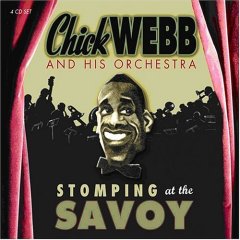
New Proper chick webb collection purchased at caiman.com via amazon for a reasonable price (check it here). Could have found it cheaper, but didn’t bother.
Quality: superior to anything else I had.
DJableness: yes
Range: covers Webb’s career on 4 CDs. As with other Proper collections, I guess it’ll do a good job covering the key moments in his career. I’m not so familiar with Webb, so I’ll have to get back to you…
If you’re not a Webb person already… we’re talking Old Scratchy action here.
Sweet-as swinging jazz recorded between 1931 and 1939. I previously knew Webb through Ella Fitzgerald – she got her first serious gig with his band as a teenager (and later led the band after his death) – knew he was important (in part for his association with the Savoy Ballroom, Home of Happy Feet), read varying discussions about the quality of his band and of course danced de lindy hop to him many times.
I had a few albums already (mostly rubbishy ‘greatest hits’ or not-so-greatly-remastered albums) and wanted something comprehensive so I could get a handle on his action, and then seek out specific albums or greater collections (let’s not talk about how my Billie Holiday obsession began).
I’ll let you know how it goes – so far I like it a lot. The tempos are pretty high (as you’d expect from an old skool Scratchy from the Savoy), which makes it less flexible for DJing (esp when the DJ in question seems destined never to play for anyone other than newbs – but I don’t fret. I’m getting valuable skills… and one day those newbs will be advanced dancers. And then, with my army of newbs, I will conquer the world!), but it’s neat for listening. Though I probably shouldn’t listen to it before bed. Like watching clips – it makes me jiggly. And it could only fuel my recent series of weirdo dance/DJing/suppressed thesis anxiety dreams).