Running a live music gig for dancers in Sydney

Just fyi, if you’re curious about how much it costs to put on a band gig in Sydney:

– band: $1500 (you can pay less, esp for a smaller band, but this is the going rate for a function gig, which is what dancers are, essentially)
– band rider: $100 – $150
– incidentals (printing, lamps, etc etc – random door kit stuff and floor things): $50-$100
– good sound + lights (engineer + gear hire + gear delivery, pick up, set up): $1000
– venue: $500 min (this is crazy cheap. $800 is more likely. You can go cheaper or more exy, but you’ll need a bigger, more exier space to cover your expenses; NB you need to pay for 2 hours before and 1 hour after the event – so you pay for 7 hours for a 4 hour gig)
– paper PR postcards: $50 (just for a small, local print run)
– band break DJ: $50 minimum

Stuff that costs, but that is often ‘invisible’ and hard to quantify:
– volunteer comps (4 hour gig: 11 comps; ie 11 people who don’t put money in the door)
– general PR (online facebook pimping, website, writing copy, photos, etc): 1 million hours (at least 2 days to put it all together, then a couple of hours a week for FB posts, answering emails, etc)
– design work for flyers/websites/fb icons, banners, images
– liaising with printers, picking up print jobs, etc
– buying stuff and transporting stuff (bottles of water, gear, documents, snacks, band riders, crates of beer, etc etc): this will cost you at least $60 in petrol/car hire/however you do it
– storage for your cache of ‘gig gear’ – lights, cash boxes, microphones, signage – all the bits of shit that take up space in your house.
– liaising with bands, DJs, MCs, etc, to be sure they all know what’s going on, and what they have to do/play/say
– public liability insurance
– APRA fees
– general business fees (accountant, etc)
– tax on income/GST if you need to collect it
– paypal or trybooking fees (take about $1 or $2 off each ticket for that)
– having the right forms for all workers (eg declaration of non-disclosure of ABN for DJs, proper invoices/receipts, etc) -> you need to research these, prepare them, print them in advance.

Upfront expenses:
You can’t just hope you’ll make enough on the night. You need to pay for things before the night.
– a $150 or $200 float (a bunch of $5 notes): you need to have that upfront
– venue hire (and bond, usually – anywhere between $100 and $500)
– band rider, incidentals, printing, etc

~$3400

You can totally do it cheaper. But there’s an economy of scale: you need more people to pay $$ so you can cover your band and sound expenses, and that usually means you need a bigger venue which costs more.

For this, you’d need to get at least 100 people paying $35 to cover your costs. But you’re not really safe, and you’re definitely not making a profit. You’d really need 100 people at $40 a ticket.
Basically, you shell out 3.5k, but you can’t guarantee you’ll cover your expenses. If it’s your first time, you have to double the amount of time it takes to do everything, and you’re less likely to find a good sound guy or band that knows its shit.

You can do a smaller live band gig for about $800, if you pay no venue hire, don’t have a band break DJ, have mad connections, hire a tiny/very new band who do their own sound. But this will not be a ‘top shelf’ gig, and you won’t get big numbers. You won’t be able to charge more than $20, so you’ll need at least 50 people.

The biggest problem is that dancers don’t drink. So you don’t have bar sales to subsidise your event, the way all other live music venues do. And you can’t afford to have a band every week, so you can’t offer them a residency, for which they’ll charge you less. If you don’t have a stable venue with good facilities, you have to keep hiring and moving gear and infrastructure (which also eats time and energy).
So the most important expense is networking: getting to know bands, sound engineers, venue managers, finding good printers and designers and so on. And that just devours time and energy. It’s also especially hard if you’re a woman in this male-dominated industry – it can be hard ‘networking’ (ie buddying up) with a bunch of very hetero, quite sexist men. It’s not always hard, and some men are totally wonderful (I’ve found a really wonderful group of musicians, sound guys, venue managers and printers here in Sydney), but they are 99% men, and it’s a very macho/masculine scene. You need to divest yourself of the traditionally ‘feminine’ characteristics that’ll stop them treating you like a professional.

Each time you run a gig, you run the risk of something going wrong – a dodgy band, shitty sound, terrible numbers. This isn’t just a problem on the night, it creates bad publicity and affects your reputation, which later makes it harder to sell tickets. So when you first start doing these gigs, it’s quite important to start with manageable, achievable goals, so you get experience in a lower risk environment, and start building your reputation. You can also take time to learn how to manage the stress of running a live gig, and how to delegate properly so you can manage them properly. Yes, you can save money by doing everything yourself. But all the worst events are the ones where the manager cannot delegate, and so no one is actually managing the thing.

Once you have some experience, skills, and profile, you can scale up. But even when things are going well, things can still go wrong and give you a scare. So you need to have recovery plans in the back of your mind. Both financial and promotional. Of course, at the end of the day, you can’t play it 100% safe – you need to take risks. And for most of us, it’s these risks that bring the stress, and which leave many of us vowing never to do this again.

Allies and buddies

I’m doing some research into how people can support their friends who are confronting harassers and bullies, or how men can confront other men about their behaviour.

Lindy hoppers don’t like conflict, and we’re generally totally rubbish about telling other dancers to stop being dicks. So we need to learn how.

I am working on being brave enough to step up and call people out on their behaviour, but I know that’s not for everyone. Particularly as our scenes have a very clear hierarchy – teachers at the top, everyone else lower down. Which sucks, and we can all work on dismantling that, too. But I do think that if you’re not actually doing something about sexual harassment and assault in your lindy hop scene, you are enabling it. You’re making it possible for men to get away with this stuff.

So what can you do?

1. You can start working on empowering women dancers in class, on teaching students how to give feedback (positive and negative) in class, and you can model this yourself. But not all of us are teachers.

2. You can be a buddy for someone who’s going off to confront someone. Go with them, stand next to them. Or just make it clear that you’re watching.

3. If you see someone doing dodgy stuff, and causing a fuss, don’t look away. Look at them, and make sure both he and the recipient of his unwelcome behaviour knows it too. You don’t have to step in or say anything, but you can turn your body to face the people talking, you can stop talking to your friends, make eye contact, you can make it clear that you are listening and watching.

4. If you’re DJing, use the mic in a way that lets the punters know you’re watching them. I’ve started doing this at our Harlem night, mostly in a good way – cheering people on in jams, etc. But it makes it clear to the punters that I am watching. DJs watch the floor all the time: if you’re DJing, put that power of observation to good use, and let organisers know when you see Dodgy Guy X being dodgy. Let them know straight away.

5. If you are a man, and if you see a guy you don’t know too well doing dodgy things, what can you do?
First, what are you limits? When do you get to too much? What will make you do something? Think about this ahead of time, so you’re ready.

When will you step in?
When the guy starts shouting?
When he touches a woman you don’t know?
When he touches a woman you do know?
When he hits them?
What is your limit?
What will you do when you reach that limit?
Practice your response, and talk to your buddy about when they’d like you step in.
Just fyi everyone: if I’m confronting someone and he touches me at all, I want you to step in! Immediately! I figure that’s a good place for all of us to set our limit: if we see someone touching someone else in an obviously dodgy way, step in!

6. If you’re a man, and your buddy or a guy you know is doing dodgy stuff, what will you do? What are your limits?
The AFL have a poster that can help you figure this out.

OPTIONS FOR THE BYSTANDER?
» Ensure your own safety

» In an emergency, call the police

» Talk to another friend about your concerns and decide on a response

» Distract the person whose behaviour is a worry and talk to them later about it

» Move away from the activity and later apologise to the woman for your friend’s disrespectful behaviour

» Leave the scene and later let the person know you had a problem with the way they treated the person

» Enlist the help of friends of the person you think is at risk of harm and check that she is OK

» Confront your friend directly and say that their behaviour is not on

» Don’t do anything at the time but later talk to a woman you know about how you could deal with the behaviour in the future

No, I’m sorry, but I am not going to be bullied.

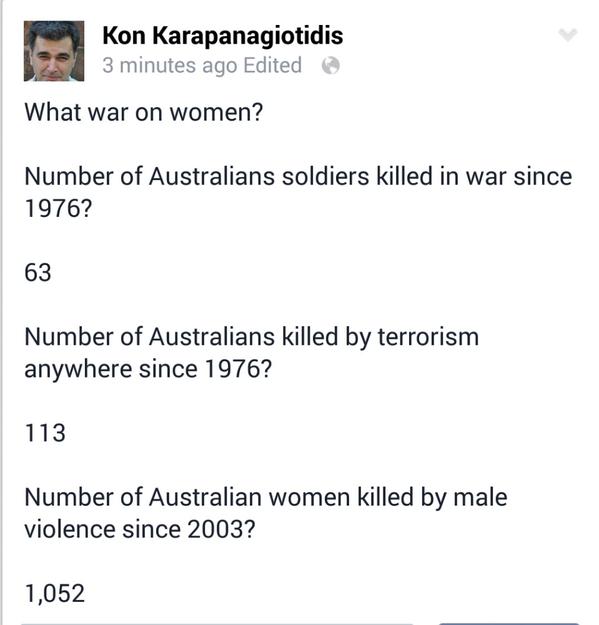
31 women killed in Australia so far this year (https://www.facebook.com/DestroyTheJoint)

CCYT72nUAAAWp7J

Kon Karapanagiotidis:
What war on women?
Number of Australian soldiers killed in war since 1976?
63
Number of Australians killed by terrorism anywhere since 1976?
113
Number of Australian women killed by male violence since 2003?
1.052

I got a bit tired of being afraid (because I’m a woman, and my friends are women), so I’ve started speaking up when I see or hear about men sexually harassing or bullying women in the lindy hop world.

See a guy pulling out unwanted air steps on the dance floor? Tell him to stop.

I’m also pro-actively talking about consent, boundaries, and respecting each other’s personal space and body in dance classes – to all students.

A woman needs someone to stand next to them while they tell a guy to back off? I’m that person.

Doing this can be scary, but it makes me feel brave. And that’s the best antidote to these sorts of statistics.
Does it mean I attract stroppy responses from men? Yes. But it’s better than that helpless feeling you get when you finish a dance where a guy has touched your boob 100 times, or holds your hand so tightly he leaves fingermark bruises, or yanks you into a swing out so roughly your shoulder aches.

I want to repeat: when I ask a man not to do lifts on the dance floor, or to stop touching women, he often responds with aggression. A guy got nasty with me on Friday when I asked him to stop pulling air steps. And then he came back to me when I was DJing. And back when I was packing up afterwards, and loitered in my peripheral vision until I’d finished talking to a number of other people. Then he had another go at me, and wouldn’t go away when I said, clearly, “I don’t want to speak about this. Please go away.” I had to actively walk away.

All I did was ask him not to do lifts on the dance floor. I was very polite and non-threatening. And he got angry, and then he came back, and wouldn’t go away.

I wasn’t afraid (because I could take him), but he was bullying and threatening. If I hadn’t done this before, if I didn’t know that I was brave enough and strong enough to deal with this, I’d have been afraid.

This sort of response is normal in the lindy hop world. I have had this sort of response from a number of men.

But don’t let this stop you telling them to stop. Whether you are a man or a woman. Don’t walk to your car alone after this, but don’t let this stop you. Bullies are easily frightened off, if you stand strong and pretend you’re fierce.

And men – you need to call other men on this. Because these types of men are used to bullying women, but they’re not so brave when another guy confronts them.

And by the way, this is why I think it’s more important to talk about men sexually harassing women, than women sexually harassing men. Because this is the sort of response men make, not women.

This is not a gender neutral issue.

So, the conversations about sexual harassment in lindy hop continue.
I’ve been telling off rough men lately, and working my way up to dealing with the less overt stuff.

Every time I talk about men and how to deal with men doing this stuff to women, I’ve had a guy or two chime in to change the pronouns and make them gender neutral, or to talk about women sexual harassing and male victims.
Yes, I know women sexually harass. But I want to talk about men as aggressors. This is a GENDERED issue. Gender is IMPORTANT. It is absolutely central to this issue. Far, far more women are harassed by men in the lindy hop scene than vice versa, and I think we need to talk about MEN and the things they do to WOMEN.

So stop messing with my pronouns. And stop trying to insert this sexually harassed man and harassing woman into all my stories. Sure, they’re out there, but I WANT to gender this story!

where femmo stroppos at?

I keep leaving facebook discussion groups that _say_ they’re all about being feminists in lindy hop, but are _actually_ all about white straight blues dancing polygamous Mens Rights Activists.

Where all the _actual_ femmo stroppos at?

Honestly, I have no time for men who want to mansplain reverse sexism at me. It’s not real. There, we’re done. Now let’s talk about something else.

Just like John Hammond: promoting jazz in a digital environment

My previous post led to this discussion on the facey, which really caught my interest. I’ve quoted other people without their permission, so do let me know if you want it deleted, you peeps.

Hetty Kate (Tues 7 April 4pm)
That’s quite a rant, however a few nice pics, a nice video, a schtick, a costume and a cute name doesn’t mean you’re actually any good. Though it does make a bookers job easier.

Sam (Tues 7 April 4.16pm)
It’s a mega rant. Having those things does make a booker’s job easier (and a dance event organiser’s – which is a slightly different role), which I guess is my point. I guess with all these things you can fake it til you make it, right?

But I actually feel quite sad when I come across fantastic musicians (especially the older ones) who don’t have any online presence . Makes it really hard for me to discover them, or chase them down after a gig. Maybe I should start a side business – ‘Dodgy Sam’s Dodgy Websites for Jazzniks.’

Hetty Kate (Tues 7 april 4.17pm)
haha, well the older musicians came up in a different environment..

Hetty Kate
lucky bastards!

Sam (Tues 7 April 4.24pm)
Totes. But they gotta get on it, if they want to develop a new (or continuing) audience. It’s a shame, because the older doods have mad skills that many younger musicians could really benefit from working with. The dance scene is particularly respectful of elders, and we really dig seeing younger and older people working together.

Hetty Kate (Tues 7 April 4:24pm)
agreed!!

Bruce (Tues 7 April 4:46pm)
You can have the best product in the world, but if its not marketed properly no one will know about it!

Sam (Tues 7 April 5:09pm)
And I guess that’s the difference between the very olden jazz days and now. In those days bands travelled endlessly, and were gigging endlessly, so the word of mouth talk was strong. And there were magazines and general news stories (because this was mainstream music then) talking up bands and musicians all the time.
But today there are fewer opportunities for jazz bands and musicians, fewer gigs, and small audiences… though part of me thinks that olden days’ musicians had it a bit easier because they were pitching to the mainstream (ie a bigger market), and modern day musicians need to work a bit harder to convince people to try something new (old). But there is the internet, which makes reaching niche audiences easier.

Now I want to post a link to that fascinating post someone hooked me up with a while ago (I think it was Andrew?), where Steve Albini argues that the internet is good for niche/indy music (Steve Albini on the surprisingly sturdy state of the music industry – in full (Monday 17 November 2014)
I’m not 100% convinced by his largely personal anecdotes, but it’s an interesting provocation. The internet is an opportunity for niche music and musicians. How else could I get hooked on the Dry Throat Fellows?

…although playing and recording music professional has always been about networks. I’m reminded of a line I read in an article about Black Swan Records. Though they were explicitly designed to record and sell to black artists and audiences, they actually sold in the Asia Pacific region, because segregation happened in our part of the world too.

So getting your product to the right market – getting your music to the right ears – is still a matter of having a savvy promoter with the right contacts and a clever understanding of who might dig what you do. John Hammond, anyone?

I am (obviously) interested in the way specific communities of interest use digital media. That was my doctoral research. Now I’m thinking about jazz musicians and how they use (or don’t use) digital media. I guess I’m especially fascinated by the tension between ‘pre-digital’ media and cultural practices operating in a ‘digital’ world.

How do I find new bands?

This piece is really a companion piece to Make it Easy for me to hire your band, where I talk about the sorts of things I need bands to have to make my job easier. Basically, they need an online presence and a name. Or, in other words, they need to make it possible for me to a) find them, b) hire them, and c) promote them. And I buy a lot of music, because I’m also a DJ.
I don’t mind (I quite like) hunting down bands and musicians, but I have only limited time and resources.

In this post, I talk explicitly about how I find new music by musicians today.

Jeff James asked in

Whats the best music mapping tool to find new swing jazz bands? (28 March at 10:36)

And of course I had a one million word reply.
You know, my responses are always long because I type quickly, and because I spent 10 years in higher education learning to write and think quickly. It’s just a job skill. It helps if you can read quickly too :D
Anyway, on track.
This was my reply. I’ve used the facey links here, because they’re a useful way of demonstrating how it’s useful for musicians to have a facebook presence, so they can be tagged and see who’s talking about them and where.

Mostly my brain. :D

I use Bandcamp for new bands, particularly American and European bands  
As a bandcamp member, I then follow a bunch of people who are dancers or DJs, and their purchases pop up in my feed, which then gives me ideas about what to buy. I can also check out the ‘supporters’ of a band I like, and buy what they buy.

I <3 Bandcamp My other way of finding out about new bands is to see what bands a particular musician I like is playing in. eg Gordon Au turns up in lots of great bands. I might find good musicians by seeing who's in a band I like - eg Gordon Webster‘s band for the ‘Live in Rochester‘ CD included Aurora Nealand, Jesse Selengut, Gordon Au, Dan Levinson, Matt Musselman, Cassidy Holden, Rob Adkins, Jeremy Noller, Naomi Uyama. I then google those musicians to see what bands they’re in, then I hunt down those bands on google, then follow links from their sites to their cd releases.

If you start with that list of musicians in Gordon’s band, you can find:
Aurora Nealand: Aurora Nealand and the Royal Roses, the New Orleans Moonshiners
Gordon Au: The Grand Street Stompers, New Orleans Moonshiners
Matt Musselman: Naomi and her Handsome Devils, Sly Blue, Glenn Crytzer‘s bands,
Jesse Selengut: Tin Pan, Mona’s Hot Four
Dan Levinson: the Bix Centennial All Stars, Janet Klein and her Parlour Boys, David Otswald’s Gully Low Jazz Band, Dick Hyman, Vince Giordano’s Nighthawks, Jeff Healy, Terra Hazelton
Cassidy Holden: Cassidy and the Orleans Kids, Luke Winslow King,

If you add Adrian Cunningham (who played on Gordon’s Live In Philadelphia album) you can follow him to Crytzer’s band with Musselman, Naomi Uyama’s Handsome Devils and the Baby Soda band.

…and then you can follow each of those bands to other good bands. That will give you a good overview of New York musicians. Mona’s Hot Four, for example, will lead you to Tamar Korn, which leads you to the Cangelosi Cards and Gaucho. Gaucho will help you find San Francisco musicians. Cassidy and the Orleans Kids will help you find New Orleans musicians.

I do the same with Australian musicians, but I’m finding the older generation (ie these guys’ parents or grandparents) are rubbish at using digital media, so it’s really hard to find their recordings. Unless you stalk the Sydney Jazz Club gigs, and look at their CD stall.

I was hiring a guy called Paul Furniss for a gig recently, and gave him a googling to see what I could find out about him. This led me to some great youtube videos, which helped me find some good bands and other musicians. Then I had to email the guys who ran their website and order a CD by mail. Laborious, but worth it.

And then, I see who the bands are in the dance videos on youtube. That’s how I found the Hot Sugar Band. I also see which bands are playing at dance events, and keep an eye on musician friends like Laura Windley, Eamon McNelis, Leigh Barker, Hetty Kate, Justin Fermino, etc etc etc.

I’m kind of a serial collector of musicians: GET ALL THE BANDS.

Make it easy for me to hire your band

This piece is really a companion piece to How Do I Find New Bands, where I talk about how I use digital media to find modern jazz bands. In this post, now, I’m going to talk about the sorts of things I need bands to have to make my job easier. Basically, bands need an online presence and a name. Or, in other words, they need to make it possible for me to a) find them, b) hire them, and c) promote them. And I buy a lot of music, because I’m also a DJ.
I don’t mind (I quite like) hunting down bands and musicians, but I have only limited time and resources.

I’ve been meaning to write about this for a while. But today I just had a bit of a spit on the facey because I wanted to actually reach some people.
This is a post about musicians, and how they can get gigs with dancers. It’s also a post about how to present yourself as a professional in the music industry.

Hey, musicians. It makes it much easier for me to promote your band if it has a name and a ‘shtick’. Five creative guys having fun is a good thing, but it’s not going to sell tickets to the average punter. And having a name and shtick is a good way to give your project focus and impetus. Which punters can connect with – it’s a way in.
Also with the hi-res photos, a short bio, and a website, please. If you have youtube videos, you’re winning.

Playing your guitar in your lounge room is art. Playing gigs where people pay you is business. Unless you actually are Django, your name alone is not enough to sell tickets. Particularly if you want to draw more than just the same five retiree jazzniks to your gigs.

Examples of bands/artists doing it right:

Hetty Kate (Melbourne, Australia)
website: http://www.hettykate.com/
facebook: https://www.facebook.com/hettykatemusic
shop: http://shop.hettykate.com/

Promotions, presence and networking.
Good, clear site, bio, pics, sound files right there.
Hetty Kate brings a good stage vibe too – she’s an entertainer. She wears good outfits, she talks to the crowd (nothing like a little witty banter to let the audience in), and she’s really present when she plays gigs. She looks at people. Jazznicks, I’m sorry, but your faded ‘gig blacks’ aren’t going to cut it. Buy a decent suit that’s comfortable and looks nice. If you’re not into suits, wear something you dig. Just show you care enough about this gig to make an effort. And punters will care enough to pay for a ticket.

Hetty Kate is also really good at networking. Or, in human words, keeping in contact with other humans. You don’t have to shmooze – in fact, it’s much better if you don’t – but it’s humans who give you gigs, so make friend with them. It’s in your interests to travel interstate and overseas to play gigs, so you’ll need a far-reaching network of professional ‘friends’.

And the best way to keep these relationships is to: a) Have a simple email address, phone number, and business card. Spread them widely, b) stay in contact (drop an email occasionally, say hi at a gig), c) Return favours and do favours (ie be a decent person, so people will help you out and stay sweet on you), c) Don’t be a dick. This last one is important. I know far too many male jazz musicians who are sexist dicks. I won’t hire you. Most of the dance event organisers in Australia are women too, and they won’t hire you either. And unlike the jazz music scene, the jazz dance has more women than men, so if you’re a sexist dick, you will not get gigs.

Naomi Uyama and Naomi & Her Handsome Devils
website: http://www.naomisdevils.com/
facebook: https://www.facebook.com/NaomisDevils
bandcamp: https://naomisdevils.bandcamp.com/

Professional musicianship and leadership.
We’ve heard all these musicians before, but this band has a distinct sound and clear leadership. They’re also pretty bloody hardcore on stage. There’s no fucking about being idiots, or screwing around with stupid in-jokes. When they get on stage, they are ON STAGE, and they bring some serious shit. They are good musicians, and they don’t patronise dancers. They recognise that lindy hoppers today are serious music fans and know an awful lot about good music. Dance event organisers and DJs often know much more than jazz musicians about what makes good dancing jazz. And this band are more than willing to accept that. They have a woman dancer leading them! Win!
They also have a website with all the info and assets (pics, etc) that I need to do my job properly. So I don’t need to hassle the band with a string of email requests.

Most importantly, they have a clear, strong leader who kicks heads and takes names. I know who to contact if I want to book her (and I’d love to!) Naomi a visible leader on stage, she dresses the part, she has serious presence, and she makes sure the band’s book is full of the right songs, played the right way for dancers. I’ve no doubt she uses her contacts as a dance teacher to secure gigs, and she stays in contact with them, figuring out which gigs are right for her band, for her, and for their reputation.

Tuba Skinny
website: http://www.tubaskinny.tk/
facebook: https://www.facebook.com/pages/Tuba-Skinny/198301143539894?fref=ts
bandcamp: http://tubaskinny.bandcamp.com/

A clear, coherent ‘brand’ or vibe.
The website is pretty basic, and it takes content directly from bandcamp, but it does the job. It has a bio, photos, and links to music!
More importantly, the band has a clear ‘brand’ or identity, which makes it easy to promote them. I don’t have to waste a lot of space explaining who they are and what they do. And what they do, they do 100%, from the songs in their book, to their clothes they wear on stage, and their presence on stage. This band identity is real, it’s who they are, and it’s what they do. They busk, they’re street jazz, and there’s a consistency right across their whole vibe – from their shows, to their recordings, to their look, their song choices, and their musical performances. This makes them easy to sell. The realness of it makes them easy to connect with, emotionally and creatively, as an audience.

This band has also worked extensively with dancers, both on the street, and for dance events. They respect what we do, and we respect what they do. So they are solid gold from a promotional perspective.

You need (if you’re actually running a band rather than screwing about):
– Band name.
– A website (even a tumblr or wordpress will do) with your email contact details right on every single page. Your phone number is also helpful. A website makes you look legit.
– A facebook page (where are you playing? What are you recording? What music do you play/love? What other bands, venues, and pages are you ‘friends’ with – who is in your network? What is your scene?).
– Sound files (complete songs) online.
– Youtube or vimeo clips are great.
– Hi-res photos of your band, taken by a pro, that are on your website.
– A short (1 or 2 paragraph) bio for your band (the musical/creative mission or vision, where you’re based, what you do), and for each member (who they are).
– And sell your music online, via downloads. So people outside your tiny local scene can give you money. Use a third party like bandcamp so people can find you.

Why a band name?
So I can say “Harlem presents: Sam and her Fancy Fiddlers!” rather than “Sam and Mike and Fred and Harry and Sheilah and a drummer if we can get him” on my 14cmx10cm postcard.

So you can develop a band ‘identity’ that helps people know what to expect when they buy tickets to your gig.

You can change the members at will, and it doesn’t screw up the PR copy (the whole is greater than the sum of its parts).

To give your band FOCUS. Your name should reflect your vibe: what music do you play? Are you rowdy jazzpunks fighting the man? Are you 100% Benny Goodman recreationists? Who ARE you?

A name shows me you can keep your shit together long enough to cooperate with a group of other musicians for a whole gig. And that suggests you’re easier to work with, and I’m more likely to hire you. I have zero interest in loner mavericks.
If you have a clear goal for your band, a clear focus, you will present as a ‘package’. You will do better music. You will work as a band not as a bunch of loner ‘artists’*. Yes, music is art. But it’s also business, and bills have to be paid. Get it together.

*wankers