

Get more genuin Scandinavian Design in you. Like IKEA, only with weirder grammar.
I think I love the fabric too much.
…there’s a reason lindy hoppers are obsessed with all things Svensk.
the hamranos
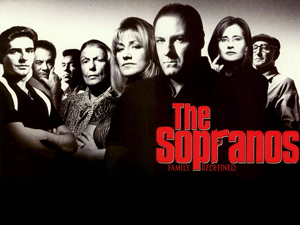
Prompted by marking quite a few essays about The Sopranos of late, I brought home the first few discs of season 1 from the video shop.
The Squeeze was instantly enthralled, and I was more than happy when he brought home our very own copy the other night. We are enchanted.
It seems we are bound to adore all gangstah action, after our brush with the Godfather, Raging Bull and assorted others.
So it seems strangely fitting that Laura posted this Sesame Streets clippy today:
Australian-Melbourne-Irish-Global media?
As some of you know, I’m booked in to give a paper at the annual CSAA conference in Canberra in December. I wrote about my abstract here and moaned about not scoring a bursary here.
Well, things have actually turned around a bit since then. I have actually scored a smallish grant from the nice people at the CSAA, which will cover my conference registration and part of my airfare. Yay.
So, come December, I’m flying up to the Can to talk theoretical turkey with acadackas, hang out with my old school friend Kate (no, not ‘old skewl’, nor is she particularly ‘old’ – she is a friend I have had for a long time) and possibly see some local dancers.
This was all very nice to hear – I’m quite proud of having scored a competitive grant from an organisation which will look good on my CV. I’m also happy to be funded for my trip to the Can – I need to get a job some time soon, and these things are good networking activities… though I seem to spend an inordinate amount of time hanging about with old UQ buddies. And as you can see from this entry, I seemed to spend more time thinking about jazz than any professional business at the last CSAA conference.
So anyways, I’m off to do a paper.
Here is the abstract again:
Swing Talk and Swing Dance: online and embodied networks in the ‘Australian’ swing dance community.
Since its revival in the 1980s, lindy hop and other swing dances have become increasingly popular with middle class youth throughout the developed world.
There are vibrant local swing dance communities in Melbourne, Sydney, Hobart, Perth, Canberra and Brisbane for whom dancing – an embodied cultural practice – is the most important form of social interaction. Swing dancers will travel vast distances and spend large amounts of money solely to attend dance events in other cities. The success and appeal of these events lies in their promotion as unique and showcasing their local dance ‘scene’.
In travel itineraries which criss-cross the country, swing dancers develop networks between local communities that are not only cemented by their embodied interpersonal interaction, but also by their uses of digital media. In this paper, I examine the ways in which the online Swing Talk discussion board is utilised by Australian swing dancers to develop personal relationships with dancers in other cities, which in turn serve to develop relationships between local communities. This insistence of local community identity in swing dance culture in Australia defies a definition of a ‘national’ swing dance community. I describe the ways in which ‘Australian’ swing dance is an ‘unAustralia’ – not a homogenous ‘whole’ but a network of embodied and mediated relationships between diverse local communities and individuals.
Right now I’m having trouble remembering what I wanted to write about. I suspect there wasn’t actually a lot of planning in there. But I have started to have some ideas. Of course stimulated by my impending trip to SLX (I’ll be off to the tram stop in a few hours – nursing this horrid cold that’s sprung up), but also prompted by planning for MLX6 planning.
Have a listen to this:
powered by ODEO
(which you can find here on the MLX6 music page).
Now, if that’s not an advertisement for glocal community, I don’t know what is. I mean, before we even get to the dance/exchange stuff, we’re listening to an Irish guy pimping Australian jazz for a Melbourne exchange to an international audience. Neat stuff, huh?
This is the stuff about lindy hoppers that I really love: the way they go nuts and do all sorts of creative things – off as well as on the dance floor. And much of this creative work is centered on big dance events like exchanges and camps. There are lots of film clips, mini-films, websites, DVDs, etc etc – and a couple of special official CDs produced – but I’m beginning to get interested in the way swing dancers use radio and audio technology. Specifically, digital audio technology. I mean, there is all that stuff about DJing, but swing dancers do other really interesting things as well: Yehoodi radio is streaming music chosen by swing dancing DJs from all over the world, the Yehoodi Talk Show is really just a chance for a couple of engaging dance/music nerds to have a chat online and Hey Mr Jess is even nerdier – a particularly lovely DJ chatting about swing music and DJing with another dance/music nerd.
Hello podcasts.
This promotional podcast by one of our MLX6 crew is interesting for the way it combines samples from local musicians’ albums (these are all bands we’re hosting for MLX6, from Melbourne and Sydney) – they’re all still living, all contemporary artists – with pimpage for our event.
I do need to sit down and do a bit of analysis of the content, but this is some interesting stuff. Radio has proved a particularly effective medium for connecting dancers in different countries – a natural complement to discussion boards. And this is one of (if not the) first Australian contribution to the international lindy hop radio world (excluding contributions by local DJs to the Yehoodi radio show) – this is the first locally produced Australian swing dance radio ‘bit’. And it’s narrated by an Irishman!
Wonderful!
I do need to sit down and think about how this works: the way ‘Melbourne’ is presented, the way ‘Australia’ is presented, and how different audiences within and without Australia (and Melbourne) might receive/interpret/read this text, but it’s a starting point – a bit of motivation – for my paper. At the very least, I can add that to my usual list of clips and photos for the presentation – always fun to do.
Yay!
–edit: you know, part of my brain is also a bit interested in the way I’ve used that odeo plugin, there: most times you see those sorts of things they’re ‘invisible’, in the way my sidebar over there is largely ‘invisible’ from the main body of the page over here. But I’ve actually framed that odeo thingy as something to use and listen to, rather than just stuffing it into my sidebar or at the bottom of this post. It’s an interesting contrast to the livefm thingy over there in the sidebar (which is still stuffed and giving me the shits). I am, of course, delighted and fascinated by all this convergence action – my blog as combining audio and visual as well as written? Let’s see a newspaper try that then! Of course, this issue is one I’ve been plaguing my students with lately in tutes – as I heard in a Media Report story about cross-media ownership and digital technology, the cross-media ownership legislation kind of collapses when faced with the internet and the fancy things newspapers have been doing online: they combine av with traditional ‘static’ text… and bloggage, and audio, and… lots of other lovely stuff.
This is such a great time to be a media studies stooge! How could you not love the internet?!
set list
I thought you might be interested to see the latest set I’ve played. I’ve done a few truly crap sets recently, in part because I’m too tired and too busy to put much thought into my music or DJing since I’ve started teaching. But I did a ‘practice’ set at a local venue recently which has a mindblowingly good set-up: don’t matter how old or how scratchy it is, it sounds GREAT there. So I took the opportunity to play only stuff I love, no matter how old or scratchy. There was a tiny crowd there, who really didn’t care what I was playing, so it was all very useful for me.
The following Thursday I played this set, which I was very proud of. Admittedly, it was kind of an easy crowd – the Thursday before a big performance ball (wtf? yes, you read right) – so there was a room packed with dancers ready to party. There were dancers with a wide range of tastes, and with different abilities, so I could really mix it up. I also used quicker transitions between tempos, though kept within my preferred genre. The first few songs were actually time-fillers because Dave and I were trying to figure out why the sound was screwed. Note to self: check all laptop settings before DJing. Again, another side-effect of being so busy and thinking so little about DJing. Viper’s Moan was where I started paying attention to the floor and working it a bit more.
The set went really really well, and I enjoyed myself DJing more than I have in ages. I also played a lot of stuff I don’t usually play. I don’t play it so much because I’ve played for a lot of intolerant groover crowds lately (blurgh), which has made for some seriously dull DJing on my part. And recent fits of pique – nay, sulkiness.
So here’s the set list (title – artist – bpm – year (NB dates are often album release date rather than song release date; bands like M’s M R, Charleston Chasers and Vince Giordano are contemporary artists) – album)
Atomic Cocktail (Original) – Slim Gaillard – 129 – 2006 – Slim Gaillard Selected Hits Vol. 1
Chicken Shack Boogie – Lionel Hampton and His Sextet – 122 – 1949 – Lionel Hampton Story 4: Midnight Sun
Hamp’s Got A Duke – Lionel Hampton and His Orchestra – 142 – 1947 – Lionel Hampton Story 4: Midnight Sun
It’s Only A Paper Moon – Ella Fitzgerald – 125 – 1996 – Ella and Her Fellas
Splanky – Count Basie – 125 – 1957 – Complete Atomic Basie, the
Stop, Pretty Baby, Stop – Count Basie and Joe Williams – 134 – 1956 – One O’Clock Jump
You’re Driving Me Crazy – Big Joe Turner with Pete Johnson and Freddie Green – 161 – 1956 – The Boss Of The Blues
A Viper’s Moan – Mora’s Modern Rhythmists – 143 – 2000 – Call Of The Freaks
For Dancers Only – Jimmie Lunceford and His Orchestra – 154 – 1937 – Swingsation – Jimmie Lunceford
Four Or Five Times – Lionel Hampton and His Orchestra – 18 – 1939 – Tempo And Swing
Good Queen Bess – Duke Ellington – 160 – 1940 – The Duke Ellington Centennial Edition: Complete RCA Victor Recordings (disc 10)
Shoutin’ Blues – Count Basie and His Orchestra – 148 – 1949 – Kansas City Powerhouse
Till Tom Special – Lionel Hampton and His Orchestra – 158 – 1940 – Tempo And Swing
Stomp It Off – Jimmie Lunceford and His Orchestra – 190 – 193 – Swingsation – Jimmie Lunceford
Foo A Little Bally-Hoo – Cab Calloway – 175 – 1994 – Are You Hep To The Jive?
Back Room Romp – Duke Ellington and his Orchestra – 155 – 2000 – Ken Burns Jazz: Duke Ellington
Savoy Blues – Kid Ory – 134 – 2002 – Golden Greats: Greatest Dixieland Jazz Disc 3
Tuxedo Junction – Erskine Hawkins and His Orchestra – 153 – 1939 – Tuxedo Junction
The Minor Goes Muggin’ – Duke Ellington – 176 – 1946 – The Duke Ellington Centennial Edition: Complete RCA Victor Recordings (disc 15)
We Cats Will Swing For You – The Cats and The Fiddle – 184 – 1939 – We Cats Will Swing For You 1939-1940
Potato Chips – Slim Gaillard – 143 – 2004 – Jazz For Kids – Sing, Clap, Wiggle, and Shake
Well Alright Then – Jimmie Lunceford and his Orchestra – 137 – 1939 – Lunceford Special 1939-40
Joshua Fit De Battle Of Jericho – Kid Ory And His Creole Jazz Band – 160 – 1946 – Kid Ory and his Creole Jazz Band 1944-46
Jungle Nights In Harlem – Charlestown Chasers – 213 1995 – Pleasure Mad
Yellow Dog Blues – Vince Giordano – 195 – 2004 – The Aviator
Blues My Naughty Sweetie Gave To Me – Sidney Bechet – 140 – 1951 – The Blue Note Years
Bei Mir Bist Du Schoen, Part 1 [alt take] – Martha Tilton with Benny Goodman Quartet – 195 – 1937 – RCA Victor Small Group Recordings (Disc 2)
A Chicken Ain’t Nothin’ But A Bird – Cab Calloway – 162 – 1994 – Are You Hep To The Jive?
old and new
My new CD has another version of Jive at Five for my collection.
I love this song more than anything. I love the way the rhythm section stomps along (hello Freddy and Jo – guitar and drums – and bass-player-whose-name-I-do-not-know). I love the featured muted trumpet. I even love the wandering saxophone. And the piano? Lovely. My favourite version (which features all these things) is a 1939 jobby, by Count Basie (and orchestra) of course. It trucks on in at 175pm.
I DJ it very rarely, in part because I have been afraid of ‘higher’ tempos until very lately (we had an epiphany last week – quicker transitions. Yes, yes, we knew, we had been told before. But now we Know). And it’s ‘lowerenergy’, and I tend to prefer playing faster stuff only if it has ‘highenergy’.
But things have changed, now, so I will soon play it every single time I DJ. Every. Single. Time.
I never tire of this gem.
I have also played a version by Jo Jones from this album, which is wonderful. Jo Jones (whom I wrote about here) was Basie’s drummer for ages. And rocks). That’s a great song, but it’s 4.07mins long, and has a big fat bass solo in the middle which goes down like a ton of bricks with dancers. Especially since the whole song is 182bpm. It is still a mighty track, made even more wonderful by Jo’s spoken introduction: “you hold up five fingers in each hand” and the chunky drum intro. The trucking rhythm section is emphasised (not surprising, considering Jo is a drummer, and this is his band), though the piano still gets in there… but with more vigour, and I think it’s all in a different key (again, I’ll have to think about it) – taken down a bit…?
But this new Basie album has another version of Jive at Five on it. It rolls along at a ponderous 147bpm, which kind of kills the sprightly, uplifting feeling of the original (sounds corny, but it really is uplifting – it makes you feel like trotting along on your tippy toes… well, that and stomping along with the rhythm doods).
But it’s a neat track, with a trombone solo substituted for the sax solo (I think it’s substituting – I can’t remember – something’s different there, anyways. I’ll have to have a look), some nice additions and embellishments to the original version. It’ll be a good track to play for noober dancers.
I have embarked on a Grand Scheme of late – playing newer ‘more accessible’ (ie hi-fi, or slightly slower, or simpler) versions of great old school tracks, then (over a series of gigs – not during the one song!) substituting the ‘originals’ and fading out the newer versions. This has worked a treat with songs like Viper’s Moan, where I started with Mora’s Modern Rhythmists’ version, then used the Willie Bryant version (which is vastly superior – I am currently obsessed with Bryant and his band. This is some HOT shit). Similar stuff has happend with the Lincoln Centre Jazz Orchestra’s version of C-Jam Blues (though I am thoroughly sick of that song, and wouldn’t play it again unless I had to), with other DJs (obviously echoing my sentiments) pulling out alternative versions.
I really like C-Jam Blues, but my preferred version is a Duke Ellington version from 1941 (the Blanton Webster era) which sits on 178bpm and rolls along. The LCJO version rocks – it’s live and very exciting – but it sits on 143bpm, and while the energy really builds in this top-notch contemporary reworking of a great song – it kind of loses the original energy of the faster version. There are some different things going on in the rhythm section too, and the neat violin solo in the third phrase has been replaced by a trumpet, which, while cool, isn’t quite as cool as the original. But that could just be the gypsy jazz in me showing.
I don’t play it very much, but Sydney Bechet’s version of Stompy Jones would be a good way of getting to Ellington’s (fabulous) version. Interestingly, Bechet’s version sits on 216bpm, while Ellington’s is about 199bpm. Ellington’s is vastly superior, in part because he’s using a whole orchestra, while the Bechet version I most prefer (Bechet and his New Orleans Footwarmers) uses a smaller group (5 or 6 or something). One of the neat things about the Ellington song (as I discovered reading Gunther Schuller’s Swing Era) is the layers and rhythms (layers of rhythms?) going on in his version.
The Ellington version I prefer is a 1934 job, while Bechet’s is from 1940. I could talk about Bechet and revivalist New Orleans jazz, and the way the rhythm section works in each, but I can’t really be bothered.
One of the side effects of listening to all this stuff with an ear to dancing is that I’ve become obsessed with rhythm sections – with the way each note is played in terms of tempo and timing and accent and emphasis, rather than in terms of melody or tone or pitch. I guess it’s because it’s difficult to make those things visible in your body, when you’re essentially working with a percussive instrument.
I’d never really thought about all this rhythm stuff when I was singing a lot at school – then I was all about pitch and stuff.
I’m also fascinated by the idea of polyrhythms. Which I need to learn more about.
The Count Basie Story – Count Basie

This lovely thing came in the mail today. Recorded in 1957, 58 and 1960, this is a collection of Basie’s big hits re-recorded by his ‘new testament’ band. It’s interesting stuff.
I’m not usually such a big fan of new testament Basie, but I do find him useful for DJing, as it’s a nice cross-over point for old school scratchy fans and hi-fi kids. This CD is great because it’s such good quality, is an interesting idea (especially in reference to Basie, whose earlier band(s) had such different sounds to his later big band(s)). If you don’t think about the ‘originals’, this is one sweet album. I know a few DJs/dancers who’d love it.
I’ll go through and listen to each song in comparison to the ‘original’ or earlier recordings and let you know what I think.
I don’t doubt that this will give me some useful fodder for my sets at SLX… now, if only I could figure out how to reinstall my bpm counter after the Great Reinstallation of 2006, prompted by the incredible CRAPtitude of itunes 7.0. BPM counter tips for mac would be very welcome.
scary stuff
The other night there was a story about the Exclusive Brethren on Four Corners which we watched all the way through.
This was mostly a story about people who had left this very conservative relgious group, and there was much discussion of the Brethren’s equivalent to ‘shunnning’, where ‘excommunicated’ members were excluded from the community. This meant that they weren’t allowed to talk to, touch or interact with their families or any other Brethren after they’d been excommunicated. When you take into account the fact that this group do not allow their members to eat or drink with non-members – effectively ‘separating’ them from the rest of society, being ‘excommunicated’ is a devastating practice.
One of the things that I noticed was how passive and unaggressive all the former Brethren members were. They spoke of experiences which made us cry, but their manner remained largely ‘flat’ – definitely unaggressive. And while there was reference made at one point to one man’s ‘aggressive’ response to being excommunicated, it wasn’t really in the range of ‘normal’ aggression, as I’d put it.
It was frightening stuff: to see people who’s lives had been devastated responding calmly. It made me wonder if perhaps they were all seriously depressed (though they probably were – suicide rates for excommunicate Brethren are frighteningly high), but it also made me think about how such controlling religions encourage passivity. It also made me think about what it would be like to teach students who’d been trained so thoroughly not to think critically, or to question.
Scary stuff.
difficult thoughts
Here is a sad story prompted by a passing comment by Ms Tartan:
It didn’t help that the kid who drew out my blood had the full Myspace emo thing going on, with asymetrical dyed black hair and a scowl and a black spike through one ear, and under his nurse blouse, a studded leather wristcuff. He seemed determined to either spit in my blood or drink some.
It reminds me of another brush with altfashion in a medical context which I had a couple of years ago.
When my mother was very ill in hospital (ie, in a coma in intensive care, or else distressed and disoriented in intensive care) – the most horrible month or two of my life – I remember noticing a (young female) doctor’s piercing – she had a couple of those tiny gold ‘pins’ through the skin at the mid-point of her chest above her breasts. It peeked out through the unbuttoned bit of her collared shirt.
I remember thinking that that was the most inappropriate piercing (or display thereof) that I’d ever seen. It really disturbed me, and not in any logical way.
I’m ordinarily fairly blase about piercings – not my cup of tea, but aesthetically ok, so long as they’re well placed and well done. In any other circumstances I’d have been fine with this.
But, at that moment, in this place of blood and needles and pain and despair, where my mother was deliriously pleading with me to “take it – take it out!” as she pulled at her IV tube, this doctor’s piercing was disturbing.
I’m not sure why. But thinking about it makes me feel bad, even now.
Perhaps it had something to do with the fact that in the intensive care unit patients have no dignity. And their distressed families have just as little. My mother had no rights – she couldn’t choose not to have that needle in her body. A woman who usually takes such care of her appearance, and who is usually so assertive and capable, strapped to a bed so she wouldn’t tear out the various tubes that were keeping her alive. And for me, being faced with the realisation that my mother wasn’t going to be the one who looked after me, but that I was the one who had to make the difficult decisions and to look after her. Even more distressing, being the one who gave permission for my mother to be sedated, intubated, made vulnerable in a frightening and dangerous moment.
To see that doctor with that piercing made me think that all that display of bodily adornment was really just a display of self-mutilation. A way of saying “I choose to make my body imperfect, to marr it, to flaw the safety of my skin, so as to make a point of fashion or politics” which seemed profoundly insulting and arrogant in that context. In that place, that piercing, to me, seemed like a flaunting of the power and health of that woman. For the patients (and more importantly, family), it seemed as if her choosing to make her (otherwise perfect, healthy) body inperfect was a slap in the face to people who would have given anything for an immune system robust enough to manage a piercing. At that moment, for me, it felt as if she was flaunting her body’s ability to fight off infection (and deliberate mutilation), when it was an infection that was killing my mother. And that there was nothing I could do.
I still don’t understand why I felt so strongly about that tiny, fairly unobtrusive piercing. No doubt in my then-state of heightened emotion, it took very little to spark off anger or frustration. And I know I was always close to tears.
But it reminds me of the way I feel about some christian religions.
Those faiths which endorse refusing medical attention – discourage taking medications, having operations, blood transfusions, and so on – disturb me. And while, on the one hand, I do feel that they have a right to make these choices, on the other, I think that this is a choice only available to the healthy, middle class living in a developed country.
Living in Melbourne, in Australia, in a comfortably middle class home, choosing not to take antiobiotics or see a conventional doctor is a luxury made possible by our high standard of living. But choosing not to be immunised against curable disease, or not to take a course of antiobiotics seems an insult to someone who lives without access to clean water, whose immune system is compromised by malnutrition or starvation or violence or war. Again, a flaunting of privilege in the face of such powerlessness. And while I see the value in principles like ‘living simply so that others may simply live’, it feels like a flaunting of health and wealth and privilege in the face of others who do not.
This is a difficult concept to think about, because I do feel strongly about ‘living simply’ – I choose not to drive a car, I choose to ride my bike, I choose to garden organically, I choose to make my own clothes and so on, because I feel that I need to tread more lightly on the earth. And, as a feminist, I choose not to ‘just take it’ when I hear or see or experience sexism or chauvenism. But at the same time, I am very much aware of the fact that I can make these choices – that I can practice these sorts of everyday eco- and politico- awareness because I am living in privileged place, at a privileged time. I was the child of a middle class family, I have a tertiary education and work in a very socially ‘safe’ environment. I do have the option of choosing how and when I will work. I do not have three children to feed and clothe and get to school every day. I am healthy enough and physically able to ride my bike. I do have the luxury of a garden where I can plant food for my family. I have the skills and access to resources to make my own clothes. And so on.
It is a conundrum: does this make me a hypocrite in the context of the religious issue?
I’m not sure that it does, particularly as there are other issues which frustrate me in terms of certain of those faiths and their approaches to gender and power within their own heirarchies.
I mean, it is a fact that access to proper health care and education, including information about contraception is essential to improving conditions for women (for children – for families) in developing countries. I have difficulty with the idea that choosing not to use contraception, not to use adequate health care, not to be educated, can in any way be a good thing for women, for societies.
And it really, really bothers me that a faith would actively discourage the use of medication or education in a developed country, because it also implicitly (if not explicitly) discourages followers in less fortunate circumstances as well. I smell a frightening use of power to secure loyalty and dependency. Particularly when the only ‘acceptable’ form of ‘medical intervention’ is prayer. Prayer with certain members of the church.
…but that’s a lot to think about on such a nice day, when I have (more!) marking to do.
lastfm
I am trying to make lastfm work for me.
I think I could get into audio scrobbling.
Except this stupid lastfm thing crashes as soon as I open it. I got it to work once, but we had to reinstall my computer, so that got busted up and now I can’t make it work again.
Any tips?
sigh…
There are so many things I could say about this clip.
I could start with the fact this is ‘traditional’ Korean music and costume, matched with ‘traditional’ beat box and breaking (with some seriously old school moves in there – a real grabfest for anyone who’s ever watched a fair amount of break dancing). And then I could go on to talk about how this is a peculiarly Korean way of moving and dancing – these are not African American dancers, nor do they dance or move like black Americans. This is Korean dance… or a Korean appropriation of a black American dance and musical form and costume and…? And then, that this is a Korean appropriation of a classical piece of music, in a hip hop context – how wonderful!
Then I could talk about the beauty of the round performance space – the perfect jam circle, with the viewer invited to take up the empty space and join in – to become part of the jam. The inclusion of the musicians in this circle only emphasises the way dance and music are inextricably bound.
And then, of course, there is the use of editing, focus, pans, cuts, etc etc to exaggerate and emphasise certain aspects of the choreography – to speed up fast parts, to add staccato to jagged movements, to highlight small movements which might otherwise be lost. The use of a constantly moving camera to heighten that sense of movement, which – if you’ve ever stood at the edge of a jam circle, digging what you see, or perhaps considering coming in – is exactly how it feels and looks. As part of the audience, you move with the dancers and the music. This is more than call and response, it is cooperative meaning making at its most pleasurable. And do I need to mention the use of video ‘screens’ in the shot to emphasise the presence of the musicians, in the face of such mesmerising physical display?
And if I had more time, I’d talk about the use of light, the use of colour, and what all this means for an art form that is so heavily inflected by discourses of skin colour and shade…
Sigh.