…I’m also posting this clip of Frida and Skye dancing at the ALHC (American Lindy Hop Championships – a very ‘proper’ dance comp and nothing like the ULHS and other comps I’ve blogged before).
I am very behind – it’s a 2005 clip, and look, we’re all in 2007 now!
This is some awesome dancing – it looks unchoreographed, and really displays Skye’s unusual personality – he and Frida are one scary combination. Scary in an entirely un G-rated way.
the cranky poo
I can now do all this part of the (renamed by The Squeeze in light of recent displays of dancing ineptitude in our house) Cranky Poo:
Well, the whole first 40 seconds of that routine. Then I get confused (it’s not really my fault – we didn’t have the timing solid for the next section when we were learning it). I’m also suspecting that Mike is a bit too ahead of himself in that clip and this one with the amazing Frida:
Now, I could be wrong on Mike’s timing (most probably, considering my wonderful work learning this routine to date), but…
Having said that, he does have lovely arms, and lovely, big movements.
My admiration for this young man is, of course, entirely G-rated.
once i’ve learnt something, it sticks
I am having a lovely time tappa tapping here at the computer, but there’s a knot of anxiety deep in my belly. It’s the ‘I should be working on my thesis not screwing around on the internet’ anxiety.
Talk about learnt habits dying hard…
I should be writing articles, but really… there’s no rush.
I also have a bunch of fabric calling out for me to go sew (you should SEE it – there’s some really pretty stuff there).
And I should pop up to the shops to do a bit of grocery shopping.
And I really should think about the set I’m doing on Thursday night (I amn’t DJing as regularly as I was, so I need to practice every now and then to keep my music fresh in my mind).
And we spent some time working on that Tranky Doo yesterday afternoon, so I should put some effort into learning it (I was, as predicted, the slowest learner. And I’m so unfit I really couldn’t hack the pace. But I will get better – and once I’ve learnt something, it sticks. I hope).
But, you know – that internet, she is like a black hole. And what’s my rush?
tappa tappa = the sound of someone blogging at speed
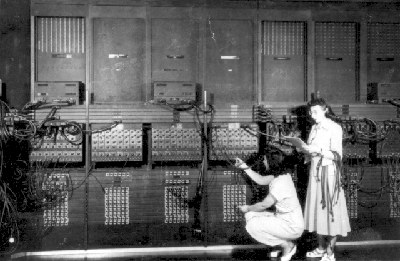 The Squeeze sent me something interesting in an email – links to these fab photos on this page of historic computer images. I don’t know anything about these photos as I haven’t taken the time to research, but I thought they’d appeal to the Sisters who dig the tappa-tappa keyboard action.
The bit of text that goes with that photo reads:
Two women wiring the right side of the ENIAC with a new program, in the “pre- von Neumann” days. “U.S. Army Photo” from the archives of the ARL Technical Library. Standing: Ester Gerston Crouching: Gloria Ruth Gorden
Here’s another neat photo:
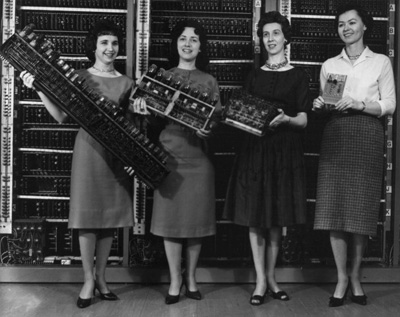
That’s the one The Squeeze sent first, but I’m not sure I like it as much as the other – feels like these ladies are there just to look pretty… or are they? Judging by the dress, these look like ladies from the 40s or 50s. If we’d been talking mid WWII, then these ladies could have been actively involved in creating these first computer bits. Heck, I am just plain old guessing… I think I need more information. I think we need The Squeeze (who has a fetish for computer history) to tell us more.
…and its caption
“U.S. Army Photo”, number 163-12-62. Left: Patsy Simmers, holding ENIAC board Next: Mrs. Gail Taylor, holding EDVAC board Next: Mrs. Milly Beck, holding ORDVAC board Right: Mrs. Norma Stec, holding BRLESC-I board
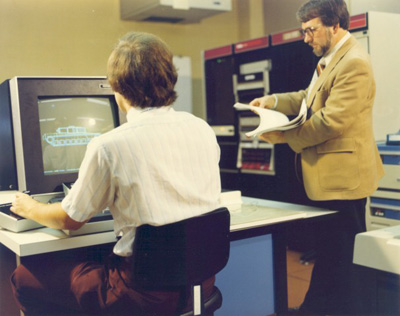 But I suspect that Mz Tartan, who has just bought a house, would perhaps prefer these images.
U.S. Army Photo, courtesy of Michael John Muuss PDP-11/70, Vector General display of XM-1 tank Left: Michael John Muuss, operating Vector General Right: Earl Weaver, inspecting printout of XM-1 design
and
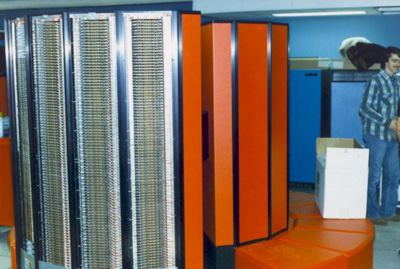
Photo of BRL’s Cray XMP48 courtesy of Michael John Muuss Right: Phil Dykstra
underwater mapping
Barista has written a really interesting post here on the history of research into techtonic plates (or more specfically, on Marie Tharp and her work on the subject). This post makes for a really good read, but the line that caught my imagination was the last (bolding is mine):
Despite the fact that the plate tectonics debate spanned fifty years, several languages and many countries, I suspect the battles fought in that house full of maps in South Nyack were some of the fiercest and most personal.
Ironically, they were all wrong. Nowadays, we believe the planet is expanding.
I wish I could string together a few coherent thoughts (I am scarily scatty at the moment – all these half-bits of posts… I promise I’ll get it together soon. Ish.), but I can’t. But I like the thought – expanding v contracting planet.
utterly trivial trivia
I think the best song of 2006 was the Scissor Sisters’ I Don’t Feel Like Dancin’.
I’ve just had a little think and can’t come up with any other songs that I know that were released in 2006. No, wait. There’s that song by the Killers where they’re driving in the car, and it’s in black and white. And then there’s that I Wish I was a punk rock… something… hm. Not sure that was 2006.
Look, so, ok, from a sample size of about five, garnered from a total of one or two mornings’ consumption of pop music via rage*, I Don’t Feel Like Dancin’ was the best song of 2006.
Well, not counting A Viper’s Moan by Willie Bryant. Or C-Jam Blues by the Lincoln Centre Jazz Orchestra, the most popular song I DJed in 2006.
I’ve had the strangest urge to listen to not-jazz today. I’ve been at a bit of a loss, as all the pop music I have is kind of 1992.
But here are the non-jazz albums I bought this year:
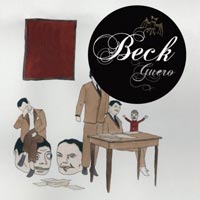
- Beck‘s Guero. Which I might have bought last year (well, The Squeeze bought it for me – from a shop, where it was full price! I love Beck – he’s one of the very few artists whose albums I always buy, religiously.
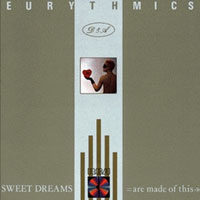
- The Eurythmics‘ Sweet Dreams [are made of this], my favourite Eurythmics album ever. I used to have a greatest hits video with the film clips from this album on it – I loved them. I used to have a casette of this album which I played over and over til the tape stretched. I loved the weirdness of this album, I loved Annie Lennox in her odd, ‘drag queen’ outfits. I just loved it. My favourite song might have been I Could Give You (a mirror), though I suspect it was the very-teen Jennifer. The Squeeze bought this CD for me too.
…I was going to add:
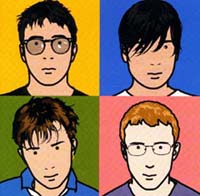 but it seems I bought that quite a few years ago.
So I guess I’m not really up on the pop music. :(
Nor do I have any indy cred.
I can hear my twenty year old self groaning in shame. That same self would also be disappointed to hear I no longer shave my head. And that I own some proper running shoes. And no longer wear my docs.
But how many CDs have I bought this year?* Weeeelllll, itunes says it’s a lot. And I believe itunes, even after accounting for all the multiple-discs-in-each-album thing.
*and really, need I look beyond rage? I think not. One of my favourite albums of all time is the first rage CD. Apparently there’s also a second one, but you can’t get it any more. Not that I would – I have always loathed Jeff Buckley, and the mere presence of one of his songs on this album is enough to put me off. Truly. Even if it does have that neat Porno for Pyros song on it.
…actually, I tell a lie. I really really wish I had that second album as well. It looks great. Dang. When was it released? Like, ten years ago or something? Shoot. Being out of the loop sucks.
quick idea
There are a number of bands who’ve played for and produced albums for swing dancers. These albums tend to be a greatest hits of what’s cool with dancers at that particular moment.
Right now I’m listening to Sol’s Swingmatism, which has the following track listing:
1. For Dancers Only
2. Johnny Come Lately
3. “Big Apple Contestâ€
4. Black and Tan Fantasy
5. Shiny Stockings
6. Indiana
7. Good Bait
8. Swingmatism
9. Cherokee
10. Moonglow
11. Cherry Point
12. Alfie’s Theme
13. Stolen Moments
14. There Will Never Be Another You
15. Funky Blues
There are a number of others, including the Campus Five albums, the Peter Davis albums, the Lincoln Center Jazz Orchestra and a few others.
The best bit of all, is that all these bands are, essentially ‘cover bands’ – tribute bands in many cases. And all these albums are made up of songs penned anywhere between the 1900s and the 1950s. And all of these songs have reached dancers today (and over the last twenty years) through DJs and live bands. No help from mainstream telly or radio. No video clips. No guest programmers on rage. Some help from bands like Big Bad Voodoo Daddy in the early 90s, but nothing significant since the flash-in-the-pan moment of neo swing. There’s been the odd jump start from people like Robbie Williams and Jamie McCullam – but we can count these guys on one hand.
While the States has had big name artists like Barbara Morrison and Junior Mance (both of whom have been promoted by swing dancers to swing dancers in a way that simply hasn’t happened in Australia), but Australia hasn’t seen their bands take on that sort of popularity.
I need to write something about this, but I don’t have the brain right now (lamb shanks cooking in the oven, too tired, new fabric on the table begging me to start sewing, DVD to watch, horrible allergies itches driving me NUTS and making it IMPOSSIBLE to concentrate).
by the by
Anyone have any good cake recipes that use oil rather than butter? I’m always after a good lacto-less cake recipe.
Actually, anyone got an unusual (yet rocking) cake recipe that they’d like to share? Please.
big apple, tranky doo, cultural transmission in dance and nerdy jazz fans
Look out: this post is a bit crapworthy. I think I’ve found my idea for the article, but it needs some work. But I just had to wack this down now while it’s on my mind (and just before I ping ding to the Laundry to see a band and do some dancing). My current mission is to learn the tranky doo routine. I am crap at learning routines. Yesterday I spent an hour and half trying to learn this version of the tranky doo (because I love Manu), and only figured out three phrases. That’s some sad arse transcription/learning on my part. These stoods (in that clip) would probably have learnt that routine in an hour or hour and a half.
Doing a little youtube browsing today (as one does when one is waiting for one’s Squeeze to get up), I discovered the following neat clip:
That’s the Silver Shadows (whose members include Todd & Naomi, Skye & Frida, Andy & Nina, Peter & Caitlin – all young, ‘famous’ dancers of the type generally referred to as rock stars) there, performing a routine at the midwest lindy fest. Now, that’s some seriously excellent lindy hopping there (and you can see more of the Silver Shadows if you do a search for them on youtube – their 2005 ULHS performance was amazing), but even more interestingly, that’s some seriously excellent use of music there.
Have a look at the following clip, but more importantly, have a listen to this clip.
You’ll notice (well, you might), that the riff that pops up at about 1.29mins is repeated in the track on that first Silver Shadows clip (at about 1.44 – when the crowd goes utterly nuts). I’m not really sure, but that sounds like an edited combination of songs on the Silver Shadows clip (I could be wrong though). Even if it’s not an edited collection of songs and is one single song referencing all those other important songs, this is still important stuff.
Historically, various riffs would pop up in a range of popular jazz songs across bands and often across moments in time during theh 20s, 30s and 40s – the ‘swing era’ (as that’s my era of interest). Individual musicians would play a particular solo, or a particular bit of melody/arrangement would be reproduced in another song, elsewhere.
This is very textual poaching stuff – jazz was all about the ‘cut and paste’ or ‘sampling’ deal.
The thing that makes this Silver Shadows routine so fascinating (and so wonderful) is the way they’ve combined various bits of iconic dance routines, to a song (or song-melange) which combines iconic combinations of notes and arrangements.
If you’re not familiar with the songs, or with the choreography of these iconic routines (and if you do a search of ‘whitey’s lindy hoppers’ and ‘harlem congaroos’ you’ll find the original sections of film on youtube), you won’t recognise this stuff in the Silver Shadows’ choreography.
That they began with the song Savoy (by Lucky Millinder I think), which is named for the famous Savoy Ballroom where the Whitey’s Lindy Hoppers were based (and which is credited as the birthplace of lindy hop), and this is a fairly nice indication of where they go with the routine and their particular style of lindy hop. These are pretty solid recreationist doods, digging ‘authentic’ music and lindy.
So when you watch that clip, you see the dancers pull out a bit of the Big Apple routine from the film Keep Punchin’. And to make this moment of intertextuality/cultural transmission/textual poaching even more wonderful, that routine in the original film (as choreographed by Frankie Manning for a combination of Whitey’s Lindy Hopper dancers) also includes parts of the Tranky Doo.
And here’s Al Minns and Leon James (more Savoy dancers) doing the Tranky Doo (note the references to Marshall Stearns, who wrote the important book on African American jazz dance Jazz Dance):
And because it’s difficult to see Al and Leon properly in that footage, check out Mike and Nina (Nina is in the Silver Shadows) doing a demonstration of the Tranky Doo steps here:
The Tranky Doo is another piece of choreography from this early era of lindy hop, one that’s become a bit popular with young swing dancers today.
And to round all of this off, the Big Apple is a dance with its roots in Africa. Here’s a big chunk of my thesis about Big Apples:
John F. Szwed and Morton Marks (32) discuss the importance of called dances in African American musical history, noting the relationship between dance and musical form. Dancers were challenged by callers to perform the called steps to the best of their ability in the earliest moments of black appropriations of European folk dances. Credible performances required dancers not only be familiar with named steps, but also be able to perform them immediately, and often with variations on the step that still maintained a recognised structure. This discussion echoes a tradition from earliest African dance. Hazard-Gordon notes that “the challenge posed by the fiddler-caller, familiar to West Africans, calls upon the dancer to perform difficult combinations of steps. The best performers are those who can meet the challenge while maintaining control and coolness†(Jookin’ 21).
Malone and others draw clear connections between the ring dances of Africa, the ring Shouts of African American gospel churches and with ring dances of the 20s and 30s such as the Big Apple. The Ring Shout was a slaves’ reworking of ancient African ritual, remade to accord with European religious expectations. Performed in a ring, most often in churches or religious services, Ring Shouts placed an emphasis on innovative interpretations of set moves (Stearns and Stearns 27). The Big Apple, popular in the 1920s and 30s and choreographed by New York dancer Frankie Manning, reworked the Ring Shout with new, formal choreography and was performed in a circle by partnered and solo dancers. A range of other ‘Apples’ were popular throughout the period, and are today in contemporary swing culture, joined by new pieces such as the Japanese swing dancers’ ‘Fuji Apple’ and unchoreographed version.
In their simplest forms, ‘Apples’ are ‘called’, requiring dancers to perform steps chosen and demonstrated by a leader, a role that is shared by all in the circle. The more complex and famous Apples were more strictly choreographed – as with the Big Apple – but individuals’ executions of these set steps were always marked by individual style and variation often with a competitive edge. Despite the constraints of called dances, Big Apples in swing dance maintained a strong sense of improvisation and a valuing of innovation. The proving of a dancer’s skill lay not only in their recognising the step called, but in their interpretation and performance of that step. Footage of Frankie Manning’s dance troupe the Hot Chocolates performing his Big Apple (Keep Punchin’ 1939), is still consulted by dancers today, and aptly demonstrates the importance of individual creative styling of choreographed steps in this historical moment.
I think the reason that I get all excited about these sorts of things, is that these connections between archival film, historical African American vernacular dance, jazz music forms and practice and so on are fascilitated by the internet (my use of youtube just there was pretty important), yet are also dependent on access to archival film footage, the instruction of surviving dancers from the 1930s, individual dancers getting together now to work on this stuff (and the Silvers Shadows’ dancers are from all over the US and include Frida from Sweden), and then (perhaps most importantly), dancers in the audience (whether there on the night or later online) recognisingall this cross-referencing and clever textual poaching.
This is community media use and practice in action. And, I think, one of the most exciting parts of using dancers as a case study: here are some doods using digitial media in really complex and sophisticated ways, yet with this technology always subsidiary to the embodied dance act. The communal embodied dance act.
Useful references:
Peter and the crew discuss the big apple on jassdance.org
not the sharpest knife in the drawer

I’m always the last to latch onto cool things – you can guarantee something’s no longer cool if I’ve suddenly discovered it.
I don’t know if anyone else is as interested in flickr as I am (well, except for Jean of course), but if you’re a flickr person (and I’ve noticed that a great deal of the people who’s blogs I read are), then you might be interested in the flickr blog. My timing is perfect, of course – flickr went down, just as I discover all sorts of interesting groups and photos and things to look at. This photo is one of them.
There’s another neat one here.