
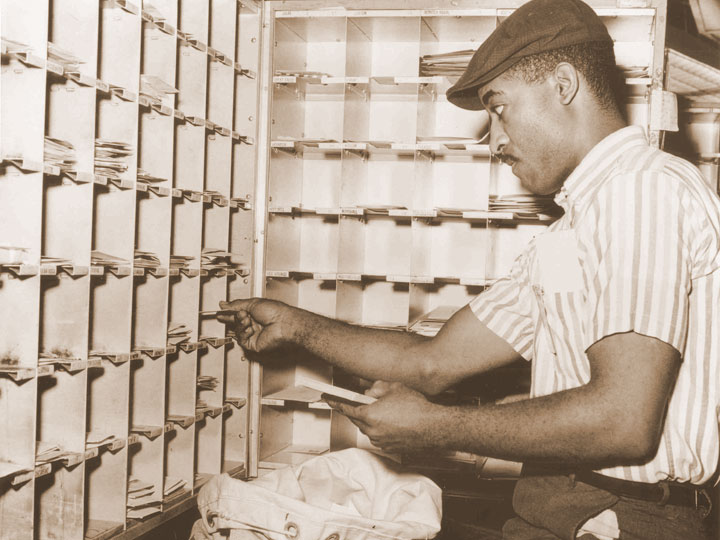
I’m checking some details in Frankie Manning’s biography, and there’s a section where he writes:
I always agreed with Martin Luther King’s point of view. In 1963, a whole group of us from the Postal Workers Union went down by bus to the rally in Washington, D.C. to support him. When I heard him give his famous ‘I have a dream’ speech, I was very moved.” (pg 218)
I’ve heard white lindy hoppers argue that Frankie wasn’t political*. That’s patently bullshit. He was a union member. He went to Washington to support King. It’s also really important to remember that the US Postal Service was (and is) an important site for Black organising and grassroots politics. Margot Lee Shetterly talks about this in her book Hidden Figures, noting the path from postal service to aeronautics for Black workers and thinkers.
And of course he choreographed and performed in A BIOGRAPHCICAL FILM ABOUT MALCOLM X. A film that directly visually referenced multiple films that starred Manning and his peers.**
I also want to point out that Frankie didn’t ‘stop dancing’ in the 1950s. He mostly retired from professional dancing, but of course he kept on dancing! Parties, dances, band gigs… all the usual places where vernacular dance lives.
References
- There’s quite a bit written about Black Americans in the USPS, and the Smithsonian has a useful series: The History and Experience of African Americans in America’s Postal Service
- Manning, Frankie and Frankie Manning: Ambassador of Lindy Hop, Temple University Press: USA, 2008.
There are the usual problems with using an autobiography as a source, but this is one of the best-researched and fact-checked sources for information about Frankie Manning. - Shetterly, Margot Lee, Hidden Figures: The American Dream and the Untold Story of the Black Women Mathematicians Who Helped Win the Space Race, William Morrow:USA, 2016.
*What do I mean by ‘political’?
On one level, it’s referring to the mechanics and institutions of a political systems – parties, voting, electoral systems, unions, politicians.
But that’s the very simplest level.
If we define ‘politics’ as being the relationships of power between people, things get a lot more interesting. This is the sort of definition used by feminist and anti-racist activists and scholars.
So ‘politics’ can expand to include the social relationships between adults and children, the collectivist philosophies of unions, the uses of power between men and women, and so on.
Every time Frankie said ‘Think of your partner as a queen’, he was making a political statement: treat your partner like royalty. Show your respect by bowing. Obviously he didn’t think they were actually a member of a royal family; this was about defining relationships between men and women as one of mutual respect, where men invite women to be powerful and love it.
** If you compare the soundie/short film Keep Punchin’ with the scenes in the ballroom in Malcolm X you’ll see characters and narrative elements from the soundie in Spike Lee’s film. This is one of the clever things about Lee’s films: he uses archival material as inspiration, but often also shows them on-screen during the films. I am a huge fan of his films.