
Half an hour per paper, 70 papers. Yes please.
Ask me how many days til MLX6.
73. Am I worried about it? Nope.
Ask me about the papers I have to write.
…no, actually, don’t.
Ask me about my application for funding goodness for the CSAA conference.
Yeah, it’ll be cool. I’m all over it.
The paper for the conference that’s getting me there and getting me the dosh?
Oh, look, something to do with the internet. It’ll be neat.
Ask me about the shitful job I did DJing last week.
Why ask. I’m sure you’ve already heard.
…there’s not so much going on in my life beyond work at the moment. This is about as exciting as it gets:
We are going lo-fi with the whole camera thing. We’re saying no to lots of pixels and yes to emoting. We are all about emoting.
We are going to SLX on the 29th September, mostly because we need a holiday, and this kind of gets us off our arses. That’ll be fun – we’re looking forward to stooging it up at the Manly Jazz Festival, eating, napping, talking shit and possibly drinking (though I will drink only softees). It’ll be just like an American road trip movie. But with more jazz. And fewer mooses (meese? baby meese?). Though I’m not sure about the boob part. There could be boobs. Or possibly moobs. Either way, somebody scores. And I’m not sure about the road part. I think there’ll mostly be trains, the odd bus and definitely a ferry. And a plane or two.
..hm. This post isn’t going terribly well. Looks like teaching is sucking my creativity right out through my… well, I’m not sure how it’s getting out of me, or where it’s going. Just imagine that I was a bit cleverer and that this post was a bit more interesting. Remember the days when I was posting posts that actually covered more than jazz and had the prose thing going on, rather than the list thing.
But meanwhile, the thesis is at the printer and will be submitted tomorrow! Yay!
Category Archives: academia
let’s leave telly behind for a while
I spend quite a few hours each week talking to young people about media. I begin every class asking them what sorts of media they’ve consumed this week (and that’s how I say it, because I like the thought of these fierce 20 somethings leaping onto BB or Women’s Weekly and devouring it – critically or no).
There’s much enthusiasm (this has been a surprisingly – satisfyingly – effective teaching tool), but all I can ever think to talk about is Smallville.I think it’s because I’m somehow still stuck at that point where the television = media. It’s certainly not the center of my media world.
I do watch a lot of [i]Smallville[/i], but I also watch broadcast telly. And other DVDs.
I listen to the radio online – the ABC almost exclusively, and Radio National specifically. I do listen to some lindy hop talk shows and music shows, but the ABC always scores the greater portion of my time.
I read the news online, through various websites.
I read blogs, academic and otherwise.
I read, voraciously, insatiably – I read over breakfast (half an hour at least), on the bus (an hour each way), in breaks, and at bedtime (at least an hour or two). I am a reading machine. And I only read science fiction or fantasy.
I do work reading – I read articles, books, magazines, journals, websites.
I haven’t seen a film in a while, but I do love the cinema. When I’m not so busy…
And I listen to music every day. I’ve just discovered The Squeeze’s ipod, and that’s neat. Though I mostly listen to the ABC, I have found it a neat tool for previewing my music for DJing. I don’t have time to sit on the couch and mull over my laptop any more – I have to listen to music on the bus. This isn’t an ideal arrangement for DJ preparation, as the sound quality on the ipod is very different to a night club system. And different to the stereo at home. When you’re dealing with old music, quality is all. But it’s also a matter of intimacy – it might sound neat on my ipod, locked away in that little sound bubble on the bus, but it mightn’t really work in a crowded room full of manic dancers.
But I don’t talk about this with my students. I’m not sure why. Perhaps I’m trying to keep this part of my everyday private. Maybe I’m self conscious. Or perhaps I’ve bought that DJ bullshit where ‘only DJs understand’, or rather, where we assume DJs listen to music in a unique way. Poppycock.
But I do know that it’s difficul to explain the pleasures of swinging jazz to 20 something media students. It’s difficult to articulate to non-dancers, to non-jazz dancers, the absolute delight we find in the jumpy, fun, wickedly naughty humour 1920s and 30s pop music. It’s certainly difficult to explain why the saucy innuendo is such a source of delight, and I wonder if that is because young people today (bah humbug) are more conservative, more prudish than the young of the 20s and 30s? It makes me wonder if that’s why I like nannas so much – they’re far naughtier than these youngsters.
This week I’ll test it out. We might talk about music this week, and leave telly behind for a while. I’ll try to tune in and let you know how it goes.
i’d do something like this
I’m sorry I haven’t had anything interesting to say in a while. I know you’re disappointed, especially after my recent rush on Terribly Clever entries. It’s just that I’ve been insanely busy lately. In fact, I remember the days where I had two – no, one! – whole day with no work to do. No thesis leftovers to tidy (helloooo CD of clips – you’d better appreciate this Markers), no teaching admin., no MLX crap to do, no giant holes to fill in in the back yard (more on this later), no week’s-worth-of-laundry to catch up on, no grocery shopping to do, no writing-up grants to apply for, no journal articles to edit and send back to the editors, no conference papers to write, no… you get the point.
I’d just like two whole days in a row with nothing for me to do. I’d go to lunch at a pub with a friend I’ve had to put off exactly three (or is it four?) weeks in a row. I’d go to breakfast at a cafe with The Squeeze. I’d do something like this:
battle by literature review
“So when you’ve done all this excellent reading, when you really know what you’re talking about, you’ve got to really make it work for you in your essay – you’ve got to BRING IT!”
You have to ask yourself, what sort of literature review would Frida do?
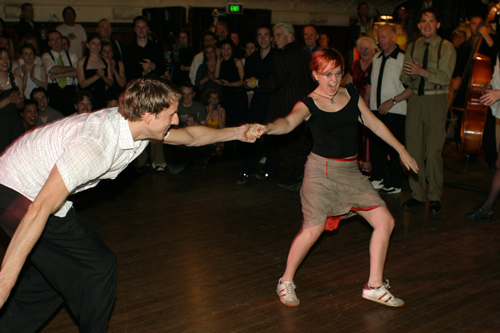
the tyranny of distance: audiences and performers/texts in high and low art forms
Laura has asked an interesting question here on a previous post:
…I would like to ask a question about “the everyday”, in those CS quote marks – is consumption of canonical or high art an everyday activity, and if it isn’t what is it? Posted by: Laura at August 7, 2006 03:30 PM
I think the man to answer this question is right up there in the cs canon (or at least the audience studies canon). Take it away Henry Jenkins…
I skip about a bit in the next part of this post (I’m a bit distracted, so I can’t really take time to formulate a sensible argument)…
I think the key point (in my approach, anyhoo) is not so much the nature of the actual text or practice, but the way it is institutionalised, commodified and ‘valued’ by various cultural and social forces.
I’ve been looking at this issue in reference to dance (of course), comparing the way ballet and vernacular dances like hip hop or breaking are approached by audiences.
[In an aside, the discussions on wikipedia’s project dance (esp the talk pages) – people want to capitalise the names of specific ballet choreographies, but aren’t so sure about how to capitalise vernacular dances like lindy or hip hop].
I’ve also noticed that the way swing dancers – DJs in particular – approach jazz is quite different to the way the genre is approached by jazzniks. One of the clearest and nicest illustrations of how different groups imagine jazz lies in the way Bennett’s Lane puts on gigs (Bennett’s Lane is a well respected local jazz venue – devoted to ‘quality’ jazz). They are very strict about noise during performances, and do NOT allow dancing. This is such a strange and bizarre contrast to the way jazz functioned socially in the 20s, 30s and 40s – it was pub music. It’s also a serious contrast to the way I experience and enjoy jazz at the Laundry in Fitzroy on Saturday afternoons: it’s loud, it’s full of smoke and drinkers, the band members will get down off the stage and kick audience arse if they give them trouble. They don’t care if we dance, and there is – as a consequence – a really exciting and dynamic relationship between dancers, musicians and audience at these gigs.
But at Bennett’s Lane (and other venues around the place), there’s a definite positioning of jazz as ‘art’, which must be ‘appreciated’ from a distance, rather than enjoyed with the body, up close and personal. There are quite culturally specific ways of demonstrating appreciation going on. Just as Jenkins noted that Checkhov fans used different language to describe their interest in theatre, there are clear differences in the way certain groups approach jazz and music.
Here’s a quote from chapter one of my thesis about the relationship between audiences and performers, audiences and texts in dance:
Considering dance, whether vernacular dance or performance dance, as a public discourse, allows us to analyse it for ideological content, for the ways in which identity markers such as class, gender, sexuality, race, ethnicity, age and so on are represented and valued by a particular community of people. Reading vernacular dance as everyday discourse encourages us to see social dance as an exchange of ideas, and as a site for the negotiation of identity and social relations between individuals and groups within a community. I draw clear distinctions between vernacular dance traditions, where dance occurs in everyday spaces, between ordinary people, and concert or performance dance traditions, where dance is relegated to particular ‘dance spaces’ which are separate from the everyday spaces of a community. Ward makes this distinction: “there is a categorical divide between dancers and the audience in performance dance …that does not exist between dancers and spectators in social dance, where those roles are interchangeable†(18). I read this dynamic relationship between the roles of ‘spectator’ and ‘dancer’ in social or vernacular dance as a clear example not only of call-and-response, but also of the ways in which readers participate in the making of meaning in textual interpretation. (pg5)
Later on I add this:
The word ‘vernacular’ in a discussion of dance refers to the everyday or ordinary, common dance of a particular group or culture. Vernacular dance is distinguished from concert or theatre dance through its positioning in everyday spaces, rather than existing only as a formalised, and usually choreographed, performance of a particular dance on a concert stage. Vernacular dance is intrinsically participatory and happens in all sorts of spaces, both public and private. It is also necessarily mutable and reflexive, responding to the cultural needs of its performers. (pg9)
I wonder if one of the key differences between ‘low’ and ‘high’ cultural forms and practices is this issue of distance – there is (in Western culture …?) a divide between the audience and text/practice in high art forms, whereas the ‘low’ forms encourage close proximity between audiences and texts – you have only to consider the Big Brother website and voting system to see how particular industries and textual forms encourage audiences to get close to texts. If only so that they can be more easily targetted by advertisers.
It can’t be an accident that high art forms like ballet and opera have trouble keeping audience numbers up, and that various marketing strategies that aim to make these sorts of forms more approachable to wider audiences are at once endorsed, yet also regarded with some suspicion by those sections of our community which have a vested interest in maintaining social heirarchies.
…there’s a good article by Joann Kealiinohomoku on reading ballet as an ‘ethnic’ dance that examines how race and class work in high and low art form (and in anthropological approaches to ‘culture’ and ‘society’): Kealiinohomoku, Joann. “An Anthropologist Looks at Ballet as a Form of Ethnic Dance.” What Is Dance? Readings in Theory and Criticism. Eds. Roger Copeland and Marshall Cohen. Oxford: Oxford University Press, 1983. 533 – 49.
the researcher in their work: natural passions
I really need to get on and do some work, but I did want to write a tiny bit about how our own interests and passions motivate our research. So, for example, I’m a keen lindy hopper, and this lead (eventually) to my writing about lindy hoppers.
This point was brought to my attention in class last week when a student blushed and declared embarassment for his passion for an ‘uncool’ film star. I took this as a neat opportunity to talk about people like Matt Hills and Jenkins and other fan studies doods, pointing out the idea that much of audience studies research – fan studies in particular – begins with the author’s own interets. In the simplest terms, our attention is caught because we give a shit about the topic. And is kept because we’re passionate about the things and people we are writing about. So being dismissive of someone’s interests simply because they’re ‘low brow’ isn’t terribly productive.
But I do think it’s a strength to write from what you know, or rather, from what you care about. Whether you’re writing about a favourite telly program or about women and capitalism. I feel that bias is a strength, if only because it serves as sufficient motivation to get us through a massive research project like a PhD or a book.
I don’t have time to go on into detail about this, but there’s a chunk of lit talking about the ethical and methodological issues which attend writing from ‘inside’ the community you’re studying.
Some of the most interesting is from dance studies. Check out this nice quote:
I am an anthropologist, but I am also a dancer and I begin my investigation of gender in ballet by using my dance experiences as a case study… I adopt this approach because it allows me to shift between my memories and comments as a dancer and my analysis as an anthropologist, in a sense using autobiography as fieldwork data.
The researcher…is an essential component of all research. …It is important to take account of the fact that I (the researchers/interviewer) was an active agent in the research setting, attempting to make sense of and contributing to the dancers’ discussions about an activity that is not bound by verbal language. I would contend that my intervention in the … process was enabling rather than, as an objectivist approach would argue, a hindrance to the research. … the idea inherent in an objectivist framework that the researcher is an invisible being who drops into and reveals the practices and ways of others (the researched) becomes redundant, in favour of a reflexivity of accounts. …this does not mean that the project should be full of ‘soul searching’ or ‘navel gazing’. It entails, rather, that the researcher reveal or uncover his/her grounds for speaking; that he/she should be reflexive on the context, methods and procedures adopted and at the same time, enable the voices of the researched to speak (35 – 76).
(Novack, Cynthia J. “Ballet, Gender and Cultural Power.” Dance, Gender and Culture. Ed. Helen Thomas. London: Macmillan, 1993. 34-48).
I’ve written in greater detail about this in my thesis, combining fan studies stuff and dance studies stuff, with an emphasis on feminist and African American writers in the latter. In fact, a significant portion of my argument throughout my work is devoted to the notion of participation in discourse, where dance is discourse, and participation is not only important, but non-verbal.
…ok, I have to run. I’ll see if I can write more later…
oh yeah
And I had my paper approved for the CSAA conference (read about it here). I didn’t unfortunately, score the bursary/grant thingy. Which means that it’ll be next to impossible for me to get to the conference to give the paper. Got no money for airfares, no money for conference registration, no money, no money, o.
The scholarship ends on the 19th, which is ok, as the thesis is totally done (did I mention that? I’d like to say there’s been some quiet triumph in our house ever since, but The Squeeze says it’s more the fact that there’s been a significant increase in shouting, carousing and declarative one-stanze (one-line) songs about how great the Ham is). But it does mean that I now, officially, have no income.
Oh, no, wait. I’m tutoring like total tutoring stooge instead. I am taking sixty million classes in a media studies subject (best not to name it, as the little darlings are a wee bit internet savvy, and google will get me in trouble… note to self: do not mention thesis topic ever again in class), so I almost have enough money to cover my PT tickets.
There are some good bits of this, and some crap.
Good:
I love teaching. I think it’s a power thing. I goddamn LOVE being in front of an audience, and I LOVE to talk, so it’s all good. But I have been practicing Shutting Up this semester, which is hard, but rewarding: we have dialogues rather than monologues.
I love teaching media stuff: who doesn’t have something to say about telly or books or magazines or the internet?
I learn a lot. Ask me about CD next time we meet. Your brain will be blown.
It gets me out of the house.
Bad
It costs a lot to get there.
I can’t ride my bike and I miss it.
I’m overworked and exploited.
I’m really really tired.
Anyway, I’d like to go to the conference, but can’t afford it. Looks like academia is for rich kids, huh?
“Emma Dawson: Left out of debate by convoluted speaking”
Is this headline more than a comment on Emma Dawson feeling excluded, or the Left’s irrelevence to public discourse?
In recent days there’s been an ongoing discussion about this article in the Australian by Emma Dawson. My responses to both the original article and the responding discussion on the CSAA list have been mixed. In that article, Dawson discusses her personal response to a notice for the Everyday Multiculturalism conference to be held at Macquarie Uni in Sydney in September.
First, my response to Dawson’s article was a little different to some of the comments on the CSAA list. While I did feel a little uncomfortable with the way Dawson’s critique of academic terminology, in the context of the Australian served as a critique of ‘the left’, I’m not sure this was how she intended her words be read. My first instinct was ‘oh, she’s not comfortable with acka talk.’ That she positioned herself as a Phd candidate encouraged me to sympathise with her, reading her feelings of exclusion as a result, perhaps of her inexperience with academia.
Listening to this ABC podcast on media ownership legislation in Canada today, my memory was jogged in regards to where I’d heard of Dawson before. I remembered this story on the ABC’s Media Report on the introduction of advertising on public broadcasters, featuring Dawson as a special guest discussing SBS in light of her Phd reseach and experience with the station. I remember thinking that Dawson was one of the ‘good guys’.
I decided to follow up some of my feelings about her article and CSAA discussion by reading up on Dawson a little further. I discovered that she’s written for the New Matilda, a lefty online magazine, and that she’s doing work on SBS, and had worked at SBS as a journalist.
With this in mind, I’m leaning towards the suspicion that Dawson’s article on lefty academic talk was perhaps read in context, by many on the CSAA list (and beyond), taken as one point in a series of critiques of lefty ideology and discourse, rather than as a distinct piece discussing the intimidating and off-putting nature of academic talk. This is not an unlikely response – the Australian opinion pages are rife with lefty/academic bashing these days.
This fascinates me as an example of the ways in which we take context – the newspaper in which an article is positioned, the recent articles on a similar topic, using similar terms and ‘buzz words’ (or making similar selections from a shared interpretive repertoire, to reference Potter and Wetherall), even the placement of an article on a page (or screen), in relation to other pieces – in our readings of meaning and ideological ‘intention’. In fact, this stuff fascinated me so much I wrote my MA on similar stuff.
Setting aside those issues of form and text and context which appeal to my critical discourse analysis side, perhaps it’s worth engaging with the issues Dawson actually raises in her piece – her opinion piece?
Perhaps Dawson was encouraging lefty academics to engage more thoroughly with everyday discourse by using everyday discourse?
As some posters to the CSAA list noted, that’s not such a bad idea. And yet, on the other hand, as others responded (and I myself feel), sometimes we need to use big words. Sometimes we need to get together and use big words. And academic conferences seem the most appropriate place for this sort of talk. After all, we wouldn’t expect a doctor to abandon the technical terms of their profession to discuss medical matters with their peers at a conference, would we?
Dawson, however, seems justified in expecting a conference on ‘everyday multiculturalisms’ to use everyday language. It’s unfortunate that the ‘everyday language’ of academia can be so impenetrable. Speaking as a (just about to submit) Phd candidate with quite a few years as a postgraduate researcher under my belt, I do actually think that it is a little naïve for a postgrad to expect an academic conference to use un-academic discourse. I mean, these are complex issues that we are dealing with, and at times we need complex language and conceptual tools to put them together or take them apart.
I wonder, though, if Dawson is a journalism student, rather than a cultural studies student, and has perhaps run into one of the most irritating stumbling blocks in world of ‘media studies’? I remember a one-day conference I attended in Brisbane in the early days of my MA (1998? 1999?) called Media Wars where I first ran into Keith Windshuttle, and was infuriated by his nasty attacks on my (then and now) hero Graybags Turner – it wasn’t the nicest introduction to the tensions between journalism and cultural studies. Though my impression that journalism (as the old kid on the block) seemed particularly threatened by media and cultural studies remains (or perhaps that was just Windshuttle’s problem with Turner… threatened by his gentle manner? His friendliness? Or perhaps his stone-washed jeans?*). It seems to me that there are many journalists and journalism academics who have a great deal of trouble with the methods and language of cultural studies. Not trouble in that they don’t understand it or aren’t capable of understanding it, but trouble in that it signifies a profound deviation from traditional quantifiable approaches to the media that sits so uneasily with many workers in the field.
So perhaps Dawson was thinking that a conference titled ‘Everyday multiculturalism’, would be using the everyday language of an academic discipline with which she was familiar? And when she read the call for papers, felt uncertain of her ability to participate in the discourse (though I do think she has a great deal to offer the discussions, particularly in regards to multicultural television). She wrote:
The call for papers started like this: “Papers … will engage with the quotidian dimensions of living with diversity. Quotidian diversity has variously been described as togetherness-in-difference (Ang 2000), and inhabiting difference (Hage 1998). We take the term to mean those perspectives on cultural diversity which recognise the embodied or inhabited nature of living with cultural difference.”
The elite intellectual language discouraged me from proposing a paper, and the very idea was firmly quashed by the suggestion that: “Papers which take an embodied approach, such as through frameworks such as affect or Bourdieu’s habitus are also particularly welcome.”
I am a PhD student in the field and have published several (admittedly non-academic) articles on cultural diversity. However, this sort of gobbledygook leaves me cold.
And then she wrote:
Lest I be sternly rebuked by fellow students and researchers, let me make it clear that I fully support rigorous scholarship and will vigorously defend the right of academics to contribute to the intellectual development of the human race at the most theoretical level. The apparently abstract and often obscure work by researchers in social sciences and cultural studies is essential to the development of ideas.
Followed by:
But this is a conference entitled Everyday Multiculturalisms, and one of its stated aims is to reflect on last December’s riots in Sydney’s Cronulla shire. There’s nothing particularly “everyday” about the language used to invite participation. Nor is there much focus on creating work that resonates beyond intellectual circles.
(all quotes from the article referenced above).
I think Dawson makes a point. The sort of hard-core academic language in the call for papers is hardly in the vernacular of the un-university world.
But I do suspect that Dawson wrote with very little knowledge of the planning behind the conference, and that she wrote quickly without exploring the conference in any great detail (understandable for a journalist writing to a deadline).
Take this comment from Ien Ang in her post to the CSAA list:
It is a pity that Emma Dawson had chosen to single out Amanda Wise’s call-for-papers text to make her points. Ironically, Amanda is one of the few people amongst us who has consistently engaged beyond academia in her work, either through public discussion or through collaborations with government or community groups. I therefore completely understand that she is upset.
(Ien Ang, email to CSAA list RE: Another attack on CS, sent: 29 July 2006 2:58:38 PM)
To explain, Wise raised the issue on the list with this email:
Any CSAA-ers want to write a letter defending us?
Another anti-left, anti-theory attack in today’s Australian, attacking the ‘Everyday Multiculturalism’ conference we are holding here at Macquarie University which a number of you are presenting at.
http://www.theaustralian.news.com.au/story/0,20867,19933096-7583,00.html
Cheers
Amanda
(Wise, to the CSAA list, Another attack on CS in the Oz, sent: 28 July 2006 11:11:28 AM)
I can imagine Wise’s frustration and upsetness, reading Dawson’s critique in the paper. As someone who’s in the middle of organising a massive event for my peers, there’s nothing as frustrating as mis-informed, negative criticism of your efforts when you’re working as hard as you can, not only to plan an excellent event, but to make that event as accessible and inclusive as you can. I can imagine it’s particularly trying for Wise, who’s working to produce a conference that will bring people together to discuss and workshop ideas to reduce injustice and exclusion and so on. Her email to the list was, I think, not only an interesting poke to a fairly quiet group of readers, but more importantly, a “Goddamn! Surely I don’t suck that much?†call for emotional and professional support from her peers.
Indeed, she writes:
Thanks for all this input. I was furious this morning, but have calmed down substantially! Softly, softly, I promise.
I think Greg (and others) make important points. I’ll synthesise these arguments and write to her and something for the oz. Indeed; I might just invite her to give her a paper!
Its always the problem writing about the ‘everyday’ as you’ve all pointed out.
Another point to be made is that ED is quite patronising towards non-academics. We have lots of non-academics coming to this conference. They come in droves because they enjoy the stimulation of hearing fresh ideas which are theoretically informed. They are quite capable of understanding the work we present. Indeed, we deliberately pitched the conference CFP at attracting ‘grounded’ work; esp based on ethnographic and/or interview based approaches – so it’s a conference full of accessible work.
But as Greg says; theory or otherwise, we have a perfect right as academics to congregate and discuss academic ideas in an academic forum. It is quite a separate question as to whether and how we subsequently communicate those ideas to the wider public.
Many of the speakers at our conference (including myself) are engaged in public debate through the media; through consulting with local, state and federal govt; through working community groups. We are quite capable of working at different registers. Ien Ang and Greg Nobles work (who are keynotes at the conf) is a case in point.
Thanks for the input. Lets see if the oz publishes my rebuttal op ed. I Hope you’re all ok if I quote some of your emails
Cheers
Amanda
(RE: [csaa-forum] Another attack on CS in the Oz Sent: 28 July 2006 2:27:08 PM)
That Wise did respond so defensively is not only an indication of her own feelings as the event organiser, but of cultural studies’ researchers’ familiarity with such comments from the main stream media – “God, why don’t they understand how important my work is?†And while that might sound like a fairly snarky comment on my part, it’s a feeling that I sometimes have to stifle: why is it that we have to continually justify our work in terms that feel so limited and simplistic, when we’re working on ideas and relations that are so complex, and really do require such big words and ideas?
That’s the sort of question that various academics in our field continue to ask ourselves. Laknath Jayasinghe pointed out in their email:
In fact, this is something that Graeme Turner alluded to in a paper he delivered in 1999, arguing that–apart from the academic stuff we do–we should be doing more work in the ‘public sphere’, the broad public sphere, that is. I take my cue from him. I believe that we should build academic bridges, not remain on separate islands. The mass media here in Oz, from both my professional and academic experience, are open to articles and letters that take new and exciting ideas to the public–from all political positions. Of course, language must be modified and the ideas recrafted and tailored to the audience; very few allusions to Bhabha, Butler or Bourdieu here!
(Re: [csaa-forum] Another attack on CS in the Oz, sent: 28 July 2006 1:07:37 PM)
Graybags himself wrote, only minutes later:
For what it’s worth, I share Mark’s reading of it. There are real differences between attacks such as this one and that provided by Windschuttle. I think this person genuinely wanted to be informed by the conference and found that its language was alienating – and therefore suggested that maybe this is something we should think about if we want our work to have a social function. Given the topic of the conference, and its objectives, that’s not an unreasonable position. It is damaging to have it published in the Australian, and it may well be the case that its inclusion is motivated by rather less sympathetic considerations than its author’s, but we need to think carefully about this kind of stuff, take it one piece at a time, avoid characterising it as motivated by a particular pathology or orientation, and be alert to the possibility that they may actually have a genuine point with which we can engage.
A response could well admit the distance created by such language, while nonetheless defending the need for people to work through these issues in their own way and at the highest level, and suggest that while the context of the topic might be the everyday, the capacity to deal with these problems so as to fully understand them is quite clearly not something that is part of the everyday life of most people. That is where academics come in.
It might also be useful to take the lead from this piece and consider if there could be some more publicly accessible outcome from the conference that even a columnist for the Australian would not find alienating, but would find informative.
And, finally, given the regularity with which this kind of issue is raised – particularly by those writing in the Australian—it is probably helpful to be reconciled to the fact this comes with the territory of working in a critical discipline and we are always going to be called to account by those outside it. I think we can wear that responsibility.
Cheers
Graeme
(RE: [csaa-forum] Another attack on CS in the Oz. Sent: 28 July 2006 1:08:57 PM)
I won’t quote the emails sent by ‘Mark’ and ‘Greg’ (and others), but you get the point.
So, I think, at the end of a couple of days posting, I’m left with the following conclusions:
- It’s crap to have your hard (community-focused) work slagged off in a very public and influential forum by someone who doesn’t appeared to have researched it properly
- Cultural studies talk is fairly exclusive, and makes the uninitiated or unfamiliar feel dumb and excluded
- While the previous might be the case, complex ideas need complex language tools, and then forums for their practice
- Perhaps cultural studies researchers and writers need to do a bit of work on producing accessible descriptions of their work and ideas for the general public?
I’m not really sure how I feel about that last point. On the one hand, I do feel, very strongly, that there’s no point doing all this research if we can’t share it with everyone – not just other cultural studies stooges. Nancy Fraser has said most of the things I’d like to say about public discourse and access and exclusiory practices. She’s also made a point about feminism and theory – that we need pragmatic feminist theory to make positive feminist change in the world. I personally feel, that if we are to see more of the work and ideas of cultural studies represented in the mainstream media beyond those of a few (somewhat scary and not terribly representative) voices, we need to get scribbling.
Yet I can’t help but think: Dawson herself sounds like she’s doing the sort of work we should dig. But when she wrote what was, in itself, a fairly ‘harmless’ comment on the terms of discursive participation, she earned a serve from the Gang. Really, how useful or possible is the ‘accurate’ representation of the diversity and depth of ideas and research in cultural studies in the mainstream media?
*This was in the days before stone wash made a comeback – in that interim period between fashions.
==EDIT: Here’s the first bloggage on the topic that I could find (even after scanning the CS stooge network): Tseen comments on Ivory Towers and the Everyday. I have a great deal of respect for Tseen and her work, so I might change me mind on this some time soon…==
Grants to Grumble
No area was so associated with bullshit as cultural studies, where sociology and anthropology met literary criticism and produced prose that repelled the lay reader like a mouthful of Mace (Haigh The Nelson Touch: The New Censorship)
And while I find the thought of a mouthful of mace kind of interesting (I’m thinking of the Christmasy spice I use in Indian cooking and interesting baking), I can see Haigh’s point.
This is a quote from an interesting article by Gideon Haigh in The Monthly – you can read it here. The article discusses the recent ARC funding fisticuffs, something I remember mostly as a fairly painful moment in academic funding where the then-Education minister Brendan Nelson apparently crossed a few applications off the funding list for having the words ‘feminism’, ‘gay’ or ‘postmodern’ in the title. Haigh’s article The Nelson Touch The New Censorship adds a tad more detail to my memory and is well worth a read. One of the most interesting comments in the article is this one:
McCalman observes that the ripple effects are still to be reckoned with: “What this has done and will do for a long time to come will bring about self-censorship. You watch: young academics will sheer away from gender, because of the perception that it’s being monitored. The fact is that in this country we have no other form of research advancement apart from the government. And it gives them a power like no other country.â€
A point which is certainly true in my case – I consciously chose not to position myself as a ‘feminist researcher’, despite the fact that my thesis is riddled with the words ‘gender’, ‘sexuality’, ‘power’, ‘resistance’ and so on. It simply seemed a sensible move to position myself within a different discourse. And perhaps to get all subterfuge-ey, exploiting the notion held by some male cultural studies academics, that if it’s got woman in the title, it should be in women’s studies rather than cultural studies.* It’s actually far more exciting to think of myself as sneaking a little illicit Sisterhood into the mix.
I’m not really clued in enough to comment critically on the article, but if it quotes Gray-bags, it’s worth a glance:
College of Experts member Professor Graeme Turner recalls:
At the end of 2004, there’d been a bit of an attitude from the other disciplines of: “Well, humanities people are wankers, Nelson was probably right.†But the second time, when the social sciences as well as the humanities were questioned, there were rumours that science would be scrutinised as well. Other people started saying: “What’s going on?†In fact, the position I took with people in science was to say: “What’s the position going to be in a few years on stem cell research? All you need’s a shift in the politics to be in the same position.â€
*Is that bitterness you sense? Oh no. Not at all. Not one bit.
abstract frenzy
I’m feeling a bit confused. A couple of months ago I went over the list of upcoming conferences and did a heap of abstracts, including one for this year’s CSAA conference. Here’s the call for papers:
f things are ‘un-Australian’ it must be because they come from UNAUSTRALIA.
Where is it?
Who lives there?
How does it come to be?
What is its past and what is its future?
While raising some very local questions of critique and desire, the theme is open to international perspectives and interpretations.
Do other places have their own unplaces? What goes on there?
UNTHEMED papers are also welcome.
I got all confused before I figured out what conference/what abstract/wuh? was going on.
I’m not too inspired by the conference theme, even though I do do a fair bit of work on global/local stuff, but almost two months ago to the day I pulled out this action:
Swing Talk and Swing Dance: online and embodied networks in the ‘Australian’ swing dance community.
Since its revival in the 1980s, lindy hop and other swing dances have become increasingly popular with middle class youth throughout the developed world.
There are vibrant local swing dance communities in Melbourne, Sydney, Hobart, Perth, Canberra and Brisbane for whom dancing – an embodied cultural practice – is the most important form of social interaction. Swing dancers will travel vast distances and spend large amounts of money solely to attend dance events in other cities. The success and appeal of these events lies in their promotion as unique and showcasing their local dance ‘scene’.
In travel itineraries which criss-cross the country, swing dancers develop networks between local communities that are not only cemented by their embodied interpersonal interaction, but also by their uses of digital media. In this paper, I examine the ways in which the online Swing Talk discussion board is utilised by Australian swing dancers to develop personal relationships with dancers in other cities, which in turn serve to develop relationships between local communities. This insistence of local community identity in swing dance culture in Australia defies a definition of a ‘national’ swing dance community. I describe the ways in which ‘Australian’ swing dance is an ‘unAustralia’ – not a homogenous ‘whole’ but a network of embodied and mediated relationships between diverse local communities and individuals.
It’s interesting to see a few other abstracts – here, here and here.
I’ll only go if I score their grant thingy for pgrads/early career types. I can’t afford to get there (air fares) or to pay to get in ($190). I doubt my paper is clever enough or sexy enough to score me some free money. But them’s the breaks. Nor am I sure it’s an especially great time for me to attend a conference – once again it’s on the weekend after MLX, which will keep me more than a little busy.
Not to mention the whole writing a paper thing. I’m kind of a bit tired of writing…