Women’s History Month: Bessie Smith!

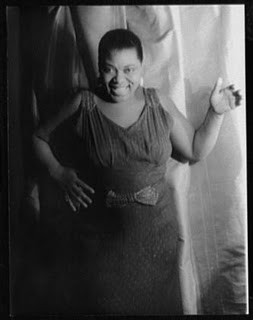
Composer, musician, singer, EXTREME BADARSE PERFORMER. There are dramatic stories about Smith seeing off violent white men in her tent shows, about her numerous lovers of both sexes, and about her violent death. My favourite is the one about working with a young Louis Armstrong, where she demanded that he play a little less enthusiastically as he was cramping her style. I have no idea whether it’s true or not. But the influence of Smith’s performing style on instrumentalists like Armstrong should not be underestimated.

Bessie Smith performing ‘You gotta give me some’, accompanied by Clarence Williams and Eddie Lang in 1929

Women’s History Month: Clora Bryant!

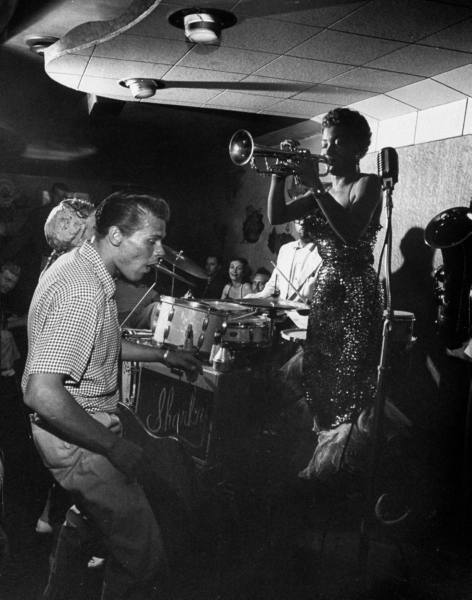
Another suggestion from a friend. Again, I’d never heard of Clora Bryant before she was recommended by the Buggzor (herself a brass instrumentalist of Repute). But now I have.

Clora Bryant was born in 1927 and is a trumpeter. She played with the International Sweethearts of Rhythm and you can listen to her play a bunch of nice songs in this video Clora Bryant /Gal With A Horn 1957:

(Photo at the top of this post taken by Loomis Dean in 1954, and lifted from the Life Magazine collection on google)

Women’s History Month: Billie Holiday!

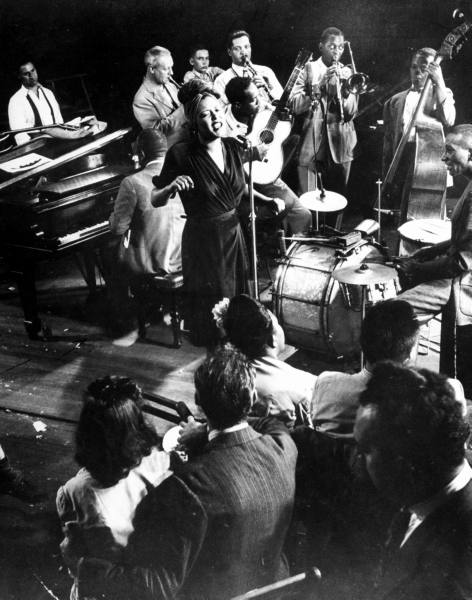
(image by Gjon Mili in 1943, New York, from the Google Life Magazine collection

Happy International Women’s Day! Today I’m doing Billie Holiday, even though she’s hardly an unknown, because she is my favourite.

Billie Holiday, singer, actress, performer.

(Billie Holiday – The Blues Are Brewin’)

Happy International Women’s Day: equity and inclusiveness can be easy

As you may or may not know, I’m teaching lindy hop with a female friend. That means that the students have two female teachers, one leading and one following. So far it hasn’t seemed to make any difference to their learning or relationship with us – beginners are too busy worrying about their feet to actually notice that the leader teacher has boobs. One of the nicest parts about our class has been that we see regular women leaders and a male follower – all very serious about learning.

One of the things we worried about when we started planning classes which welcomed – normalised! – female leads, male follows and generally genderflexed approaches to dance roles was how we’d handle some problems. We welcome women who don’t feel comfortable dancing with men (for whatever reason), and we also welcome men who’d rather dance with men. But we weren’t sure how we’d make clear who was leading, who was following, and who wanted to dance with whom.

My first instinct is ‘everyone dance with everyone else – we’re a safe, welcoming place’, but I also understand that many women simply don’t feel safe or ok being touched by men. And that some men would really rather dance with other men, because the opportunities to social dance like this with other men are so few and far between. So how were we to accomodate all these variations in partnering?

Well, we haven’t solved those particular problems (we are currently just encouraging everyone and hopefully modelling a dancing partnership where each partner is treated with respect, and dancers learn to touch in a respectful way), but other problems have turned up. For as long as I’ve been leading, I’ve never been in a class where no one has remarked on the fact that I’m a woman leading (rather a man). Until this past weekend at the Sweet n Hot workshops, where nobody commented, and even I forgot that I was doing something unusual. Until I had to ask (reluctantly, and with trembling-scardycatness) for the teachers to use gender neutral pronouns because I was getting confused. Generally, though, I’m placed in a position where I have to respond to endless, endless comments about the fact that I’m a woman. I’ve always replied with lighthearted explanations.

I suspect that the students in our classes have had similar experiences. We usually mention the fact that we welcome students in either role, though we are still figuring out a way to do this that doesn’t imply that male leaders and female followers were/are ‘normal’, because they have always been just one option of many. But students are obviously still dealing with curious comments.

I’ve realised over the last couple of weeks, though, that the students have figured out their own solution. They just write ‘leader’ or ‘follower’ on their name tag, underneath their name. Simple, and effective. Why haven’t I ever thought of that? #doofus

Happy International Women’s Day! Some problems need big, complicated, difficult solutions. But others just need a little practical thinking.
Women’s History Month on Riverwalk Jazz

How perfect! The Riverwalk Jazz radio show has a Women’s History Month special on women in jazz this month: Blues Queens, Cakewalkin’ Babies & Songbirds: A Riverwalk Jazz Salute to Women’s History Month.

The radio show blurb reads:

To honor National Women’s History Month, vocalist and actor Carol Woods joins The Jim Cullum Jazz Band to salute leading women in early jazz. …This week on Riverwalk Jazz, Carol Woods portrays women who were seminal figures in jazz with dialogue based on their first-person accounts, and presents important songs from their careers.

Women’s History Month: Billy Tipton!


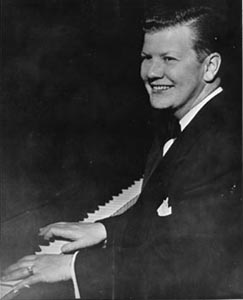
(image lifted from wikipedia)

I’d never heard of pianist, composer, bandleader Billy Tipton before I was sent an email recommending him for this series of posts (I’ll leave that kind correspondent to out themselves in the comments if they like.) Everything I know, I’ve scrounged online.

Basically, Billy Tipton was born Dorothy Lucille Tipton in 1911, and was a keen pianist interested in a life in jazz. By 1940 he was living as a man, binding his breasts and otherwise dressing and identifying as male. It wasn’t until he died in 1989 that Tipton’s family discovered he was assigned female at birth.

I don’t know the exact reasons for Tipton’s living as a man, but I want to include him in these Women’s History Month posts because he draws attention to the limits of single definitions of masculine and feminine. And one of the clearest points to be made about Tipton’s story is that living as a woman musician limited (and limits today) your profesional opportunities.

Sweet Georgia Brown by Billy Tipton

Women’s History Month: Alberta Hunter!

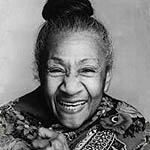
(Alberta Hunter, pic lifted from wikipedia)

Hunter (1895-1984) really had two careers – the first beginning in 1911 when she was 16 and ending in 1956, the second beginning in 1977 and ending with her death in 1984. She was a musician, song writer and performer who travelled all over the world, took lovers of both sexes and recorded with all sorts of musicians, from Louis Armstrong to Lovie Austin. Her song ‘Downhearted Blues’ was recorded to great success by Bessie Smith.
Blues singers like Hunter and Victoria Spivey are important in a history of jazz for their contribution to the careers of musicians like Armstrong, their role in the development of the recording industry (which grew largely through the popularity of blues music) and their strength as composers developing a popular jazz repertoire and aesthetic.

Hunter performing live in 1981 at 86 (Alberta Hunter – Two-fisted Double-Jointed Rough & Ready Man):

Hunter recorded singing ‘Fine and Mellow’ in 1939 with Charlie Shavers (Alberta Hunter Fine and Mellow):

You can read more about Alberta Hunter on the Red Hot Jazz Archive.
Or you can read about her on the Stomp Off blog.