What are we actually doing about sexual harassment?

We at Swing Dance Sydney have developed a several-prong approach to this issue over the past few years. Everyone we know has been asked for advice or suggestions, and it’s definitely a collaborative project. It takes time, thought, and research. I looked up other organisations’ codes of conduct, and govt bodies’ s.h. prevention strategies. including the human rights commission’s definitions of s.h.

Each step has kind of developed from the one before. And we keep going back and revising and improving things.

For example:

  • We developed a code of conduct, referring to lots of other examples.
  • Then we needed definitions of sexual harassment for that code, so we all knew what we were talking about.
  • Then we had to give students FAQs for making complaints, knowing their boundaries, etc.
  • Then we had to be available for students to talk to us, and we had to follow up on our hunches and ask students about things we’d seen. Which meant we needed casual social spaces and opportunities for talking with our students – like non-dancing parties.
  • Then we had to just get rid of horrible harassers.
  • Then we had to have consequences for banned people.
  • Then we had to have processes for enforcing bans.
  • Then we had to tell our door people what to do if banned people turned up.
  • Then I told other organisers in our city that we’d banned X, and I keep them updated each time I get another complaint about anyone.
  • Then we had to find out what our legal rights were.
  • Then we had to practice doing this ourselves.
  • Now I’m asking myself ‘how long is a ban? if it’s forever, how do we maintain it if the personnel and staff change?’

And of course, this has to be an interactive design process: you have to keep getting feedback on the process, and changing and improving things. Soz, but it’s never done.
My current project: a report log, and way of keeping track of issues.
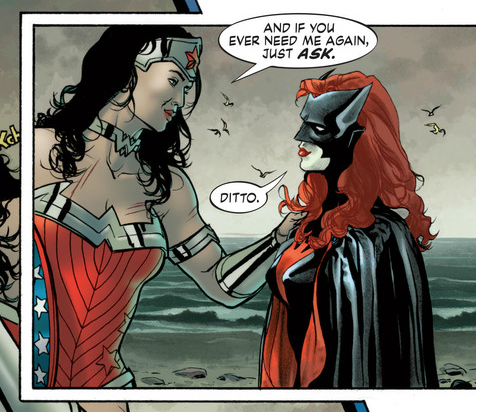
batwoman-wonderwoman
This is my experience:
As a woman, it is scary as fuck to tell a big, imposing bully of a man he is banned from your event. Or to warn one. So I had to develop the bravery to do it, and contingency plans to make sure I was safe (eg I told my male friends – don’t leave me on my own for the next hour or two; I don’t want to seem vulnerable if he gets nasty). I also practiced giving warnings and bans – I wrote little scripts and then practiced them with my buddies. And I told my buddies when I was going to do it, and what their job was.

So you need to skill yourself up, look after yourself, work with other women, and develop strategies, and PRACTICE. It’s hard to overcome a lifetime of training which tells women to avoid conflict because they’re vulnerable. You have to teach yourself that you are tough. It’s helpful to think of people like Norma Miller, who was a black woman running a dance troupe in the 50s. You have to truly believe that you are the best person for this job, and that you are RIGHT.

I’m glad I do this, as I’ve had men get nasty with me in public at events (I particularly enjoyed that one time a man I’d warned earlier about non-consensual aerials trying to shout at me while I was DJing. NOT).

Documents (ie rules):
1. We have a code of conduct on our site. But I’m pretty sure no one reads it.
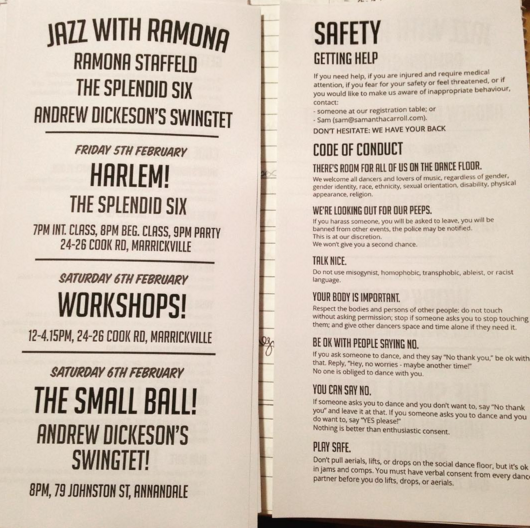
Screen Shot 2016-02-18 at 5.46.41 pm
So I made an abridged, paper version which is now available at the door to events on the back of a paper program (and everyone picks up a paper program, and gets one in their rego packs), which I talk about when I’m MCing at every party and workshop day at an event. I actually say it explicitly: “Have a read of this code. There’s info here about what to do if you get injured, if you feel unsafe, or if someone’s hassling you.” And I’ve actually turned to one of the (big blokey male) band members and said, “X and I were talking about this earlier, and now X knows what to do if he feels unsafe.” And we all loled, but it was very effective – no awkward shyness or silliness. I just added it to the talk about where the first aid kit is and how to get a drink of water.
The online version has actual descriptions of what counts as sexual harassment. That part is THE most important.

2. We have a parties FAQ which explains what to do if you get harassed.

3. You have to tell people you have docs – don’t hide them away on your website. And just be very casual and matter of fact about it – of course we have a code of conduct, don’t you?
11215092_10153165911123483_7470119082234769586_n
Processes:
1. I warn people who break the rules if they seem to be a bit clueless (eg air steps on the social floor, boob swiping, etc.) I encourage other people to warn other people (especially men! Men are 90% of the problem, so they should be 90% of the solution – it’s not a ‘women’s issue’!)

2. I ban people who are serial offenders, and tell them so to their face, making it clear that they cannot attend any of my events (I name them all), and if they turn up I’ll call the police. I don’t engage in discussions or conversations – I just tell them straight up. And I do it at public events in public places because my own safety is important. And I put on my invisible ‘I am an arse kicking fierce superhero’ cloak. I literally pretend that I am as tall and strong and immovable and implacable as Wonder Woman.

3. Once they’re banned, I put their name and description (and photo if I have it) on the door at our events, and circulate it to volunteers who’ll be working at events.

4. I explain the process to volunteers should these banned people turn up: Say “hello, Sam would like to speak with you, please wait a minute while I find her.” then find me and i’ll deal with it. They all work the door in pairs, so one is left at the door waiting. They’re to do some ‘important paper work’ while they wait, and not engage the bloke. Then I come and call the police immediately. No arguments or engagement.

-> I tell everyone about all these documents and processes. Since I started telling people I ban offenders, and since our volunteers started learning the process, I’ve had a scary number of people make complaints about the people I’ve banned/warned: knowing you’ll deal with this shit gives people the guts to speak up. I keep all complaints anonymous and confidential. None of this ‘right of reply’ bullshit.

Cultural change:
Of course we use gender-neutral language, stamp on homophobia, etc etc. Because we are adults, and this shit is necessary. And we don’t tolerate any of that stuff in our classes or at our parties. You simply CANNOT address these issues if you, for example, always refer to leads as ‘he’ or ‘gentlemen’. It’s a shitty barrier to fixing things up.

1. How we teach beginners. We talk about how to ‘make connection’ with a partner (eg in closed) not in terms of ‘your hand always go here’ but in terms of ‘you want to find the middle of their back, so ask them ‘is this right?’ Then we get them to practice this little conversation. Boom. Winners – it teaches them that each partner is a different size and shape, and you need to adapt to that. As opposed to having rules for ‘correct’ connection, we make it clear that ‘connection’ is about working with another human. There’s lots of this sort of thing – from talk about making confident mistakes to saying ‘start when you feel ready’ instead of counting them in.

2. We only have women teachers atm, so we start classes with “I’m Sam, and I’m leading tonight,” and “I’m X and I’m following tonight” and then we demonstrate what that means. Then we say “Choose whether you want to lead or follow. You could change next week, but please stick with one role for this class.” Then we let them choose whether they’re leading or following, then we send them to find a partner.

3. When we ask them to partner up, we say “Introduce yourself first; don’t touch anyone if you don’t know their name” and we act out asking someone to dance, shaking hands, and introducing ourselves. BOOM. They just do this themselves all the rest of the class.
-> etc etc etc

4. We give the follows specific information about what they’re doing in class, and we phrase it in a way which is about agency, self-determination, and power. eg I say to follows “You are the BOSS of your own body. Don’t compromise your posture or timing or rhythm for the lead’s. This is a class, so you should be both talking to each other, resolving these issues verbally.” I often to say to follows and leads “Both of you have a responsibility to keep time and maintain a rhythm. So if you’re stressing, listen to your partner’s body and let them help you find the beat again.” And then we explain how connection is a two-way line of communication, talking about how follows send info to leads and vice versa. Using very simple things like “Check in with yourself – is your hand a tight claw of fear? What does this say to your partner?” etc etc etc.

5. Women DJs, Women teachers, women MCs, women solo dancing, women leads, women follows, male follows, male leads, male DJs. We have them. We just do this shit ourselves – you have to be the change you want to see. And we just treat it as normal. None of this bullshit “Traditionally, men did X in lindy hop” talk because that’s untrue, made up bullshit. We just DO this stuff.

6. Actively supporting new DJs, dancers, organisers, etc. In all sorts of ways. Whether they are men or women – we just step up and be useful, even if that means coming along and being a punter. A culture of creative support and curiosity is good for a community, and it undoes patriarchal cultures which are particularly obstructive for women.

7. Be ambitious and motivated. Aim to be really fucking good at all this. If you’re a woman lead, aim to be really GOOD at it. If you’re running an event, run the BEST event. And just see undoing patriarchy (which is what fighting sexual harassment is) as part of being really fucking good at what you do. So be good at it.

I have to repeat: you can’t do this on your own. Everyone has to play a part in looking after everyone else. Me, other teachers, the students in class, your dance partners, other event organisers, volunteers at events, DJs, band members, sound engineers. If you talk to each of these people individually, involving them in the process somehow, making their role clear (eg the volunteers working on the door), then they will be invested and will do their bit. Or you get to leverage the guilt – because only a cockface would argue that this stuff isn’t important :D

I could burn them where they stand

I’ve been a little sceptical of claims that Sanders is more feminist than Clinton because of that one time he was down for equal rights. I’m sure he’s a great bloke, but Clinton’s got feminist cred. Long term feminist cred.

You don’t tell them to fuck off. You let them test you to see if you’re an angry feminist, and you pass the test by letting them insult you to your face and not getting angry. Because after everything you’ve done, everything you’ve fought for, that’s still what most men want to know. They want to know they can insult you and get away with it. They won’t work with you if they can’t….

….I know this is true, not just in politics, but everywhere in the world. That women can never be seen as “the most qualified person,” even when they’re more qualified than men, because people keep asking us these fucking questions, the ones they don’t ask men, about whether our gender would prevent us from doing the work (source.)

More importantly, I’ve stopped just smiling and ignoring those sorts of provocative questions. On the weekend a particularly sexist musician tried to get a rise out of me with a deliberately provocative line. I said, with an iron fierceness, “We don’t make those sorts of jokes here.” And when he tried to pass the ball to his bloke mates to get a laugh from them, I intercepted and repeated my point: “We don’t make those jokes. We do NOT make those jokes here. I’m getting hard on this shit. Understand, bros?” and I raised my eyebrows and looked them all in they eye. I was the ultimate feminist killjoy. And then later on, when he tried it again, I pulled him up on his shit. And I’ll be making I’ve made a complaint about him.
And those younger musicians who like to get on the drink at gigs and can’t do their job because they’re too pissed? Yes, I did give them a telling off. Yes, I am a bloody sour, humourless killjoy bitch. And they’re lazy, drunken fools, while I’m a fully fit, seriously healthy arse kicker. And I am not afraid to give them a telling off or kick them out. I don’t give a fuck how good a musician they are.

I am that angry femmostroppo. And I still do twice as good a job as a man who does half as much work as I do in the same job. Because women have to. And I know there are a couple of hundred dancers standing behind me, ready to get my back.

Scared the pants off me at first, to do this. But now I just figure yolo. Bitches get shit done. And I’ve had all those years experience in academia, where the highest profile people in my profession were arsehole headkickers. I’m prepared to kick heads for the sisterhood. And I don’t think those men realise just how deep the rage goes. I’ve got a lifetime of harassment and impediments to fuel this rage. And they should thank their lucky stars they get away with some sharp wit and a cold, fierce line in Aussie humour.
Because I could burn them where they stand.

Australian dance events and their codes of conduct: let’s be more awesome

As I noted in Polite ladies don’t swear I’m doing a survey of the Australian swing dance events and their codes of conduct. Do they have them? Are they publicly available? Can they be found and read easily?

This post is a very basic, very simple overview.
I ask:

  • Does the event have a code of conduct listed on its website?
  • Is it available from a link on the main page (it should be), or is it hidden behind a few clicks?
  • If the event doesn’t have a code, does its parent organisation?

Of course, having a code is pretty much a token exercise without supporting response strategies, training for all workers, and the code itself being readable, accessible, and available in paper form at the event. It has to be accompanied by in-class teaching and training for cultural change.

So of course, the next step in assessing Australian events would be to assess the in-person responses and processes of each event. So far MLX is winning: I was very impressed by what I saw this year at that event. Hopefully we don’t have to wait until something happens to assess an event’s response strategy.

Why did I do this? Why am I being such a pain? Because I’m a keen social dancer, I’m a DJ, and I go to events. I want to be safe. I want my friends to be safe. As a woman, I experience sexual harassment pretty much every week, and pretty much every time I leave the house. So you know what? I say FUCK THAT noise. I want my lindy hop to be safe, and I am DONE with fuckers who are busy with one hundred excuses for not doing something to make dance events safe. THERE IS NO ACCEPTABLE EXCUSE.

And if I ask questions about this, other people will too. We’ll stop being a community of ostriches, and we’ll start actually stepping up. I hope that other women will see that a woman can say something quite loudly, and be powerful.

Why is a code important?
It tells your attendees the ‘rules’. It makes it clear to attendees and workers that your event is thinking about and working towards safety and preventing sexual harassment.
It also helps create a culture of ‘prevention’ and ‘respect’. I was absolutely delighted by the way MLX’s public code of conduct and open discussion of these issues led directly to a general attitude of ‘look out for each other’ at the event itself. I saw dancers go out of their way to do things for each other.
So having a code tells people that a code is important. It tells people that these ideas are important enough to talk about, write about, and act upon.

What should a code include?

  • Basically, a list of ‘rules’: dos and don’ts.
  • You also need to include a ‘what do you do if you need help?’ process for dancers
  • a list of contact names (for both attendees and workers to contact)
  • a response strategy or process if something does happen (eg when do you call the cops?
  • training for all workers before the weekend, to be sure everyone knows the code, and knows the process.
  • I think it should also include a list of consequences: eg repeated complaints about you, and you’re banned.
  • A process and training for carrying out these consequences. eg once you’re banned, your name and picture is in the door kit, and door staff are trained in how to prevent your entry (eg calling the police). Banned dancers should be notified in person about being banned, and this knowledge should be circulated amongst local dance organisers.
  • Banning: if you have banned someone, do you have a responsibility to warn organisers about them?

This last point is particularly important, I think. It’s not ok to say “each issue will be dealt with on a case by case basis.” You need to plan ahead. That means coming up with scenarios, and response strategies, and then training people in these strategies. Because we are a community of dancers and musicians, and the relationships between scenes are absolutely central to our local, national, and international success and viability (try running a big exchange without a network of peeps in other cities to invite and to help you distribute promotional material), we need to think collaboratively about response strategies.
eg Last week I banned a guy who’s been groping women. He gave me a bullshit line about how ‘it’s just a blues’ hold!’ Yeah right, buddy. I’m not no noob to be buying that shit. I’ve told other organisers in my city about this guy, what I’ve done, and what he said. The blues dancers and event organisers were immediately alarmed, because this line ‘it’s just a blues hold’ is some very bad PR for blues. And let’s be honest: the blues scene has been faster and more diligent in their responses to these issues than the lindy hop scene.
So these local peeps now have a chance to raise the issue in class: ‘it’s a blues hold’ is not a license to grope. The other organisers in my town know that this guy is not welcome at my events, and that he’s aggressive and may retaliate against me personally at a dance event. So they’re keeping an eye out (I hope! I know other dancers are). And if they do choose to ban him as well, they have a precedent. But they may also use this as a chance to give him an ultimatum: get your shit together, or you lose my events too.

Me, personally, I’ve found having a network of organisers in my town, and good, clear communications about these issues absolutely essential. We may not all be best friends, but we are all capable of open, civil conversation, and have all worked in at least civil will to reduce conflict where we can. In this instance, I know that there are other organisers in my city (many of whom are actually my friends) thinking about these issues, and giving me feedback on my processes.

Anyway, back on topic.

NSW (Sydney)
Me first.
Little Big Weekend (lindy hop/solo jazz) – that’s me and Swing Dance Sydney. It does have a publicly available code, and we do have a safety response plan at the door. I circulate the code with all teachers, musicians, sound engineers, etc etc before the weekend, and make it clear to all these people in their written agreements, that they must all read and agree to abide by the code before they work for me. So we are pretty much pirates, right?
My weaknesses:
– no written copy of the code at the door
– the code has too many words
– I’m thinking about a visual guide to not harassing people, which I’d like to get done next year.
– I’m currently working on a readable, useable version of the code for the door
– we need more training: our teachers need in-class strategies; our door staff need training for dealing with banned people; we all need training in knowing when to call the police. I’ve worked with security guards at events before (including one memorable late night party where a DJ threatened me, and I got to tell the big security guard to kick him out), I’ve kicked people out quite a few times (random drunks mostly), and I’ve called ambulances. But what’s my plan for responding when a woman is sexually assaulted at my event?
– I’d like to do some security/defence training for dealing with trouble at events.

These are my focus areas for 2016.

Jazz with Ramona – as with LBW above

Sydney Lindy Exchange – no code of conduct (NB I did provide Bruce with a draft version when I was first working with this event earlier this year, but it’s not been adopted). This event is managed by Bruce Elder and Swing To It Sydney. Swing To It does not have a code either.

Sydney Blues – does have a code of conduct. I don’t know how it runs on the day. This event is run by Chris Kearns.

For Dancers Only (lindy, bal, tap, solo) is run by Trudi Pickering in Sydney and has a Code
NB the Canberra version of the site doesn’t have the code. This seems like a site design problem, rather than an oversight.

ACT (Canberra)
Canberrang (lindy hop, blues, balboa, solo) – no code of conduct. This event is managed by Jumptown Swing, a non-profit organisation based in Canberra. Jumptown does have a Declaration of Safe Space document on its website, but the link’s hidden under a drop down menu.

Jumptown Jam (lindy hop, blues, balboa, solo) – no code of conduct. Also Jumptown Swing managed.

Slow Down (slow lindy, blues, slow balboa, slow solo)- Does have a code, but the link is hidden behind a drop down. Run by Cathie Gough and Shobana Nambier, and sponsored by Cathie’s company Savoy Canberra. Savoy Dance Canberra has no code of conduct.

VIC (Melbourne)
Melbourne Swing Festival (lindy hop, solo, blues) – no code of conduct. Managed by Swing Patrol Melbourne, which does have a code of conduct on its site.

Melbourne Lindy Exchange (lindy hop, blues, solo, balboa)- has a safe spaces document AND guidelines for attendees. Run by a non-profit organisation the Melbourne Jazz Dance Association. Has a very good f2f safe spaces process, and provides hard copies of the code at the door to events.
I was on the MJDA founding committee, and we specifically included the concepts of equity and accessibility as well as promotion and preservation of jazz music and dance in the Association’s charter.

Blues Before Sunrise (blues dance) Doesn’t have a code of conduct, but was held in March this year, and was really too early to have gotten to this issue. It’s a tricky one because Steven Mitchell was involved with this event as a teacher. I think (but can’t be sure) BBS won’t be running in the future, as the organisers are moving on to other projects. This event was administered by Swing Patrol Melbourne.

Cider House Blues (blues) – Does have a code, and developed it before the Mitchell thing. This event is run by a few friends.

SA (Adelaide)
Southern Blues (blues) – Has a safer spaces policy.

WA (Perth)
Hullabaloo (lindy hop) – has an inactive page atm. It’s run by the Perth Swing Dance Association, and I’m pretty sure the event will have a code and a process, as they are fully ninjas behind the scenes on this stuff. The PSDA does have a code, but it’s hidden behind a few too many clicks.

Perth Lindy Jam has no code. It’s run by Swing It, and was only held in March, so again it’s probably not had time to get a code sorted. Swing It does not have a code.

Shag About (shag) – Does not have a code. It’s run by Shag About, which does not have a code.

Margaret River dance camp (lindy hop?) – does not have a code. It’s run by Simply Swing, which does not have a code.

QLD
Sunshine Swing (lindy hop) – doesn’t have a code on its site, but its site is a place holder only atm. This event has been undergoing some changes. I’m not sure whether it’s run by Empire Swing or Corner Pocket Swing. Corner Pocket doesn’t have a code, nor does Empire Swing.

Swing Camp Oz (lindy hop, etc) does not have a code of conduct. This event is run by Joel Plys from outside Australia. There has been a fb post about a code of conduct, but this code is wholly inadequate.

Bal on the River (balboa) does have a code.

TAS
Swingmania in Launceston does have a code, but it’s a bit tricky to find. It’s linked from the Registration page, and the link is right above the ‘register’ in this body of text: “SwingMania is an inclusive and warm environment. Any participant who marginalises another may be asked by the organising committee to cease their involvement with the event. To view our full Code of Conduct”. So while it’s harder to find, it’s actually cleverly placed, because you know registrants will read it. Hopefully.

[edit: I added For Dancers Only and Swingmania after this page was published because I forgot them]

As you can see, we’re not doing very well, Australia. Time to get your shit in gear, right? After all, we’ve had 11 months since January, so we should all have been thinking about it since then. And there have been some very good resources floating about.

Basically, if you haven’t got a code of conduct on your event’s website (and on your dance school’s website), you’re telling dancers you don’t prioritise their safety. I know that getting content onto a website can be a pain if you’re not tech-savvy, but I’m pretty sure we all manage to get ads for our next event up on the website promptly.

Let’s step up. Be more awesome.

how to exploit people

link

I’ve had a couple of emails this week alone asking me if my business would like the opportunity to work for free. I said no.
But I know a lot of DJs work for free for ‘experience’ or ‘exposure’, I know newer dancers perform for free for ‘exposure’ or ‘experience’, and I know teachers work at big events within Australia for ‘experience’. None of whom receive free entry to the event or any equitable compensation (eg a free pass). One of the bigger areas of exploitation in the dance world is administration – running large events or regular classes.
All of this is pretty much bullshit.

I’m particularly annoyed by the way volunteering is used to gain free labour from dancers, without providing safe, reasonable working conditions. Volunteering is a good thing in many cases (and the lindy hop community needs it to work), but you have a responsibility as the employer (because that’s what you are) to provide safe, equitable, and just working conditions and terms for all the people who work for you. Volunteers, employees, and contractors.Simply justifying this lack of pay as ‘growing the scene’ or doing it ‘for the scene’ is not ok.

If you really want to ‘grow the scene’ you pay people so they can then invest some of that money back into the scene (or you know, paying their electricity bill). A healthy, growing community is sustainable, economically and socially. In other words, you want to retain skilled workers (rather than overworking them and burning them out) so you can retain their knowledge and abilities and help your community improve what it does.
You want to offer people opportunities to develop these skills and interests, so that they can move on to run their own projects, develop their own ideas, and help your community become a more interesting, diverse creative space. In other words, you’ll get better dancing, DJing, and events in your scene if people stick around longer, and feel good about what they do. Eventually people get tired of being screwed over, and they drop out.

More importantly, when you exploit people, you are facilitating conditions which make it possible for your workers to be abused in other ways. Including sexual harassment and bullying. So when you say, “Oh, you should DJ/teach/manage the door for free because I want you to, and I’m just doing this ‘for the scene’,” you’re telling people that they should do unfair, unsafe, unpleasant, exploitative things ‘for the scene’ just because someone powerful or ‘important’ asks them to.

Whenever I hear the phrases ‘grow the scene’ and ‘doing this for the scene/community’, my alarm bells ring. Volunteers, workers, dancers, DJs, teachers, students ARE the scene. So you should – you have a responsibility protect their interests and rights.