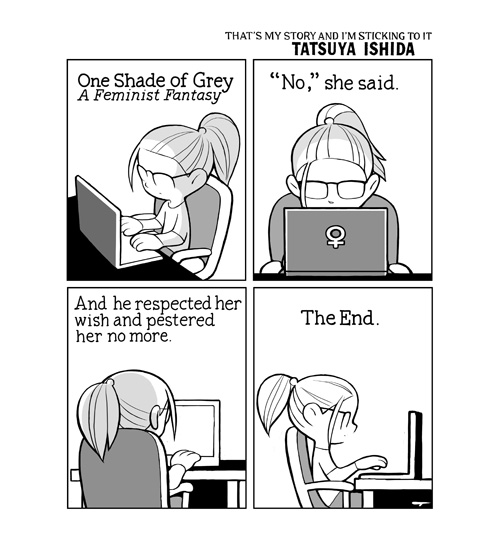
(from sinfest, via mindlessmunkey)

(from sinfest, via mindlessmunkey)
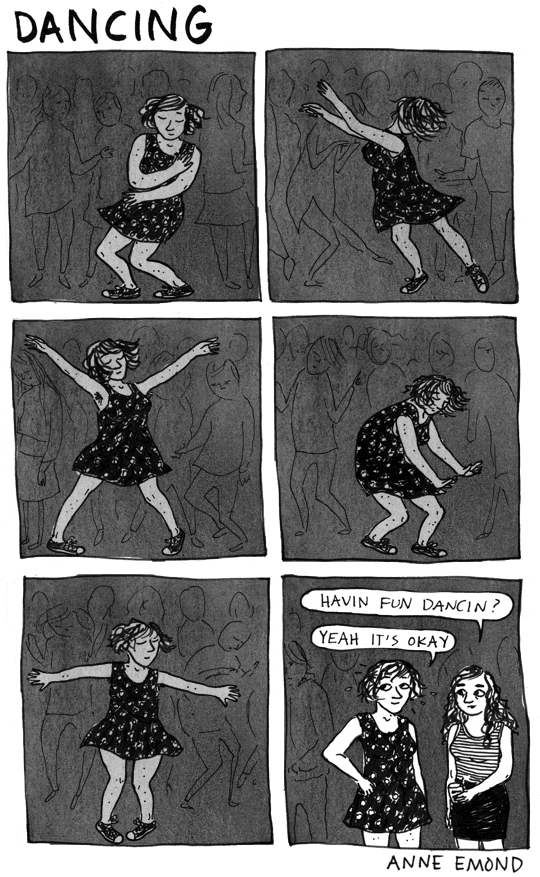
Things haven’t been so great round here, so I haven’t been able to do any Women’s History Month updates. Here’s a comic by one of my favourite illustrators, Ann Emond, because it reminds me that the best dancing in all the world is the dancing you do with your eyes closed, wearing your favourite clothes and not worrying about what you look like. So, pretty much the opposite of 90% of lindy hop.
I know nothing about this woman.
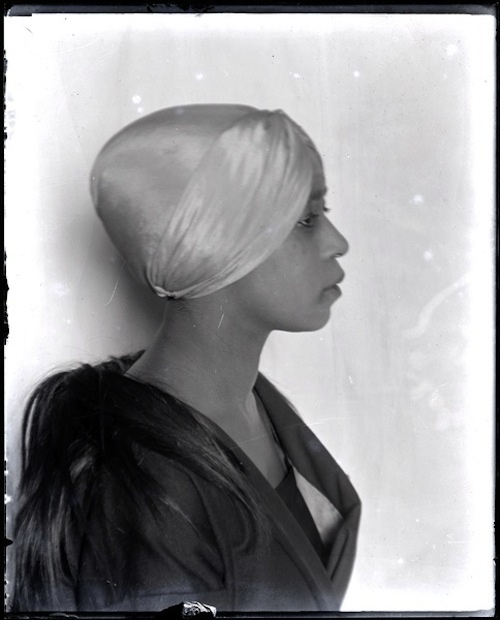
This is a photo of her from 1922 by Man Ray.
I found her name in Michel Fabre’s article ‘Rediscovering Aïcha, Lucy and D’al-Al, Colored French Stage Artists’
He writes
A circus artist, then a popular model, then a self-trained, occasional music hall dancer and actress, Aïcha Goblet had already taken many of the career steps that Baker would herself later attempt, and evoked a very similar response from many critics. As Salmon remarked, in language that more than obliquely references Baker, “the voluptuous beauties at the Colonial Exhibition could not vie with those in Montparnasse … The Miss Africa of Montparnasse is Aïcha.” Nevertheless, Aïcha did not become nearly as celebrated as Baker and had to content herself with making a modest living and enjoying all the while an impeccable reputation.
And Fabre quotes writer and art critic André Salmon:
If Aïcha is often naked, she rarely undoes her head kerchief—now cabbage-green, now the color of silver—which suits her so well. Aïcha is too much a girl from Roubaix not to be perfectly civilized. She sits, she dances, she is pleasant. Long before Josephine Baker launched the fashion of banana belts, Aïcha wore, at wild parties in Montparnasse, her diminutive raffia skirt.
I can’t find any footage of her dancing.
Josephine Baker!
linky
There’s an interesting issue of Scholar&Feminist Josephine Baker: A Century in the Spotlight.
Baker is very important. If you’re a jazz dancer, you need to know about her.
I’ve also just discovered Black Paris, which is very useful and interesting.
Ryan Swift’s Photo of Dawn Hampton at LindyFest 2011 decided me on Dawn Hampton for today’s Woman Jazz Dancer.
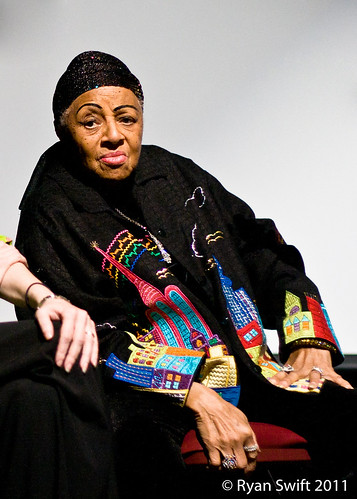
Hampton played a bundle of instruments in her family’s band and has had a long career in music and dance. But she’s best known today for her musicality classes, and there are a couple of clips of her scaring teaching dancers about musicality at Lindyfest this year. I really like these clips because she does the sort of nuanced dancing that reminds me of dancers like Leon James – stillness and minimalism combined with sharp, dramatic movements.
A demonstration dance with Virgine Jensen, Steven Mitchell and Frida Segerdahl:
Teaching a musicality class:
linky
aka Mildred “Boogie” Pollard, aka Lindy hopper!
In Radio City Revels in 1938, the second couple in the jam, but the first couple after the cut from the singer at the beginning (ie there’s another couple in the jam before Gibson and partner ‘Shorty’ Davis).
In Spirit Moves in 1950 with James Berry:
A lindy hopper I knew nothing about (which isn’t saying much – I don’t know the west coast dancers very well at all), and who was brought to my attention by Bobby White’s post on women dancers from last year.
I know very little about Pearl Primus, but I’ve been fascinated by this photo since I found it on the Google Life photo collection:
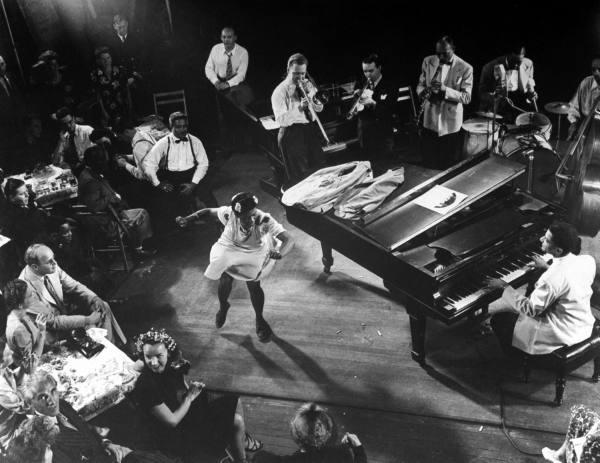
(“Pearl Primus performing to “Honeysuckle Rose” played by Teddy Wilson at piano, Lou McGarity on trombone, Bobby Hackett on trumpet, Sidney Catlett on drums & John Simons on bass during jam session at Gjon Mili’s studio” – Gjon Mili – New York – 1943)
She’s not a ‘jazz dancer’ in the strictest sense – she probably fits a little more comfortably into the concert dance or even ballet basket. But she was very much an activist, with a passion for African and African American dance, and she was definitely active as a dancer, performer and choreographer during the 1930s and 40s.
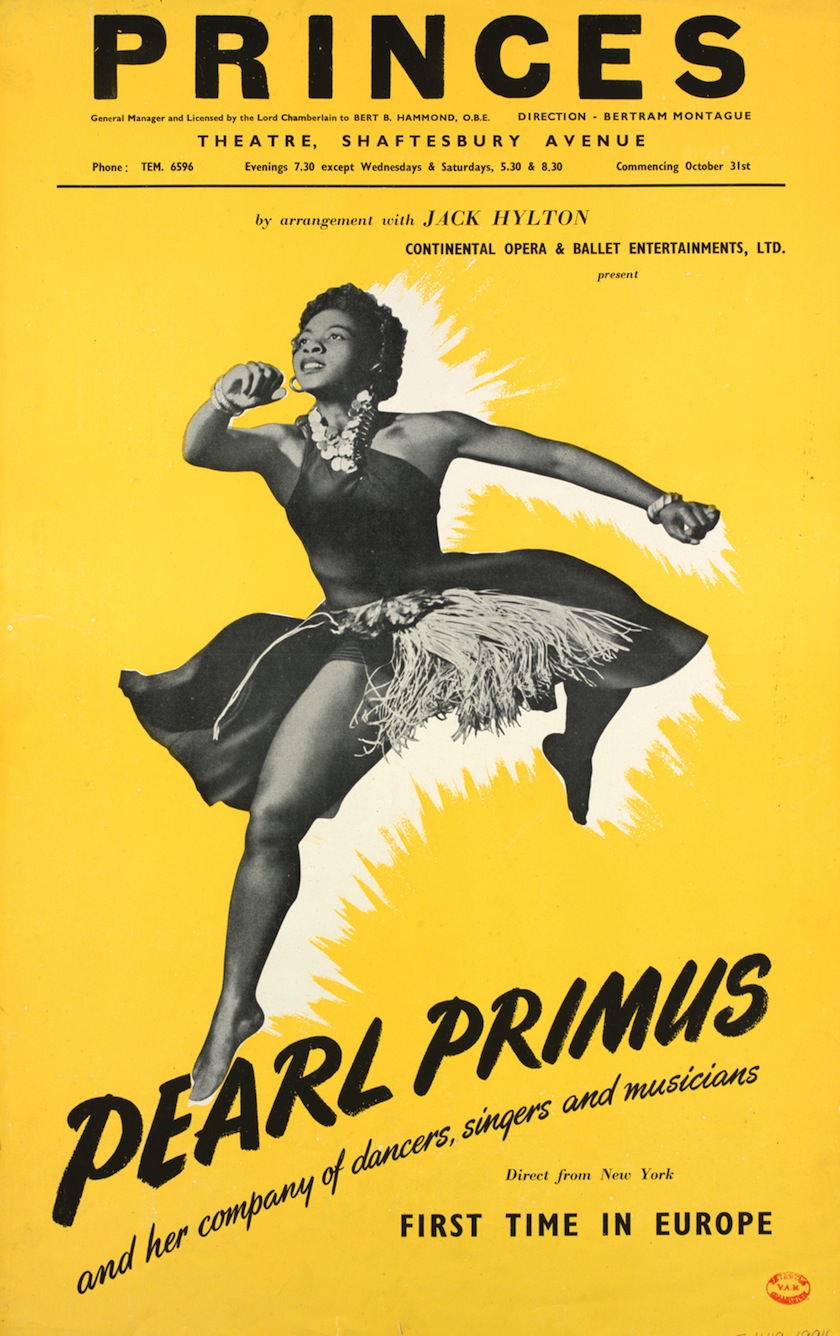
(photo from The Victoria and Albert Museum’s ‘History of Black Dance: 20th-Century Black American Dance’ page)
I did a bit of googling and came up with very few actual videos of her dancing on youtube, but I did find this little doco about her that only fuelled my interest:
Then I found this video of her dancing, which isn’t too great – you can’t really see what she’s doing, and I’m not sure it really does her work justice.
NB that first photo is from a series called ‘Jam Session’ by Gjon Mili in the Life Magazine collection on google, which features many other amazing pics.
Gjon Mili is interesting because he directed here, featuring Marie Bryant) AND, the great ‘Blues for Greasy’ jam session film which starred:
Harry ‘Sweets’ Edison: trumpet
Lester Young: Tenor Sax
Flip Phillips: Tenor Sax
Bill Harris: Trombone
Hank Jones: Piano
Ray Brown: Bass
Buddy Rich: Drums
Ella Fitzgerald: Vocals
Mili worked with Norman Granz on this film, and Granz owned the Verve record label as well as organising the Jazz At The Philarmonic concerts and being hardcore anti-segregation.
Whitey’s Lindy Hopper of awesome!
Second couple in this scene from the 1947 film Boy! What a Girl!:
At 3.00 dancing at the Savoy with Leon James (from 1950 Mura Dehn docoSpirit Moves):
In a whole series of sequences from Spirit Moves, wearing a shiny skirt and strapless shirt:
[Thanks again to Peter Loggins for helping me figure out who’s who in the clips, AND for suggesting Esther!]